
- Release Year: 2001
- Platforms: Macintosh, Windows
- Publisher: BMS Modern Games Handelsagentur GmbH, EMME Interactive SA, Junior.TV GmbH & Co. KG, Tandem Verlag GmbH
- Developer: EMME Interactive SA, Lexis Numérique SA
- Genre: Adventure, Educational
- Perspective: 3rd-person
- Game Mode: Single-player
- Gameplay: Interactive story, Mini-games, Point-and-click, Quests
- Setting: Aquatic, Underwater
- Average Score: 67/100
Description
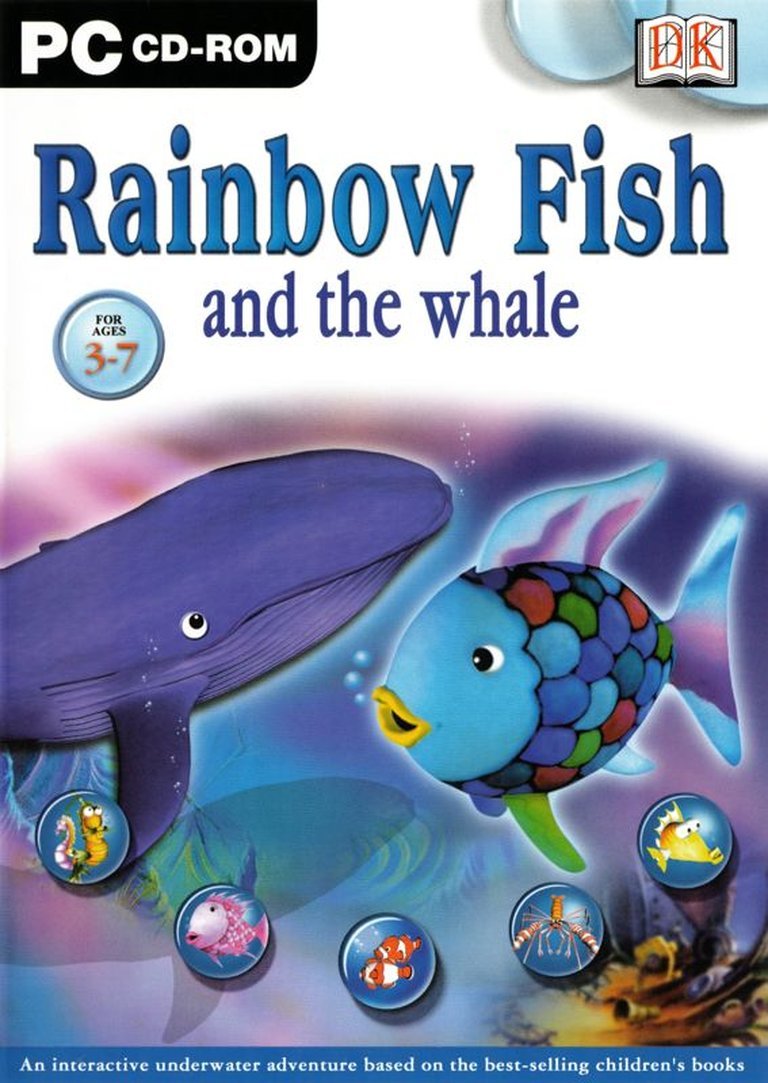
Rainbow Fish and the Whale is an interactive point-and-click adventure game based on Marcus Pfister’s beloved children’s books. The story follows Rainbow Fish and Hermit Crab as they journey into the belly of a whale to rescue their swallowed friends, encountering a variety of mini-games and quests along the way. Players solve puzzles like freeing trapped friends, sorting mussels by color, and repairing a broken geyser machine, all while navigating a whimsical underwater world. With two difficulty levels and choices that lead to different endings, the game is designed to be accessible and engaging for young players.
Gameplay Videos
Rainbow Fish and the Whale Free Download
Rainbow Fish and the Whale Guides & Walkthroughs
Rainbow Fish and the Whale Reviews & Reception
mobygames.com (67/100): A point-and-click interactive story/adventure based on Marcus Pfister’s colorful fish characters.
Rainbow Fish and the Whale: A Deep Dive into a Forgotten Edutainment Gem
Introduction: The Whale’s Belly as a Playground
Few children’s games from the early 2000s have left as curious a legacy as Rainbow Fish and the Whale. Released in 2001 by EMME Interactive SA and Lexis Numérique, this point-and-click adventure is a rare specimen—a licensed edutainment title that doesn’t just preach morality but embeds it within a whimsical, interactive underwater odyssey. Based on Marcus Pfister’s beloved Rainbow Fish picture books, the game transforms the biblical trope of Jonah and the whale into a vibrant, child-friendly rescue mission, where friendship, problem-solving, and a dash of hiccup-curing whimsy take center stage.
At its core, Rainbow Fish and the Whale is a game about empathy. When Rainbow Fish’s friends are accidentally swallowed by a benevolent but hiccup-plagued whale, players must navigate the creature’s cavernous belly, solving puzzles and mini-games to reunite the group. The premise is simple, but the execution is layered with charm, educational subtlety, and a surprising degree of player agency for its target audience of preschoolers and early readers.
This review will dissect the game’s development, narrative depth, gameplay mechanics, artistic vision, and lasting impact. Was it merely a forgettable cash-in on a popular children’s franchise, or does it deserve recognition as a thoughtful, if flawed, experiment in interactive storytelling for young audiences? Let’s dive in.
Development History & Context: The Birth of an Underwater Adventure
The Studio and the License
Rainbow Fish and the Whale was developed by Lexis Numérique SA and EMME Interactive SA, two studios with a shared history in educational and family-oriented software. Lexis Numérique, founded in 1989, had already carved a niche in adventure games (Alice in Wonderland, The Messenger) and edutainment titles, while EMME Interactive specialized in multimedia adaptations of children’s literature. Their collaboration on the Rainbow Fish series—beginning with Rainbow Fish: The Most Beautiful Fish in the Ocean (1999) and Rainbow Fish and the Amazing Lagoon (2001)—was a natural fit, given Pfister’s books’ emphasis on visual splendor and moral lessons.
The game’s development coincided with a golden age of CD-ROM-based edutainment, a period when titles like Reader Rabbit, Putt-Putt, and Freddi Fish dominated the “kids’ software” aisle. However, Rainbow Fish and the Whale distinguished itself by leaning harder into narrative-driven adventure rather than pure skill drills. The team, led by Éric Viennot (original concept, script, and dialogue) and Nicolas Delaye (computer graphics), sought to create an experience that felt like “playing inside a storybook.”
Technological Constraints and Design Philosophy
Built using Macromedia Director (a staple for multimedia CD-ROMs of the era), the game’s engine was optimized for low-system-spec PCs and Macs, ensuring accessibility for schools and households still running Windows 95 or Mac OS 7.5.3. The 3D animation, handled by Arnaud Cortado and Nicolas Lembrouck, was rudimentary by modern standards but serviceable for its time, with a focus on bright colors and exaggerated expressions to engage young players.
One of the most intriguing design choices was the dual-difficulty system, a rarity in preschool games. Players could toggle between “easy” and “hard” modes at the start, adjusting the complexity of puzzles and the frequency of hints. This nod to scalable challenge suggested an understanding that even young children benefit from tailored experiences—a philosophy ahead of its time.
The Gaming Landscape of 2001
The early 2000s were a transitional period for children’s gaming. While console games like Pokémon Snap and Rayman 2 offered more dynamic gameplay, PC edutainment was still thriving, albeit with increasing competition from web-based Flash games. Rainbow Fish and the Whale arrived alongside titles like The Tortoise and the Hare (1993) and Scooby-Doo!: Case File N°2 (2003), but its literary roots and gentle pacing set it apart from the more action-oriented fare.
Critically, the game was not a commercial juggernaut. With only one recorded critic review (a 67% from German site Feibel.de) and a small but devoted player base, it remained a niche product. Yet its existence speaks to a broader trend: the blurring of lines between storytelling and gameplay in children’s media, a trend that would later flourish in games like Kirby and the Rainbow Curse (2015).
Narrative & Thematic Deep Dive: A Tale of Friendship and Hiccups
Plot Summary: Into the Whale’s Belly
The game’s story is deceptively simple:
- The Setup: Rainbow Fish and his friends are playing in the ocean, unaware that a friendly whale is watching them from afar.
- The Crisis: Hermit Crab delivers dire news—the whale has accidentally swallowed Rainbow Fish’s friends (including Giggles, Molo, Ruby, and a baby seahorse).
- The Quest: Rainbow Fish and Hermit Crab voluntarily enter the whale’s belly to rescue their friends, encountering a series of puzzles and mini-games along the way.
- The Climax: After freeing all their friends, the duo must cure the whale’s hiccups (via a repair-the-geyser machine mini-game) before escaping.
- The Ending: Players choose between two exits (a “calm” escape or a “dramatic” one), offering a rare branching narrative for the genre.
Themes: Sharing, Empathy, and Problem-Solving
The game’s themes are lifted straight from Pfister’s books but adapted for interactivity:
- Friendship as Action: Unlike passive storybooks, the game requires players to actively help friends, reinforcing the idea that friendship involves effort.
- Empathy for the “Monster”: The whale is not a villain but a gentle giant with a problem (hiccups), subverting the “big bad whale” trope.
- Collaboration Over Competition: Mini-games like herding mussels by color or freeing Molo from crab brothers emphasize teamwork.
- Choice and Consequence: The Yes-No fish mechanics (where players click on nodding or shaking fish to make decisions) introduce basic agency, a novel concept for preschool games.
Characters and Dialogue
The cast is small but memorable:
- Rainbow Fish: The protagonist, voiced with cheerful earnestness, serves as the player’s avatar.
- Hermit Crab: The nervous but loyal sidekick, providing exposition and comic relief.
- The Whale: A silent, almost mythic presence—more of a living environment than a character.
- Supporting Friends: Each has a distinct mini-game tied to their rescue (e.g., Ruby trapped in a bubble, Molo pinned by crabs).
The dialogue, written by Éric Viennot, is minimal but effective, avoiding the pitfalls of condescension. Lines like “We have to help our friends!” and “The whale didn’t mean to swallow them!” are delivered with sincerity, reinforcing the game’s themes without heavy-handedness.
The Two Endings: A Rare Narrative Branch
For a preschool game, the inclusion of two endings was ambitious. Depending on player choices, Rainbow Fish and Hermit Crab could:
1. Exit calmly through the whale’s mouth after curing its hiccups.
2. Escape dramatically via a geyser eruption (a more “action-packed” finale).
This small but meaningful choice gave players a sense of ownership over the story, a feature more common in modern narrative games than in early 2000s edutainment.
Gameplay Mechanics & Systems: Puzzles, Mini-Games, and Whale Anatomy
Core Gameplay Loop
Rainbow Fish and the Whale is structured as a linear but interactive story, with gameplay divided into:
- Exploration: Players click around the whale’s belly (rendered as a series of interconnected chambers) to find friends and triggers.
- Mini-Games: Each friend’s rescue involves a unique puzzle or challenge.
- Dialogue Choices: The Yes-No fish system lets players decide how to proceed (e.g., “Should we help Giggles now or later?”).
Mini-Games Breakdown
The game’s six major mini-games are its standout feature, each tied to a friend’s rescue:
| Mini-Game | Objective | Educational Value |
|---|---|---|
| Find Giggles | Locate Giggles in a junk pile, then catch him as he pops out of coral pipes. | Memory/Observation |
| Free Molo | Avoid crab pinches while freeing Molo from their grasp. | Timing/Hand-Eye Coordination |
| Sort Mussels | Herd mussels into color-coded corrals. | Color Recognition/Classification |
| Pop Bubbles for Ruby | Pop small bubbles to reach and free Ruby from a giant bubble. | Cause-and-Effect/Reflexes |
| Bloom the Flower | Help a flower bloom to release a baby seahorse. | Sequential Logic |
| Repair the Geyser | Find and fit sea urchins into a machine to fix the whale’s hiccups. | Problem-Solving/Spatial Reasoning |
Difficulty and Accessibility
The two difficulty settings adjust:
– Puzzle complexity (e.g., fewer mussels to sort on “easy”).
– Hint frequency (the game offers more guidance on “easy”).
– Mini-game speed (e.g., Giggles pops out of pipes slower on “easy”).
The Yes-No fish system is a masterstroke of child-friendly UI design:
– No text required: Players click on a nodding fish (yes) or shaking fish (no).
– Low-pressure choices: Wrong answers don’t punish but gently redirect.
Flaws and Frustrations
While innovative, the gameplay has notable shortcomings:
– Repetition: Some mini-games (e.g., bubble-popping) grow tedious.
– Limited Replayability: Once all friends are rescued, there’s little incentive to replay.
– Clunky Controls: The point-and-click interface can feel imprecise for young children.
– Linear Progression: Despite the two endings, the lack of open-ended exploration limits freedom.
World-Building, Art & Sound: A Whale of a Wonderland
Setting: The Whale as a Living Dungeon
The game’s most striking achievement is its environmental storytelling. The whale’s belly is not a generic cave but a whimsical, almost surreal ecosystem:
– Chambers with distinct themes: A junk pile for Giggles, a crab-infested zone for Molo, a bubble-filled grotto for Ruby.
– Organic obstacles: Coral pipes, giant flowers, and a broken geyser machine that feels like part of the whale’s anatomy.
– Soft, rounded aesthetics: The art style avoids sharp edges, reinforcing safety and wonder.
Visual Design: A Faithful Adaptation
The game’s 2D/3D hybrid art stays true to Marcus Pfister’s illustrations:
– Rainbow Fish’s iconic shimmering scales are rendered with a glowing effect.
– Characters are expressive, with exaggerated animations (e.g., Hermit Crab’s scuttling, the whale’s hiccup-induced tremors).
– Color palette: Dominated by blues, purples, and pastels, creating a soothing underwater atmosphere.
Sound and Music: Underwater Ambience
The audio design is understated but effective:
– Original melodies by Jean-Pascal Vielfaure: Light, airy tunes that evoke curiosity.
– Voice acting: A mix of child and adult voices, with standout performances from Terrence Scammell (a veteran of Canadian animation) and Jennifer Séguin.
– Ambient sounds: Bubbles, distant whale groans, and hiccups that add immersion.
Atmosphere: Cozy, Not Creepy
Unlike darker “inside a whale” stories (e.g., Pinocchio), the game’s tone is warm and inviting. The whale’s belly feels like a playground, not a prison—a testament to the developers’ understanding of their audience’s emotional needs.
Reception & Legacy: A Quiet Ripple in Gaming History
Critical Reception: A Mixed but Positive Blip
The game’s reception was sparse but generally favorable:
– Feibel.de (67%): Praised the charming characters but noted some frustrating difficulty spikes.
– Player ratings (3.4/5 on MobyGames): Suggests a cult following among parents and educators.
– Abandonware communities: Often cited as a hidden gem for its narrative ambition.
Commercial Performance: Niche Appeal
Rainbow Fish and the Whale was not a blockbuster, but it found its audience in:
– Educational markets (schools, libraries).
– Parents seeking “screen time with substance.”
– Fans of the book series eager for interactive extensions.
Legacy: Influence on Later Games
While not a direct influence on major titles, the game’s design philosophies echo in modern edutainment:
– Narrative-driven puzzles (seen in Kirby and the Rainbow Curse).
– Child-friendly UI innovations (e.g., Paw Patrol games’ icon-based choices).
– Empathy-based gameplay (a precursor to games like A Short Hike’s gentle storytelling).
Preservation and Abandonware Status
Today, the game is preserved on abandonware sites (e.g., MyAbandonware, Archive.org) and remembered fondly by those who played it as children. Its hybrid PC/Mac CD-ROM format makes it a relic of a bygone era, but its core ideas—friendship, problem-solving, and whimsy—remain timeless.
Conclusion: A Small Game with a Big Heart
Rainbow Fish and the Whale is not a masterpiece by conventional metrics. Its graphics are dated, its gameplay is repetitive, and its scope is limited. Yet, within its constraints, it achieves something remarkable: it makes children feel like heroes.
By framing a rescue mission as a series of collaborative, empathy-driven challenges, the game transcends its edutainment label. It’s not just about teaching colors or coordination—it’s about teaching kindness, perseverance, and the joy of helping others.
In the pantheon of children’s games, Rainbow Fish and the Whale deserves recognition as a thoughtful, if imperfect, experiment in interactive storytelling. It may not have changed the industry, but for the kids who played it, it offered something rarer: a world where friendship was the ultimate power-up.
Final Verdict: 7.5/10 – “A Whale of a Good Time”
Pros:
✅ Charming, faithful adaptation of Marcus Pfister’s work.
✅ Innovative Yes-No fish UI for young players.
✅ Meaningful themes of empathy and teamwork.
✅ Two difficulty settings and endings add replay value.
Cons:
❌ Repetitive mini-games lack depth.
❌ Linear structure limits exploration.
❌ Clunky controls may frustrate younger players.
Best For: Parents and educators seeking a gentle, narrative-driven game for ages 4–8. A nostalgic curiosity for fans of early 2000s edutainment.
Where It Stands in History: A minor but memorable entry in the Rainbow Fish franchise and a testament to the potential of story-driven children’s games. While overshadowed by bigger titles, its heart and creativity ensure it’s not entirely forgotten.
Final Thought: If you ever find yourself inside a whale’s belly, bring a friend—and maybe a wrench for that geyser.