
- Release Year: 2014
- Platforms: PlayStation 3, Windows, Xbox 360
- Publisher: Reef Entertainment Ltd.
- Developer: Teyon S.A.
- Genre: Action
- Perspective: First-person
- Game Mode: Co-op, Single-player
- Gameplay: Quick Time Events, Rail shooter, Shooter
- Setting: Afghanistan, United States, Vietnam
- Average Score: 43/100
Description
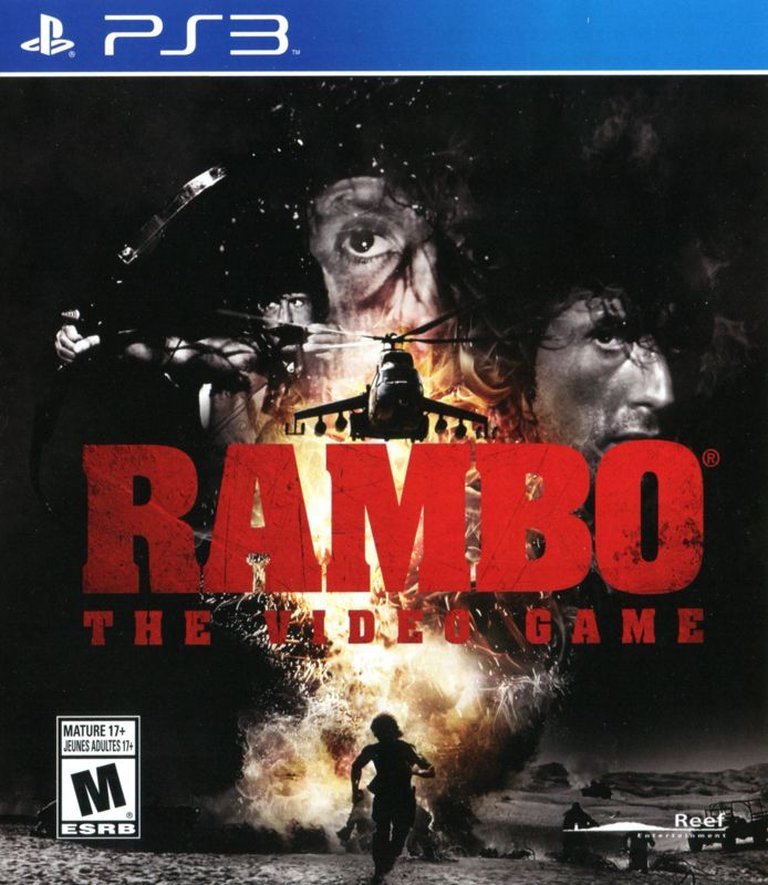
Rambo: The Video Game is a first-person rail shooter that immerses players in the iconic action sequences from the first three Rambo films starring Sylvester Stallone, released between 1982 and 1988. Set against the gritty backdrops of Vietnam jungles, American small towns, and Southeast Asian jungles, the game follows John Rambo as he battles overwhelming enemy forces through guided levels featuring intense shooting, quick-time event takedowns, stealth mechanics, and a wrath mode that slows time and grants unlimited ammo, all while earning experience to unlock perks and weapons in single-player or local co-op mode.
Gameplay Videos
Patches & Mods
Guides & Walkthroughs
Reviews & Reception
metacritic.com (34/100): Generally Unfavorable
ign.com : you should not come to the Rambo: The Video Game at all.
opencritic.com (35/100): A shallow, on-rails experience that really can’t make much of a case for itself in 2014.
destructoid.com : Rambo: The Video Game is an unpolished, uninspired on-rails lightgun game that’s currently being sold for $40 in 2014.
gamespot.com (60/100): Rambo: The Video game is a fun, simple rail shooter.
Rambo: The Video Game: Review
Introduction
In the pantheon of 1980s action cinema, few icons embody raw, unyielding masculinity and explosive vengeance quite like John Rambo. Debuting in Ted Kotcheff’s 1982 film First Blood, Sylvester Stallone’s portrayal of a tormented Vietnam veteran transformed the one-man army archetype into a cultural phenomenon, spawning two sequels that escalated the carnage while delving deeper into Cold War-era heroism. Over three decades later, Rambo: The Video Game (2014) arrives as a digital resurrection of this legacy—a rail shooter that chronicles the events of the original trilogy through interactive set pieces. Yet, in an era dominated by open-world epics and narrative-driven blockbusters, this Teyon-developed title feels like a relic from a bygone arcade age, trapped between nostalgic ambition and budgetary inadequacy. My thesis: While Rambo: The Video Game faithfully recreates the films’ visceral action in a compact package, its outdated mechanics, technical shortcomings, and tonal missteps render it a misguided adaptation that squanders the franchise’s potential, serving more as a cautionary tale for licensed games than a triumphant return.
Development History & Context
Developed by Polish studio Teyon S.A. and published by UK-based Reef Entertainment Ltd., Rambo: The Video Game emerged from a licensing deal struck in August 2011, when Reef acquired rights to the Rambo franchise from StudioCanal. At the time, the trilogy had grossed over $600 million worldwide, buoyed by the 2008 reboot’s box-office success and Stallone’s resurgence in films like The Expendables. Reef’s commercial director, Craig Lewis, envisioned a project that would let players “get under the skin of Rambo” by wielding his iconic arsenal in battle, positioning it as a launchpad for the publisher’s ambitions in action gaming.
Teyon, known for budget-conscious shooters like Heavy Fire: Afghanistan and later Terminator: Resistance, handled the core development under director Piotr Łatocha, with lead programmer Jakub Lisiński and lead gameplay designer Tomasz Dziobek at the helm. The 96-person credits list (including 95 developers) highlights a modest team, with key roles filled by 3D artists like Sebastian Spłuszka and animation specialists such as Joanna Iwan. Vision-wise, the game aimed to modernize the rail-shooter genre—evident in Time Crisis-inspired cover mechanics and Gears of War-like active reloads—while staying true to the films. To evoke authenticity, Teyon licensed original audio tapes from StudioCanal, incorporating Stallone’s and the late Richard Crenna’s (who died in 2003) film lines without new recordings, a cost-saving measure that preserved the era’s gritty voice but led to synchronization issues.
Technological constraints were glaring: Built on an aging engine reminiscent of PS2-era tech, the game targeted Xbox 360, PlayStation 3, and PC with a 2012 release initially planned, delayed to February 21, 2014 (PAL) and April 29 (NA for PC/PS3). The 2014 gaming landscape was unforgiving—indie darlings like Dark Souls II and AAA juggernauts like Titanfall emphasized fluid controls, expansive worlds, and polished experiences. Rail shooters, once arcade staples (e.g., House of the Dead), had waned post-motion controls boom, making Rambo‘s on-rails format feel anachronistic without light-gun support (save PS3’s Move integration). Budget limitations—evident in recycled assets and minimal marketing—mirrored the pitfalls of licensed tie-ins, where quick cash-ins often trumped innovation. Reef teased trailers via Machinima, misleadingly framing it as a full FPS, but the result was a $40 product that screamed compromise from its February launch.
Narrative & Thematic Deep Dive
Rambo: The Video Game structures its story as a nonlinear anthology of the trilogy, framed by a 1988 funeral eulogy for John Rambo—delivered by a rescued POW (revealed as Lt. Banks from First Blood Part II)—revealing his “death” as a cover for an unsanctioned Afghan mission. This alternate-universe framing adds intrigue, diverging from canon by faking Rambo’s demise to evade government oversight, but it ultimately undermines the films’ emotional weight.
The plot compresses First Blood (1982) into Chapter 1: A Vietnam prologue (1971) shows Rambo and Delmar Barry (an ascended extra from the film) escaping a POW camp, killing 147 foes in eight minutes—a stark contrast to the movie’s accidental lethality. Flashbacks depict Rambo’s PTSD-fueled rampage in Hope, Washington, arrested by Sheriff Teasle, escaping abuse, and evading a manhunt that escalates to National Guard involvement. Unlike the film’s restraint (only one death), gameplay encourages massacres, with non-lethal disarms optional but cumbersome. Colonel Trautman intervenes, leading to Rambo’s arrest.
Chapter 2 adapts Rambo: First Blood Part II (1985): Released for a recon mission, Rambo infiltrates the same camp with spy Co Bao (romance implied but truncated). Betrayed by Murdock (omitted here), he’s tortured by Lt. Col. Podovsky (absent in-game). Co’s death fuels a rampage, destroying a bridge, hijacking a helicopter, and extracting POWs via M72 LAW showdowns. Only three POWs appear, streamlining the extraction.
Chapter 3 covers Rambo III (1988): Rambo rescues Trautman from a Soviet Afghan fort, allying with Mujahideen against Col. Zaysen. Infiltrations, cave defenses, and a tank-fueled finale culminate in a defiant last stand turned cavalry charge. DLC Baker Team (free in 2016) adds a Cambodia prequel with Rambo’s unit, resolving noodle incidents like Barry’s fate.
Thematically, the game grapples with Rambo’s core motifs—PTSD, betrayal by bureaucracy, and one-man redemption—but flattens them into action beats. First Blood‘s anti-violence elegy becomes a cop-killer shooter (earning a “Cop-Killer” achievement), ignoring Teasle’s humanity or Rambo’s vulnerability. Sequels’ anti-Communist fervor amplifies body counts (Vietcong, Soviets as identical hordes), but skips nuanced alliances (e.g., no Mujahideen names). Characters suffer: Rambo’s model is stiff, his 10-ish lines from films feel mismatched (e.g., “Mission accomplished!” from Part II repurposed). Teasle resembles Art Galt visually; Co Bao sports boyish hair, ditching her elegance. Dialogue mixes film clips with new voiceovers (e.g., Kerry Shale as generics), creating disjointed soundboards. Themes of survival and wrath persist via mechanics, but the narrative’s compression—abridging 270+ film minutes into 3-4 hours—sacrifices depth for spectacle, turning tragedy into trashy excess.
Gameplay Mechanics & Systems
At its core, Rambo: The Video Game is a rail shooter hybrid, blending arcade shooting galleries, QTE-driven set pieces, stealth hunts, and destruction segments across 15 missions (plus DLC). Rambo auto-advances through linear paths, with players controlling a first-person crosshair via mouse (PC), analog stick (consoles), or Move (PS3). Five lives per stage enforce arcade tension; depleting them restarts the level.
Combat loops revolve around mowing enemies while chaining kills for multipliers (up to x10), rewarding headshots (5% health via perks) and disarms (non-lethal on Americans). Weapons—pistols (Colt M1911A1), rifles (AK-47, M16A1), SMGs (MAC-10), shotguns (Remington 870), machine guns (M60), snipers (SVD Dragunov), launchers (RPG-7, M72 LAW), bows (compound with explosive arrows), grenades, and knives—unlock via Trautman Challenges (e.g., no-kill runs). All deal uniform damage except mag size, a flaw homogenizing arsenals. Active reloads (Gears-inspired wheel) double ammo; cover arrows enable peeking (Time Crisis-style), but shaky cam on damage disorients.
Innovations include Wrath mode: Kills fill a meter for activation, slowing time, granting unlimited ammo, highlighting orange-glowing foes (Assassin’s Creed Eagle Vision homage), and health regen per kill—essential sans health packs. Stealth sections (bow/knife takedowns) mix lethal/non-lethal QTEs (shrinking circles like Tomb Raider 2013), with exclamation marks signaling alerts (Metal Gear nod). Vehicle/turret bits (DShK, M2 Browning) and destruction (e.g., Hope station, bridges) add variety, but QTEs dominate non-shooting (e.g., cliff dives, escapes), feeling redundant with a “No QTE Fails” perk.
Progression uses 25 skill points across trees: Toughness (damage resistance), Light/Heavy Weapons (firing bonuses), Special Equipment (grenade/arrow capacity), Wrath (meter extension). Perks (15 total, three equippable) like “Headshots Earn 5% Health” or “Wrath Burns 10% Slower” encourage replays for scores/XP, but UI is cluttered—wrath bars, multipliers, and ammo overlap amid screen splatters (blood, rain). Co-op splits screen poorly: Player 2 adds a blue reticule sans unique model or explanation, exacerbating repetition. Flaws abound: Unfair AI (lethal exclamation foes), buggy physics (ragdolls glitch), and imbalance (easy early, brutal finale). At 3-4 hours, it’s shallow; DLC adds three Cambodia missions with similar loops but CoD subtitles. Overall, mechanics evoke 1990s arcades but falter in modern execution, lacking depth for mastery.
World-Building, Art & Sound
The game’s world-building leans on fidelity to the films, recreating iconic locales without innovation. Chapter 1’s Hope, Washington—rain-slicked forests, police station—mirrors First Blood‘s claustrophobic tension, with destructible buildings emphasizing Rambo’s rampage. Vietnam’s POW camps and jungles (Chapter 2) evoke humid guerrilla warfare, complete with river runs and waterfalls; Afghanistan’s forts, caves, and deserts (Chapter 3) capture Mujahideen alliances amid Soviet incursions. Blackout basements (night raids, muzzle flashes) build suspense, while rain-soaked battles heighten atmosphere. However, linearity confines exploration—rails dictate paths, with no verticality or secrets beyond challenges. Optional objectives (e.g., bonus kills) tie into lore, like Trautman’s voiceovers, but world feels static, enemies spawning predictably from crates.
Art direction prioritizes film homage over polish: Rambo’s model—mullet, bandana, glistening arms—nailed Stallone’s likeness, but supporting cast falters (bearded Teasle, short-haired Co). Environments use PS2-level textures—blocky foliage, low-res cinematics—but destructible elements and ragdolls add chaotic flair. Visuals age poorly: Misshapen limbs, dead eyes, VHS-like knockoffs per critics. Atmosphere shines in Wrath’s red filter (Unstoppable Rage) and bullet cams (Sniper Elite-style bow headshots), but camera abuse (debris splatters) fatigues.
Sound design repurposes film audio innovatively yet disastrously: Stallone’s gravelly growls (“To live… fight!”) and Crenna’s authoritative baritone sync unevenly, with emphasis mismatches and mono quality evoking cassette rips. New voices (e.g., Duong Hoang as Co) clash, volume spikes during clips disrupt flow. Jerry Goldsmith’s scores recycle (e.g., Part II theme in loops), gunfire booms adequately, but repetitive enemy calls (“He’s a man, not a God!”) grate. Mujahideen chants and explosions contribute immersion, but overall audio feels cheap—nasty per Games TM—undermining the explosive experience.
Reception & Legacy
Upon release, Rambo: The Video Game bombed critically and commercially, earning a 3.6/10 Moby Score (26% critics, 2.4/5 players) and Metacritic aggregates of 34/100 (PC), 23/100 (PS3), 28/100 (Xbox 360). Of 28 critic reviews, only GameSpot’s 6/10 praised its “frenetic action” and cover innovation; most lambasted it as outdated (IGN: 3/10, “unmitigated waste”), unfinished (Destructoid: 1/10, “insulting at full price”), and tonally off (Eurogamer: 5/10, “cheesy but zero irony”). The Escapist (1/5) urged watching Hot Shots! Part Deux instead; Games.cz (1/10) compared it to a colonoscopy. Player scores echoed this (1.7/10 on Metacritic), with complaints of bugs, shortness (3-4 hours), and misleading marketing (trailers hid rail mechanics). Sales were dismal—32 MobyGames collectors—despite $40 pricing, leading to “Worst Game” nods (Giant Bomb 2014, EGM’s Most Misguided Adaptation).
Post-launch, reputation solidified as a “nanar vidéoludique” (Gameblog.fr: 0/10, “cult for bad reasons”). Free 2016 DLC Baker Team (three missions, trophies) offered minor redemption but highlighted abandonment. Legacy-wise, it influenced little—exemplifying licensed game pitfalls alongside Ride to Hell: Retribution—but Teyon’s team rebounded (Terminator: Resistance, 78/100 Metacritic). As a rail-shooter artifact, it nods to arcade roots amid 2014’s shooter saturation (Destiny, Wolfenstein), critiquing how nostalgia can’t salvage tech deficits. In Rambo’s canon, it joins middling adaptations (NES Rambo III: 4/10); fans warmer (OpenCritic user hints at charm), but it warns against half-baked revivals, evolving from flop to ironic meme (Angry Joe’s 2/10, PTSD skits).
Conclusion
Rambo: The Video Game captures the franchise’s explosive essence in bite-sized, film-faithful bursts, from Hope’s hunts to Afghan showdowns, bolstered by authentic audio and Wrath-fueled catharsis. Yet, its rail-bound simplicity, QTE bloat, graphical antiquity, and narrative distortions—turning restraint into rampage—doom it as a flawed curio. In video game history, it occupies a niche as a 2014 licensed misfire, a testament to arcade ambition clashing with modern expectations, best appreciated by diehards for its trashy charm rather than excellence. Verdict: Skip the game; rewatch the trilogy—it’s cheaper, longer, and infinitely superior. 3/10.