
- Release Year: 2004
- Platforms: Windows
- Publisher: Morphicon Limited
- Developer: 7FX, s.r.o.
- Genre: Action, Strategy, Tactics
- Perspective: 1st-person
- Game Mode: Single-player
- Gameplay: Shooter
- Average Score: 75/100
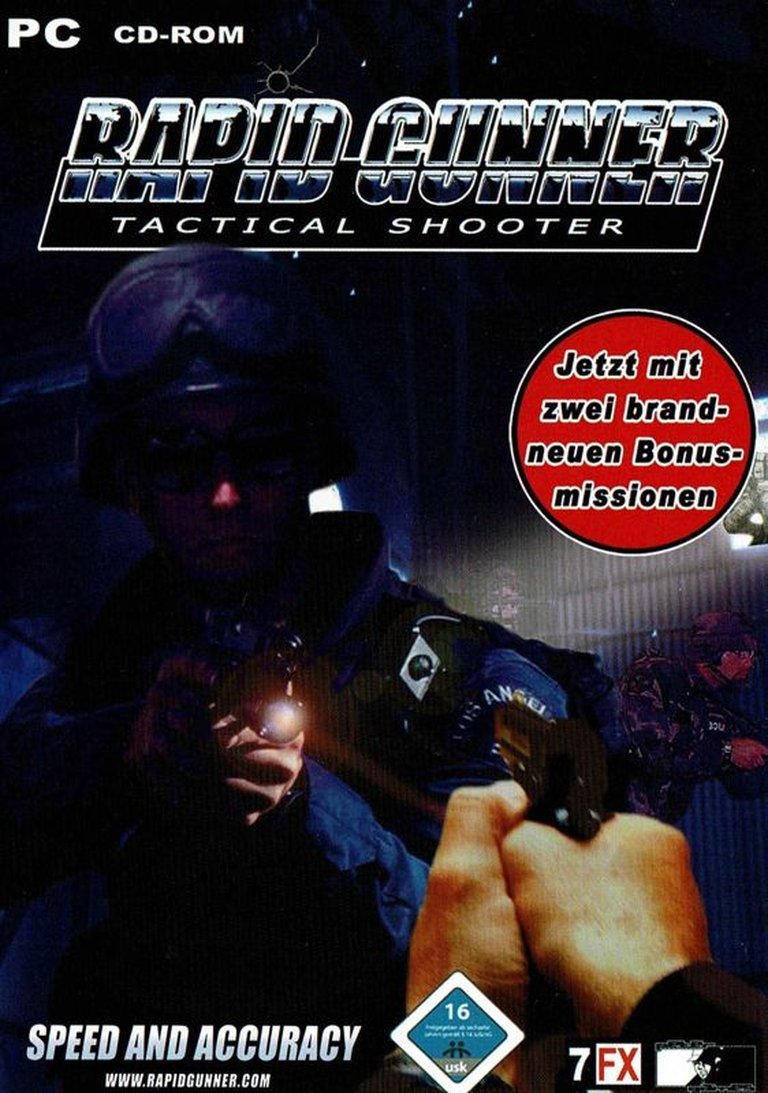
Description
Rapid Gunner: Tactical Shooter is a first-person shooter game released in 2004, where players must complete 8 missions by eliminating all targets in the shortest time possible while avoiding civilian casualties. Set across diverse environments like warehouses, planes, and parking garages, the game offers a variety of firearms and emphasizes speed and precision. With a cinematic camera perspective and real-time pacing, it blends action and tactical strategy, though its simplicity and repetitive gameplay have drawn mixed reviews.
Rapid Gunner: Tactical Shooter Cracks & Fixes
Rapid Gunner: Tactical Shooter Patches & Updates
Rapid Gunner: Tactical Shooter Mods
Rapid Gunner: Tactical Shooter Reviews & Reception
newqualitipedia.telepedia.net : The definition of “poverty” belongs to this game.
mobygames.com (58/100): Average score: 58% (based on 1 ratings)
myabandonware.com (92/100): kinda fun game ok if you just want to pass the time a bit
Rapid Gunner: Tactical Shooter – A Forgotten Relic of Early 2000s FPS Design
Introduction: The Curious Case of a Shooting Gallery Simulator
In the annals of first-person shooter history, Rapid Gunner: Tactical Shooter (2004) stands as a bizarre footnote—a game that defies conventional expectations of the genre. Developed by the Czech studio 7FX, s.r.o. and published by Morphicon Limited, this title is less a tactical military simulator and more a shooting gallery experiment, stripping the FPS formula down to its most basic mechanical elements. With its eight missions, rudimentary visuals, and an almost clinical focus on target elimination, Rapid Gunner occupies a unique (if unenviable) position in gaming history.
This review seeks to dissect Rapid Gunner not merely as a “bad game,” but as a cultural artifact—a product of its time, its technological constraints, and the ambitions (or lack thereof) of its creators. Through an exhaustive analysis of its development, design, reception, and legacy, we will explore how this game reflects the evolving expectations of early 2000s PC gaming, the challenges of indie development in Eastern Europe, and the fine line between minimalism and inadequacy.
Development History & Context: A Czech Studio’s Modest Ambition
The Studio Behind the Game: 7FX, s.r.o.
7FX was a small Czech development team with a portfolio that included titles like US Special Forces: Team Factor (2003) and Loco Mania (2004). Their work was largely budget-oriented, catering to a niche market of simulation and tactical shooters in the early 2000s. Rapid Gunner was not their most ambitious project, but it was one of their most focused—a game built around a single, unadorned premise: shoot targets, avoid civilians, and do it quickly.
The team consisted of 12 developers, with Marek Trefný serving as both executive producer and lead programmer, a dual role that suggests a hands-on, resource-constrained production. The art direction was led by Libor Batek, who also contributed to level design, indicating a small, multifaceted team where individuals wore multiple hats.
Technological Constraints & Engine Limitations
Rapid Gunner was built using the LightForce 2 engine, a proprietary tool developed by 7FX. This engine was not cutting-edge—even by 2004 standards. The game’s visuals are starkly reminiscent of late 1990s shooters, with:
– Low-resolution textures that appear blurry and repetitive.
– Flat, sprite-based environmental details (e.g., trees, distant objects).
– Basic lighting and shadow effects that lack the dynamism of contemporaries like Far Cry (2004) or Doom 3 (2004).
The game’s system requirements were modest, reflecting its technical simplicity:
– Minimum CPU: Likely a Pentium III or equivalent.
– RAM: 128–256 MB (standard for the era).
– GPU: Compatible with Direct3D 9, but without advanced shader support.
This technical modesty was not necessarily a flaw—many indie games of the era embraced functional minimalism. However, Rapid Gunner’s failure to compensate with compelling gameplay made its limitations glaring.
The Gaming Landscape of 2004: A Crowded FPS Market
2004 was a golden year for first-person shooters, with landmark releases such as:
– Half-Life 2 (Valves’ physics-driven masterpiece).
– Doom 3 (id Software’s atmospheric horror-FPS).
– Far Cry (Crytek’s open-world tropical shooter).
– Counter-Strike: Source (the definitive competitive FPS).
In this context, Rapid Gunner was not competing for mainstream attention. Instead, it targeted a niche audience—players interested in shooting simulators rather than narrative-driven or action-packed experiences. Its closest contemporaries were arcade-style shooters like Time Crisis or Virtua Cop, but without their polish or arcade charm.
The Vision: A Tactical Shooting Trainer or a Half-Baked Experiment?
The developers marketed Rapid Gunner as a “tactical shooter” that trains accuracy, precision, and perceptiveness. The game’s description emphasizes its educational potential, suggesting it could be used for firearms training or competitive score-chasing.
However, the execution betrays this ambition. The game lacks:
– Dynamic enemy AI (targets are static or follow predictable patterns).
– Meaningful tactical depth (no cover mechanics, no squad commands).
– Progression systems (no unlocks, no skill trees).
Instead, it plays like a glorified shooting gallery, where the only challenge is finding and clicking on targets before time runs out.
Narrative & Thematic Deep Dive: The Absence of Story
Plot: Nonexistent by Design
Rapid Gunner has no narrative. There is:
– No protagonist (the player is a faceless, nameless shooter).
– No backstory (missions are standalone scenarios).
– No dialogue (outside of minimal UI prompts).
This is not inherently a flaw—games like Counter-Strike thrive without narrative. However, Rapid Gunner fails to replace story with compelling gameplay mechanics, leaving a void where engagement should be.
Themes: The Illusion of Tactics
The game’s title suggests tactical depth, but the reality is far simpler. The underlying themes (if they can be called that) revolve around:
1. Precision Under Pressure – The timer encourages quick, accurate shots.
2. Civilian Avoidance – A rudimentary moral constraint (though civilians are just as static as targets).
3. Repetition as Training – The game frames itself as a drill, not an experience.
These themes are functional but uninspired. The game does not explore why these skills matter—it merely presents them as abstract challenges.
Characters & World: Cardboard Cutouts in a Sterile Environment
The “enemies” in Rapid Gunner are literal cardboard targets—some shaped like humans, others like road signs or geometric shapes. Civilians are similarly non-descript, often indistinguishable from the environment.
The levels (warehouse, airplane, parking garage, quarry) are devoid of personality. They serve as shooting ranges, not immersive spaces. The lack of environmental storytelling makes each mission feel interchangeable.
Gameplay Mechanics & Systems: The Bare Minimum
Core Gameplay Loop: Find, Shoot, Repeat
The gameplay is stark in its simplicity:
1. Enter a level (e.g., a warehouse, an airplane hangar).
2. Locate all targets (marked by a red square when hit).
3. Shoot them before time runs out.
4. Avoid shooting civilians (though the penalty is unclear).
There is no health system—the player cannot die. The only “failure state” is running out of time or shooting too many civilians, which deducts points.
Weapons & Combat: A Pistol-Only Affair
The game offers multiple handguns (Mk23, Glock 17, CZ75, etc.), each with slightly different handling:
– Reload speeds vary.
– Recoil patterns differ.
– Ammo capacity changes.
However, the lack of variety is striking:
– No rifles, shotguns, or explosives.
– No weapon upgrades or customization.
– No secondary fire modes.
The shooting mechanics are serviceable but unremarkable:
– Mouse-controlled aiming (no controller support).
– Basic ballistics (no bullet drop or ricochets).
– Hit detection is functional but occasionally unresponsive.
Level Design: Small, Repetitive, and Confusing
The eight missions take place in:
1. Warehouse (boxes, crates, and targets).
2. Airplane (narrow corridors, seated “civilians”).
3. Parking Garage (cars as cover, targets behind pillars).
4. Quarry (open space, distant targets).
5. Western Movie Set (a bizarre, themed range).
6. Snowboarding Resort (blocked paths, awkward angles).
7. Abandoned Block (tight corridors, poor visibility).
8. Urban Street (cars, alleys, and civilian clusters).
Problems with Level Design:
– Lack of verticality (most shooting is done at eye level).
– Poor visual clarity (targets blend into textures).
– Confusing layouts (players often get lost in the abandoned block level).
– No dynamic elements (no moving targets, no destructible cover).
UI & Feedback: Minimalist to a Fault
The HUD consists of:
– A timer (counting down).
– A target counter (how many left).
– An ammo counter.
There is no map, no objective marker, and no mission briefing. The player must figure out objectives through trial and error.
Progression & Replayability: A Score-Chasing Ghost Town
The game’s only replay incentive is the online leaderboard (now defunct). Players could submit their times to compete globally, but:
– No unlockable content.
– No difficulty settings (beyond implicit time pressure).
– No mod support (though a widescreen FOV fix was later created by fans).
The lack of post-launch support (only a three-map DLC was released) ensured the game faded into obscurity.
World-Building, Art & Sound: Aesthetic Austerity
Visual Design: A Time Capsule of Early 2000s Indie Limitations
The game’s art style is realistic but rudimentary:
– Textures are low-resolution, often stretched or tiled poorly.
– Character models (what few exist) are blocky and stiff.
– Lighting is flat, with no dynamic shadows.
– Animations are janky (the player’s walking cycle looks like a “drunk teenager”).
The cinematic camera (as listed in MobyGames) is misleading—there are no scripted sequences, just static first-person views.
Sound Design: The Auditory Equivalent of a Fart Joke
The sound effects are notoriously bad:
– Gunshots sound like “modified farting” (per Qualitipedia).
– Reloading is clunky and unrealistic.
– Ambient noise is nonexistent (no wind, no distant echoes).
– Music is completely absent.
The lack of audio feedback makes the game feel sterile and lifeless.
Atmosphere: The Absence of Immersion
Rapid Gunner fails to create any sense of tension or excitement. The lack of music, poor sound design, and repetitive environments make each mission feel like a chore rather than a challenge.
Reception & Legacy: A Game That Time Forgot
Critical Reception: “Simple, But Boring”
The only professional review (from Absolute Games, 58%) summarized it as:
“A very simple shooting range. Thanks for the competitive element, but even with it, the game gets boring quickly.”
Player reception was far harsher:
– Gry-Online (Polish gaming site): 2.0/10 average.
– Qualitipedia (Crappy Games Wiki): Labeled it “the definition of poverty.”
– User “zanonimizowany940001”: “Why do we go and shoot cardboard ducks?” (0/10).
– BartekGM (Polish reviewer): “7FX’s work can be compared to big elephant shit.”
Commercial Performance: A Budget Title That Flopped
The game was commercially insignificant, selling poorly even in its German release (published by Peter Games). Its lack of marketing, weak presentation, and niche appeal ensured it vanished from store shelves quickly.
Legacy: A Cautionary Tale in Game Design
Rapid Gunner is not remembered fondly, but it serves as a case study in:
1. The dangers of over-simplification (removing too much leaves nothing).
2. The importance of polish (even a simple game needs good feedback).
3. The challenges of indie FPS development in the 2000s (competing with AAA giants).
Its only lasting contribution is as a speedrunning curiosity—some players enjoy racing through its eight levels in under 20 minutes.
Conclusion: A Game That Exists in the Negative Space of FPS History
Rapid Gunner: Tactical Shooter is not a good game, but it is a fascinating one. It is a relic of an era when developers could release unambitious, mechanically barebones shooters and still find a tiny audience. It is a testament to the importance of polish, feedback, and player engagement—elements it lacks in every conceivable way.
Final Verdict: 3/10 – A Flawed Experiment, Not a Masterpiece
- ✅ What It Does Well:
- Focused gameplay loop (if you enjoy shooting galleries).
- Accurate weapon handling (for a 2004 indie game).
- Speedrunning potential (short, repetitive, and score-based).
- ❌ What It Does Poorly:
- No narrative, no immersion, no soul.
- Repetitive, confusing level design.
- Terrible sound design and visuals.
- Zero replay value beyond leaderboards.
Where It Stands in History:
Rapid Gunner is not a hidden gem—it is exactly as mediocre as its reception suggests. However, it is a valuable artifact for understanding:
– The struggles of small Eastern European studios in the early 2000s.
– The evolution of FPS design (from Doom to Half-Life 2).
– The fine line between minimalism and laziness.
For historical curiosity, it’s worth a brief playthrough. For entertainment, you’re better off with literally any other shooter from 2004.
Final Score: 3/10 – A Museum Piece, Not a Game to Remember.