
- Release Year: 2007
- Platforms: Wii, Windows
- Publisher: ak tronic Software & Services GmbH, Ubisoft Entertainment SA
- Developer: Ubisoft Paris Studios SARL
- Genre: Action, Mini-game, Party
- Perspective: Third-person
- Game Mode: Co-op, Single-player
- Gameplay: Customization, Mini-game collection, Music rhythm
- Setting: Asia, Earth, Europe, USA
- Average Score: 61/100
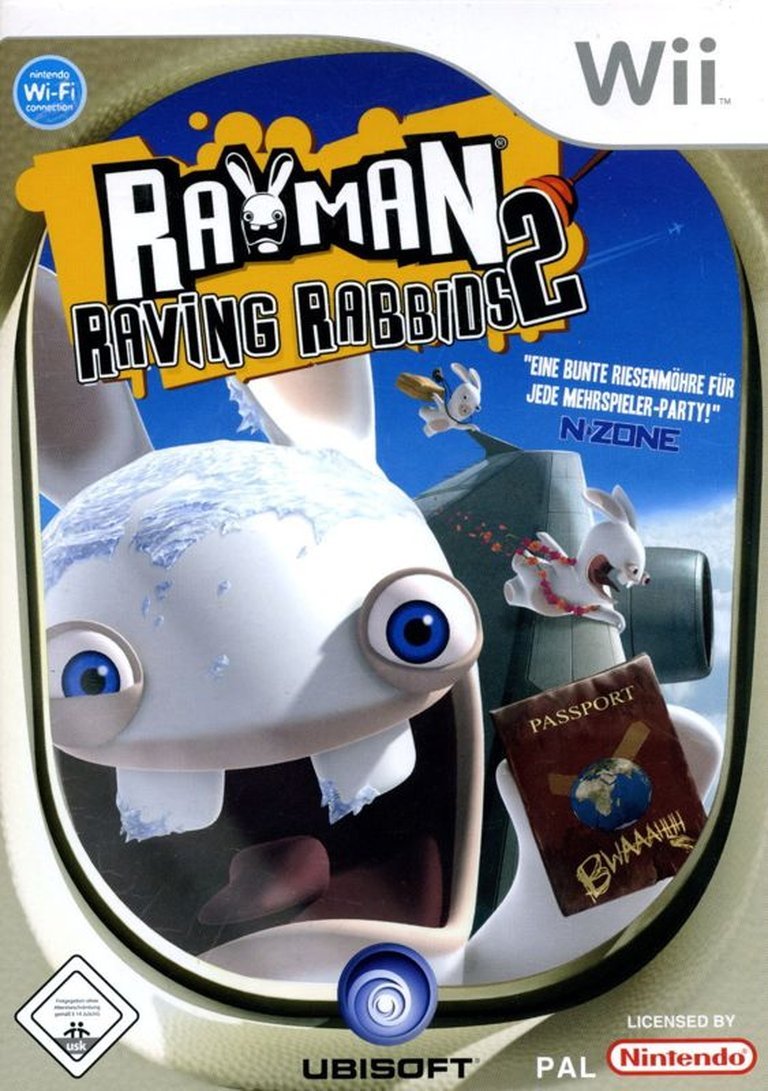
Description
Rayman: Raving Rabbids 2 is a Wii party game where, after being thwarted in the first title, the mischievous Rabbids launch an Earth‑wide invasion. Players control Rayman using the Wii Remote and Nunchuk to tackle sixty varied mini‑games—ranging from rhythm challenges and balance tests to racing—across five themed regions, with up to four players competing or cooperating and a massive array of customizable costumes and items.
Gameplay Videos
Rayman: Raving Rabbids 2 Free Download
Rayman: Raving Rabbids 2 Mods
Rayman: Raving Rabbids 2 Reviews & Reception
metacritic.com (67/100): The graphics are cheery and hilarious, and the Wi‑Fi connection adds a nice touch.
nintendoworldreport.com (55/100): The gameplay fails to deliver the same freewheeling satisfaction as its predecessor, making the sequel hard to recommend.
nintendolife.com : The game shines in multiplayer but offers little for solo play, so it’s only worth buying for group fun.
Rayman: Raving Rabbids 2 Cheats & Codes
Nintendo DS
Enter Action Replay codes using an Action Replay device.
| Code | Effect |
|---|---|
| 022d6aac ffffffff | Unlock All Bunny Stuff |
| 022d6ab0 ffffffff | Unlock All Bunny Stuff |
| 222d6ab4 000000ff | Unlock All Bunny Stuff |
| 222d6ba0 00000001 | Unlock Latina |
| 222d6ba4 00000001 | Unlock Japan |
| 222d6ba8 00000001 | Unlock Asia |
Rayman: Raving Rabbids 2 – Review
Introduction
When Ubisoft first unleashed the chaotic, helium‑filled Rabbids onto the Wii in 2006, the world’s first encounter with those yellow‑eyed lunatics became an instant cultural meme. Rayman: Raving Rabbids 2 arrived a year later, brandishing a fresh coat of absurdist humor, a larger roster of mini‑games, and a promised emphasis on simultaneous multiplayer. The thesis of this review is simple: the sequel succeeds where the original faltered—namely in party‑mode accessibility—but it also betrays the inventive spirit that made the first title a surprise hit. In the sections that follow, we will unpack the game’s development, narrative, mechanics, audiovisual design, and its lasting impact on the Wii’s party‑game landscape.
Development History & Context
Studio and Vision
- Developer: Ubisoft Paris Studios (with additional support from Ubisoft Casablanca for the DS version)
- Executive Direction: Xavier Poix (Studio Director & Executive Producer) and Nicolas Normandon (Creative Director & Lead Game Design)
- Engine: Jade, the same internal engine used for previous Rayman titles, adapted for Wii’s motion‑control pipeline.
Ubisoft’s ambition was two‑fold: exploit the Wii’s motion‑control novelty to its fullest while turning the Rabbids from a quirky side‑kick into a standalone franchise. The developers deliberately shifted the focus from Rayman’s platforming roots to a party‑game formula, a decision reflected in the game’s subtitle “Rabbids Party Returns.”
Technological Constraints and Market Landscape
The Wii’s hardware was modest by 2007 standards—limited GPU horsepower and a 32‑bit CPU—forcing developers to rely on clever art direction and efficient code rather than raw fidelity. Ubisoft leveraged Bink Video middleware to composite live‑action footage with cartoon Rabbids for the shooting arcade, a cost‑effective way to give the game a “real‑world” feel without demanding high‑resolution 3‑D environments.
At the time of release, the Wii’s library was saturated with mini‑game collections (Mario Party 8, Wii Sports, WarioWare: Smooth Moves). Rayman Raving Rabbids 2 entered a crowded market, positioning itself as a family‑friendly, humor‑driven alternative that could appeal to both casual and hardcore audiences.
Narrative & Thematic Deep Dive
Plot Overview
The story opens with a news broadcast (voiced by an announcer named Jennifer Hart) announcing the Rabbids’ invasion of Earth via a fleet of yellow flying submarines. Rayman, disguised as a Rabbid, infiltrates a mall headquarters, steals a plunger, and is thrust aboard an airborne submarine to “stop the Rabbids from taking over the world.” The game’s narrative is deliberately thin, serving primarily as a framework for the diverse mini‑game “Trips” set across five global regions: USA, Europe, Asia, South America, and the Tropics.
Characters and Dialogue
- Rayman: The classic hero, now reduced to a silent avatar whose primary role is to act as a player‑controlled proxy.
- Rabbids: The central comic villains, each with a distinct voice‑sample of manic “BWAAAAAAAAH!” screams, delivering slapstick one‑liners that parody pop culture (e.g., references to The Office, Transformers, and Bedknobs & Broomsticks).
The dialogue is intentionally nonsensical, leaning into surreal humor to mask the game’s lack of narrative depth. This aligns with the series’ thematic core: celebrating chaotic, unfiltered absurdity while lightly satirizing everyday human rituals (shopping malls, school classrooms, office life).
Underlying Themes
Beyond the surface comedy, the game subtly critiques consumer culture. The Rabbids’ attempts to mimic human behavior—watching TV commercials, attending school, playing music—serve as a parody of how media influences identity. The “Trip” structure, where players travel the world studying human habits, mirrors the Rabbids’ own quest for cultural appropriation, turning the entire world into a giant game board.
Gameplay Mechanics & Systems
Core Loops
- Trips Mode: Players select a region and must complete six mini‑games per trip. Successful completion unlocks those mini‑games for Free Play.
- Custom Trips: After unlocking, players can curate their own “trip” of up to nine mini‑games, a feature introduced to address the original’s random selection complaints.
- Multiplayer: Up to four players can compete simultaneously, a major improvement over the first game’s turn‑based multiplayer.
Mini‑Game Variety
The sequel boasts 60 distinct mini‑games, spanning categories such as:
| Category | Example | Wii Remote Usage |
|---|---|---|
| Rhythm/Music | Band performance (guitar, drums, keyboard) | Timing button presses with on‑screen prompts |
| Balance | Burger Balance | Hold Remote steady to keep a virtual item balanced |
| Shooting Arcade | On‑rails shooter with real‑world footage | Point Remote to aim, Nunchuk to fire |
| Driving | Bicycle race (one player pedals, another steers) | Tilt Remote for steering |
| Physical Gestures | Chili mini‑game (fling Remote upward) | Shake or flick Remote |
While many of these rely on shaking or tilting the Wii Remote—a design choice that many critics labeled “waggle‑tastic”—others integrate more nuanced gestures (e.g., precise IR pointing in shooting levels).
Progression and Rewards
- Costume Customization: Over 110 unlockable outfits for both Rayman and the Rabbids, ranging from pop‑culture homages (Spider‑Man, Ninja Turtles, Assassin’s Creed) to original parodies. The total combinatorial possibilities exceed 540,000, encouraging replay for completionists.
- Online Leaderboards: Integrated with Nintendo Wi‑Fi Connection, each mini‑game records high scores, adding a competitive layer absent from the first installment.
UI and Control Scheme
The UI is intentionally minimalist: a mall‑corridor menu that mirrors the “shopping‑mall” setting of the story. Each mini‑game presents a clear prompt, but the reliance on generic motion gestures can feel disconnected from the on‑screen action—a point repeatedly highlighted by reviewers.
Innovation vs. Flaws
- Innovations: Simultaneous four‑player support, custom trip builder, real‑world video integration for shooters, extensive costume system.
- Flaws: Over‑reliance on shaking, shallow single‑player experience, occasional low‑frame‑rate in video‑backed shooters, repetitive sound cues.
World‑Building, Art & Sound
Visual Direction
The game embraces a bright, cartoonish palette consistent with the Rabbids’ slapstick aesthetic. Environments are stylized but relatively simple; textures are low‑resolution, a consequence of both hardware limits and the decision to allocate resources toward the video‑backed shooting arcade.
- Real‑World Backdrops: The shooting arcade overlays Rabbids onto live footage of global landmarks (e.g., Paris streets, Tokyo skylines). This hybrid approach creates a whimsical juxtaposition reminiscent of The Muppet Movie and Bedknobs & Broomsticks.
- Character Animation: Rabbids exhibit exaggerated facial expressions and “wobble” physics, reinforcing their chaotic nature. Rayman’s animation is more restrained but retains the series’ signature fluidity.
Sound Design
- Voice Samples: The Rabbids’ signature shrieks, “BWAAAAAAAAH!” exclamations, and nonsensical chatter dominate the soundscape, delivering relentless comic relief.
- Music: Each mini‑game features its own looped track, often parodying popular songs (e.g., a Rabbid‑styled rendition of “Around the World”). While the tunes are energetic, they lack lasting memorability, and repeated exposure can become monotonous.
- Audio Integration: The sound cues are tightly synced with motion controls (e.g., a “whoosh” when shaking the Remote for the Chili game), reinforcing feedback loops but occasionally feeling over‑stated.
Overall, the audiovisual design succeeds in creating a frenetic, party‑ready atmosphere, even if technical constraints limit depth.
Reception & Legacy
Critical and
- Aggregate Scores: Metacritic 67/100 (Wii), GameRankings 66% (Wii). Individual outlets ranged from AceGamez (90%) to G4 TV (40%).
- Common Praise:
- Multiplayer Focus: Critics lauded the simultaneous four‑player mode and the ease of jumping into a game with friends.
- Humor: The Rabbids’ absurd jokes and visual gags earned accolades, winning 4Players’ “#3 Most Humorous Game of the Year” in 2007.
- Customization: The extensive costume unlocks and online leaderboards were highlighted as valuable additions.
- Common Criticism:
- Control Simplification: Many reviewers (IGN, Nintendo World Report) decried the over‑reliance on shaking motions, deeming them repetitive and shallow.
- Single‑Player Deficiency: The solo experience was described as “repetitive” and “lacking depth,” limiting the game’s appeal to groups.
- Technical Shortcomings: Low‑resolution textures, occasional frame‑rate drops in video shooters, and a modest amount of content compared to the original (fewer mini‑games, shorter tracks).
Commercial Performance
The game sold modestly, enough to merit a sequel (“Rayman Raving Rabbids TV Party,” 2008) and a DS spin‑off. Its inclusion in the Rayman Trilogie collection (2012) suggests a sustained, if niche, demand.
Influence on the Industry
- Rabbids Franchise: The game cemented the Rabbids as a distinct intellectual property, paving the way for later titles such as Mario + Rabbids Sparks of Hope and the mobile Rabbids Invasion series.
- Party‑Game Design: RRR2’s emphasis on instant‑play multiplayer and online leaderboards foreshadowed later Wii titles that prioritized social play over narrative depth (e.g., Wii Fit competitions, Just Dance series).
- Hybrid Video Integration: While the shooter backdrops received mixed reception, the technique demonstrated a cost‑effective method for blending live‑action footage into game worlds—a practice later revisited in titles like Kinect Sports and Just Dance 2015.
Conclusion
Rayman: Raving Rabbids 2 represents a bold but uneven evolution of the original’s chaotic charm. Ubisoft succeeded in delivering a vibrant, laugh‑filled party experience that shines brightest when played with friends, thanks to its simultaneous multiplayer, robust customization, and witty Rabbid antics. Yet the game’s reliance on simplistic motion gestures, thin single‑player content, and technical compromises prevent it from achieving the timeless appeal of its predecessor.
Verdict: A solid, if imperfect, entry in the Wii’s party‑game canon. It deserves a place on any family’s shelf for occasional multiplayer sessions, but casual players should consider the original first.
Final Score (historical consensus): 6.7/10 (Moby Score) – a respectable middle ground reflecting both its strengths and its shortcomings.