
- Release Year: 1999
- Platforms: Android, Dreamcast, iPad, iPhone, Nintendo 64, PlayStation, Windows
- Publisher: Acclaim Entertainment, Inc., Big Bit Ltd., Game Factory Interactive Ltd., H2 Interactive Co., Ltd., Russobit-M, WeGo Interactive Co.,Ltd.
- Developer: Acclaim Studios Limited
- Genre: Action, Driving, Racing
- Perspective: Behind view
- Game Mode: LAN, Online PVP, Single-player
- Gameplay: Arcade, Power-ups, Track racing, Vehicle simulator, Vehicular
- Setting: Luxury liner, Supermarket, Toy shop
- Average Score: 79/100
Description
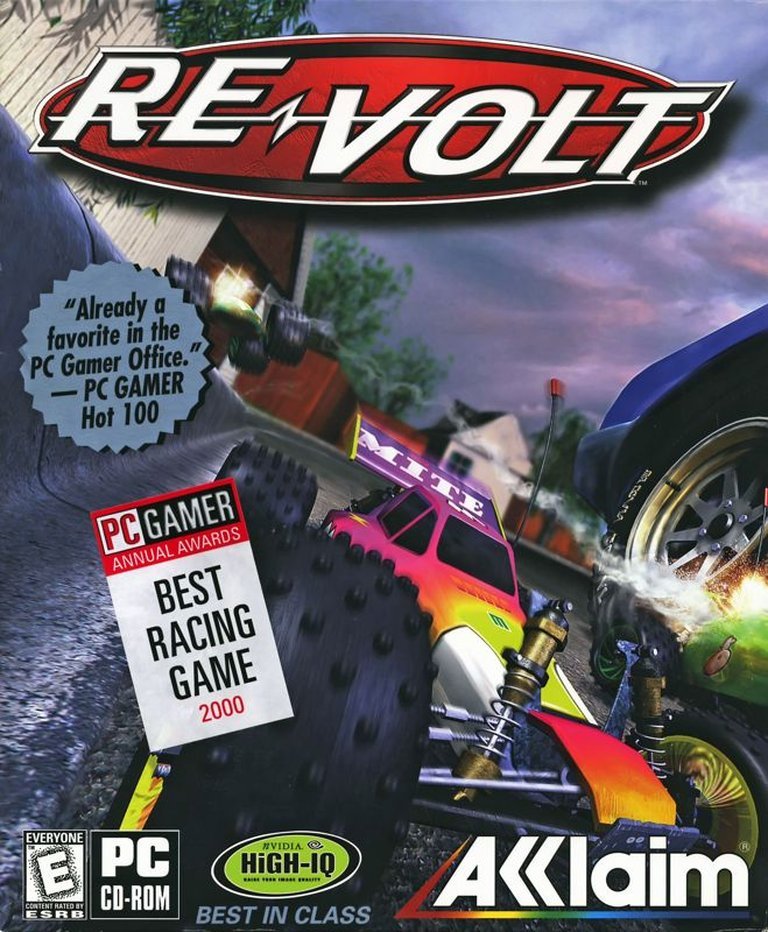
Re-Volt is a classic arcade racing game where players control remote-controlled (R/C) cars across 13 vibrant and imaginative tracks, including a toy shop, supermarket, luxury liner, and more. Set in the whimsical world of the Toy-Volt company, whose RC cars mysteriously ‘come to life,’ the game offers fast-paced races filled with power-ups like missiles, lightning bolts, and freezing stars to disrupt opponents. Featuring single-player modes like Championship, Time Trial, and Stunt Arena, as well as multiplayer support for up to 12 players, Re-Volt blends nostalgic toy-car chaos with customizable realism settings and creative track designs.
Gameplay Videos
Where to Buy Re-Volt
Re-Volt Free Download
Re-Volt Cracks & Fixes
Re-Volt Patches & Updates
Re-Volt Mods
Re-Volt Guides & Walkthroughs
Re-Volt Reviews & Reception
gamespot.com (65/100): Re-Volt has its share of problems and ends up being only decent when it could have been great.
christiananswers.net (100/100): A great game with a catchy title. I will somewhat agree with the reviewers comments about the games controls.
mobygames.com (74/100): For a fun, R/C racing game, that offers advanced realism, in addition to one of the most amazing career modes you’ve ever seen in a racing game, check out Re-Volt !
Re-Volt Cheats & Codes
PC
Enter codes at the name screen to activate corresponding cheats.
| Code | Effect |
|---|---|
| CARNIVAL | All cars |
| TRACKER | All tracks |
| DRINKME | Small cars |
| JOKER | Identical cars in multi-player mode |
| CHANGELING | Change car in mid-race |
| URCO | UFO vehicle |
| SADIST | Unlocks weapons. Weapon select using Right Shift |
| TVTIME | Alternate views (Press F5 or F6) |
| MAKEITGOOD | No clipping (press F6) and flight mode (press F6 twice) |
PlayStation
Enter codes as a name to activate corresponding cheats.
| Code | Effect |
|---|---|
| CARNIVAL | All cars |
| TRACKER | All tracks |
Dreamcast
Enter codes as a name to activate corresponding cheats.
| Code | Effect |
|---|---|
| CARTOON | All cars |
| CARNIVAL | All cars |
| TRACTION | All tracks |
| TRACKER | All tracks |
| YOY | All weapons. Press L+R to change weapons |
| SADIST | Unlocks all weapons. Press L+R during a game to cycle through weapons |
| YUEFO | Enable UFO |
| FLYBOY | Increase car details |
| CHANCER | Change cars |
| GOATY | Edit progress table |
| MAGGOT | Tiny mode |
Nintendo 64
Enter codes during gameplay to activate corresponding cheats.
| Code | Effect |
|---|---|
| B, A, Z, Z, B, L, A, Up, C | Unlock all cars and tracks |
| CARTOON | All cars |
| CARNIVAL | All tracks |
| TRACKER | All tracks |
| TRACTION | All tracks |
| SADIST | All weapons |
| OYOY | All weapons |
| CHANCER | Change cars |
| GOATY | Change progress table |
| FLYBOY | Hi-fi mode |
| YUEFO | Probe U.F.O |
| DRINKKME | Tiny cars |
| MAGGOT | Tiny racers |
Xbox
Enter codes as a name to activate corresponding cheats.
| Code | Effect |
|---|---|
| CARTOON | All cars |
| CARNIVAL | All cars |
| TRACTION | All tracks |
| TRACKER | All tracks |
| OYOY | All weapons |
| SADIST | All weapons |
| CHANCER | Change cars |
| GOATY | Change progress table |
| FLYBOY | Hi-fi mode |
| YUEFO | Probe U.F.O |
| URCO | Probe U.F.O |
| DRINKME | Tiny cars |
| MAGGOT | Tiny racers |
| TVTIME | View select |
Re-Volt: Review
A Toybox Revolution That Outpaced Its Era
Re-Volt isn’t just a racing game—it’s a love letter to the miniature chaos of remote-controlled cars, a subversive twist on the arcade racer that remains unmatched in its niche. Released in 1999 by Acclaim Studios London, this cult classic blended punishing realism with whimsical toyetic charm, carving a legacy that still resonates through modding communities and nostalgic retrospectives. Beneath its cartoonish veneer lay a fiercely innovative racer that dared to shrink the stakes, magnifying the intensity of competition into micro-scale warfare. This review dissects how Re-Volt defied its technical constraints and flawed execution to become an enduring benchmark in the racing genre.
Development History & Context
The Little Studio That Could
Studio Ambitions Amidst Turbulence
Developed by Acclaim Studios London (formerly Iguana UK), Re-Volt emerged during a tumultuous period for Acclaim Entertainment, known for both bold experiments and financial instability. Led by designers Paul Phippen and Simon Harrison, the team sought to reinvent the arcade racer by focusing on radio-controlled cars—a novel concept at the time. The vision was clear: merge the tactile joy of RC racing with Mario Kart-style weaponized chaos, all while grounding the physics in realism.
Technical Constraints as Creative Fuel
In 1999, hardware limitations forced ingenuity. The Nintendo 64’s foggy draw distances and the PlayStation’s texture warping posed challenges, but the PC version became the technical showcase, boasting detailed environments and smoother framerates. Coder Balor Knight’s physics engine mimicked real RC dynamics—weight distribution, traction loss, and even battery drain (simulated via speed decay). The team’s collaboration with RC manufacturer KYOSHO lent authenticity, though the console ports suffered cuts: fewer tracks, simplified textures, and choppy performance (PS1 reviews lambasted its “appalling pop-up”).
The 1999 Racing Landscape
Re-Volt launched into a market saturated with Gran Turismo’s simulation and Crash Team Racing’s frantic party ethos. Its toy-car premise risked dismissal as a “kiddie” racer, yet it carved a niche by striking a razor’s-edge balance: punishing handling demanded mastery, while imaginative arenas (a supermarket, a sinking pirate ship) invited accessibility. Despite mixed reviews, it garnered a Computer Gaming World “Sleeper Hit of the Year” award—a testament to its underdog appeal.
Narrative & Thematic Deep Dive
The Silent Rebellion of Sentient Toys
Re-Volt’s narrative is barely skin-deep—a tongue-in-cheek backstory about the Toy-Volt Corporation, whose RC cars “come to life” through vague corporate magic. This premise serves as scaffolding for gameplay, not lore. There are no cutscenes or character arcs; the cars themselves (toaster-shaped Hot Wheels homages, sleek dune buggies) are protagonists through sheer personality.
Subtext in Scale
Thematically, Re-Volt revels in the subversive thrill of occupying adult spaces as minuscule intruders. Racing through a museum or luxury liner transforms mundane environments into treacherous obstacle courses—a soda can becomes a ramp, a chess piece a barricade. This “Honey, I Shrunk the Racer” ethos echoes Toy Story’s exploration of hidden worlds, framing competition as a secret rebellion against the human-scale mundane.
The Absurdity of Toy Warfare
Power-ups like homing missiles and EMP pulses inject dark humor: these are toys escalating, turning suburban kitchens into battlegrounds. The lack of explicit narrative paradoxically heightens immersion—players project their own stories onto silent RC cars, each dent and crash narrating a miniature epic of resilience.
Gameplay Mechanics & Systems
Precision Chaos in a Microcosm
Physics: A Double-Edged Sword
Re-Volt’s standout feature is its physics model. Cars handle like genuine RC vehicles: lightweight, prone to flipping, and treacherously responsive. Four realism settings (from arcade to simulation) cater to skill levels, but even “rookie” mode demands respect. Landing from jumps requires careful alignment—tilt mid-air, and you’ll careen into walls. This unforgiving design polarized critics (GameSpot called it “evil”), yet it rewarded patience with unparalleled satisfaction.
Weaponized Toybox Mayhem
Power-ups are randomized, ensuring chaos reigns:
– Electro-Zapper: Chain-lightning AoE stun
– Pie Plate: Deployable shield
– Homing Missile: Self-explanatory havoc
The AI’s ruthlessness shines here—rivals weaponize pickups strategically, swerving to fire backward missiles or block shortcuts. Multiplayer (up to 12 players online via LAN/modem) amplified this chaos, though connectivity hiccups plagued early adopters.
Progression & Modes
– Championship: A grueling series requiring top-three finishes to advance. Unlocking cars like the turbo-boosted Cougar or drift-friendly Lucky Star felt monumental.
– Stunt Arena: A makeshift skatepark demanding precision jumps to collect stars.
– Track Editor: Limited by primitive tools, yet birthed a modding renaissance. Fan-made tracks (e.g., Venice) became legendary.
Flaws & Frustrations
The learning curve verged on sadistic. Newcomers spun out incessantly; rubber-banding AI felt cheap. The track editor’s clunkiness (PC Gamer: “a major hassle”) necessitated third-party tools. Car customization was absent—each vehicle’s fixed stats locked strategies.
World-Building, Art & Sound
A Vivid Diorama of Nostalgia
Level Design as Playground
Tracks doubled as environmental storytelling:
– Toy World 1-2: A sprawling department store with laser-tag ambience and plushie obstacles.
– S.S. Minnow: Rain-lashed decks of a tilting ship, demanding split-second navigation.
– Bio Hazard: A nuclear plant oozing toxic sludge (a fan-made map elevated to canon).
Each locale brimmed with interactive props—rolling soda cans, flickering TVs—creating dynamic hazards.
Aesthetic Chops
Despite hardware limits, the art team achieved a crisp, toyetic sheen. Car models reflected real RC brands, while plastic textures gleamed under dynamic lighting. The Dreamcast version’s 60 FPS and enhanced reflections set a high bar, though the N64’s foggy draw distances dampened scope.
Sound Design: Techno and Tiny Carnage
A pulsing techno soundtrack (divisive but era-appropriate) underscored races. Sound effects sold the illusion: whirring motors, plastic-on-tile scrapes, and the crunch of chassis meeting pavement. Notably, muting the music heightened immersion—the clatter of tiny tires became ASMR-triggering ambience.
Reception & Legacy
From Commercial Misfire to Cult Immortality
Launch Reception: Divided by Platform
Critics lauded the PC original (80% average) for its ambition but skewered console ports. Praise centered on physics and creativity; scorn targeted difficulty spikes and performance:
– PC Gamer (88%): “An exceptional balance of realism and arcade thrills.”
– IGN PS1 (6.1/10): “A great idea hobbled by technical failings.”
Sales were modest—16,528 PC copies in 1999—but fervent word-of-mouth sustained it.
The Modding Renaissance
Re-Volt’s true legacy lies in its community. Fan patches (like v1.2) fixed bugs, restored cut content, and added widescreen support. The open-source RVGL project ports the game to modern OSes, while RV House’s multiplayer hubs keep races alive. Track editors birthed thousands of custom courses—a testament to the game’s malleable core.
Influence on the Genre
While no direct successor matched its formula, echoes appear in Rocket League’s vehicular acrobatics and Hot Wheels Unleashed’s toy-nostalgia theme. The 2012 mobile re-release (Re-Volt Classic) flopped due to cramped touch controls, but the 2022 Steam/GOG revival—with Workshop support—proves its enduring appeal.
Conclusion
A Masterclass in Miniature Mayhem
Re-Volt is a paradox: a game of frustrating imperfections that coalesce into something transcendent. Its razor-sharp physics and diorama-like worlds demand investment but repay it with unmatched tactile joy. While uneven ports and a brutal difficulty curve alienated some, its heart—pure, unfiltered RC carnage—secured its cult following.
Today, Re-Volt stands as a testament to a bygone era of bold experimentation, where even flawed gems could inspire decades of devotion. It isn’t just a racing game; it’s a tiny revolution in a box, demanding you kneel down and play. Final Verdict: 8.5/10 – A flawed yet indispensable classic whose legacy outpaces its original finish line.