
- Release Year: 1998
- Platforms: Windows
- Publisher: Jordan Freeman Group, LLC, Knowledge Adventure, Inc.
- Developer: Knowledge Adventure, Inc.
- Genre: Educational
- Game Mode: Single-player
Description
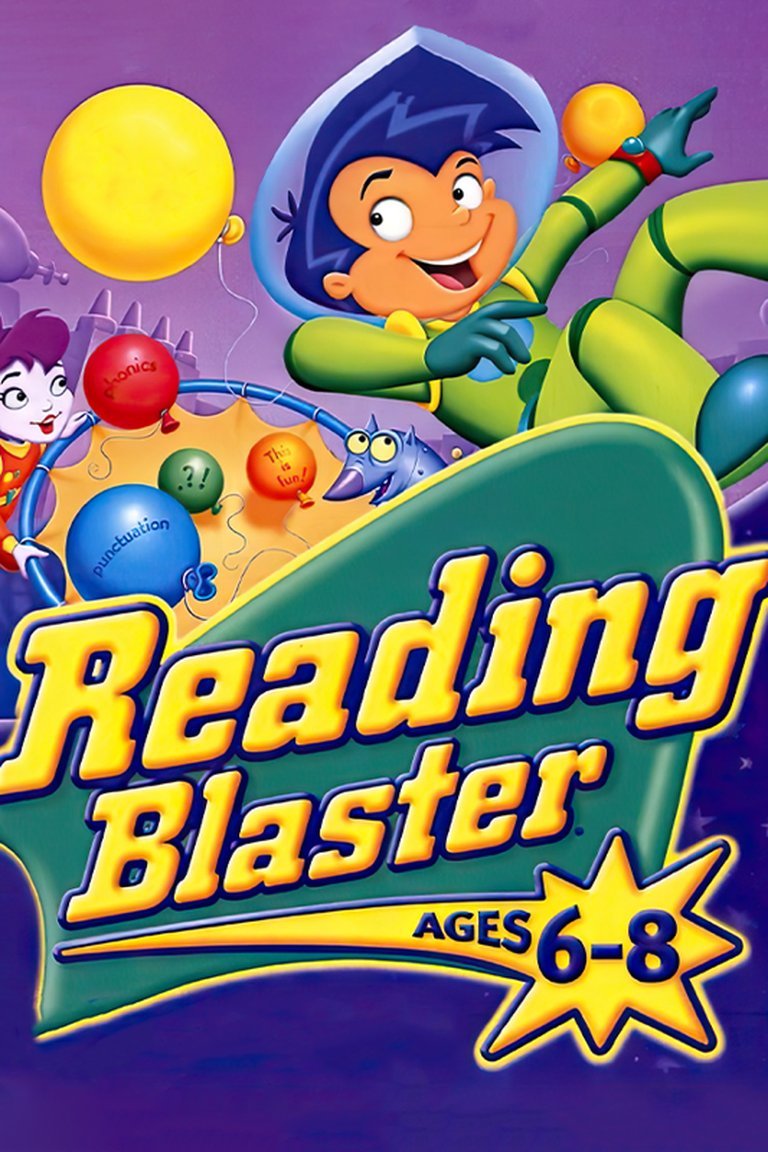
Reading Blaster: Ages 6-8 is an educational adventure game set on the planet Islandia, where players join Blaster and Galactic Commander on vacation only to have their relaxation disrupted by Mumblers disguised as tourists who invade and jumble words and letters. Children aged 6 to 8 must enhance their reading and writing skills through engaging mini-games like Bridge Puzzle and Mumbler Maze to combat the Mumblers and restore order, all within a point-and-click interface designed for literacy development.
Gameplay Videos
Reading Blaster: Ages 6-8 Free Download
Reading Blaster: Ages 6-8 Guides & Walkthroughs
Reading Blaster: Ages 6-8: A Radiation-Scorched Relic of the Edutainment Boom
Introduction: The Last Word in a Galactic Classroom
In the towering, neon-drenched pantheon of 1990s edutainment, few software franchises cast a longer shadow than the Blaster Learning System. For a generation of school computer lab dwellers, the Math Blaster and Reading Blaster titles were the Apple II and Windows 95 equivalents of a workbook—only with more lasers, vaguely menacing robot sidekicks, and a persistent, almost existential threat of word-based villainy. Yet, nestled between the high-stakes world-saving of Reading Blaster: Invasion of the Word Snatchers (1994) and the grade-level granularity of the late-90s Knowledge Adventure reboots lies a curious, transitional title: Reading Blaster: Ages 6-8. Released in 1998 for Windows, this game is not merely a sequel but a deliberate recalibration. It swaps planetary peril for the glitzy, artificial stakes of an intergalactic game show, a shift that speaks volumes about the evolving philosophy of children’s educational software at the close of the 20th century. This review argues that Reading Blaster: Ages 6-8 is a pivotal, if flawed, artifact—a game thatrecognized the need to soften its narrative edges and gamify learning for a younger, more competitively-minded audience, even as it foreshadowed the franchise’s eventual dilution into branded, grade-specific content mills.
Development History & Context: From Davidson’s Forth to Knowledge Adventure’s CUC
The Blaster series was the brainchild of Davidson & Associates, a company founded by Janice G. Davidson, PhD, that became a titan of educational software in the 1980s and 90s. The original Math Blaster! (1983) was written in AppleSoft BASIC, but under engineer Mike Albanese, Davidson pioneered a cross-platform development system using Fig Forth, a language that allowed them to efficiently port games across Apple II, Atari 8-bit, Commodore 64, and eventually MS-DOS and Windows. This technical foundation enabled the series’ prolific output.
By the mid-90s, Davidson’s narrative ambitions grew. Math Blaster Episode I: In Search of Spot (1993) and its reading-focused counterpart, Reading Blaster: Invasion of the Word Snatchers (1994), introduced fully animated cutscenes, voice acting, and a continuous storyline starring the iconic trio: the heroic Blasternaut (later just “Blaster”), the capable Galactic Commander (GC), and their loyal robotic dog, Spot. These games featured a classic sci-fi villain, Illitera, who sought to steal all language from Earth.
The seismic shift came with Reading Blaster 2000 (1996), developed by Davidson but already bearing the marks of a changing corporate landscape. In 1996, Davidson & Associates was acquired by CUC International, which also owned Knowledge Adventure. By 1998, the brands were merging under the Knowledge Adventure banner. Reading Blaster 2000—already a remake/soft-reboot of the 1994 title—was re-released and rebranded as Reading Blaster: Ages 6-8 (August 5, 1998). Later still, it would become Reading Blaster for 3rd Grade (2000) as Knowledge Adventure pivoted to a strict “grade-level” marketing strategy to compete with its own JumpStart series. This title exists in this fascinating liminal space: a Davidson-designed game published under the new Knowledge Adventure regime, using the “Ages 6-8” taxonomy that was soon to be replaced by “2nd Grade” and “3rd Grade” labels.
Technologically, the game was built with the Atlas engine, a common Davidson/Knowledge Adventure middleware of the era. It features fixed, flip-screen visuals and a point-and-select interface, hallmarks of CD-ROM-era edutainment. The constraints of late-90s Windows (limited color palettes, low-resolution SVGA graphics) are evident, but the art direction maximizes its space-themed aesthetic with bold colors and chunky, readable sprites—a design necessity for a reading product meant to be legible on bulky CRT monitors.
Narrative & Thematic Deep Dive: The Game Show as a Narrative Softening
The most profound shift in Reading Blaster: Ages 6-8 is its complete abandonment of the “save the world” plot. The original Reading Blaster had players thwart Illitera’s plot to steal language itself—a nearly cosmic scale of stakes. Here, that apocalyptic threat is replaced by the inconsequential, commercialized arena of “The Challenge of the Reading Gladiators,” an interstellar game show hosted by the two-headed alien, Ike and Rita Cuecard (a pun on “I can read a cue card”).
The player selects Blaster, GC, or Spot to compete. In single-player mode, the opponent is the now-diminished Illitera, stripped of her world-ending ambitions and reduced to a rude, catty contestant who “bad-mouths the show’s hosts and elicits boos from the unseen audience.” In multiplayer mode (a rarity in the series, later excised from re-releases), a second player controls another Blaster Pal. The narrative is not a story to be completed but a meta-frame for the minigames. Winning the show’s three “Reading Blaster Adventure Stories”—The Spooky House, The Panther and the Dragon, and Dr. Dabble’s Revenge—unlocks as episodic rewards.
This thematic pivot is significant. By moving to a game show format, the developers accomplish two things:
1. Defuse Anxiety: The pressure shifts from “saving literacy” to “winning a trivia contest.” Failure has no universe-altering consequences; it’s just a lost round. This is crucial for the 6-8 age group, where the fear of “getting it wrong” can inhibit learning.
2. Introduce Competitive Framing: The show structure inherently creates a “you vs. opponent” dynamic, making skill drills feel like head-to-head competition rather than solitary punishment. The Adventure Stories themselves are simple, “Choose Your Own Adventure”-style tales with basic prose (“This place is scary,” said Blasternaut. “I’m not scared,” said GC. “Let’s go in.”) that serve as contextual rewards, teaching that reading unlocks narrative progression.
The only recurring villain, Illitera, is rendered toothless. Her presence is more a nostalgic nod than a threat, embodying the series’ past while the present focuses on benign competition. The true antagonists are the Mumblers—in the Ages 6-8 iteration, they are “jumbling everything up on Islandia,” a more localized, less existential problem. This “lighter and softer” approach, noted by TV Tropes, represents a conscious decision to prioritize engagement over epic narrative, Banking on the intrinsic motivation of gameplay over the extrinsic motivation of saving the world.
Gameplay Mechanics & Systems: The Minigame Carousel
The core loop is a carousel of six distinct minigames, each targeting a specific reading sub-skill, accessed from the hub world of “Islandia” (or in the original Reading Blaster 2000, the game show set). Completing any game earns a “clue.” Collect five clues, and the player can deduce which Mumbler stole the book (in the Islandia plot) or advance to the next Adventure Story chapter.
- Bridge Puzzle: A spelling-focused activity where players correctly spell words to reconstruct a bridge.
- Mumbler Maze: A significant evolution from the Spelling Blaster precursor. Instead of collecting letters to spell a single word, players collect words scattered as gems, then must order them to form a coherent sentence. This directly teaches syntax and sentence structure. Mumbler enemies cause the player to drop their collected gems, adding a pressure element.
- Ski Bum Mumbler (Unique to this version): The player reads a short story passage, then races a Mumbler down a ski slope. At the end, a comprehension question about the text must be answered correctly to win. This is a pure reading comprehension test disguised as a race.
- Geyser Valley: A syllable-counting drill. Players launch balls from a catapult to plug geysers. The ball’s number must match the syllable count of the word displayed under the geyser. Power management (the colored bars) adds a primitive physics-puzzle layer.
- Volcano Climb & Volcano Drop: Two sides of the same coin, both focused on vocabulary and word relations. In Climb, players follow verbal instructions (e.g., “Find a word that is the opposite of ‘happy'”) to select the correct rock to scale a volcano; wrong choices cause the rock to crumble. Drop is a similar traversal but uses portals, with the added threat of a Mumbler scrambling word tiles.
- Media Madness (Implied via TV Tropes): A memory matching mini-game using TV screens that reveal images or sounds.
After every successful minigame, the player returns to the central hub, the Juice Shack. Here, they can read the Adventure Stories, check progress, print certificates or word puzzles, and use the “Blaster Message Board” to create pictures or stories—a simple, creative writing tool.
Systems Analysis: The design is archetypal “drill-and-practice” edutainment, but cleverly camouflaged. The skill tiering is evident: from discrete letter-sound work (spelling) to sentence construction, comprehension, and higher-order vocabulary (antonyms, syllables). The clue-collection meta-goal provides a long-term objective beyond individual minigames. However, the systems are simple. There is no true character progression; “leveling up” is an illusion. The difficulty is likely static or marginally increased, relying on the player’s growing familiarity with the interface and vocabulary. The removal of multiplayer in later releases was a significant blow to the social, competitive dynamic that initially differentiated it from other solitary reading programs.
World-Building, Art & Sound: A Pastel Saturn
The game’s setting is a pastel, 90s interpretation of outer space. Islandia (or the game show studio) is a cluster of floating, geometric islands or a soundstage with visible rigging and cosmic backdrop. The visual style is fixed flip-screen: each minigame and hub is a single, static screen with animated sprites. This was a cost-effective and technically manageable approach for the era, ensuring low system requirements.
The character designs are key. This version uses the pre-1999 “Blaster Pals” designs—Blaster as a blue-suited humanoid, GC as a purple female commander, and Spot as a simple, R2-D2-esque robot who communicates solely in electronic beeps and boops (“The Unintelligible” trope). These designs are distinct from the later “Rave” or 2000s redesigns. The villains, the Mumblers, are generic, fuzzy, non-descript creatures, their threat level purely visual (they bump into you). Illitera, when she appears, is a sharp-dressed, sneering humanoid with a villainous aesthetic downgraded for comedy.
The sound design is typical of the period: upbeat, repetitive MIDI tunes for menus and victory jingles, with synthesized sound effects for actions (catapult whooshes, gem collections, Mumbler collisions). The “Adventure Stories” are narrated with clear, slow, emphatic diction, a necessity for early readers. Audio cues for correct/incorrect answers are distinct and immediate, providing instant feedback.
Collectively, the art and sound create a world that is simultaneously fantastic and safe. It’s space, but a playground space, not the dangerous frontier of earlier Blaster titles. The aesthetic prioritizes clarity and bright, cheerful colors over immersion or atmospheric depth, perfectly aligned with its direct, functional educational goals.
Reception & Legacy: A Bridge Between Eras
Contemporary reception is difficult to gauge precisely from the provided sources, as MobyGames lists no critic reviews and user reviews are absent. However, we can infer its position. The Blaster series was a commercial juggernaut; by June 1997, Davidson reported 5 million copies sold across the line. The shift to a game show format in Reading Blaster 2000/Ages 6-8 was likely a response to market research suggesting younger players needed lower-stakes frameworks. The rebranding to “Ages 6-8” and then “3rd Grade” reflects the late-90s trend of hyper-specific age/grade targeting in educational software, a move that would eventually lead to market fragmentation.
Its legacy is one of transition and quiet obsolescence.
* Within the Series: It is the final game to feature the classic pre-1999 Blaster Pal designs and the Islandia/Mumbler plotline. The subsequent Knowledge Adventure titles would introduce the “Rave” characters and MEL the robot dog for the Blaster’s Universe TV series tie-in.
* In Edutainment History: It exemplifies the late-CD-ROM edutainment model: a self-contained, single-subject product sold in retail boxes. It was a peak-of-the-physical approach that would be rendered archaic by the mid-2000s shift to online subscription models (like the post-2011 Math Blaster MMO) and mobile app stores.
* Cultural Footprint: It is a footnote. Unlike Myst or Oregon Trail, it did not transcend its genre. Its primary preservation is through archival efforts like the Internet Archive (hosting the “Reading Blaster 6-9” ISO) and fan wikis like Math Blaster Wiki. The Wikipedia page for Reading Blaster 2000 is a stub, and the Everything Explained entry is largely a factual dump, indicating a lack of sustained cultural memory or scholarly attention.
* The End of an Era: The ultimate fate of its corporate home is telling. Knowledge Adventure, after acquiring Davidson and merging brands, was itself acquired by CUC Software, then spun off, and eventually became part of JumpStart Games. JumpStart’s shutdown announcement on June 13, 2023, and the termination of Math Blaster support on June 30, 2023, marks the definitive end of the line that Reading Blaster: Ages 6-8 helped define. This game is a snapshot of a corporate identity in flux—Davidson’s creative spirit being standardized into Knowledge Adventure’s grade-based merchandising machine.
Conclusion: A Competent, Compromised Artifact
Reading Blaster: Ages 6-8 is neither a masterpiece nor a disaster. It is a competently engineered, pedagogically sound, but narratively neutered product of its time. Its minigames effectively drill sentence structure, syllables, and comprehension. Its game show premise successfully lowers affective filters for young learners. Its visual design is clear, functional, and emblematic of its era.
However, its historical significance lies in what it represents: the moment the Blaster series decisively moved from sci-fi adventure to branded educational content. By replacing Illitera’s planet-snatching scheme with a game show rivalry, it sacrificed the series’ unique, high-concept identity for a safer, more marketable template. It is the bridge between the inventive, story-driven edutainment of the early 90s and the commodified, grade-specific software suites of the late 90s and 2000s.
In the grand museum of video games, Reading Blaster: Ages 6-8 belongs in a wing labeled “Efficient Learning Machines.” It does not ask to be remembered for its artistry but for its utility. For those who played it, it is a potent Proustian trigger for the smell of CRT monitors and the sound of a classroom’s din. As a historical document, it is an essential data point in the evolution of a foundational franchise and a stark reminder of how the business of “edutainment” eventually consumed the very “entertainment” it sought to leverage. Its final verdict is one of poignant, practical mediocrity: a perfectly serviceable teacher’s aide that helped countless children practice reading, even as it marked the point where the Blaster universe’s soul began to drain away, replaced by the cold calculus of the grade-book.
Final Verdict: 2.5 out of 5 Stars. A pedagogically effective but creatively compromised title that serves as the definitive end of an era for the classic Blaster Learning System identity.