
- Release Year: 2006
- Platforms: PlayStation 2, Windows
- Publisher: In2Games Ltd
- Developer: Aqua Pacific Ltd., In2Games Ltd
- Genre: Simulation, Sports
- Perspective: 3rd-person
- Game Mode: Hotseat, Single-player
- Gameplay: Championship Mode, Mini-games, Motion-based controls, Party mode, Tournament Mode, Training mode
- Setting: Golf Course
- Average Score: 72/100
Description
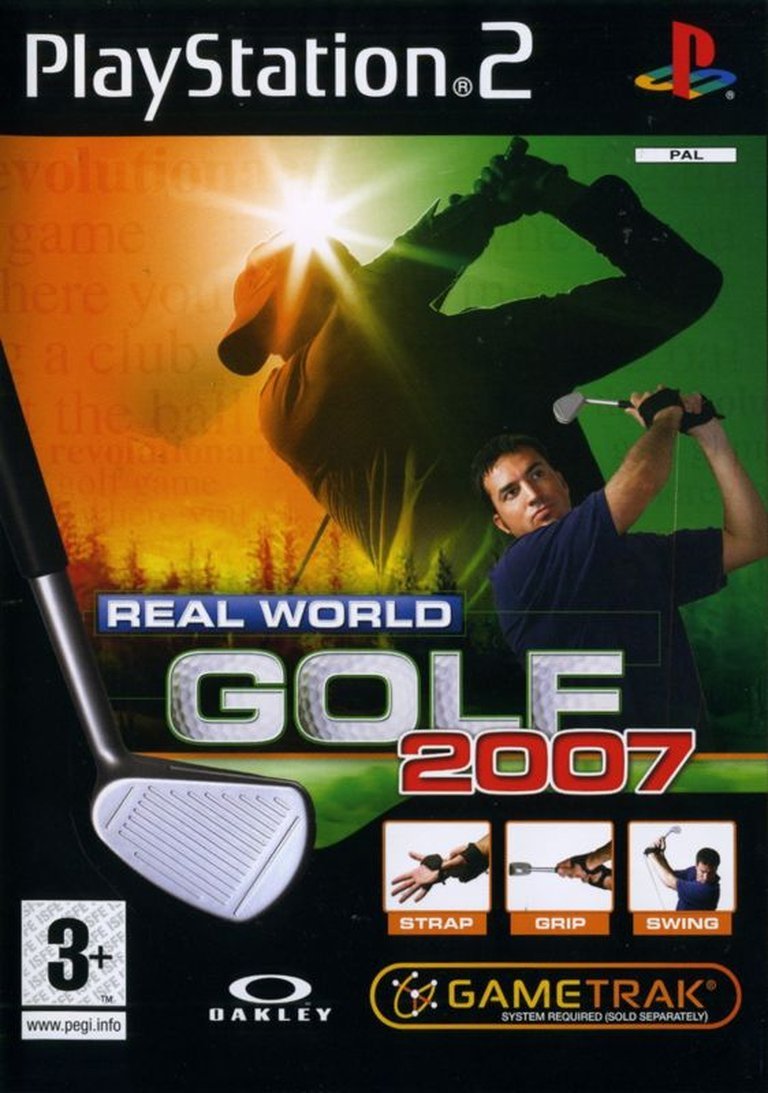
Real World Golf 2007 is a golf simulation game that utilizes the Gametrak motion-tracking hardware, allowing players to swing a plastic golf club with realistic motions to control their shots. The game features 15 unlockable 18-hole courses, multiple modes including tournament, championship, training, and party modes (with mini-games like hitting targets or cars), and supports hotseat multiplayer for up to four players. Navigation is handled entirely through hand gestures, eliminating the need for a keyboard or gamepad, and the game introduces a revamped putting system for enhanced realism.
Gameplay Videos
Real World Golf 2007 Cracks & Fixes
Real World Golf 2007 Reviews & Reception
en.wikipedia.org (73/100): The game received “mixed or average” reviews according to the review aggregator website Metacritic.
eurogamer.net : It works. To an extent. The game purports to actually help with your real life golf swing.
metacritic.com (74/100): Hands-down, the Gametrak system provides the most realistic home experience of the sport, even if the game itself isn’t revolutionary.
mobygames.com (70/100): Real World Golf 2007 is the sequel to Real World Golf. Like its predecessor it make use of the Gametrak, an external hardware gadget that tracks your motions.
Real World Golf 2007: A Swing into the Future of Motion-Controlled Sports
Introduction: The Gametrak Revolution
In the mid-2000s, the video game industry was on the cusp of a motion-control revolution. While Nintendo’s Wii would later popularize the concept with its Wii Remote, a lesser-known peripheral called the Gametrak was already pushing boundaries. Real World Golf 2007, developed by Aqua Pacific Ltd. and published by In2Games Ltd., was the sequel to Real World Golf (2005) and one of the few games to fully embrace this innovative technology. Released on August 25, 2006, for PlayStation 2 and Windows, the game promised an unprecedented level of immersion by translating real-world golf swings into digital gameplay.
This review explores Real World Golf 2007 in exhaustive detail, examining its development, gameplay mechanics, narrative (or lack thereof), world-building, reception, and legacy. While it may not have achieved the mainstream success of Tiger Woods PGA Tour or Mario Golf, its bold experimentation with motion controls makes it a fascinating case study in the evolution of sports simulations.
Development History & Context: The Gametrak’s Ambition
The Studio and the Vision
Aqua Pacific Ltd. and In2Games Ltd. were relatively small players in the gaming industry, but they had a bold vision: to create a golf game that felt as close to the real sport as possible. The original Real World Golf (2005) was their first attempt, and while it received mixed reviews (Metacritic scores of 73/100 on PS2 and 74/100 on Xbox), it laid the groundwork for a more refined sequel.
The Gametrak was the centerpiece of this vision. Unlike traditional controllers, which relied on button presses and analog sticks, the Gametrak used motion-sensing gloves connected by thin wires to a base unit. Players would strap on the gloves, grip a lightweight plastic club, and swing as they would in real life. The system could detect speeds ranging from 1 millimeter per hour to 2,000 miles per hour, allowing for precise control over everything from gentle putts to powerful drives.
Technological Constraints and Innovations
The Gametrak was a technical marvel, but it was not without limitations:
– Wired Design: The gloves were tethered to the base unit, restricting movement and occasionally causing tangles.
– Learning Curve: Players had to adjust their swings to account for the lack of physical resistance (unlike a real golf club).
– Calibration Issues: Early adopters reported occasional inaccuracies in swing detection, particularly with short chips and putts.
Despite these challenges, the Gametrak represented a leap forward in motion-controlled gaming. The developers doubled down on its potential in Real World Golf 2007, introducing:
– A revamped putting system that accounted for green slope and speed.
– A Swing Trainer mode that analyzed swing mechanics and provided feedback.
– 15 new 18-hole courses, including real-world locations like The Belfry (famous for hosting the Ryder Cup).
– Enhanced commentary from legendary golf commentator Peter Alliss.
The Gaming Landscape in 2006
When Real World Golf 2007 launched, the sports gaming market was dominated by EA Sports’ Tiger Woods PGA Tour series, which had already perfected the traditional controller-based golf experience. Meanwhile, Nintendo’s Wii was on the horizon, promising a wireless, more accessible motion-control solution.
In this context, Real World Golf 2007 was a niche product—a game for hardcore golf enthusiasts and early adopters willing to invest in specialized hardware. Its £50-£80 price tag (including the Gametrak) was steep compared to standard games, but for those who embraced it, the experience was unparalleled.
Narrative & Thematic Deep Dive: The Story of You
The Absence of a Traditional Narrative
Unlike story-driven sports games (e.g., NBA 2K’s MyCareer mode), Real World Golf 2007 eschewed scripted narratives, characters, and cutscenes. Instead, its “story” was emergent, shaped by the player’s progression through tournaments, unlockable courses, and personal milestones.
Thematic Focus: Mastery and Progression
The game’s core themes revolved around:
1. Skill Development: The Swing Trainer and Impact Analyzer tools encouraged players to refine their technique, mirroring real-world golf coaching.
2. Achievement and Reward: Unlocking courses and earning golden pins (akin to Xbox Achievements) provided a sense of accomplishment.
3. Social Competition: The Party Mode and hotseat multiplayer fostered friendly rivalries, turning living rooms into virtual golf tournaments.
The Role of Commentary
Peter Alliss’ commentary added a layer of authenticity, though its repetitive nature was a common criticism. His lines were sparse but provided context, such as praising a well-executed drive or lamenting a missed putt. While not a narrative in the traditional sense, his presence reinforced the game’s simulation aspirations.
Gameplay Mechanics & Systems: Swinging for the Greens
Core Gameplay Loop
Real World Golf 2007 structured its gameplay around four primary modes:
1. Tournament Mode: Multi-round competitions with escalating difficulty.
2. Championship Mode: High-stakes events requiring consistent performance.
3. Training Mode: Drills for driving, chipping, and putting.
4. Party Mode: Mini-games like:
– Car Smash: Hitting balls into a parking lot to destroy vehicles.
– Bullseye Challenge: Aiming for a giant target in the sky.
– Hoop Shot: Navigating balls through floating rings.
The Gametrak in Action
The Gametrak’s motion tracking was the game’s defining feature:
– Full Swings: Players could adjust their stance, backswing, and follow-through to shape shots (e.g., draws, fades, topspin).
– Putting: The revamped system required precise control over power and angle, accounting for green slopes.
– Menu Navigation: Hand gestures replaced traditional controllers—raising an arm to select options or leaning forward for course flyovers.
Strengths and Flaws
Strengths:
✅ Unmatched Immersion: The physicality of swinging a club made every shot feel personal and impactful.
✅ Skill-Based Progression: The Swing Trainer provided real-time feedback, helping players improve.
✅ Variety of Modes: From serious tournaments to silly mini-games, there was something for every type of player.
Flaws:
❌ Hardware Limitations: The wired gloves could feel restrictive, and calibration issues occasionally led to frustrating mis-hits.
❌ Repetitive Commentary: Peter Alliss’ lines repeated frequently, breaking immersion.
❌ Lack of Depth in AI: Opponents in tournaments lacked personality, making victories feel hollow.
Multiplayer and Replayability
The hotseat multiplayer (1-4 players) was a standout feature, allowing friends to take turns with the Gametrak. The Party Mode mini-games were particularly social and chaotic, making the game a great party title.
However, the lack of online multiplayer (a standard in Tiger Woods PGA Tour by 2006) limited its long-term appeal.
World-Building, Art & Sound: The Virtual Links
Course Design and Visuals
The game featured 15 unlockable 18-hole courses, each with distinct themes:
– The Belfry (Ryder Cup course): A real-world replica with challenging water hazards.
– Fictional Courses: Ranging from links-style coastal layouts to parkland designs with rolling hills.
Graphical Highlights:
– Crisp textures for fairways, bunkers, and greens.
– Dynamic weather effects (rain, fog, sunlight).
– Motion-captured animations that mirrored the player’s swings.
Criticisms:
– Distant objects could appear pixelated at maximum zoom.
– Character models were basic compared to Tiger Woods PGA Tour.
Sound Design and Atmosphere
- Ambient Sounds: Birds chirping, wind rustling, and club impacts added realism.
- Commentary: Peter Alliss’ dry British wit was a highlight, though repetition was an issue.
- Music: A subdued orchestral score played during menus but was largely absent during gameplay.
Reception & Legacy: A Mixed but Memorable Swing
Critical Reception
Real World Golf 2007 received mixed reviews, with critics praising its innovation but noting its flaws:
– Eurogamer (7/10): “It’s hardly the best golf game overall, but it’s at its best when it requires you to drive the ball 270 yards down the fairway and you’re making those actual motions in real life.”
– GameSpot (6/10): “Once you get past the novelty, there’s nothing to keep you playing.”
– IGN (7.9/10): “On a rainy day when the muni-course is closed, Real World Golf is an affordable and fun golf experience.”
Commercial Performance
The game struggled commercially due to:
– The high cost of the Gametrak bundle.
– The looming release of the Wii, which offered wireless motion controls.
– Limited marketing compared to EA’s Tiger Woods franchise.
Legacy and Influence
Despite its niche appeal, Real World Golf 2007 left a lasting impact:
– Pioneered Motion Controls: It proved that full-body motion tracking could work in sports games, influencing later titles like Wii Sports and Kinect Sports.
– Inspired Future Golf Sims: Later games, such as ProStroke Golf, adopted similar motion-based mechanics.
– Cult Following: Among golf purists, the game remains a curiosity—a bold experiment that almost succeeded.
Conclusion: A Bold Experiment That Missed the Fairway
Real World Golf 2007 was ahead of its time, offering a level of immersion that traditional golf games couldn’t match. Its Gametrak peripheral was a technical marvel, but hardware limitations, repetitive commentary, and lack of online play held it back from greatness.
Final Verdict:
⭐⭐⭐⭐☆ (4/5) – A Flawed but Fascinating Innovation
Who Should Play It?
– Golf enthusiasts who crave realistic swing mechanics.
– Motion-control historians interested in pre-Wii experiments.
– Party gamers looking for chaotic mini-games.
Who Should Avoid It?
– Casual players who prefer pick-up-and-play experiences.
– Those unwilling to invest in specialized hardware.
In the end, Real World Golf 2007 was a swing for the fences—one that didn’t quite clear the green but left an indelible mark on the history of sports gaming. If you’re willing to strap on the gloves and embrace its quirks, it remains a unique and rewarding experience.
Final Score: 7.5/10 – A bold, flawed, but unforgettable experiment in motion-controlled golf.