
- Release Year: 2011
- Platforms: Windows
- Publisher: Boss Baddie, Ripstone Ltd.
- Developer: Boss Baddie
- Genre: Action
- Perspective: Side view
- Game Mode: Co-op
- Gameplay: Procedural generation, Shooter, Side-scrolling, Space flight
- Setting: Futuristic, Sci-fi
Description
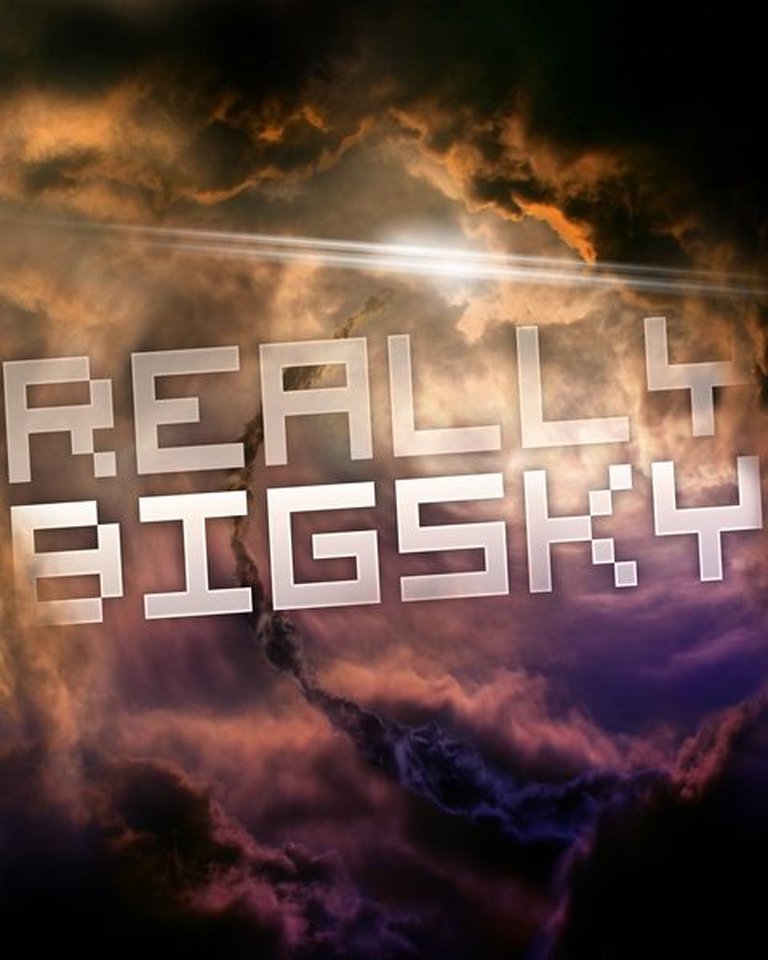
Really Big Sky is a twin-stick side-scrolling shooter set in space, where players pilot a craft through procedurally generated levels featuring unique enemies, attacks, and events based on a seed. The game offers 12 diverse modes like Classic, Arcade, Hell, and Boss Rush, with features such as auto-firing weapons, a drill mode for navigation and bonuses, power-ups, permanent upgrades, and cooperative multiplayer for up to four players.
Gameplay Videos
Where to Buy Really Big Sky
PC
Really Big Sky Patches & Updates
Really Big Sky Guides & Walkthroughs
Really Big Sky Reviews & Reception
indiegamemag.com : Really Big Sky is mostly an arcade shooter, given that its regular ‘Classic Mode’ is a score-based mode. However, its merit lies in the fact that the game randomly generates your environment, enemies/bosses, power-ups, and so forth.
dualshockers.com : Really Big Sky is a great pick-up-and-play-for-fifteen-minutes game, but not one worth marathoning.
Really Big Sky: Review
Introduction
In the vast cosmos of indie gaming, few titles capture the frenetic energy and addictive gameplay loops of twin-stick shooters quite like Really Big Sky. Released in 2011 by Boss Baddie, this high-octane sequel to the cult classic Big Sky (2010) thrusts players into a procedurally generated space odyssey where survival hinges on reflexes, strategy, and a healthy dose of British humor. With its kaleidoscopic visuals, relentless pace, and staggering 12 game modes, Really Big Sky stands as a testament to the ingenuity of small-scale developers. Yet, beneath its vibrant exterior lies a game that balances brilliance with brevity, offering a singular experience that is both exhilarating and occasionally exhausting. This review deconstructs its legacy, dissecting how a game with “simple” mechanics became a benchmark for replayability in the indie shooter renaissance.
Development History & Context
Really Big Sky emerged from the British studio Boss Baddie, a passion project led by James Whitehead and Caroline Powrie, who handled programming, art, design, and writing. Using Multimedia Fusion 2.5—a engine known for rapid development but technical limitations like clunky controller support—Whitehead and Powrie crafted a sequel that expanded upon their 2010 precursor, Big Sky. While Big Sky was a niche hit, Really Big Sky aimed to be a “super fast, twin analogue shooter for the modern age,” doubling down on procedural generation and variety.
The game’s release in October 2011 coincided with a pivotal moment for indie gaming. The digital distribution boom (Steam, Desura) and growing acceptance of “arcade-style” indies created fertile ground for titles like Geometry Wars: Retro Evolved 2. Boss Baddie capitalized on this by emphasizing Really Big Sky’s high replayability and co-op features, positioning it as a definitive multiplayer experience. Technically, the engine constrained them—early controller bugs plagued Xbox 360 compatibility, requiring a “total recode” using XNA post-launch. Yet, these hurdles underscored the team’s dedication, evidenced by a year of free content updates (e.g., the “2.1 Retro Update” adding a new mode, boss, and events). This iterative approach mirrored the game’s own philosophy: constant evolution through player interaction.
Narrative & Thematic Deep Dive
Really Big Sky eschews traditional storytelling in favor of a minimalist, high-concept premise: aliens covet your planet, and you must blast through them in a “super big” space battle. The narrative unfolds through the game’s mechanics rather than cutscenes, with the “cheeky cockney AI” narrator (voiced by Alex Sumesar-Rai) serving as the sole character. His irreverent quips—mocking players for dying or praising their “mad laser skills”—inject personality into the void, transforming the sterile cosmos into a chaotic, interactive stage.
Thematically, the game explores futility and perseverance. The one-hit-kill mechanic embodies the fragility of existence in an indifferent universe, while the upgrade system’s “carrot-on-a-stick” loop mirrors the Sisyphean struggle of progress. Even the procedural generation reflects a core theme: the unpredictability of space, where each run is a unique battle against entropy. This abstraction elevates Really Big Sky beyond a simple shooter; it’s a meditative dance with chaos, where survival is both victory and surrender.
Gameplay Mechanics & Systems
At its core, Really Big Sky is a twin-stick shooter with twin-stick perfection. Players pilot a ship that auto-scrolls forward, using analog sticks or mouse to aim and fire. A single button toggles “drill mode,” crucial for navigating enclosed sections (e.g., asteroid cores) while hovering over power-ups. Auto-fire can be interrupted to conserve ammo for stronger lasers, adding a layer of tactical depth. This simplicity is deceptive, however, as the game’s genius lies in its procedural generation. Every level’s enemies, bosses, events (black holes, wormholes), and pacing are dynamically stitched together from a vast pool, creating infinite replayability.
The 12 game modes form the game’s backbone. Classic mode perm-upgrades your ship with points, while Arcade lets players select three perks (e.g., rapid fire) before runs. Varied modes like Pacifism (no shooting), Hell (extreme difficulty), and Retro (pixelated visuals) cater to diverse playstyles. Progression is tied to unlocking these modes, encouraging mastery of Classic’s high-score grind. Power-ups (shields, score multipliers) and the “Friendly Mothership” ally add layers, but the true standout is the Cascade Events—gameplay-altering surprises (e.g., screen warps) that keep runs unpredictable.
Multiplayer is equally robust, with 4-player local co-op featuring scalable difficulty and exclusive Cascade events. However, the UI’s minimalism can be a flaw; tutorial information is sparse, and the library documenting enemies/events feels underutilized. Controller support was initially poor but improved post-update, reflecting the developer’s responsiveness.
World-Building, Art & Sound
Really Big Sky’s world is a vibrant, psychedelic dreamscape. Planets explode in showers of color, asteroids shatter into jagged fragments, and gas giants loom like nebulous titans. The art direction, a kaleidoscope of neon hues and particle effects, evokes the chaos of a “trippy acid trip,” as one critic noted. This visual density serves a functional purpose: it obscures threats, demanding players hone their reflexes. Yet, it also risks sensory overload; the “large color palette” can make enemies and hazards hard to distinguish, a trade-off for its aesthetic flair.
Sound design amplifies the mayhem. The soundtrack, composed by James Whitehead, Alex Sumesar-Rai, and others, blends chiptune melodies with pulsating electronic beats, shifting dynamically during “bullet-hell” events. The narrator’s Cockney accent is the star, turning routine gameplay into a running comedy act. Together, these elements forge an atmosphere that is both oppressive and exhilarating—a testament to how audio and visual cohesion can elevate arcade simplicity into an immersive experience.
Reception & Legacy
Upon release, Really Big Sky received mixed but largely positive reviews. Critics praised its replayability, modes, and visuals but flagged its steep learning curve and limited enemy variety. PC Gamer UK lauded it as “utterly compulsive” (85%), while XGN noted its “simple gameplay” and “limited enemies” deemed it “worth the purchase” (65%). Players on Steam awarded it a “Mostly Positive” 75/100, with comments highlighting its “satisfying” difficulty and “great soundtrack.” Commercially, it estimated 136k sales, bolstered by bundles like The Chosen 2 (2013).
Its legacy is twofold. As a sequel, it cemented the Big Sky series (Big Sky: Infinity followed in 2012), but its true impact lies in its design philosophy. Procedural generation and high-score chasing became staples of indie shooters, influencing titles like Nuclear Throne. Boss Baddie’s post-launch updates set a benchmark for community engagement, adding content based on player feedback. Yet, its reputation has softened over time; some now view it as a “modestly entertaining” but “forgettable” gem, overshadowed by later genre titans like Vampire Survivors. Still, its cult endures, cited for perfecting the “15-minute burst” gameplay loop.
Conclusion
Really Big Sky is a paradox: a game of infinite variety built on simple mechanics. Its procedurally generated chaos, relentless challenge, and sheer breadth of modes create an experience that is both timeless and fleeting. While limited enemy diversity and a punishing early learning curve temper its brilliance, the game’s strengths—its vibrant art, charismatic narration, and addictive progression—elevate it beyond a mere clone of Geometry Wars.
In the pantheon of indie shooters, Really Big Sky occupies a unique niche: a polished, feature-rich experiment that proved depth could emerge from randomness. It may not be a “masterpiece” by traditional standards, but its legacy as a catalyst for procedural design and its enduring appeal in short-session gaming cement its place. For players seeking a “super fast” dose of chaos with a cheeky British wink, Really Big Sky remains an essential, if imperfect, journey into the really big void.