
- Release Year: 2007
- Platforms: Windows
- Publisher: Alpha Secret Base
- Developer: Alpha Secret Base
- Genre: Action
- Perspective: 2D side-view
- Game Mode: Single-player
- Gameplay: Arcade, Bullet reflection, Lane movement, Shield deployment, Shooter
Description
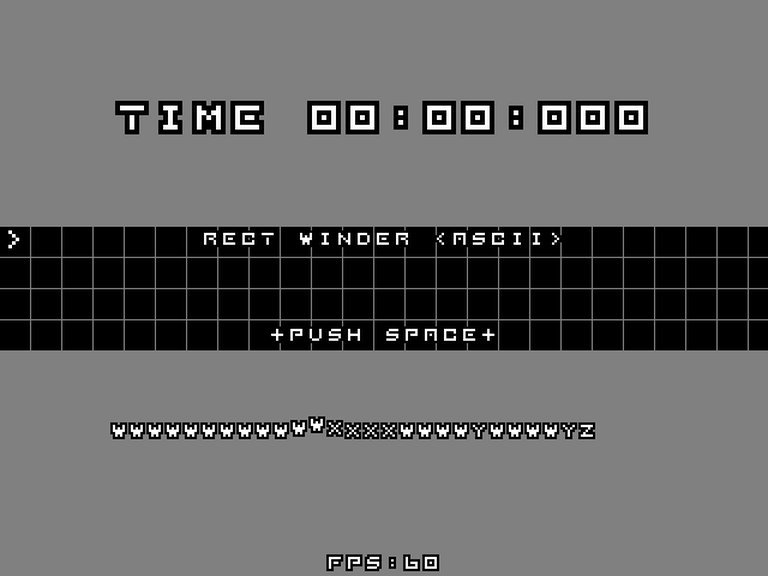
RECT WINDER (ASCII) is a minimalist arcade shooter rendered in ASCII graphics, where players control a ‘>’ symbol on a four-lane grid to strategically place ‘#’ shields that reflect laser attacks from stationary or moving letter-based enemies. With only one shield permitted and a single hit resulting in game over, the goal is to eliminate all enemies in the shortest time possible, emphasizing quick reflexes and precise timing in a stark, text-only environment.
RECT WINDER (ASCII): A Microscopic Masterpiece of Bullet-Hell Asceticism
Introduction: The Ghost in the Machine
In the vast, over-polished landscape of modern gaming, where photorealism and sprawling open worlds are the norm, there exists a spectral title that represents a deliberate, radical departure. RECT WINDER (ASCII), released on the final day of 2007 by the enigmatic “Alpha Secret Base,” is not merely an arcade shooter; it is a profound exercise in reductionist design, a game that strips the bullet-hell genre down to its atomic components. Its very existence—a high-intensity action game rendered in monochrome text characters on a Windows PC in an era ofShader 3.0 and unified memory—poses a defiant question: can sublime, punishing gameplay exist divorced from any graphical heritage? This review argues that RECT WINDER (ASCII) is not a retro curiosity but a purist’s manifesto, a game that leverages extreme constraint to forge a unique, brutally pure feedback loop of prediction, placement, and perfection. It is a monument to the idea that the most potent game mechanics are often those built from the simplest, most fundamental rules.
Development History & Context: Asceticism in a Age of Polygons
RECT WINDER (ASCII) exists at a fascinating historical crossroads. Developed and self-published by the shadowy collective Alpha Secret Base, its lineage is explicitly stated: it is “based loosely on the earlier freeware game RECT WINDER.” This reveals a key aspect of its context—the enduring, vibrant culture of the Japanese doujin (self-published) game scene, where small teams or individuals prototype and refine mechanics in obscurity, often years before a “definitive” version emerges. The 2007 release date is pivotal. This was not the 1980s, where ASCII was a necessity due to hardware limitations. This was the era of the Xbox 360 and PlayStation 3, when BioShock and Mass Effect were redefining narrative scope. For Alpha Secret Base to choose ASCII in 2007 was not an act of technological compromise, but a deliberate aesthetic and philosophical stance. It aligns with a small but potent movement of “neo-ASCII” or “text-mode” development—a conscious return to the wellspring of early computer art to focus on gameplay purity. The alleged Reddit rumor that the developer “coded it with binary in notepad,” while almost certainly apocryphal, captures the mythos surrounding such projects: a lone hacker, merging with the machine at the most fundamental level of 1s and 0s, creating a functional game from the rawest data. This places RECT WINDER (ASCII) in a direct lineage with the classic ASCII Roguelikes (Rogue, NetHack) and early shooters, but filters that lineage through a modern sensibility of razor-sharp, short-form challenge.
Narrative & Thematic Deep Dive: The Elegance of Absence
To speak of “narrative” in the conventional sense for RECT WINDER (ASCII) is to misunderstand its core. There is no story, no characters, no dialogue, no diegetic world. The “field” is an abstract grid. The player is a >; enemies are letters (A, B, C, etc.). The only “theme” is absolute, mechanistic conflict. However, this vacuum is itself a profound narrative statement. The game embodies the thematic principles of minimalism and pure system. It reflects a world-view where problems are reducible to patterns and solutions to precise inputs. The thematic deep dive, therefore, must be into the meta-narrative of game design itself. RECT WINDER (ASCII) posits that drama, tension, and triumph need not emerge from story but from the elegant interplay of a few immutable rules. The “plot” is the player’s desperate attempt to map enemy fire patterns and shield cooldowns in their mind’s eye. The “character arc” is the journey from fatal confusion to reflexive mastery. The game’s stark visual language forces the player to project strategy onto the void, making the player’s cognitive adaptation the true, unstated narrative. It is the story of a mind learning to see the matrix.
Gameplay Mechanics & Systems: The Calculus of the Hash Sign
The genius of RECT WINDER (ASCII) lies in its deceptively simple yet brutally interlocking mechanics.
- Core Loop & Lanes: The player’s
>is confined to the left edge, able to shift between four horizontal “lanes.” Movement is likely binary (up/down between lanes). The arena is a discrete grid. This lane-based system is a foundational abstraction, reducing spatial awareness to a 1D positioning problem on a 2D plane. - The Bullet Reflect Mechanic: This is the game’s soul. Pressing a button places a
#(hash) shield one square to the right of the player’s current position. This shield can intercept a single laser beam, nullifying it and instantly causing it to reverse direction, now traveling rightward as a player-controlled projectile. This transforms defense into offense. The mechanic creates a brilliant risk-reward calculus: do you place the shield preemptively to handle an expected shot, or reactively to a laser already on screen? The shield’s position—one lane ahead—creates immediate tactical tension. You are always placing it in front of you, committing to a defensive (and offensive) line that you must then vacate by moving. - The One-Shield, One-Life Rule: These two constraints are what elevate the game from interesting to merciless.
- One Shield: You can have only one
#active. Placing a new one removes the old. This prevents “safe” setups and forces constant, dynamic repositioning. You cannot create a permanent barrier; you must perpetually manage your only resource. - One Hit Death: A laser striking the
>is immediate, final failure. This eliminates the concept of a health bar, making every frame, every lane, a life-or-death decision. It enforces hyper-vigilance and perfect execution.
- One Shield: You can have only one
- Enemy Patterns & Victory Condition: Enemies (letters) appear in “set patterns,” either stationary or moving. Their laser fire is the primary threat. The goal is to destroy all enemies by reflecting their own shots back at them. The remaining enemy count is displayed, providing a constant, daunting tally. The “shortest time possible” objective adds a secondary layer of pressure, pushing players to optimize shield bounces to chain kills, rather than simply survive.
Systems Analysis: This is a game of pattern recognition under extreme pressure. The systems are flawless in their interconnectedness. The shield cooldown (implied by placement latency), enemy shot timings, and lane switching create a puzzle where the solution is a sequence of placements and moves. It’s a real-time, physicalized logic puzzle. The lack of a health bar means the game state is binary: alive or dead. This binary nature is its greatest strength and barrier to entry; it offers no quarter, but also no dilution of its core challenge.
World-Building, Art & Sound: The Aesthetic of the Terminal
Here, RECT WINDER (ASCII) makes its most audacious statement. In 2007, its world is the command prompt. The “setting” is a monochrome (presumably green or white on black) grid, defined by the fixed-width geometry of ASCII characters. The > player, the # shield, the letter enemies—these are not sprites; they are semiotic entities. Their meaning is learned instantly through convention (a greater-than sign points right, a hash is a solid block). The visual “direction” is purely functionalist. There is no atmosphere in a traditional sense—no mist, no crumbling ruins—because there is no world. The atmosphere is the sterile, clinical space of the codex.
Sound design, per the sources, is unmentioned, implying either a minimalist electronic soundtrack or, more likely, the classic retro approach of simple, generated beeps and bloops for actions (shield place, laser fire, enemy death). This audio would complement, not distract from, the visual austerity.
This aesthetic choice is a powerful filter. It demands the player engage with the pure topology of the challenge. The brain parses not a pretty hazard, but a data point (A at lane 3, firing in 0.5s). It connects the game directly to its ancestral home: the hacker’s terminal, the first MUDs, the original Rogue. Its beauty is not in the imitation of reality, but in the clarity of its symbols. Every element is visible, every threat is a clear character on a grid. There is no visual “noise” to obscure the mechanical truth. This is the ultimate expression of the “Art Through Constraint” philosophy described in the ASCII article: with 96 characters, you build not a picture, but a playable diagram.
Reception & Legacy: The Cult of the Obscure
By any commercial or mainstream critical metric, RECT WINDER (ASCII) is a non-entity. MobyGames records a single player rating of 4.0 out of 5, with zero written reviews. It was a self-published, niche Windows title with a tiny distribution footprint. Its immediate reception was, for all historical record, silence.
Yet, its legacy is not in sales or awards, but in ideological resonance. It is a key artifact in the 2000s/2010s movement of “neo-retro” and ” minimalist indie” design. While games like Dwarf Fortress (2006) used ASCII for vast, complex simulation, RECT WINDER (ASCII) uses it for arcade purity. It prefigures—or perhaps runs parallel to—the explosion of “ultra-hard” precision platformers and bullet-hells that value mechanical depth over graphical fidelity. Its core loop of “place shield, reflect shot” is a cousin to the parry systems of later games like Dead Cells or the bomb mechanics in classic Touhou titles, but distilled to a single, binary interaction.
Its influence is likely indirect, felt in the DNA of developers who value constraints as a creative force. It stands as a direct descendant of Rogue and Hunt the Wumpus, proving that the text-mode ethos was not a dead language of the 80s, but a living dialect that could still be spoken with revolutionary clarity in 2007. It is a testament to the fact that the tools of the 1970s could still produce experiences of breathtaking modernity, if wielded with sufficient vision and rigor.
Conclusion: A Perfect, Isolated Mechanic
RECT WINDER (ASCII) is not for everyone. Its lack of hand-holding, its instant-death cruelty, and its deliberately archaic visuals are barriers to accessibility. But to judge it by those standards is to miss the point entirely. It is a game that earns its austerity. Every rule, every visual limitation, is in service of a single, exquisitely tuned moment-to-moment experience.
It is a flawless gem of game design: a tiny, self-contained system where player skill, pattern memory, and calm under pressure are the only currencies. It demonstrates that lavish art assets and complex narratives are not prerequisites for engagement; sometimes, the most profound interaction is between a player’s forebrain and a grid of flashing characters. Its near-total obscurity is a loss for game history, but also a purity of its own. RECT WINDER (ASCII) is not a game that sought an audience; it is a game that defined its own universe on its own uncompromising terms. It is a vital, quiet monument to the power of the idea, executed with the cold precision of a line of code.
Final Verdict: 9/10 – An indispensable study in mechanical purity. Its obscurity is its only flaw.