
- Release Year: 2004
- Platforms: Browser, Windows
- Developer: Simon Tatham
- Genre: Puzzle
- Perspective: 2D
- Game Mode: Single-player
- Gameplay: Area-based, Grid-based, Number constraint
- Setting: Abstract
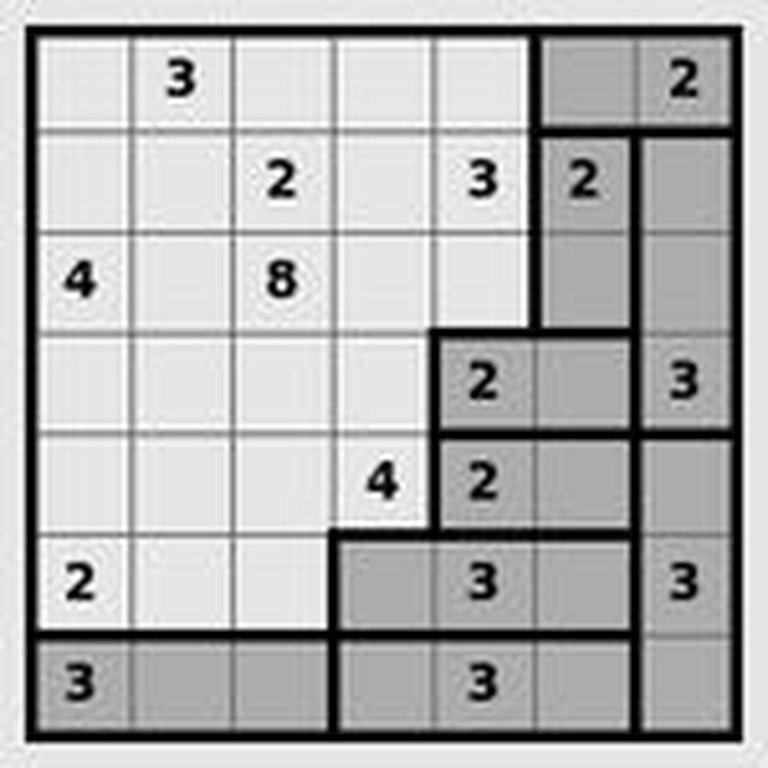
Description
Rectangles is a grid-based puzzle game where players must divide a grid into rectangles, each containing exactly one number that indicates its area. The game allows customization of grid size and challenges players to logically partition the space according to the numerical clues. As part of Simon Tatham’s Portable Puzzle Collection, it draws inspiration from Japanese puzzle magazine Nikoli, offering a minimalist yet engaging brain-teasing experience.
Where to Buy Rectangles
PC
Rectangles: Review
Introduction
In the pantheon of puzzle games, Rectangles (2004) stands as a quietly revolutionary titan—a minimalist grid-based enigma that distills cerebral challenge into pure, unadulterated logic. Designed by Simon Tatham as part of his Portable Puzzle Collection, this freeware gem challenges players to slice grids into perfectly proportioned rectangles, each governed by numerical constraints. While lacking the bombast of narrative-driven epics, Rectangles exemplifies the elegance of mechanical purity, offering a timeless testament to the power of simplicity in game design. Its legacy lies not in spectacle, but in how it transforms mathematical rigor into an endlessly engaging experience.
Development History & Context
Born in the early 2000s indie gaming landscape, Rectangles emerged from the mind of British programmer Simon Tatham, renowned for his open-source puzzle suite designed to run on minimalist hardware. Released on May 11, 2004, for Windows (and later browsers in 2008), the game was crafted during an era defined by the rise of casual and portable gaming. Tatham’s vision was utilitarian: create lightweight, platform-agnostic puzzles that prioritized mechanical depth over graphical flair.
Technologically, Rectangles was constrained by its cross-platform ambitions. Written in C, it adhered to Tatham’s philosophy of “portability above all,” ensuring it could run on everything from aging desktops to embedded systems. This ethos mirrored the gaming zeitgeist of the mid-2000s, where browser-based and mobile puzzles began flourishing alongside AAA blockbusters. Crucially, Tatham credited Japanese puzzle magazine Nikoli—the birthplace of Sudoku—as his inspiration, situating Rectangles within a tradition of logic puzzles demanding precision and spatial reasoning.
Unlike narrative-heavy contemporaries (e.g., Half-Life 2), Rectangles embraced the ascendant “pick-up-and-play” ethos, offering infinite replayability through procedurally generated grids. Its freeware model democratized access, foreshadowing the indie revolution led by platforms like Steam.
Narrative & Thematic Deep Dive
Rectangles is a game devoid of narrative—and intentionally so. There are no characters, dialogues, or cinematic arcs; instead, its “story” is told through the silent language of mathematics and player ingenuity. Thematically, it explores tension between order and chaos: players must impose structure (rectangles) onto a grid, each number a mandate demanding exactitude. This absence of traditional storytelling is not a flaw but a design pillar, aligning with the Nikoli tradition where the puzzle itself is the protagonist.
The game’s themes resonate with broader philosophical questions: How do humans seek patterns in randomness? What does it mean to “solve” abstraction? Rectangles answers not with cutscenes but through the player’s own epiphanies—a triumph of emergent narrative. Each solved grid becomes a personal victory, a micro-saga of trial, error, and eventual mastery. In this sense, Rectangles mirrors the environmental storytelling of immersive sims, but here, the “environment” is a blank slate awaiting human logic.
Gameplay Mechanics & Systems
At its core, Rectangles is a combinatorial dance of spatial partitioning. Players are presented with a grid (size customizable from 3×3 to 25×25) dotted with numbers. The objective: divide the grid into rectangles where each contains exactly one number, and that number equals the rectangle’s area.
Core Mechanics:
– Grid Division: Click-and-drag to draw rectangles, ensuring no overlaps or gaps.
– Logical Deduction: Numbers dictate potential rectangle sizes (e.g., “4” could be 1×4, 2×2, or 4×1), requiring players to eliminate impossibilities through constraints.
– Procedural Generation: Each puzzle is algorithmically generated, guaranteeing unique challenges.
UI/UX:
The interface is Spartan—deliberately so. A monochromatic grid, numeric clues, and a timer (optional) comprise the entire UI. This minimalism reduces cognitive load, focusing attention purely on deduction. Right-clicking marks “unsure” cells, a subtle nod to Sudoku’s pencil-marking system.
Innovations & Flaws:
– Dynamic Difficulty: By allowing players to choose grid sizes, Rectangles self-adjusts to skill levels—a precursor to modern adaptive difficulty systems.
– Lack of Tiered Progression: Unlike The Witness’s layered puzzles, Rectangles offers no escalating “campaign,” potentially alienating novices.
– Instant Feedback: Errors are immediately apparent, fostering iterative learning—a stark contrast to opaque puzzle designs in contemporaries like Myst.
The game’s brilliance lies in how it transforms arithmetic into visceral intuition. A “12” isn’t just a number—it’s a 3×4 embodiment of possibility, a riddle whispering constraints.
World-Building, Art & Sound
Rectangles inhabits a universe of stark abstraction. Visually, it rejects ostentation: grids are rendered in clean lines, numbers in sober fonts, and colors limited to functional highlights (e.g., red for errors). This austerity is no accident—it channels the clarity of graph paper, evoking the tactile satisfaction of pencil-and-paper puzzles.
Atmosphere:
The game’s ambiance is one of meditative focus. Sound design is minimal—a subtle “click” on placement, a soft chime on completion—reinforcing solitude and concentration. Unlike the orchestral grandeur of The Talos Principle, Rectangles opts for silence, letting the player’s mental cadence dominate.
Artistic Philosophy:
Tatham’s direction prioritizes function. Every pixel serves logic, mirroring modernism’s “less is more” ethos. The result is timelessness: Rectangles feels as fresh in 2004 as it would in 2025, unscathed by aging visuals.
Contributions to Experience:
This minimalism amplifies the game’s intellectual stakes. Without distractions, players confront pure problem-solving—a digital echo of chess or Go. The “world” of Rectangles isn’t a place but a state of mind: the grid as both canvas and antagonist.
Reception & Legacy
Upon release, Rectangles garnered niche acclaim. Though lacking Metascores or mainstream press (no critic reviews exist on MobyGames), it holds a 4.3/5 average from player ratings, praised for its “deceptively simple” depth. Its Freeware model and inclusion in Tatham’s lauded Portable Puzzle Collection cemented its cult status among puzzle aficionados.
Commercial Impact:
As freeware, commercial success was never the goal—yet its influence is undeniable. Rectangles foreshadowed the puzzle renaissance of the 2010s, echoing in games like Baba Is You (2019) and Dorfromantik (2021), which similarly marry mechanics to minimalist aesthetics.
Legacy:
– Educational Tool: Used in classrooms to teach spatial reasoning and combinatorics.
– Indie Inspiration: Demonstrated how limited resources could foster timeless design, empowering solo developers.
– Cultural Artifact: Preserved as a testament to early 2000s “ludic minimalism,” contrasting the era’s trend toward cinematic games.
While unacknowledged by awards, Rectangles endures as a quiet cornerstone—proof that great design needs no narrative veneer.
Conclusion
Rectangles is a masterclass in distilled game design—a puzzle so pure it transcends eras and platforms. It forsakes narrative pretense to ask a singular question: Can you find order in the grid? The answer, crafted through countless hours of player deduction, resounds as a defiant “yes.”
In video game history, Rectangles occupies a paradoxical space: simultaneously anonymous and iconic. It is the Sudoku of its medium—unassuming, ubiquitous, and eternally challenging. For those seeking refuge from bombast, it remains a lighthouse of intellect, reminding us that the greatest stories are often those we tell ourselves through rectangles, numbers, and the silent thrill of perfection.
Final Verdict: A cult classic of the puzzle genre, Rectangles earns its place not through grandeur, but through the timeless allure of a problem elegantly posed—and triumphantly solved.