
- Release Year: 1998
- Platforms: Windows
- Publisher: Sierra On-Line, Inc., Sold Out Sales & Marketing Ltd.
- Developer: Dynamix, Inc.
- Genre: Simulation
- Perspective: 1st-person, Behind view
- Game Mode: LAN, Online PVP, Single-player
- Gameplay: Career mode, Combat flight, Damage modeling, Flight Simulation, Historical missions, Multiplayer dogfights, Realistic Physics
- Setting: Historical events, World War I
- Average Score: 65/100
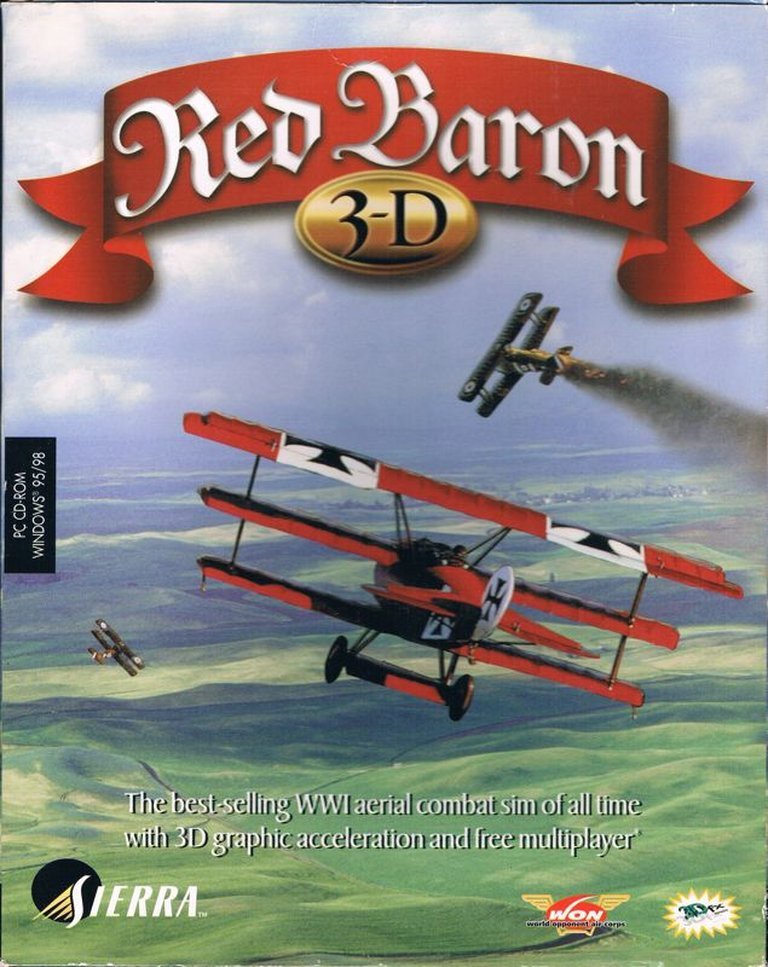
Description
Red Baron 3-D is a World War I combat flight simulation that serves as an enhanced version of Red Baron II, featuring significant improvements in 3D graphics and flight models. Set in the historical context of aerial warfare during the Great War, players can pilot 22 authentic aircraft from French, British, German, and American forces in single-player campaigns or instant missions, as well as engage in multiplayer dogfights supporting up to 100 opponents via online services, capturing the atmosphere of early aviation combat.
Gameplay Videos
Red Baron 3-D Free Download
Red Baron 3-D Patches & Updates
Red Baron 3-D Mods
Red Baron 3-D Reviews & Reception
en.wikipedia.org (65/100): a fine addition to the series, and despite small, technical shortcomings, it establishes itself as one of the most entertaining flight experiences on the market today.
Red Baron 3-D: The Phoenix of the Western Front
Introduction: The Poisoned Chalice Redeemed
In the annals of PC gaming, few titles have a story quite like Red Baron 3-D. It is the ultimate case study in a studio’s reputation salvaged not by a new project, but by a monumental act of remediation. Born from the wreckage of the critically panned Red Baron II (1997), this 1998 release represents one of the most dramatic post-launch turnarounds in genre history. As a simulation, it is a historian’s dream and a pilot’s trial; as a product, it is a testament to the power of dedicated patching and a community’s refusal to let a gem stay buried. This review will argue that Red Baron 3-D is not merely a “fixed” game, but the definitive evolution of the Red Baron legacy—a flawed, demanding, and profoundly immersive simulation that captures the terror, exhilaration, and brutal authenticity of World War I air combat better than any game before or since its release. Its significance lies in its synthesis of a deep, dynamic campaign, a brutally honest flight model, and an emergent narrative structure that places the player squarely in the leather-bound cockpit of history.
Development History & Context: From Scandal to Salvation
To understand Red Baron 3-D, one must first confront the disaster of Red Baron II. Developed by Dynamix—a studio with a storied pedigree in simulation titles like Aces of the Pacific and Earthsiege—and published by Sierra On-Line, Red Baron II arrived in December 1997 with immense hype. It promised to be the true successor to the beloved 1990 original. However, it launched in a state that modern audiences would call “early access at its worst.” It was plagued by bugs, a broken multiplayer function, lack of 3D accelerator support (a critical failing in 1997-’98), and a flight model many felt was unsatisfying. Reviews were middling to poor (a 65% aggregate on GameRankings), and the franchise’s credibility lay in tatters. The project’s director was Tucker Hatfield, with Graeme Bayless producing and Brian Apgar as lead engineer—a team that would labor extensively to repair their creation.
The context of 1998 is crucial. The flight simulation genre was at a crossroads. MicroProse’s European Air War (1998) was setting new standards for graphics and depth in the WWII arena. For WWI sims, the field was narrower, with titles like Dawn Patrol and Knights of the Sky being older or less sophisticated. The technological constraint was the 3D accelerator wars: 3dfx’s Glide API dominated the high-end market, while Direct3D was a struggling alternative. Red Baron II was a software-rendered dinosaur upon release. Dynamix’s response was not a new game, but a herculean patch. The “1.0.7.7” patch, released in October 1998 and branded as Red Baron 3-D, was essentially a complete overhaul. It added full Glide 3D acceleration support, reworked the flight model, fixed countless bugs, and integrated the previously broken multiplayer via Sierra’s World Opponents Network (WON). Crucially, as MobyGames trivia notes, the rebranding was a necessary commercial move to distance the product from its tarnished predecessor. This was not a sequel; it was a repentance in patch form, sold at retail and offered as a free upgrade to existing Red Baron II owners. The development history is a narrative of damage control transformed into a labor of love, with the core team (including “Flight Data Guru” Jerome Kluth) working to realize the vision they felt they had initially failed to deliver.
Narrative & Thematic Deep Dive: The War is the Story
Red Baron 3-D possesses no traditional scripted narrative with cutscenes or dialogue trees. Its genius lies in the emergent narrative generated by its core systems, which together paint a visceral, historically-grounded picture of the Great War in the air. The game’s “story” is the player’s personal journey from an anonymous rookie to a celebrated ace (or a forgotten casualty).
The Campaign Mode is the narrative heart. Set on the Western Front from 1916 to 1918, it is a dynamic, persistent war. The front lines shift based on the cumulative success of mission objectives (destroying enemy balloons, reconnaissance planes, or ground targets). Your squadron’s location, the opposing squadrons you face, and the types of missions you receive are all dictated by the state of the war. This creates a profound sense of being part of a larger conflict. As the CombatSim.com article aptly notes, “No flight sim before or since has presented a more historically immersive campaign.” The theme is one of brutal attrition and personal survival. Kills are not routine; death or severe injury is a constant, looming possibility. The manual’s extensive historical section, praised by GameGenie, reinforces this theme, grounding every mission in real tactics and the limitations of the technology.
Character progression is purely mechanical and statistical, yet deeply narrative. You start with a basic aircraft and no reputation. Success brings promotion within your squadron (from pilot to flight leader to squadron commander), decorations (like the Iron Cross or Military Cross), and the ability to request better aircraft or transfers to famous units (like Jasta 11 or the Lafayette Escadrille). The game’s system for tracking your personal dossier, with statistics on kills, missions flown, and wounds sustained, creates a biography. The dialogue is sparse—limited to pre-mission briefings and post-mission debriefings from your commanding officer—but these terse communiqués, coupled with the “summary reports” mentioned by All Game Guide, contextualize your actions within the war effort. The underlying theme is the individual’s experience within the machinery of war: you are not saving the world, you are one pilot in a sky filled with hundreds, where luck and split-second decisions determine your fate. The absence of a grand, personal villain (beyond the abstract ” Germans” or “Allies”) focuses the narrative on the nature of combat itself, not a hero’s journey.
Gameplay Mechanics & Systems: A Deep and Unforgiving Sim
Red Baron 3-D’s gameplay is a masterclass in simulated complexity that demands mastery. Its core loop—planning, flying, fighting, surviving—is enriched by several interconnected systems.
1. Flight Model: This is the game’s crowning achievement and its primary obstacle. The model, refined in the 3-D patch, simulates gyroscopic effects from rotary engines (the torque that would pull the plane into a left turn on some models), stall characteristics, and prop wash. Landings require significant practice; a wheels-up landing might be survivable, but a stall-spin near the ground is often fatal. The model is “pseudo-realistic,” as Wikipedia notes, meaning it captures the feel and key limitations of biplanes without being a full physics simulation. Each of the 22 flyable aircraft (from the fragile Morane Bullet to the powerful Fokker D.VII) handles distinctly, forcing the player to adapt tactics to their machine’s strengths and weaknesses.
2. Combat Systems: Gunnery is an art. The primitive, low-velocity .303 and 7.92mm rounds have realistic drop and travel time. Deflection shooting—leading a moving target—requires immense practice. The game models weapon malfunctions (jams), engine damage from enemy fire, and pilot injury (which can impair control). A hit to the fuel tank doesn’t always cause an instant fire; you might first see a leak, then a drop in fuel efficiency, and finally a catastrophic blaze. Critical systems like the radiator can be targeted, causing engine overheating. This layered damage system, highlighted by All Game Guide, makes every engagement a tactical puzzle, not just a shooting gallery.
3. Campaign & Mission System: The dynamic campaign is the star. It generates missions based on the war’s state: patrol the front, escort reconnaissance planes, attack enemy balloon positions (a high-risk, high-reward “balloon busting” role), or conduct ground strafing runs on troop concentrations and supply depots. The mission generator, mentioned in the Wikipedia entry, ensures variety. The AI squadrons you encounter are not static; they have their own patrol routes and objectives, leading to unpredictable “furballs.” As GameSpot‘s review states, the AI is “challenging and unpredictable.”
4. Multiplayer: For its time, the support for up to 100 players in a single dogfight via the WON network was staggering. It transformed thegame from a solitary trial into a chaotic, player-driven recreation of the Western Front. While finding full games years later is impossible, at launch it was a landmark feature, directly enabled by the 3-D patch.
5. User Interface & Customization: The UI is utilitarian but informative. The cockpit is fully modeled (with optional “glass” or “no glass” modes for visibility), and a wide array of adjustable camera angles (including external “chase plane” views) aid navigation. The options menu is exceptionally deep, offering controls for texture detail, levels of detail (LOD), shadows, and realism sliders that can toggle everything from wind effects to weapon jamming. This level of customization, from All Game Guide‘s “dozens of game options,” allows players to tailor the experience from a hardcore simulation to a more casual arcade-style game.
Innovations & Flaws: The primary innovation was the fusion of a deep, dynamic campaign with a flight model of unprecedented authenticity for a WWI sim. The major flaw, even after the patch, was the terrain and static object detail. As GameStar (Germany) and Squakenet harshly noted, the ground textures are simplistic (“wabern”), and structures are basic polygons. This “emptiness” can break immersion when flying low. However, this weakness became the community’s greatest opportunity.
World-Building, Art & Sound: Atmosphere Through Authenticity
The setting is the sky over a reconstructed Western Front. The game world covers over 40,000 square miles, based on topographic maps (GamePressure.com). While the high-resolution terrain textures are lacking (a point of frequent modding), the layout is historically sound. You recognize the arcs of the trenches, the locations of key towns, and the geography of places like the Somme and Verdun. This geographical accuracy, more than graphical fidelity, sells the setting.
The art direction prioritizes aircraft authenticity over environmental dazzle. The 22 flyable planes and 18+ AI-only types are modeled with accurate dimensions, markings, and color schemes for different nations and time periods. The cockpits, while low-poly, are functional and recognizable. The true artistic achievement is in the skins and detail mods created by the community post-launch (as chronicled by CombatSim.com), which added wing wires, fabric textures, and animated rotary engines, bringing the visuals into the 2000s.
The sound design is a critical component of immersion. The roar and throb of different rotary and inline engines are distinct and powerful. The crack of machine gun fire is sharp and immediate. The sound of a bullet hitting your own plane’s fabric skin—a dull thwack—is a heart-stopping audio cue. The Miles Sound System (noted in PCGamingWiki) delivers these effects with clarity. The manual’s historical text and the sparse, period-appropriate UI sounds further build the 1916-1918 atmosphere. You are not in a sleek, silent jet; you are in a vibrating, noisy, open-cockpit machine.
Reception & Legacy: The Cult Classic That Endured
At Launch (1998): The critical reception for Red Baron 3-D was a dramatic reversal from its predecessor. While Red Baron II struggled (PC Gamer UK: 53%), Red Baron 3-D achieved an 84% critic average on MobyGames. Reviews were glowing in their praise for the campaign and simulation depth. GameSpot (9/10) declared it “the best World War I simulation yet,” only slightly edged out by European Air War. Computer Gaming World (4.5/5) noted it was “the game RED BARON II should have been.” The Cincinnati Enquirer review captured the sentiment perfectly: “If you’re tired of Sidewinder missiles… you owe it to yourself to rough it in the skies of the early 1900s.” The few dissenting voices, like GameStar (78%), focused squarely on the dated graphics engine and its Glide dependency—technical nitpicks in the eyes of sim purists.
Long-Term Legacy: Red Baron 3-D‘s legacy is twofold. First, it stands as the pinnacle of the WWI flight sim genre on PC. For over two decades, no commercial title has seriously attempted to challenge its depth in dynamic campaign and flight modeling. Second, and more remarkably, it fostered one of the most dedicated and long-lived modding communities in simulation history. As the 2003 CombatSim.com article, “The Baron is Back!”, detailed, user development was still thriving five years post-release, with major mods like “Beery’s Super Patch,” “Hell’s Angels,” “Revenge of the Jastas II,” and photorealistic terrain mods (“Promised Land,” “On the Edge”) pushing the game far beyond its original specifications. Modders corrected historical inaccuracies, added aircraft, overhauled flight models (e.g., Panamanian Red’s work), and created entirely new campaigns. The community hubs it listed—Wings of Valor, Society of WWI Sim Artisans, Cage’s World—were vital nodes of preservation and enhancement.
Its influence is intangible but real; it set a benchmark for historical authenticity and campaign dynamism that later sims in other eras (like IL-2 Sturmovik‘s later Dynamic Campaign Generator) would strive toward. It proved that a dedicated fanbase could keep a technically obsolete game not just alive, but relevant. The 2009 re-release in the Red Baron Pack on GOG and Steam, which includes the game pre-patched and ready for modern systems via community wrappers like OpenGlide, is a direct result of this enduring love.
Conclusion: A Scarred Masterpiece
Red Baron 3-D is not a perfect game. Its graphics, even with Glide acceleration, are dated and sparse. Its interface is functional but dated. It can be brutally, unfairly difficult. It was born from a failure and bears the scars of its rushed, compromised origin. Yet, to dismiss it for these reasons is to miss its monumental achievements. It delivers an unparalleled simulation of historical experience. The combination of its unforgiving flight model, its layered damage systems, its dynamic and historically-rooted campaign, and its sheer variety of authentic aircraft creates an ecosystem where every flight is a story.
It is the ultimate “simulator’s simulator” for the World War I air war. It does not hold your hand; it demands you learn the rhythms of a Sopwith Camel just as a real pilot would. It makes you feel the weight of history not through scripted drama, but through the systemic pressure of a shifting front line and the constant, mortal danger from every direction. In the hierarchy of flight sims, Red Baron 3-D is a unique artifact: a commercial product saved by its developers and then elevated by its community into a timeless, if technically quaint, monument to the first knights of the sky. For those willing to climb into its cockpit and endure its harsh lessons, it offers an experience no other game has ever replicated: the true, terrifying, and glorious sensation of being a pilot in the First World War. Its place in history is secure—not as a best-seller, but as the definitive, enduring phoenix of the Western Front.