
- Release Year: 2011
- Platforms: Windows
- Publisher: 1C Company, Lace Mamba Global Ltd., Tripwire Interactive, LLC
- Developer: Tripwire Interactive, LLC
- Genre: Action
- Perspective: First-person
- Game Mode: Online PVP, Single-player
- Gameplay: Bleeding Mechanics, Class-based Roles, Cover System, Morale system, Rank Progression, Realistic Ballistics, Tactical Command
- Setting: Stalingrad, World War II
- Average Score: 63/100
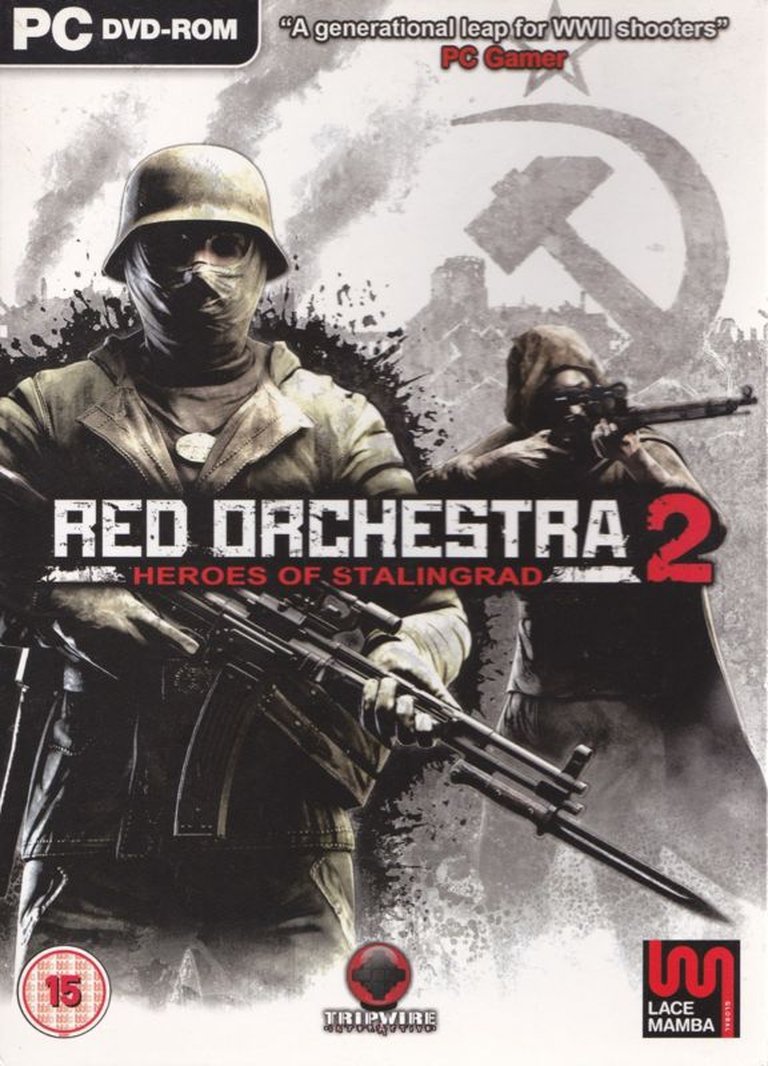
Description
Red Orchestra 2: Heroes of Stalingrad is a multiplayer first-person shooter set during the Battle of Stalingrad in World War II, emphasizing realism with instant kills, realistic weapon handling, and a slower, tactical gameplay pace. The game features unique mechanics like limited class availability, delayed respawns, and a morale system, along with three multiplayer modes and single-player campaigns with AI-controlled opponents.
Gameplay Videos
Where to Buy Red Orchestra 2: Heroes of Stalingrad
PC
Red Orchestra 2: Heroes of Stalingrad Cracks & Fixes
Red Orchestra 2: Heroes of Stalingrad Mods
Red Orchestra 2: Heroes of Stalingrad Guides & Walkthroughs
Red Orchestra 2: Heroes of Stalingrad Reviews & Reception
metacritic.com (76/100): Red Orchestra 2 spoils you. Playing any other shooter, especially one that claims to be realistic, after going through a few rounds in RO2 is bound to be a disappointment.
pcgamer.com (85/100): Red Orchestra 2 is the best murder simulator I’ve ever played… in the killing, and in the being killed, Red Orchestra 2 is a terrifying and satisfying experience.
gamewatcher.com : Red Orchestra 2 was developed by a team of exorcists… the commitment to authenticity is visible in a more general sense too.
howlongtobeat.com (30/100): Red Orchestra 2: Heroes of Stalingrad is a fine historical first person shooter. It is covered in bugs that cause crashes and bizarre Ai movements.
Red Orchestra 2: Heroes of Stalingrad Cheats & Codes
PC
Enter commands in the in-game console (press ~ to open).
| Code | Effect |
|---|---|
| Add bots (number) | Add X number of bots |
| Killbots | Eliminates bots |
| Suicide | Kill player |
| Behindview 1 | Switches to 3rd person view |
| Behindview 0 | Switches to 1st person view |
| Quit | Quits game |
| Exit | Closes game |
| Switchteam | Changes players team |
| Playersonly | Freezes bots |
| QuickLoad | Load the save game created by the QuickSave exec function. |
| QuickSave | Create a save game for the game in progress. |
| RestartLevel | Restarts the current level. |
| Switchlevel (mapname) | Changes to level named |
| Open (mapname) | Opens named map |
| AffectedByHitEffects | Makes the player immune to all hit effects (i.e., momentum, hit ef |
Red Orchestra 2: Heroes of Stalingrad: Review
Introduction
In an era dominated by hyper-arcade shooters like Call of Duty and Battlefield, Red Orchestra 2: Heroes of Stalingrad emerged as a defiant anachronism. Released in September 2011 by Tripwire Interactive, this sequel to the cult-classic Red Orchestra: Ostfront 41-45 doubled down on uncompromising realism, immersing players in one of World War II’s most brutal campaigns: the Battle of Stalingrad. While its contemporaries prioritized accessibility, Heroes of Stalingrad demanded patience, teamwork, and a tolerance for suffering. Yet beneath its technical flaws and underwhelming singleplayer lay a multiplayer experience so viscerally authentic that it redefined tactical shooters. This review argues that despite its rocky launch, Red Orchestra 2 stands as a landmark achievement in simulating the psychological and physical horrors of war, leaving an indelible mark on the genre.
Development History & Context
Tripwire Interactive, a studio founded by modders who cut their teeth on the Unreal Tournament 2003 mod Red Orchestra, approached Heroes of Stalingrad with a singular vision: to create the most authentic WWII shooter ever conceived. Development began in 2009, leveraging the Unreal Engine 3 to render detailed environments and ballistics. The team prioritized historical accuracy over spectacle, eschewing cinematic set pieces for meticulous recreations of Stalingrad’s ruins, winter forests, and industrial complexes. This focus was a deliberate response to the genre’s trend toward modern settings—a 2011 landscape dominated by Call of Duty: Black Ops and Battlefield 3, both of which traded historical nuance for streamlined action.
Technologically, the game pushed PC hardware, demanding robust systems to handle its 64-player battles, complex vehicle physics, and dynamic destruction. Tripwire faced unique challenges: balancing realism with playability, optimizing Unreal Engine 3 for large-scale infantry and tank engagements, and crafting a progression system that rewarded skill without alienating newcomers. The studio’s commitment to modding—releasing the Steam Development Kit (SDK) in 2012—reflected its roots in the mod community, fostering a dedicated player base that would sustain the game for years. Despite these ambitions, the 2011 launch was hampered by crippling bugs, frequent crashes, and abysmal singleplayer AI issues, leading to criticism that Tripwire had “bitten off more than they could chew” (Gamepyre).
Narrative & Thematic Deep Dive
Red Orchestra 2’s narrative is intentionally sparse, serving as a framing device for its multiplayer chaos rather than a driving force. The singleplayer campaigns—German and Soviet—play out as bot-filled multiplayer matches bookended by animated historical vignettes. The German campaign, for instance, presents an alternate history where the Wehrmacht holds Stalingrad, framing the conflict as a desperate defense against a “red plague” (TV Tropes). Dialogue is minimal, limited to grunted commands and battlefield cries (“For my brother!” in Russian; “That was for my comrade!” in German). While this approach emphasizes immersion over storytelling, it also results in a hollow experience: soldiers lack names or personalities, and objectives feel like abstract checklist completions.
The game’s true narrative strength lies in its thematic underpinnings. Mechanisms like the suppression system—where bullets drain color from the screen and shatter focus—encapsulate the psychological toll of combat. Soldiers bleed out if wounds aren’t bandaged, and dying characters scream for mothers, underscoring War Is Hell (TV Tropes). As scholar Maxim Tvorun-Dunn notes, this embodies “social realism,” using gameplay to reflect war’s dehumanizing brutality. The absence of kill confirmations, friendly name tags in Realism mode, and the requirement to manually track ammo fosters paranoia and uncertainty, mirroring the fog of war. Even the progression system reinforces themes of attrition: leveling up classes and weapons rewards persistence, but veteran players’ worn uniforms and upgraded gear visually signify the cost of survival.
Gameplay Mechanics & Systems
Red Orchestra 2’s gameplay is a masterclass in systemic depth, albeit one with a steep learning curve. Combat revolves around ballistics modeled with obsessive detail: bullet drop, spin, and penetration require players to adjust aim for distance and cover. Weapons behave realistically; machine guns must be deployed to stabilize fire, and bolt-action rifles demand careful chambering. The game’s signature “one-hit kill” philosophy—where most shots are instantly fatal—demands tactical caution. Health does not regenerate; players must bandage wounds to stanch bleeding, adding a layer of vulnerability absent in most shooters.
The class system enforces team cohesion. Limited slots per role (e.g., only two Commanders per team) prevent class stacking and encourage specialization. Riflemen form the backbone, while Machine Gunners suppress enemies, Engineers breach defenses with satchel charges, and Commanders coordinate artillery strikes. The Commander and Squad Leader roles are particularly crucial: Commanders call in recon and bombardments, while Squad Leaders spawn teammates and mark targets, turning individual skirmishes into coordinated operations.
Vehicles add another dimension of depth. Tanks like the German Panzer IV and Soviet T-34 feature fully modeled interiors, requiring dedicated drivers, gunners, and hull machine-gunners. Tripwire’s president, John Gibson, noted these tanks “rival or exceed tank simulation games” (Wiki), though their scarcity on maps (only two at launch) limited their impact. The cover system, while rudimentary by modern standards, allowed players to blind-fire from obstacles, though smaller objects offered partial protection—a mechanic that rewarded positional awareness.
Progression ties into gameplay through the Honor system. As players earn points for kills and objectives, they unlock higher-tier classes (e.g., Elite Riflemen) and weapon upgrades like bayonets, drum magazines, or scopes. While these provide marginal stat boosts (reduced recoil, faster reloads), they never unbalance the experience, skill remaining the primary determinant of success. Game modes include Territory (capture-and-hold objectives), Countdown (single-life objectives), and Firefight (team deathmatch), though the latter felt incongruent with the game’s tactical ethos.
World-Building, Art & Sound
Red Orchestra 2’s world-building is a triumph of atmospheric authenticity. Maps like Pavlov’s House—a bombed-out apartment complex—and Grain Elevator recreate Stalingrad’s claustrophobic urban warfare, with rubble-strewn streets and bullet-pocked walls inviting tactical engagement. Winterwald’s snow-laden forests and Mamayev Kurgan’s hillside trenches evoke the Eastern Front’s brutal winters, while subtle details—like propaganda posters or discarded helmets—ground the setting in historical reality.
Artistically, Unreal Engine 3 delivers a gritty, monochromatic palette that mirrors war’s drabness. Character models gain wear and tear as they rank up, uniforms becoming increasingly frayed and bloodstained. Weapon animations are equally meticulous: reloading a Kar98k reveals whether the new magazine is full or empty, and switching between iron sights and scopes feels tactile. Though criticized for “matschy textures” (4Players.de), the art excels in conveying scale and destruction, especially in maps like Red October Factory, where industrial machinery becomes cover.
Sound design is arguably the game’s crowning achievement. Weapons boast distinct, deafening reports that echo across maps, while artillery thuds and grenade concussions induce visceral panic. Composer Sam Hulick’s dynamic score—separate for German and Soviet factions—swells during assaults and recedes into silence during lulls, heightening tension. Voice acting, initially in English, was patched to include native languages, amplifying immersion. Soldiers bark commands in Russian or German, and dying gasps (“Mama!”) underscore the human cost, creating a soundscape that is both immersive and harrowing.
Reception & Legacy
Red Orchestra 2 launched to mixed but generally favorable reviews, holding a Metacritic score of 76. Critics lauded its realism and immersion but lambasted its technical issues. GameSpy awarded it 90%, calling it “the definitive hardcore FPS,” while GameSpot (7.5/10) praised the multiplayer but criticized the “uninteresting” singleplayer and “frequent crashes.” Players were similarly divided, with Metacritic’s user score hovering at 7.3, praising depth but lamenting the “steep learning curve” and “broken XP system” (PC Gamer).
Tripwire’s post-launch support was pivotal. Patches fixed bugs, optimized performance, and even removed the singleplayer campaign (which was widely derided for “terrible AI” that ran in circles or ignored enemies). The 2013 standalone expansion Rising Storm, shifting the Pacific Theater with asymmetric U.S.-Japan gameplay, revitalized the community. Its success spawned Rising Storm 2: Vietnam (2017), cementing the series’ legacy in tactical realism.
Red Orchestra 2’s influence extends beyond sequels. It popularized the “realistic shooter” subgenre, inspiring titles like Squad and Insurgency: Sandstorm. Its emphasis on suppression, class roles, and team-based strategy became a blueprint for hardcore multiplayer experiences. Even its flaws—particularly the initial bugs—served as a cautionary tale for studios prioritizing innovation over polish. Today, it endures as a cult classic, with dedicated servers and mods like Heroes of the West keeping its legacy alive.
Conclusion
Red Orchestra 2: Heroes of Stalingrad is a flawed masterpiece—a game that stumbled out of the gate but ultimately redefined what a WWII shooter could be. Its singleplayer is an afterthought, its launch was marred by technical gremlins, and its uncompromising realism will alienate casual players. Yet in its multiplayer, Tripwire crafted something transcendent: a simulation of war not as a heroic spectacle, but as a grueling, terrifying exercise in survival. The thrill of a well-aimed rifle shot, the camaraderie of holding a position with your squad, the dread of hearing footsteps in a ruined apartment—these moments are unparalleled in tactical gaming.
Red Orchestra 2 is not merely a game; it’s an artifact of a bygone era when PC gaming still catered to niche, passionate audiences. Its legacy is one of ambition and perseverance—a testament to the idea that when realism and gameplay align, the results can be as brutal as they are unforgettable. For those willing to endure its harshness, Heroes of Stalingrad offers not just entertainment, but a profound, unforgettable glimpse into the chaos of war.