
- Release Year: 1998
- Platforms: DOS, Macintosh, Windows
- Publisher: Interplay Entertainment Corp., Mallard Outdoor
- Developer: Xatrix Entertainment, Inc.
- Genre: Action
- Perspective: 1st-person
- Game Mode: Single-player
- Gameplay: Hunting
- Setting: Wilderness
- Average Score: 35/100
Description
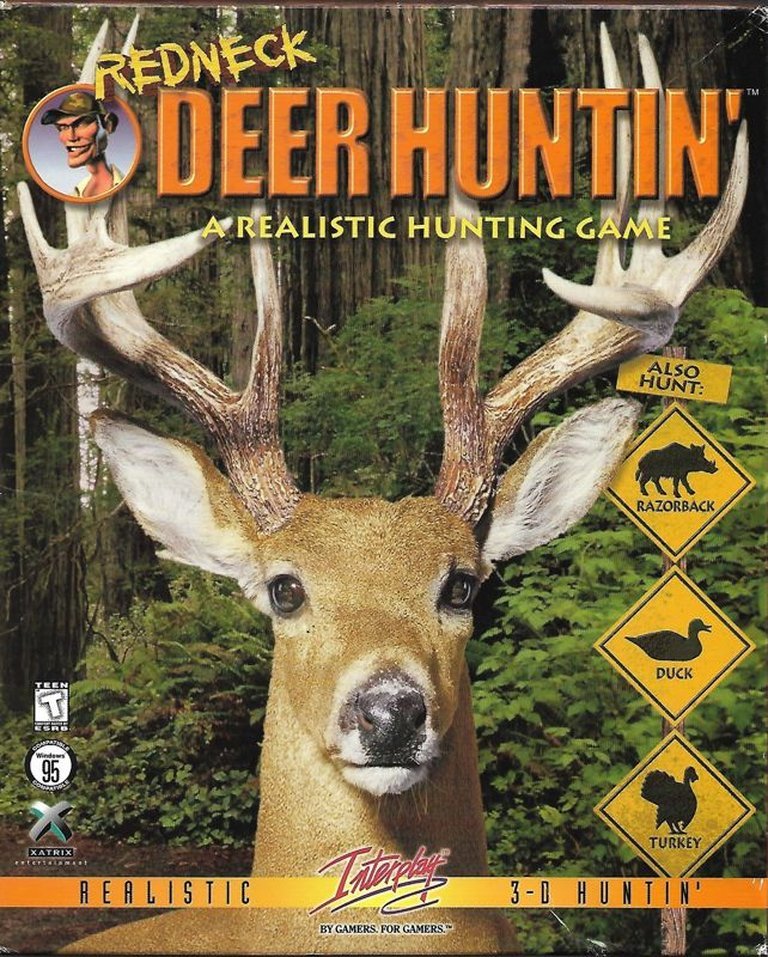
Redneck Deer Huntin’ is a first-person hunting game set in 8 acres of wilderness in redneck country, where players join Leonard, a redneck native, to hunt deer, ducks, razorbacks, and wild turkeys using various weapons. This title delivers a humorous take on realistic hunting with attitude, emphasizing patience, calling, and baiting mechanics amid the Redneck Rampage series style.
Gameplay Videos
Where to Buy Redneck Deer Huntin’
PC
Redneck Deer Huntin’ Free Download
Redneck Deer Huntin’ Guides & Walkthroughs
Redneck Deer Huntin’ Reviews & Reception
en.wikipedia.org : The game received generally very negative reviews.
gamepressure.com (39/100): From the technical side, the program looks very poorly.
mobygames.com (28/100): Average score: 28% (based on 8 ratings)
steambase.io (39/100): Mostly Negative
Redneck Deer Huntin’ Cheats & Codes
PC
While playing the game, enter one of the following codes.
| Code | Effect |
|---|---|
| dhcome | Deer attracted to you |
| spork1 | Turbo mode |
| spork2 | Deer are tracked |
Redneck Deer Huntin’: Review
Introduction
In the late 1990s, as first-person shooters like Quake II and Unreal redefined interactive violence with bleeding-edge 3D graphics, a peculiar spinoff slunk into the PC market: Redneck Deer Huntin’, a hunting simulator starring the shotgun-toting hillbilly Leonard from the Redneck Rampage series. Promising “hunting with attitude” amid the redneck wilderness of Hickston, Arkansas, this 1998 obscurity from Xatrix Entertainment attempted to blend crude stereotypes with the surprise popularity of Sunstorm Interactive’s Deer Hunter. Yet, what emerged was less a triumphant genre fusion and more a cautionary tale of opportunistic design clashing against technological obsolescence. This review argues that Redneck Deer Huntin’ endures not as a playable gem, but as a fascinating artifact of late-’90s market pandering—a rushed Build engine hack that exposes the pitfalls of repurposing FPS tech for simulation, forever relegated to the bargain bin of gaming history.
Development History & Context
Xatrix Entertainment, a small California studio known for quirky shooters like the Redneck Rampage trilogy, developed Redneck Deer Huntin’ as a blatant cash-in on Deer Hunter‘s unexpected 1997 success. That game sold nearly two million copies by 2000, tapping into America’s heartland via Wal-Mart shelves with its accessible, no-frills hunting sim appeal. Xatrix, fresh off Redneck Rampage Rides Again (1998), saw synergy: recycle Leonard, the gravel-voiced protagonist (voiced by Burton Gilliam), and repurpose the Build engine—the same 2.5D powerhouse behind Duke Nukem 3D and the Rampage series—for open-world hunting.
Leadership fell to designer Drew Markham, with lead programmer Jeff Schulz handling core hacks like animal AI and “Tile Monkey” level editing. Producers Greg Goodrich and Bill Dugan oversaw a 40-person credit list including artists like Viktor Antonov (later of Half-Life 2 fame) and animators Barry Dempsey and Jason Hoover. “Huntin’ Advisors” Tony Sylvester and Dave Dolbee lent authenticity, while Interplay Entertainment published alongside outdoor specialist Mallard Outdoor. Released July 31, 1998, for MS-DOS and Windows (with a 2017 Steam/Mac port), it targeted $19.95 budgets amid a landscape dominated by full 3D engines like id Tech 2 and Unreal. Build’s sector-based rendering suited tight corridors but choked on vast wilderness, a constraint Xatrix ignored. No 3D accelerator support exacerbated pixelated horizons, reflecting Xatrix’s post-Rampage desperation before their 2002 shuttering as Gray Matter Studios. In 1998’s gaming scene—post-Half-Life hype, pre-mass online multiplayer—this was a relic, born from Wal-Mart opportunism rather than innovation.
Narrative & Thematic Deep Dive
Redneck Deer Huntin’ eschews plot for pure simulation, thrusting players into Leonard’s boots for endless hunts across Arkansas backwoods. Absent are Rampage‘s alien invasions or shotgun rampages; instead, Leonard mutters folksy one-liners like “I guess I oughta load my gun!” or “Shoot-fire, I missed!” as he stalks prey. Voiced by Burton Gilliam with sanitized twang (Wal-Mart censorship nixed vulgarity), Leonard embodies the redneck archetype: beer-swilling, overall-clad everyman, now “gone huntin’.” Dialogue is sparse—F2 reload prompts, F5-F8 animal calls yielding grunts—but underscores themes of rural Americana.
Thematically, it satirizes (or panders to) hunting culture’s tedium: wind direction, scent trails, noise discipline mimic real hunts, contrasting Rampage‘s farce. No story arc exists; success tallies in a trophy room via randomized stats (deer points, weights), evoking endless trophy-chasing machismo. Subtext critiques commodified leisure—Leonard as proxy for disaffected gamers “escaping” to virtual woods—yet falters without humor. Europe retitled it Deer Stalker, scrubbing redneck tropes for broader appeal, highlighting cultural dissonance. Writer Alex Mayberry’s contributions feel perfunctory, reducing narrative to ambient flavor: howling wolves, rustling leaves symbolizing isolation. Ultimately, it’s thematically shallow, a vessel for mechanics masquerading as Leonard’s “attitude,” revealing Xatrix’s tonal whiplash from shooter schlock to sim sobriety.
Gameplay Mechanics & Systems
At core, Redneck Deer Huntin’ loops through patient stalking in first-person: select from four vast maps (lake, three seasonal woods totaling “8 acres” of Build-rendered sprawl), arm one of five weapons (.44 Magnum revolver, .30-06 rifle, scoped variant, 12-gauge shotgun, crossbow), then hunt deer, razorback boars, wild turkeys, or ducks. Ammo types toggle via F3 (e.g., birdshot vs. buckshot, razor vs. swift arrows); bait/scent/decoys deploy on F4. Realistic twists—wind (on-screen arrow), noise (stepping on twigs or running scares prey), scent (upwind placement flees animals), tracks/droppings—demand stealth. Calls lure (theoretically), and kills score randomized trophies. Two target ranges offer practice: stationary/mobile pop-ups test aim.
Yet execution crumbles. Maps are expansive—a single pond lap takes three minutes running, double walking—breeding boredom amid sparse spawns. Animals bolt arbitrarily: ducks ignore decoys/calls, deer spot you pixel-horizons away despite crouching. Tracks fade due to memory limits, proving useless; no respawns mean finite prey per load. No goals, progression, or multiplayer—just grind until disinterest. UI is primitive: fixed green crosshair, unrebindable arrows/right-mouse movement, 800×600 max resolution, scant options (brightness, sensitivity). Reloading interrupts flow, and mechanics feel like “engine hacks”—Build sprites jitter, physics glitch. Practice ranges shine briefly, but hunting devolves to waiting, not mastery. Innovative sim nods drown in repetition, making it less game, more screensaver purgatory.
World-Building, Art & Sound
Set in Hickston’s “redneck country,” the world comprises four seamless 2.5D sectors: a lake for ducks, woods in autumn/winter/spring for others. Build’s flexibility yields pretty textures—leafy canopies, snowy expanses, rippling water—but vastness exposes flaws: distant sprites blur into stumps, pixel mush at range. No 3D cards mean flat, stretched horizons; animals (sprites) pop awkwardly. Art direction by Michael Kaufman and Corky Lehmkuhl impresses in close-ups—detailed deer antlers, boar tusks by modeler Kyle Strawitz—but scale betrays it.
Atmosphere leans immersive realism: dynamic weather (implied via seasons), day-night? (unconfirmed), ambient loops of wind, birds, wolves. Sound design by Gary Bradfield prioritizes utility—crunching leaves, animal footfalls—but falters: repetitive howls/shrieks grate (no independent volume), no soundtrack dulls tension. Leonard’s drawl anchors immersion, yet tame delivery lacks Rampage‘s bite. Diane Cooper’s animations sell lifelike trots/flights, but AI pathing clips through foliage. Collectively, elements evoke lonely hunts, but tech constraints—Build’s open-space struggles—undermine majesty, yielding pretty prisons over living wilderness.
Reception & Legacy
Launch reception was dismal: MobyGames aggregates 28% critics (8 reviews), 2.6/5 players (9 ratings), ranking #26,598/26,946 overall, #1,770/1,782 DOS. German outlets eviscerated it—Power Play (18%): “blander than a screensaver,” questioning hunting sim demand; GameStar (28%): “crude graphics, boring chases”; PC Games (22%): “DOS relic for old folks’ homes.” U.S. echoed: PC Accelerator (1/10) dubbed it a “boring genre that won’t die”; Game Over Online (27%) warned non-hunters away. CNET Gamecenter (4/10) praised ranges/Build freedom but slammed it as “$19.95 rip-off.” One outlier: PCmanía (77%) lauded sim fans. Steam (2017) fares worse: 39% positive (18 reviews), “Mostly Negative.”
Commercially, it sold 100,000+ units—respectable budget fare, bundled in Gamefest: Redneck Classics (2000). Legacy? Negligible. No direct sequels; Xatrix folded post-Kingpin. It pioneered 3D hunting (Deer Hunter clones followed), proving Build’s versatility (even Ion Fury later), but stigmatized as rushed opportunism. Cult curiosity today via Steam/Epic, fan maps exist, yet no influence—overshadowed by Deer Hunter sequels, Cabela’s empire. A footnote in Build history, redneck gaming, and sim genre birth pangs.
Conclusion
Redneck Deer Huntin’ epitomizes 1998’s gold-rush pitfalls: Xatrix’s Build-engine gambit on Deer Hunter‘s coattails birthed ambitious sim elements—tracks, wind, stealth—in pretty wilds, but suffocated them under tedium, tech limits, and content drought. Leonard’s hunts capture rural drudgery authentically, yet without goals, humor, or polish, it alienates all but masochists. Poorly received then and now, its 100k sales nod to niche appeal, but history verdicts it a curio, not classic. Final Score: 3/10—play for Build oddity or redneck lore, but skip for actual gaming. A relic best preserved in MobyGames databases, whispering “what if” to forgotten FPS fringes.