
- Release Year: 2002
- Platforms: Windows
- Publisher: Phantom EFX, Inc.
- Developer: Phantom EFX, Inc.
- Genre: Gambling
- Perspective: 1st-person
- Game Mode: Single-player
- Gameplay: Cards, Tiles
Description
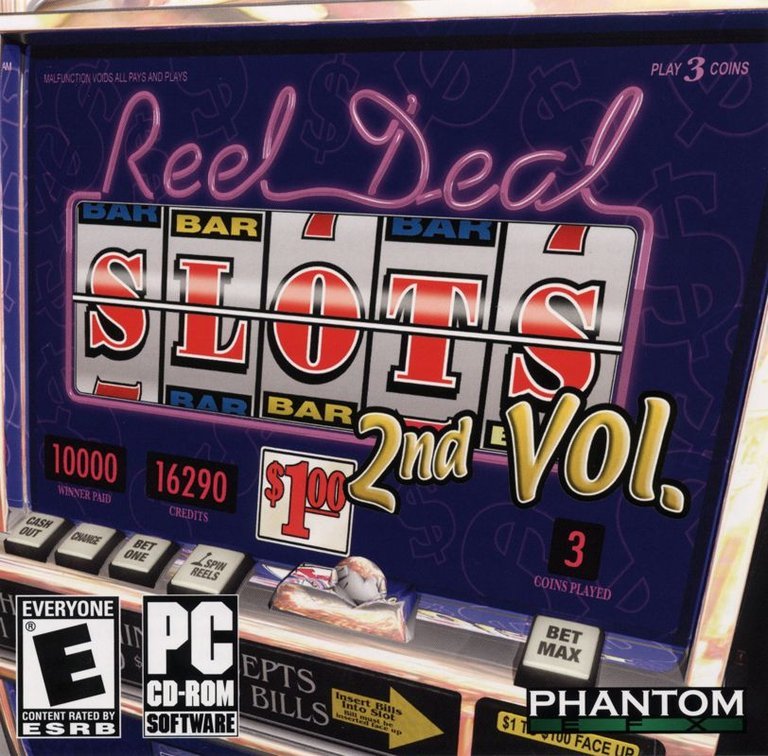
Reel Deal Slots 2nd Vol. is a virtual casino simulation game where players begin with $3,000 and engage with a diverse array of 39 modern slot machines, 5 video poker machines, and 1 video bingo machine to potentially grow their bankroll. The game tracks performance statistics for each machine, allowing players to identify the most profitable games, and earns prize tokens through gameplay that can be exchanged for virtual rewards in an in-game gift shop, all within a first-person, mouse-controlled interface.
Gameplay Videos
Reel Deal Slots 2nd Vol. Free Download
Reel Deal Slots 2nd Vol. Cracks & Fixes
Reel Deal Slots 2nd Vol. Patches & Updates
Reel Deal Slots 2nd Vol. Reviews & Reception
myabandonware.com : Thank you for keeping these games alive with all the tech changes.
Reel Deal Slots 2nd Vol.: A Historical Appraisal of the Early 2000s Casino Simulator
Introduction: The One-Armed Bandit in the Digital Age
In the sprawling taxonomy of video game history, certain genres exist in the shadows of critical discourse, their value derived not from narrative grandeur or mechanical innovation, but from their unfiltered role as digital cultural artifacts. The casino simulation—a niche once dominated by the likes of Hoyle Casino and Casino Empire—represents a peculiar intersection of software, gambling culture, and the burgeoning “casual” market of the late 1990s and early 2000s. Within this context, Phantom EFX’s Reel Deal Slots 2nd Vol. (2002) emerges not as a revolutionary title, but as a quintessential, meticulously compiled time capsule. This review posits that the game’s primary significance lies in its function as a commercial and technological snapshot: a faithful, if unadorned, digital translation of the American slot floor into the Windows 98/XP era. It is a game less about playing and more about simulating the act of playing, offering a sterile, stat-tracked mirror to the sensory overload of a real casino. Its legacy is one of functional preservation rather than artistic achievement.
Development History & Context: Phantom EFX and the Niche of “Serious Fun”
The Studio and Its Vision: Phantom EFX, Inc. was a specialist developer and publisher that carved out a profitable niche in the “casual entertainment” and training simulation space. Their portfolio, centered on the Reel Deal series and other casino-themed titles (Reel Deal Casino: High Roller, WMS Slots: Reel ‘Em In), reveals a clear, consistent focus: creating accessible, low-stakes digital gambling experiences. The studio’s vision was not to simulate the high-roller glamour of James Bond 007: Nightfire‘s casino, but the ubiquitous, middle-ground allure of the nickel and quarter slot machine found in any local riverboat casino or Las Vegas lobby. Reel Deal Slots 2nd Vol., as a direct sequel to 2000’s Reel Deal Slots & Video Poker, represents the iterative refinement of that core concept—more machines, more features, but the same fundamental premise.
Technological and Market Context: The game’s release in 2002 places it at a pivotal moment. The dot-com bubble had burst, but PC gaming was robust, with Windows XP having recently standardized the desktop environment. CD-ROMs were the dominant distribution method for “shovelware” and casual titles, often sold in big-box stores or via mail-order catalogues. The technological constraints are palpable: the game runs in a fixed window, its graphics a blend of pre-rendered 2D assets for the machine faces and simple polygonal 3D for the reels and bonus games. This was the era before broadband was ubiquitous, so the entire experience is offline and self-contained. The gaming landscape was bifurcating between hardcore 3D adventures/PCRPGs and this burgeoning casual sector. Reel Deal Slots 2nd Vol. squarely targets the latter: an older demographic (hence the “Everyone” ESRB rating) seeking a stress-free, familiar pastime with no learning curve beyond clicking a mouse.
Narrative & Thematic Deep Dive: The Illusion of Progress in a Deterministic System
A slot machine simulator, by its very nature, eschews traditional narrative. There is no protagonist, no plot, no dialogue. The “story” is the player’s session—a self-authored chronicle of near-misses, small wins, and the perpetual chase for the elusive progressive jackpot. Yet, a deeper thematic analysis reveals the game’s engagement with potent concepts:
-
The Construct of Agency: The player is given a starting bankroll of $3,000 and complete autonomy over which of the 45+ machines to play, bet sizing, and when to quit. This creates a powerful illusion of control within a system that is, by design, entirely governed by a pre-set, weighted random number generator (RNG). The game mechanically encourages this fallacy through its stats-tracking system. By logging “per-game” performance, it suggests that skill—or at least machine selection based on historical “payout”—can influence outcomes. This directly mirrors the cognitive biases of real slot players who track “hot” or “loose” machines.
-
Capitalism as Gameplay Loop: The core loop is pure micro-capitalism: invest capital (credits), hope for a return (credits plus bonus), and reinvest or withdraw. The secondary loop of earning “prize tokens” (VIP points) and redeeming them for “virtual prizes in the gift shop” introduces a meta-game of collection and completionism. This transforms the purely financial gamble of the reels into a gamified loyalty program, a mechanic that would later become endemic in free-to-play and mobile gaming. The ultimate “win” here is not a virtual fortune, but a “congratulatory message from the designers at Phantom EFX” for completing the collection—a textual pat on the back that replaces a monetary payout.
-
The Simulation of Risk-Free Gambling: Thematically, the game exists in a ethical and experiential limbo. It simulates the thrill of the gamble (flashing lights, sound effects, the suspense of a near-win) while entirely removing all negative consequences of actual gambling: financial loss, addiction, and legal age restrictions (hence the “Everyone” rating). It is, in effect, a behavioral training simulator for gambling habits, but one sandboxed in a world of pretend money. This creates a strange, detached experience where the tension is purely self-imposed and the stakes are infinitely low.
Gameplay Mechanics & Systems: Compilation Over Innovation
The mechanical bedrock of Reel Deal Slots 2nd Vol. is its sheer volume and organization. It is a museum of early-2000s slot machine design.
-
The Core Reel-Spin Loop: The primary interaction is clicking the mouse to spin the reels of one of 39 “modern” slot machines. These are not generic; they are thematic licensed or branded simulations (implied by titles like “Fruit Frenzy” or “Diamond Run”). Each machine features its own paytable, number of lines (typically 3-9), and “features and gimmicks”—the industry euphemism for bonus rounds, wild symbols, scatter pays, and second-screen interactive bonuses. These are the game’s centerpiece, attempting to break the monotony of reel-spinning with brief, often crudely animated, mini-games.
-
The Subsidiary Casino Floor: Diversifying the portfolio are 5 video poker machines (classic Jacks or Better, Deuces Wild, etc.) and 1 video bingo machine. These offer different strategic calculators—optimal hold strategies for poker, pure luck for bingo—providing a change of pace. Their inclusion makes the package feel like a “casino sampler,” expanding the perceived value beyond pure slots.
-
Progression & Meta-Systems: The two key systemic innovations are the per-game statistical ledger and the Token/VIP Point economy.
- The stats screen (accessible between spins) logs plays, wins, losses, and theoretical “payout percentage” for each machine. This caters directly to the analytical “advantage player” fantasy, even if the data is retrospective and not predictive.
- The token system is a classic comps mechanic. Every spin earns a small number of points, which accumulate separately from the in-game cash. These points are currency for the “Prize Vault,” a virtual shop filled with absurd, whimsical trophies and trinkets (a “gold-plated toaster,” a “flying pig”). This creates a dual-currency economy: cash for gambling, points for hoarding. It incentivizes prolonged play not for wealth, but for completion, fundamentally altering the player’s goal from “win money” to “collect all prizes.”
-
UI and Flaws: The user interface is functional and dated. Machines are selected from a grid. Betting is done via +/- buttons. The flaw lies in the fundamental dissonance between simulation and engagement. The game accurately simulates the act of playing but misses the psychology of a casino floor: the absence of crowd energy, the lack of tactile feedback, the inability to physically “lock” reels. The bonus games are often slow to load and simple to the point of being anticlimactic. The token grind is also notoriously slow, making full completion a tedious marathon rather than a satisfying journey.
World-Building, Art & Sound: A Digital Limbo
The setting is an unambiguous, first-person “virtual casino”—an empty, sound-damped room where machines float in a grid. There is no NPC crowd, no dealer banter, no ambient casino din beyond a low, looping hum. This creates a sterile, almost clinical atmosphere that emphasizes the solitude of the activity.
-
Visual Direction: Art is a mix of static, illustrated machine cabinets (bright, glossy, early-2000s Flash-game aesthetic) and the spinning reels themselves, rendered in basic 3D. Bonus games feature the cheapest possible 2D animations. The overall effect is not immersive but representative. It’s a catalog of slot machine skins, not a world to inhabit. The color palette is dominated by the neon blues, purples, and golds of casino marketing.
-
Sound Design: Sound is the primary atmospheric tool. Each machine has a distinct, repetitive chime sequence for wins and losses. The overall soundscape is a cacophony of electronic beeps, whistles, and the iconic “cha-ching” of a payout. However, like the visuals, it lacks spatial depth or dynamic mixing. It is a constant, unmodulated barrage that quickly becomes grating, ironically simulating the sensory overload of a real casino but without its human warmth or rising/falling tension. The sound design underscores the game’s thesis: this is a machine for operating, not a place for being.
Reception & Legacy: The Quiet Success of the Shovelware Era
Reel Deal Slots 2nd Vol. exists in a strange critical void. As evidenced by the MobyGames and Metacritic entries, no professional critic reviews from 2002 are readily archived in major databases. This is not an anomaly but the norm for the genre. Such games were reviewed in the back pages of Computer Gaming World or PC Gamer in brief blurbs, if at all, and were often dismissed as “non-games” by the press. Their commercial success was measured in mass-market retail sales (via Amazon listings, as seen in the source material showing a $9.99 used price) and word-of-mouth in a community largely ignored by the enthusiast press.
Its legacy is twofold:
1. The Reel Deal Series Pedigree: This title solidified Phantom EFX’s long-running franchise. The source material clearly charts its lineage: direct sequel to the original, followed by Nickel Alley (2003), Nickels & More! (2004), and broader expansions like Reel Deal Casino: Championship Edition (2004) and Vegas Casino Experience (2009). It was a reliable, annually updated product line for a devoted audience.
2. Preservation and Abandonware Status: The very existence of multiple, patched versions (v1.0, v1.6) on the Internet Archive and MyAbandonware is its most telling historical marker. These repositories, curated by “The Rogue Archivist” and others, have saved the game from extinction. The community comments (“Thank you for keeping these games alive”) speak to a niche but passionate preservation effort for the software archaeology of casual PC gaming. It is now a digital fossil, a perfectly preserved example of the pre-Steam, physical-distribution, casual-game era.
Its influence on the industry is indirect but identifiable. The token-for-prizes meta-game is a clear precursor to the “comp point” systems of modern social casino apps like Jackpot Party or Cashman Casino. The model of licensing and simulating specific real-world slot machine brands and mechanics would later be perfected by companies like IGT and WMS in their own PC and mobile titles.
Conclusion: A Slot in Time
Reel Deal Slots 2nd Vol. is not a game to be judged by the conventional metrics of narrative depth, mechanical ingenuity, or artistic merit. To do so is to misread its purpose entirely. It is, instead, a hyper-specific simulation of a specific leisure activity at a specific technological moment. It succeeds—and its value lies—in its fidelity to that template: the wide variety of machines, the accurate representation of paylines and bonus triggers, the stat-heavy feedback loop, and the compulsion of the token-grind.
Historically, it is an important document. It captures the moment when personal computers became suitable for delivering a credible facsimile of a casino experience to the home user, stripping away all danger and social context. It represents the apex of the “shovelware” business model for casual games, where quantity (over 45 machines) was the primary selling point. Its preservation on abandonware sites ensures that future historians can study the UI conventions, audio libraries, and graphical limitations of early 2000s casual software development.
Final Verdict: As a game, it is a forgettable, repetitive, and ultimately shallow experience. As a historical artifact, it is an exceptionally clear and well-preserved example of its genre and era. Its place in video game history is not on a pedestal, but in a carefully labeled drawer in the archive: “Casino Simulators, Windows 9x/XP Era, Volume 2.” For the player seeking digital slots, better, more modern alternatives exist. For the historian seeking to understand the shape of early-2000s casual gaming, Reel Deal Slots 2nd Vol. is an essential, if repetitive, primary source.