
- Release Year: 2011
- Platforms: Windows
- Publisher: Focus Multimedia Ltd.
- Genre: Adventure
- Perspective: 3rd-person (Other)
- Game Mode: Single-player
- Gameplay: Hidden object, Mini-games
- Setting: Asylum, City, London, Mental facility, Time travel, Venice
Description
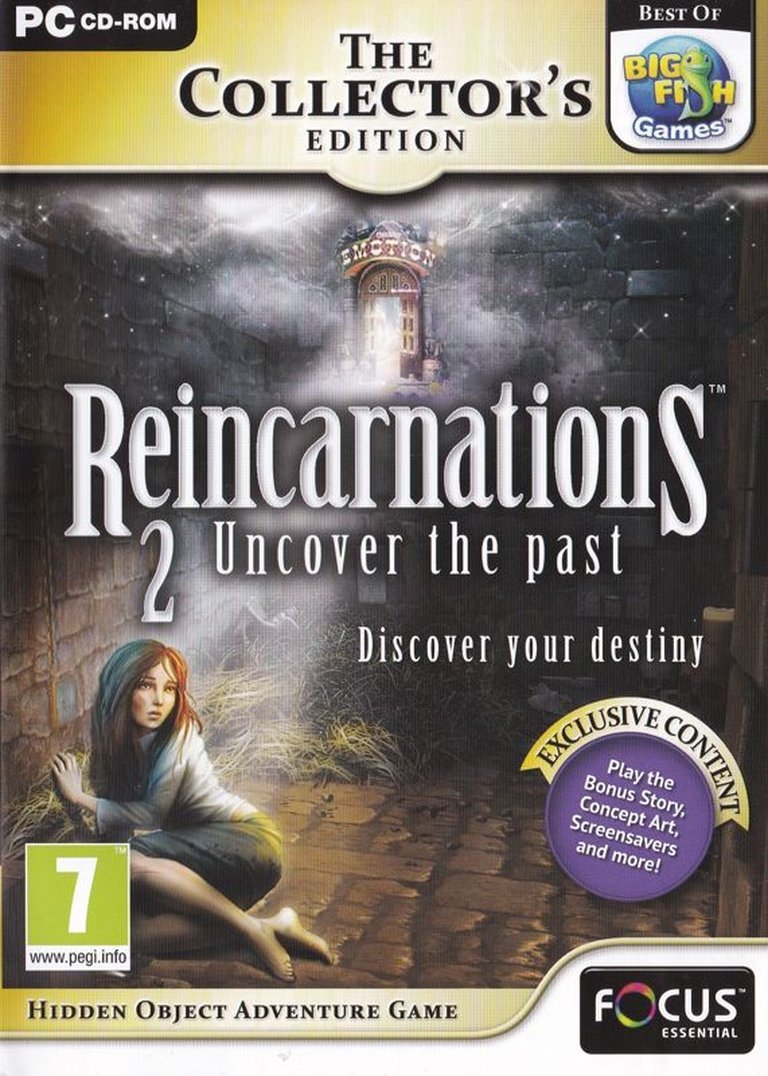
In this hidden object adventure game, players follow Jane as she investigates her own reincarnation past lives after a breakthrough study with Dr. Herzle is compromised by her kidnapping. Set in diverse locations including London, Venice, and a psychiatric ward, the game combines mystery-solving with hidden object scenes and mini-games. The Collector’s Edition expands the experience with a strategy guide, screensavers, artwork, and a bonus chapter titled ‘Rainbow Circus’ that explores an unrelated past life of Jane as a circus artist.
Gameplay Videos
Reincarnations: Uncover the Past (Collector’s Edition) Cracks & Fixes
Reincarnations: Uncover the Past (Collector’s Edition) Guides & Walkthroughs
Reincarnations: Uncover the Past (Collector’s Edition) Reviews & Reception
gamezebo.com : a pretty decent choice for players in the mood for some straight-up hidden object adventuring.
Reincarnations: Uncover the Past (Collector’s Edition): Review
A Journey Through Time, Identity, and Hidden Object Mastery
1. Introduction
In the crowded landscape of hidden object adventure games (HOGs), few manage to blend narrative depth with satisfying gameplay mechanics as seamlessly as Reincarnations: Uncover the Past (Collector’s Edition). Released in 2011 by developer Vogat Interactive and published by Big Fish Games, this title stands as a testament to the genre’s peak creativity during its golden age. As journalist Jane, players navigate a race against time after her kidnapping by the nefarious Dr. Weiner, forced to solve puzzles and uncover secrets across her past lives to escape his asylum. While the premise leverages the popular theme of reincarnation—a narrative device explored in earlier titles like its predecessor, Reincarnations: Awakening (2009)—this Collector’s Edition elevates the experience with a bonus chapter, art, and a strategy guide. My thesis is that Uncover the Past excels in atmospheric storytelling and mechanical polish, yet ultimately settles into comfortable genre conventions rather than pushing boundaries. It remains a refined, if derivative, entry in the HOG canon.
2. Development History & Context
Reincarnations: Uncover the Past emerged from Vogat Interactive, a studio specializing in narrative-driven casual games during a period when HOGs dominated the digital market. Published by Big Fish Games—a powerhouse in the casual space—the game arrived in 2011, an era defined by accessible Windows XP/Vista titles (as per system requirements) and the rise of Collector’s Editions as a premium model. Technologically, the game adhered to flip-screen fixed-perspective visuals, a deliberate choice to maintain focus on hand-painted environments without the demands of 3D rendering.
The gaming landscape in 2010–2011 was saturated with HOGs, with Mystery Case Files and Enigmatis setting high standards for production value. Vogat’s vision was clear: create a sophisticated, time-travel narrative that blended detective elements with supernatural themes. The inclusion of two distinct historical eras—Victorian London and Renaissance Venice—demonstrated ambition, though the asylum setting in the present anchored the story in psychological horror. This context reveals a studio aiming to compete with genre titans through execution rather than innovation, a strategy reflected in the game’s polished-but-familiar mechanics.
3. Narrative & Thematic Deep Dive
The narrative centers on Jane, a journalist reincarnated across lifetimes, whose breakthrough research is sabotaged by Dr. Weiner, a psychiatrist seeking to exploit her abilities for fame. Dr. Herzle, Jane’s reluctant ally, hides a magical amulet in her asylum cell, enabling her to journey into past lives. The story unfolds across three acts:
– London (Theater Emotion): Jane investigates her brother’s murder in a surreal puppet theater, encountering magic masks and clockwork puzzles. Themes of familial duty and artistic obsession permeate this Victorian gothic setting.
– Venice (Inquisition-era): Jane aids Fabio, her imprisoned lover, navigating a labyrinthine dungeon and a vine-choked library. Here, themes of forbidden love and persecution emerge, with the Inquisition serving as a dark metaphor for Dr. Weiner’s “treatment.”
– Asylum (Psychiatric Ward): Jane confronts her captor, blending psychological horror with steampunk-esque contraptions.
The dialogue is functional, prioritizing clarity over flair, but shines in environmental storytelling—e.g., the “SEMPER VIRENS” (Ever Green) cipher in Venice. Underlying themes include identity fluidity (Jane as detective, puppeteer, prisoner) and cyclical trauma (her abusers recur across eras). Dr. Herzle’s moral ambiguity adds depth, positioning him as both savior and coward—a rare nuance in a genre often black-and-white.
4. Gameplay Mechanics & Systems
Uncover the Past exemplifies HOG design, marrying hidden object scenes with intricate puzzles:
- Hidden Object Scenes: These are well-designed, requiring players to uncover items through environmental interaction (e.g., smashing an egg to find a yolk). Orange-listed items demand prior actions, adding layers of logic. However, pixel hunting and obtuse solutions (e.g., finding “butterflies” in a cluttered room) can frustrate.
- Puzzles: From gear-based contraptions in Venice to sliding-tile puzzles in the asylum, the variety is commendable. Puzzles often require inventory assembly (e.g., combining a “gear” and “handle” to operate an elevator), rewarding experimentation. Notably, the “cause and effect” puzzle in Venice—swapping tiles to display logical sequences—stands out for creativity.
- Inventory Management: Items are logically used (e.g., a “razor” cuts ropes; a “sponge” absorbs water). The game’s cursor sensitivity penalizes rapid misclicks, a double-edged sword that prevents spamming but breaks immersion.
- Bonus Chapter: “Rainbow Circus” offers a lighthearted detour as a lion tamer, though its brevity and simpler puzzles feel tacked-on compared to the main campaign.
Strengths include seamless integration of gameplay and narrative; weaknesses include over-reliance on HOG tropes and occasional illogical progression. The Collector’s Edition’s strategy guide is invaluable, providing puzzle solutions without removing challenge.
5. World-Building, Art & Sound
The game’s art direction is its standout achievement. Environments are richly detailed: Victorian London’s decaying theater features velvet curtains and mechanical puppets, while Venice’s canals and vine-covered libraries evoke Renaissance opulence. Hand-painted backdrops and atmospheric lighting (e.g., candlelit dungeons) create palpable tension.
Sound design complements this: ambient tracks—from theater crowds to Venetian water lilies—immerse players, while voice acting (minimal but effective) conveys urgency. The asylum’s creaking floors and distant screams heighten psychological dread. Notably, the “lightning bug” puzzle’s chime and the theater’s organ score are memorable audio signatures. This synergy of art and sound elevates routine exploration into a sensory experience.
6. Reception & Legacy
Upon release, Reincarnations: Uncover the Past received mixed-to-positive reviews. Gamezebo awarded it a 70/100, praising its “solid, stock hidden object adventure” and art but criticizing derivative tropes. Collector’s Edition extras like “Rainbow Circus” were seen as filler, though concept art and wallpapers pleased fans. Commercially, it performed well on platforms like Big Fish Games, leveraging the genre’s audience.
Legacy-wise, the game cemented the Reincarnations series’ niche as a narrative-focused HOG. It influenced later titles like Echoes of the Past (2010–2011), which adopted similar period settings and puzzle integration. However, its lack of innovation—especially compared to contemporaries like Mystery Case Files—prevented it from achieving genre-defining status. Today, it’s remembered as a polished example of mid-2010s HOGs, valued for its atmosphere but overshadowed by bolder projects.
7. Conclusion
Reincarnations: Uncover the Past (Collector’s Edition) is a masterclass in execution over innovation. Its atmospheric art, intricate puzzles, and time-travel narrative create a compelling experience, even as it leans on HOG conventions. The Collector’s Edition enhances value with extras, yet the bonus chapter feels underwhelming. For genre enthusiasts, it’s a must-play; for others, it’s a solid but unremarkable entry. Vogat Interactive succeeded in crafting a polished adventure that honors the HOG legacy without reinventing it, leaving Jane’s journey as a nostalgic footnote in the genre’s evolution.
Final Verdict: A refined, atmospheric HOG that excels in execution but lacks the ambition to transcend its genre. ★★★★☆