
- Release Year: 2010
- Platforms: OnLive, Wii, Windows
- Publisher: Mastiff, LLC
- Developer: eV Interactive LLC
- Genre: Action, Simulation
- Perspective: 1st-person
- Game Mode: Single-player
- Gameplay: Hunting, Shooter
- Setting: Africa
Description
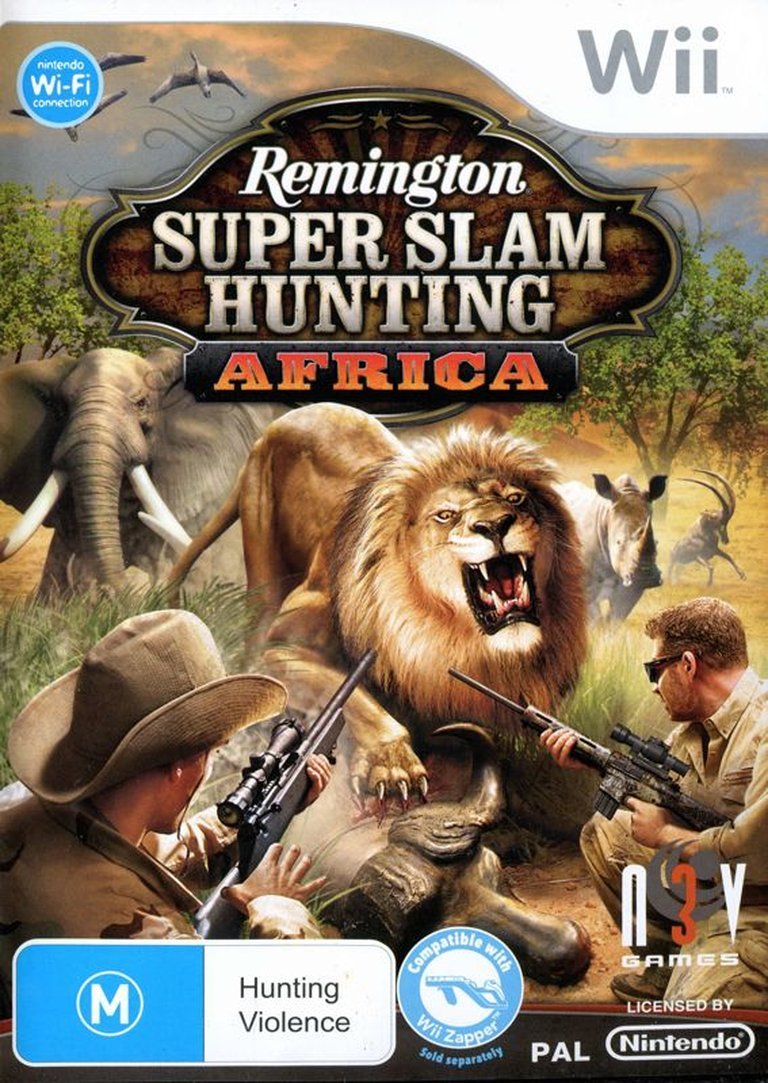
Remington Super Slam Hunting: Africa is a first-person hunting simulator set across over 30 diverse African landscapes. Players track and hunt a variety of wildlife, including lions, antelopes, and zebras, using an arsenal of over 30 licensed Remington firearms. The game features timed challenges, a scoring system based on accuracy and efficiency, and a collection of 175 trophies and awards to unlock, blending action and simulation elements in a licensed outdoor adventure.
Gameplay Videos
Remington Super Slam Hunting: Africa Free Download
Remington Super Slam Hunting: Africa Reviews & Reception
popzara.com : Remington Super Slam Hunting: Africa is enjoyable enough, especially if you’re looking for a quick shooter experience that doesn’t take itself too seriously.
Remington Super Slam Hunting: Africa Cheats & Codes
Wii
Enter codes using Gecko.
| Code | Effect |
|---|---|
| 0408AB00 90830100 | Infinite Ammo |
| 0406DA44 60000000 | Infinite Chain |
Remington Super Slam Hunting: Africa: A Forgotten Relic of the Hunting Simulator Genre
Introduction
In the vast and often overlooked landscape of hunting simulators, Remington Super Slam Hunting: Africa (2010) stands as a curious artifact—a game that attempted to blend arcade-style shooting with the trappings of a licensed hunting experience. Developed by eV Interactive and published by Mastiff, this title arrived at a time when the Wii was flooded with motion-controlled shooters, many of which leaned heavily on gimmicks rather than depth. Remington Super Slam Hunting: Africa was no exception, but its ambition to deliver a fast-paced, multiplayer hunting experience set it apart from its peers. This review will dissect the game’s development, mechanics, reception, and legacy, ultimately arguing that while it was far from a masterpiece, it remains a fascinating case study in the evolution of the hunting genre.
Development History & Context
The Studio and the Vision
Remington Super Slam Hunting: Africa was developed by eV Interactive, a studio with a modest portfolio that included other hunting and fishing simulators like Shimano Xtreme Fishing and Reload. The game was part of a broader Remington Super Slam Hunting series, which also included North America and Alaska editions, all released in quick succession between 2010 and 2011. The series was clearly designed to capitalize on the popularity of the Cabela’s franchise, which had dominated the hunting simulator market for years.
The vision for Africa was straightforward: create an arcade-style hunting experience that emphasized fast-paced action over realism. Unlike the Cabela’s games, which often leaned into simulation elements, Remington Super Slam Hunting: Africa was unapologetically arcadey, with a focus on high scores, unlockable weapons, and multiplayer competition. The game’s development was constrained by the Wii’s hardware limitations, which meant simplified animal models, repetitive environments, and a lack of the polish seen in more mainstream titles.
The Gaming Landscape of 2010
The game’s release in November 2010 placed it squarely in the midst of the Wii’s motion-controlled shooting craze. Titles like Cabela’s Dangerous Hunts and Deer Drive were already established in the market, and Remington Super Slam Hunting: Africa had to compete with these while also carving out its own niche. The Wii’s unique control scheme made it an ideal platform for hunting games, as the Wii Remote’s pointer functionality mimicked the act of aiming a rifle. However, the market was becoming oversaturated, and many of these games struggled to stand out.
The game’s later release on OnLive (a now-defunct cloud gaming service) and Windows in 2011 was an attempt to broaden its audience, but by then, the hunting simulator genre was already in decline. The lack of critical or commercial success for Remington Super Slam Hunting: Africa reflects the challenges of breaking into a niche market dominated by a single franchise.
Narrative & Thematic Deep Dive
The Plot (or Lack Thereof)
Remington Super Slam Hunting: Africa is not a game driven by narrative. There is no overarching story, no characters to speak of, and no dialogue beyond the occasional voiceover announcing a successful shot or a missed target. The game’s “plot” is simple: you are a hunter in Africa, tasked with completing missions that involve shooting specific animals within a time limit. The lack of narrative depth is not necessarily a flaw—hunting simulators have never been known for their storytelling—but it does highlight the game’s focus on gameplay over immersion.
Themes: Hunting as Sport vs. Hunting as Simulation
The game’s themes are equally straightforward. It presents hunting as a sport, emphasizing competition, high scores, and unlockable rewards. There is no attempt to simulate the ethical or ecological implications of hunting, nor does it delve into the cultural significance of African wildlife. Instead, it treats hunting as a purely mechanical activity, one that is measured in points and trophies.
This approach sets Remington Super Slam Hunting: Africa apart from more serious hunting simulators, which often attempt to replicate the patience and strategy of real-world hunting. Here, the emphasis is on reflexes and precision, making it more akin to a shooting gallery than a true simulation. The game’s arcade sensibilities are further reinforced by its multiplayer modes, which encourage players to compete for the highest scores rather than engage in any form of cooperative or strategic hunting.
Gameplay Mechanics & Systems
Core Gameplay Loop
The core gameplay loop of Remington Super Slam Hunting: Africa is simple: select a mission, enter an environment, and shoot the designated animals before time runs out. Each mission takes place in one of over 30 African locales, ranging from open plains to dense jungles and abandoned mines. The game’s arcade nature is evident in its scoring system, which rewards players for headshots, long-range kills, and quick successive shots.
The game’s time-limited missions add a layer of urgency, forcing players to act quickly rather than carefully stalk their prey. This design choice further distances the game from simulation territory, instead positioning it as a fast-paced shooter. The lack of a stealth mechanic or any form of animal behavior simulation means that the game’s challenge comes from the player’s ability to aim and fire accurately under pressure.
Weapons and Progression
One of the game’s standout features is its arsenal of over 30 licensed Remington weapons, including rifles, shotguns, and scopes. Each weapon has distinct stats, affecting factors like accuracy, range, and recoil. Players can unlock new weapons by earning points, which are awarded for successful hunts. However, the progression system is shallow—there is no meaningful customization or upgrade path, and weapons are unlocked linearly rather than through player choice.
The game’s trophy and achievement system is similarly simplistic. With 175 trophies to earn, the game encourages replayability, but the lack of depth in its mechanics means that the experience quickly becomes repetitive. The multiplayer modes—supporting up to four players in cooperative and competitive modes—add some variety, but the core gameplay remains unchanged.
Controls and Accessibility
On the Wii, the game utilizes the Wii Remote’s pointer functionality, which works well for aiming but lacks the tactile feedback of a real rifle. The Windows and OnLive versions, by contrast, rely on traditional mouse-and-keyboard or controller inputs, which feel less intuitive for a hunting game. The OnLive version, in particular, suffered from input lag, a common issue with the cloud gaming service at the time.
The game’s lack of a cover or stealth system means that players are often exposed to animal attacks, particularly from predators like lions and leopards. This adds a layer of tension but also highlights the game’s arcade nature—players are encouraged to shoot first and ask questions later.
World-Building, Art & Sound
The African Safari Aesthetic
Remington Super Slam Hunting: Africa attempts to capture the grandeur of an African safari, but its visual presentation is severely limited by the Wii’s hardware. The environments are repetitive, with little variation in terrain or foliage. Animal models are simplistic, with stiff animations that lack the realism seen in more polished titles. The game’s attempt to include dynamic weather effects—such as rain, fog, and brushfires—is admirable but ultimately underwhelming due to the technical constraints.
The sound design is equally basic. The game features generic ambient noises, such as animal calls and rustling foliage, but there is little in the way of immersive audio. The voiceovers, which announce successful shots or missed targets, are campy and over-the-top, adding to the game’s arcade-like charm but doing little to enhance the sense of realism.
Atmosphere and Immersion
The game’s lack of immersion is its greatest weakness. Unlike titles like Cabela’s African Adventures, which attempt to create a sense of place and atmosphere, Remington Super Slam Hunting: Africa feels more like a shooting gallery than a true hunting experience. The environments are static, the animals behave predictably, and the missions lack variety. The game’s attempt to include “dangerous” environments, such as abandoned mines and swamps, does little to alleviate the repetitiveness.
Reception & Legacy
Critical and Commercial Reception
Remington Super Slam Hunting: Africa received little critical attention upon release. The game has no Metacritic score, and there are no professional reviews available on major gaming sites. Player reviews, where they exist, are mixed. Some praised the game’s fast-paced action and multiplayer modes, while others criticized its lack of depth and repetitive gameplay.
Commercially, the game was a minor blip in the hunting simulator market. It failed to compete with the Cabela’s franchise, which continued to dominate the genre with more polished and immersive experiences. The game’s release on OnLive and Windows did little to boost its profile, and it quickly faded into obscurity.
Influence and Legacy
Remington Super Slam Hunting: Africa has had no discernible influence on the hunting simulator genre. The Remington Super Slam Hunting series itself was short-lived, with only three entries released before disappearing entirely. The game’s arcade-style approach to hunting was not adopted by later titles, which continued to emphasize realism and simulation.
Today, Remington Super Slam Hunting: Africa is remembered, if at all, as a curiosity—a relic of the Wii’s motion-controlled shooting craze. It serves as a reminder of the challenges faced by developers attempting to break into a niche market dominated by a single franchise.
Conclusion
Remington Super Slam Hunting: Africa is a flawed but fascinating artifact of the hunting simulator genre. Its arcade-style gameplay and fast-paced action set it apart from more serious titles, but its lack of depth and repetitive mechanics ultimately hold it back. The game’s attempt to blend licensed weapons, multiplayer modes, and dynamic environments is admirable, but the execution falls short due to technical limitations and a lack of polish.
In the grand scheme of video game history, Remington Super Slam Hunting: Africa is a minor footnote—a game that tried to carve out its own niche but was ultimately overshadowed by more established franchises. For those interested in the evolution of the hunting simulator genre, it remains a curious case study, but for most players, it is little more than a forgotten relic of the Wii era.
Final Verdict: 5/10 – A flawed but intriguing arcade-style hunting simulator that fails to leave a lasting impression.