
- Release Year: 2004
- Platforms: Windows
- Publisher: Nordos Game Studio
- Developer: Nordos Game Studio
- Genre: Educational
- Perspective: Top-down
- Game Mode: Online PVP, Single-player
- Gameplay: Puzzle
- Setting: Ecology, Nature
- Average Score: 80/100
Description
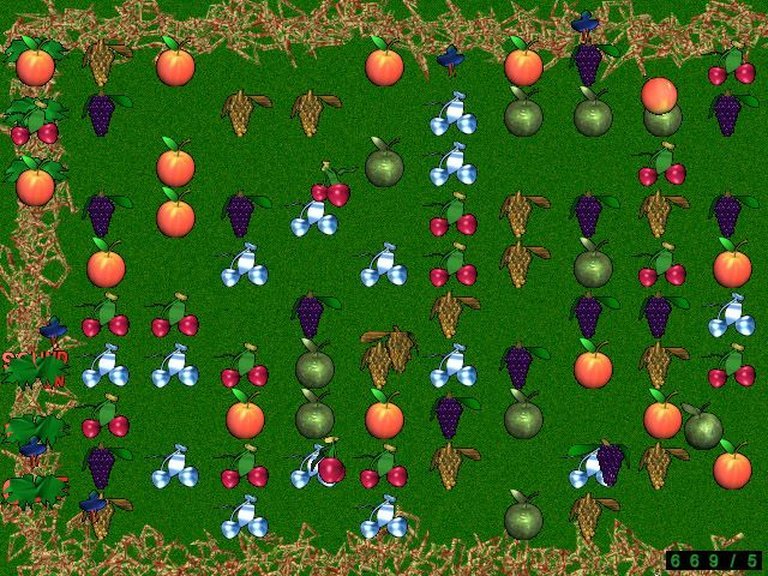
In Renex III, players must strategically align five balls of the same color horizontally, vertically, or diagonally to clear them from the board before it fills up and ends the game. The challenge lies in moving only the three balls available in the upper-left corner while navigating randomly spawning fish that can land anywhere, often blocking potential moves by lining up four identical balls that cannot be shifted, adding a layer of unpredictability to the puzzle-solving experience.
Renex III Reviews & Reception
retro-replay.com : It’s deceptively simple, endlessly addictive, and will keep you hooked as you chase new high scores!
mobygames.com (80/100): This is nowhere near as easy as it sound.
Renex III: Review
Introduction
In the pantheon of puzzle games, where mechanics are often refined to near-perfection but rarely reinvented, Renex III emerges as a fascinating footnote. Released on May 2, 2004, by the Russian studio Nordos Game Studio, this top-down puzzle title belongs to the “5-in-a-line” genre, yet distinguishes itself through deceptively simple mechanics layered with strategic depth. At first glance, it appears to be a casual diversion—aligning colored balls to clear a board. Yet, its interplay with unpredictable aquatic obstacles and an educational framing elevates it beyond mere pastime. This review argues that Renex III is a masterclass in minimalist design, transforming a familiar concept into a tense, endlessly replayable experience that balances accessibility with surprising complexity. Its legacy, though obscured by the shadow of 2004’s AAA behemoths, lies in its elegant execution and thematic ingenuity.
Development History & Context
Origins and Vision
Developed and published by Nordos Game Studio, Renex III emerged from a burgeoning Russian indie scene in the early 2000s. As a shareware title distributed via digital downloads, it operated outside the mainstream gaming ecosystem, catering to niche audiences of puzzle enthusiasts. The studio’s vision, as articulated in promotional materials, was to create a “top quality puzzle game” with “excellent 3D-rendered graphics” and extensive user customization. This ambition is reflected in the game’s built-in themes (skins) and support for plug-in themes, allowing players to personalize the experience—a forward-thinking feature for its era.
Technological Constraints
Released for Windows 2000/XP, Renex III was built on modest hardware, requiring a mere Intel Pentium II CPU, 32 MB of RAM, and DirectX 7.0. Its reliance on lightweight 3D rendering for balls and fishes ensured broad compatibility with mid-2000s systems. The inclusion of Dolby Pro Logic II sound support in system hints at an attempt to elevate the audio experience beyond typical puzzle games, though the final implementation remains sparsely documented.
Gaming Landscape of 2004
Renex III debuted in a year dominated by genre-defining titans: Half-Life 2, Grand Theft Auto: San Andreas, and World of Warcraft. These AAA titles redefined expectations for immersion and scale, leaving little room for niche puzzle games. Renex III existed in a parallel universe, targeting audiences seeking bite-sized, cerebral challenges over epic narratives. Its educational classification—tagged with “Ecology / nature”—also positioned it as a subtle learning tool, aligning with a mid-2000s trend of “edutainment” software that blended play with pedagogy.
Narrative & Thematic Deep Dive
Minimalist Storytelling
Renex III eschews traditional narrative in favor of environmental storytelling. The game’s premise is inferred from its aquarium-themed visuals and mechanics: players assume the role of an underwater caretaker, tasked with managing a grid of colorful orbs while mischievous fishes disrupt their efforts. There are no characters, dialogue, or explicit plot—only the silent tension of a board filling with lifeless balls and living obstacles.
Thematic Resonance
The ecology/nature theme permeates every aspect of the design. The fishes are not mere nuisances; they symbolize the unpredictability of natural systems, forcing players to adapt their strategies like an ecosystem responding to change. Clearing balls becomes a metaphor for maintaining balance—each line erased is a victory against entropy. This framing elevates the game beyond a simple puzzle, embedding subtle lessons about resource management and environmental harmony. The absence of overt narrative allows players to project their own stories onto the experience: Are they taming a chaotic reef, or merely surviving its whims?
Characterization Through Obstacles
The fishes are the game’s sole “characters.” Their random landings and immobility personify nature’s indifference—adorable yet disruptive. When a fish blocks a near-completed line, it transforms from a visual quirk into a narrative antagonist. This anthropomorphism, though unstated, enriches the thematic tapestry, making each failure feel like a dialogue with an unruly world.
Gameplay Mechanics & Systems
Core Loop: Precision and Pressure
The objective is straightforward: line up five balls of the same color horizontally, vertically, or diagonally to clear them. Failure is inevitable if the board fills entirely. The twist lies in the movement mechanics: players can only move the three balls in the upper-left reserve. Each placement is a critical decision, as new balls replenish the reserve immediately after use. This scarcity of moves transforms the game into a high-stakes balancing act—every action must serve multiple future possibilities.
Innovation: The Fish Obstacle
The defining mechanic is the random spawning of fishes. These aquatic entities drift onto the board, occupying empty spaces and often landing in positions that block potential matches. Unlike moveable balls, fishes are immovable, forcing players to reroute entire strategies. Their unpredictability injects chaos into the puzzle, turning predictable setups into tense improvisation sessions. For instance, a near-perfect horizontal line might be foiled by a fish, demanding a creative diagonal or vertical solution instead. This mechanic prevents rote memorization and ensures every playthrough feels unique.
Progression and Challenge
Renex III lacks traditional levels or story progression, relying instead on an endless high-score chase. The difficulty curve is steep but fair: early stages allow for easy clears, but as the board fills and fishes proliferate, players must execute chain reactions with surgical precision. The absence of save systems or checkpoints heightens the stakes, making each “just one more round” compulsive yet punishing. Multiplayer support (1-2 offline, 2 online) adds a competitive layer, though it remains underexplored due to the game’s niche status.
UI and Customization
The interface is utilitarian yet polished, with a clean grid display and a reserved area for the three moveable balls. FileForum’s praise for “excellent 3D-rendered graphics” is apt—balls pop with vibrant hues, and their dissolution into particle effects provides satisfying feedback. The customizable themes (three built-in, one plug-in) allow players to alter the aesthetic, from color palettes to background textures, adding a layer of personalization rare in 2004 puzzle games.
World-Building, Art & Sound
Aquatic Atmosphere
The game’s world is a serene, abstract aquarium. Blue gradients evoke the ocean’s depth, while the grid resembles a coral reef. The fishes, with their looping idle animations and ripple effects upon landing, bring this environment to life. This art direction, while simple, creates a cohesive atmosphere—calm on the surface, but teeming with underlying tension.
Visual Design: Function and Charm
Balls are rendered in 3D with glossy textures, making colors easily distinguishable. The fishes, though small, are animated with personality—their smooth, drifting movements and subtle details (e.g., flicking tails) prevent them from feeling like mere obstacles. The particle effects when balls disappear are crisp and unobtrusive, reinforcing the game’s focus on clarity over spectacle. The overall aesthetic avoids clutter, ensuring players can track board states even during frantic endgame moments.
Sound Design: Submerging the Senses
While audio details are scarce, the Dolby Pro Logic II support implies an attempt at immersive sound. Gentle water-ambient tracks likely accompany gameplay, with subtle chimes for successful clears and soft “plops” for fish landings. The lack of intrusive sound effects aligns with the game’s minimalist ethos, letting the visuals and mechanics take center stage.
Reception & Legacy
Launch Reception
Renex III received minimal critical attention at launch, a fate common for shareware titles amid 2004’s blockbuster releases. MobyGames notes a single player rating of 4.0/5, suggesting a niche but positive reception. FileForum and download platforms like CNET recorded modest traffic (310 downloads on FileForum), indicating word-of-mouth appeal among puzzle aficionados. The game’s educational classification may have limited its mainstream appeal, but its addictive nature fostered a small, dedicated following.
Longevity and Influence
Over time, Renex III has been rediscovered by puzzle purists and preservationists. Its legacy lies in its innovative fish mechanic—a precursor to modern roguelike elements where randomness shapes strategy. The game’s emphasis on environmental themes also foreshadowed the “eco-games” trend of the late 2000s and 2010s. While it never spawned a direct sequel, its DNA can be seen in titles like Zuma or Candy Crush Saga, which similarly twist classic formulas with dynamic obstacles.
Preservation and Community
Efforts by sites like MobyGames and Retro Replay have documented Renex III’s specifications and gameplay, ensuring its place in gaming history. The game’s shareware roots and Russian origin make physical copies rare, but digital archives keep it playable. Its absence from mainstream discussions (e.g., Edge Magazine’s high-score lists) underscores its cult status, yet this obscurity has preserved its purity—untainted by commercial expectations or sequel-driven dilution.
Conclusion
Renex III is a triumph of constrained creativity. In a year saturated with sprawling epics, it offered a focused, intelligent alternative—a puzzle game that doubled as a meditation on balance and chaos. Its genius lies in how it subverts expectations: the humble ball-matching loop becomes a strategic ballet, while the whimsical fishes introduce a poetic layer of unpredictability. Though its legacy is muted by the shadows of 2004’s giants, Renex III remains a testament to the power of minimalist design. It is not merely a game to be played but experienced—a quiet dive into a world where order and entropy waltz in perfect, frustrating harmony. For historians, it is a snapshot of an era where indie ingenuity thrived outside the mainstream; for players, it is a hidden gem awaiting rediscovery. In the end, Renex III earns its place not as a blockbuster, but as a perfectly executed piece of interactive art.