
- Release Year: 2012
- Platforms: Windows
- Publisher: S.A.D. Software Vertriebs- und Produktions GmbH
- Developer: Alawar Melesta
- Genre: Action
- Perspective: Diagonal-down
- Game Mode: Single-player
- Gameplay: construction, Rescue, Resource collection, Time management
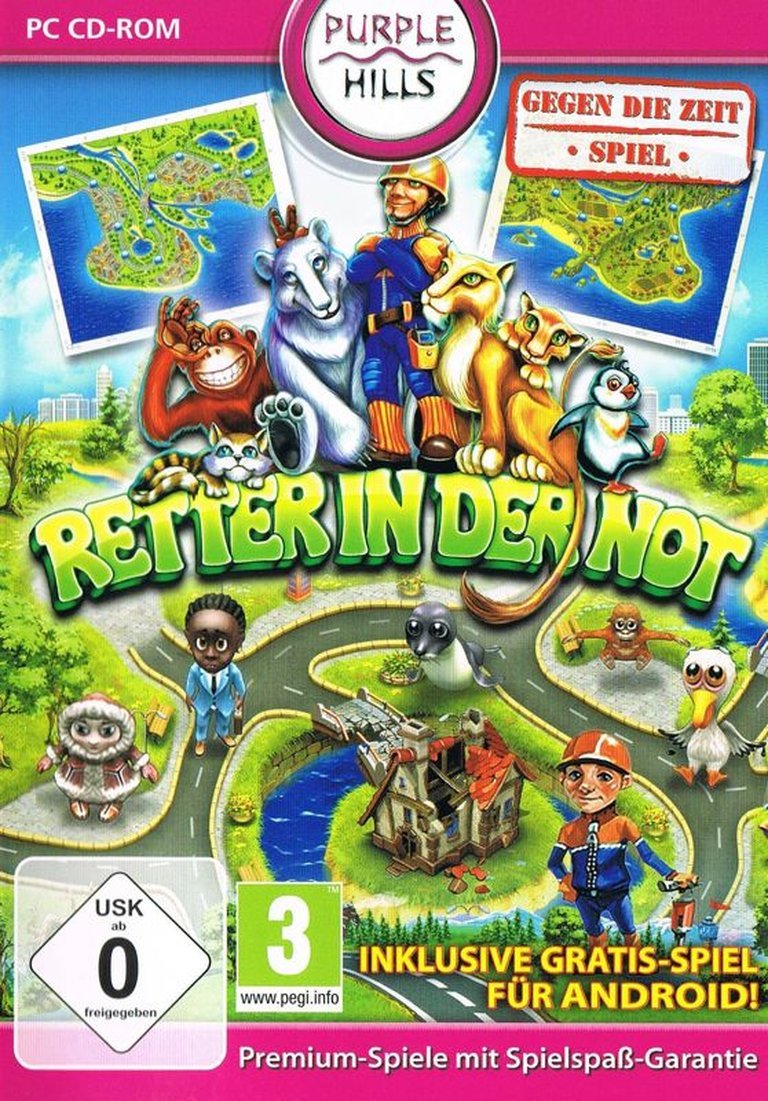
Description
Rescue Frenzy is a time management game where players rescue humans and animals from natural disasters like storms, earthquakes, and forest fires. By evacuating zones and collecting resources, they build infrastructure such as hospitals and power plants across 45 levels, each with a fixed time limit.
Rescue Frenzy Free Download
Rescue Frenzy Reviews & Reception
gamezebo.com : In the end, fans of this genre will definitely be content with Rescue Frenzy.
Rescue Frenzy: Review
Introduction
In the bustling ecosystem of early 2010s casual PC gaming, a peculiar subgenre thrived in the shadow of giants: the frantic, mouse-clicking odyssey of the time-management sim. While titles like Diner Dash and the Farm Frenzy series dominated airwaves and storefronts, a quieter, more grounded competitor emerged from the Eastern European studio Alawar Melesta. Rescue Frenzy, released in October 2012 for Windows, traded pastoral whimsy for the tangible, terrifying immediacy of modern urban disaster response. It is a game that asks you to be not a chef or a farmer, but an emergency coordinator, a logistical architect of hope amidst concrete and chaos. This review posits that Rescue Frenzy is a fascinating, deeply flawed inflection point—a title that grasped for a more sophisticated, thematically mature niche within the casual time-management genre but was ultimately hamstrung by a lack of beginner-friendly scaffolding and a confusing progression of ideas. It stands not as a classic, but as a compelling case study in ambition, constraint, and the narrow margins between engagement and frustration in a genre built on simplicity.
Development History & Context
The Studio and Its Pedigree
Rescue Frenzy was developed by Alawar Melesta, a studio with a prodigious output in the casual and “tycoon” space. The credits list 25 individuals, helmed by Director Alexey Meleshkevich, Art Director Sergey Starokhozyaev, and Lead Programmers Sergey Khovansky and Sergey Leiko. This was not a fledgling team; producer Denis Sedovich and graphics producer Maxim Mihaelis had credits on dozens of prior Alawar titles. The studio’s pedigree is inextricably linked to the Farm Frenzy series—explicitly cited in promotional material from GameHouse and Kotaku as being “from the makers of Farm Frenzy.” This lineage is crucial: Rescue Frenzy represents a deliberate attempt to apply the familiar, click-driven resource-loop mechanics of Farm Frenzy to a new, more serious thematic setting.
Technological and Market Context
Released in 2012, the game arrived at a pivotal moment. The PC casual market was still robust via platforms like Big Fish Games and GameHouse, but the seismic shift toward mobile gaming (the App Store had launched only four years prior) was reshaping expectations. Technologically, Rescue Frenzy was a product of its time: a 2D, isometric (“diagonal-down” perspective) game built on what were likely in-house or licensed middleware tools. System requirements from WildTangent and Game-Owl—a 1.0-1.2 GHz processor, 512MB-1GB RAM, DirectX 9.0—speak to a game designed for the average household PC of the era, prioritizing accessibility over graphical prowess. Its business model was straightforward commercial distribution via CD-ROM and digital storefronts, a final gasp of the premium casual model before free-to-play and ad-supported mobile games became ubiquitous.
The Gaming Landscape
The time-management/tycoon genre was crowded. Players expected a gentle learning curve, a clear visual language for tasks, and a satisfying progression of new buildings and challenges. Against this backdrop, Rescue Frenzy‘s choice of setting—contemporary urban disaster response—was its most defining and risky gambit. It moved away from the escapist fantasy of farm life or fantasy kingdoms and into the realm of plausible, media-saturated crises (storms, earthquakes, wildfires). This thematic shift demanded a different kind of player empathy and presented unique design challenges in translating severe real-world events into satisfying, gamified loops.
Narrative & Thematic Deep Dive
Plot and Structure
Rescue Frenzy possesses the barest skeleton of a narrative frame. There is no protagonist, no overarching story campaign, and no character arcs. Instead, the “story” is delivered episodically through a clever diegetic device: a TV news report at the start of each level. As described by Gamezebo, this report “displays the current scenario and explains your objectives.” This framing device is the game’s most successful narrative innovation. It contextualizes each 5-15 minute level as a discrete news segment, with the player as the unseen, heroic “rescue team” working just off-camera. The disasters are specific: a flood requiring pump station repair, a wildfire threatening a residential zone, an earthquake that has damaged a nuclear power plant. The goals align with these reports—rebuild the fire station, evacuate citizens, destroy the reactor to prevent meltdown.
Characters and Dialogue
Characters exist purely as functional units. The “rescue workers” are an anonymous, faceless horde of identical sprites. “Citizens” and “animals” are similarly generic, distinguished only by their color and the building they must be delivered to (hospital vs. animal shelter). There is no dialogue, no characterization. The only “voice” is the implied, urgent narration of the TV reporter, which serves as a tutorial and objective-giver. This absence of character is a double-edged sword: it reinforces the theme of faceless, systemic crisis and the anonymity of disaster response work, but it also makes the rescued entities feel likeabstract commodities rather than lives saved, slightly undermining the humanitarian premise.
Underlying Themes
Thematically, Rescue Frenzy is an exercise in applied humanitarian logistics. It explores:
* Crisis as System: Disasters are not chaotic messes but systems of interdependent failures. A blocked road prevents medicine delivery; a downed power station halts water pumps; a lack of fuel stalls rescue vehicles. The player must diagnose and repair these systemic links.
* Infrastructure as Hero: The true protagonists are the buildings—hospitals, gas stations, foundries, pump stations. Their construction, upgrade, and resource output are the gameplay. The game argues that in modern society, survival depends on functional infrastructure.
* Time as the Ultimate Adversary: The title’s “Frenzy” is not about combat, but about the relentless, non-negotiable pressure of the clock. The disaster clock ticks regardless of player action, creating a pervasive sense of urgency that mirrors real-world emergency response.
* Urban Fragility: Unlike the bucolic isolation of Farm Frenzy, the disasters here threaten dense, interconnected urban environments. The theme is the vulnerability of modern, complex society to natural forces—a surprisingly mature and resonant topic for a casual game.
Gameplay Mechanics & Systems
Core Gameplay Loop
The loop is quintessential time-management: a top-down view of a disaster zone littered with obstacles (debris, burning trees, downed power lines), civilians/animals in need, and resource nodes. Workers (spawned from a central “town hall” or other buildings) must be clicked and directed to perform tasks: clear debris (costs fuel, yields materials), rescue a person (costs food, yields money), etc. Resources (Money, Food, Fuel, Materials, Medicine, Metal) are the game’s currency and are generated by specific buildings or recovered from the map. The player must balance worker allocation, resource production chains, and time to complete level-specific objectives before the timer expires.
Level Design and Strategic Depth
This is where Rescue Frenzy diverges significantly from its peers and where Gamezebo’s review hits its most crucial point: the deliberate, thoughtful level design. The game’s 45 levels are not just difficulty curves but curated puzzles. Gamezebo notes variations like “beating a level without a gas station under your control” or being “totally dependent on resources from international aid funds.” This forces the player to adapt strategies. The interdependence of resources is key: to upgrade a hospital (requiring Metal), you might need to run a foundry (requiring Money and Materials from other structures). The order of operations matters immensely, and the game rewards (in terms of achieving “Master” rank) efficient, non-linear thinking. The possibility to replay levels with different approaches is a strong point, encouraging optimization.
Combat? Progression? UI.
There is no traditional combat. “Combat” is against the environment and the clock. Character progression is non-existent; there is no persistent tech tree or character leveling between levels. All upgrades occur within the confines of a single level’s buildings. The UI is functional but dense. With six resource types, multiple building icons, and a constantly scrolling map, visual clutter is high. The game lacks a robust tutorial—a major flaw cited by Gamezebo—throwing players into this complexity immediately. The “help” is minimal, presuming familiarity with the genre’s conventions.
Innovative and Flawed Systems
- Innovative: The integrated urban infrastructure model. Treating power plants, hospitals, and pump stations as functional gameplay nodes that must be actively managed (repaired, staffed) rather than just objectives to click on was a step toward systemic thinking in casual games. The TV news report intro is a genius piece of immersive framing for a genre rarely concerned with narrative.
- Flawed: The absence of progressive complexity revelation. All buildings, resource types, and obstacle types are presented from Level 1. There is no “unlocking” of systems, which removes the sense of rewarding discovery and overwhelms newcomers. The lack of meaningful fail state is also noted by Gamezebo—you can always eventually complete a level, removing the stakes and tension that a hard timer could provide. The power-ups (four types, per WildTangent) feel like a perfunctory addition, lacking clear integration into the core strategic loop.
World-Building, Art & Sound
Setting and Atmosphere
The setting is the game’s defining artistic choice: contemporary, realistic post-disaster urban and suburban zones. There are no talking animals or cartoonish clouds. The screenshots (available on MobyGames) show wrecked streets, modern apartment blocks, industrial facilities, and forests ablaze with semi-realistic fire. This creates a tone of urgent plausibility absent from