
- Release Year: 2006
- Platforms: Windows
- Publisher: Akella
- Genre: Compilation
- Perspective: Third-person
- Game Mode: Single-player
- Gameplay: Inventory management, Puzzle-solving, Survival horror
- Setting: Horror, Modern, Urban
- Average Score: 89/100
Description
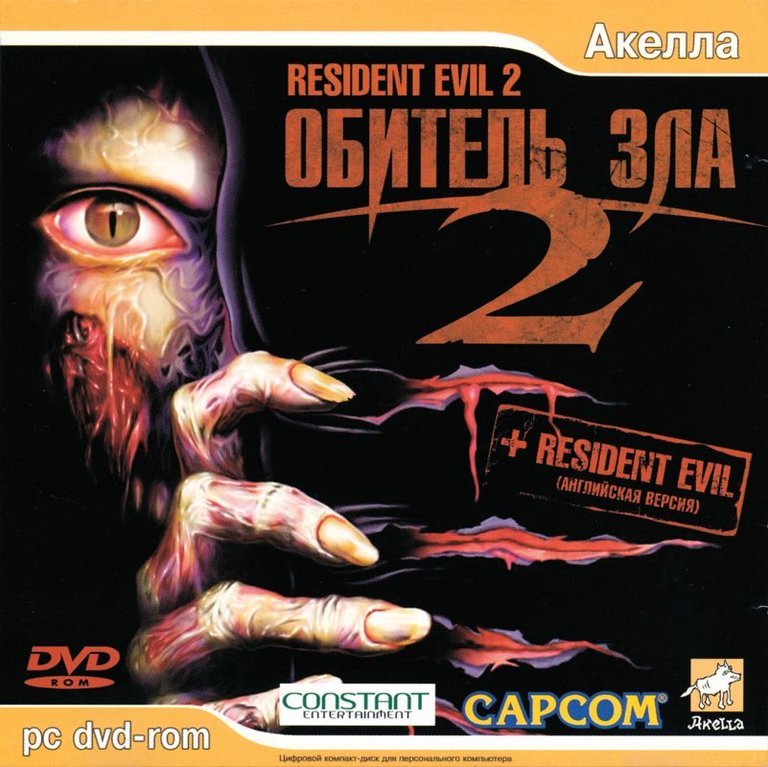
Resident Evil 2: Obitel’ zla 2 + Resident Evil is a 2006 Windows compilation released by Akella in Russia, bundling the survival horror classics Resident Evil (1996) and Resident Evil 2 (1998). The collection features Resident Evil with English language support while Resident Evil 2 is fully localized with Russian text and dialogue, allowing players to explore the zombie-infested Raccoon City and the terrifying Spencer Mansion in this double-pack edition.
Resident Evil 2: Obitel’ zla 2 + Resident Evil Reviews & Reception
metacritic.com (91/100): The stunning graphics, incredible survival horror combat and wonderfully eerie setting make picking up a copy of Resident Evil 2 a no-brainer.
ign.com (88/100): Now THIS is how you remake a classic. Resident Evil 2 expertly reanimates the horrifying atmosphere and moments of extreme tension that made the original so revered.
imdb.com (90/100): More than a simple remake: it’s one of gaming’s best reimaginings.
Resident Evil 2: Obitel’ zla 2 + Resident Evil: Review
Introduction
In the pantheon of survival horror, few titles command as much reverence as Resident Evil 2 (1998). Its legacy—a masterclass in atmospheric dread, narrative tension, and innovative design—has been cemented through countless ports, remasters, and even a full 2019 remake. Yet, nestled in the annals of gaming history is a curious artifact: the 2006 Russian compilation Resident Evil 2: Obitel’ zla 2 + Resident Evil. Curated by publisher Akella, this bundle paired the original Resident Evil (1996) with the acclaimed sequel, offering Russian players a gateway into Capcom’s apocalyptic saga. While the games themselves are untarnished masterpieces, this compilation serves as a fascinating case study in regional publishing, cultural adaptation, and the enduring power of a franchise. This review dissects the bundle not merely as a product, but as a historical artifact that amplifies the brilliance of its contents while highlighting the idiosyncrasies of its execution.
Development History & Context
The genesis of Resident Evil 2 is a story of creative resurrection. Conceived in early 1996 by a Capcom team led by director Hideki Kamiya and producer Shinji Mikami, the project began with a radical departure from its predecessor. An early build, codenamed Resident Evil 1.5, featured protagonist Elza Walker, a non-connected civilian, and a more grounded Raccoon City Police Station. However, by late 1996, Mikami deemed this iteration “dull” and axed it at 60-80% completion, citing a failure to coalesce into a cohesive vision. This $1 million gamble forced a full redesign, birthing the final version we know today.
The reboot, helmed by screenwriter Noboru Sugimura, injected Hollywood-esque melodrama and franchise continuity. Elza Walker was replaced by Claire Redfield, sister of the first game’s Chris, while rookie cop Leon S. Kennedy became the everyman hero. The “Zapping System” was introduced, allowing two intertwined scenarios per character for quadruple replay value. Technically, the game pushed the PlayStation’s limits with pre-rendered backgrounds and polygonal characters, each background taking weeks to render on SGI O2 workstations.
Akella’s 2006 compilation arrived amidst a post-remaster boom, with Resident Evil and Resident Evil 2 already ported to Windows, Nintendo 64, Dreamcast, and GameCube. Akella’s offering was pragmatic: bundle the foundational titles for the Russian market, localizing Resident Evil 2 with Cyrillic text while keeping Resident Evil in English. A 2008 reprint subtly altered advertisements but retained the core content. This release wasn’t an enhancement but a preservation effort—a digital time capsule for a region gaining access to the series’ roots.
Narrative & Thematic Deep Dive
Resident Evil 2’s narrative thrives on a paradox: the banality of evil amid catastrophic horror. Set two months after the Spencer Mansion incident, Raccoon City is a necropolis of T-virus victims, its secrets buried in corruption. Rookie cop Leon S. Kennedy and college student Claire Redfield—searching for her brother, Chris—become reluctant heroes navigating a labyrinth of corporate malfeasance. The Umbrella Corporation, its tendrils entwined with city officials like Police Chief Brian Irons, has weaponized the G-virus, transforming scientist William Birkin into a grotesque, mutating abomination.
The narrative’s brilliance lies in its duality. Leon’s “B Scenario” (after Claire’s “A Scenario”) reveals how prior actions alter the environment—solved puzzles, dead enemies, and even psychological scars. This “Zapping System” isn’t just gameplay innovation; it’s a thematic exploration of consequence. Ada Wong, a mysterious spy, embodies moral ambiguity: her love for Leon clashes with her mission to steal the G-virus. Meanwhile, Sherry Birkin, a child caught between her parents’ monstrosity and maternal love, becomes a symbol of innocence sacrificed in a war for power.
The dialogue, often critiqued for its B-movie charm (“You were almost a Jill sandwich!”), underscores the game’s tone: a grim parody of action tropes. William Birkin’s transformations—from human to “G-Adult” to a train-sized horror—reflect the series’ themes of biological hubris. The police station, once a symbol of order, becomes a charnel house, with Marvin Branagh’s final, guttural plea (“Don’t worry… I’ll be fine…”) etching survival’s cost into memory.
Gameplay Mechanics & Systems
Resident Evil 2 perfected the template established by its predecessor, refining it into a survival horror ballet. The core loop—exploration, puzzle-solving, and resource management—remains a masterclass in tension. Players navigate Raccoon City via fixed-camera angles and tank controls, turning simple movement into a deliberate, high-stakes chore. This design, initially divisive, forces players to preempt threats, heightening vulnerability.
Combat emphasizes scarcity. Ammo is a currency, not a tool, encouraging strategic retreats over brute force. Leon’s lighter and Claire’s lockpick provide asymmetry, but their starting gear is otherwise identical, ensuring balanced scenarios. The “Zapping System” elevates replayability: Claire’s path reveals Ada’s backstory; Leon’s uncovers Sherry’s connection to Birkin. Four playthroughs yield new context, from Annette Birkin’s descent into madness to HUNK’s silent extraction of the G-virus.
Inventory management is a love-it-or-hate-it mechanic. Item boxes magically connect across the city, forcing players to “save and store” like a survivalist squirreling supplies. Healing herbs—green, red, and their combinations—add a touch of alchemy to survival. The Windows port included “Arrange” mode and “Extreme Battle,” but Akella’s compilation omits these extras, sticking to the original PlayStation experience. Despite its age, the systems’ elegance endures: every locked door, every zombie groan, every typewriter save point synergizes into a relentless, oppressive flow.
World-Building, Art & Sound
Raccoon City is a character in its own right, rendered with meticulous pre-rendered backdrops that ooze decay. The police station—modeled after Osaka’s City Central Public Hall—marries Gothic architecture with bureaucratic mundanity: blood-streaked desks, flickering fluorescent lights, and lockers plastered with missing-person posters. Outside, the streets are a tableau of apocalypse: burning cars, shambling corpses, and the distant wail of sirens. This world-building isn’t just aesthetic; it’s functional. A zombie’s moan cues proximity; a creaking floorboard signals instability.
Character design blends realism with grotesquerie. Leon’s boyish naiveté contrasts with Claire’s pragmatic resolve, while William Birkin’s mutations—each stage more unhinged than the last—visualize biological horror. Ada’s femme fatale allure, despite polygonal limitations, remains iconic. The sound design is equally vital. Masami Ueda’s score uses leitmotifs—three-note brass motifs for Leon, haunting piano for Claire—to underscore emotional beats. Zombie groans, gunshots, and the click of an empty magazine create a symphony of dread. Even the menu’s typewriter soundscape reinforces the theme of a world unraveling.
Akella’s bundle retains this artistry but layers it with localization. Cyrillic UI elements for Resident Evil 2 immerse players in its Russian context, while English voice acting for Resident Evil offers a stark contrast. The compilation’s greatest strength, however, is its preservation: it unearths the raw, unfiltered vision of 1998, before HD remasters sanitized the grit.
Reception & Legacy
Resident Evil 2’s 1998 debut was a phenomenon. It sold 4.96 million copies on PlayStation alone, breaking records for fastest-selling game and outgrossing most films of its opening weekend. Critics hailed its atmosphere, graphics, and “Zapping System,” though controls, voice acting (“S.T.A.R.S.” as “STARS” was a notorious gaffe), and inventory puzzles drew ire. The Nintendo 64 port, a technical marvel fitting two discs onto one cartridge, added Dolby Surround and “Ex Files” lore, earning a 89% Metacritic score.
Akella’s 2006 compilation, however, flew under the radar. It was a niche product for a nascent Russian market, with no critical reception documented in major outlets. Yet its existence underscores the franchise’s global reach. Resident Evil 2’s DNA permeated survival horror: its structure inspired Silent Hill, its pacing shaped Dead Space, and its characters became icons. Leon and Claire reappeared in sequels, spin-offs, and even films, while the G-virus and Birkin’s legacy haunted Resident Evil 7 and Village.
The 2019 remake, using Capcom’s RE Engine, modernized the gameplay but retained the soul of Kamiya’s vision. Yet purists argue the original’s fixed angles and tank controls—imperfect as they were—fostered a unique tension. Akella’s bundle, in preserving this flawed yet brilliant iteration, becomes a testament to Resident Evil 2’s timelessness: even in a compilation, its heart still beats.
Conclusion
Resident Evil 2: Obitel’ zla 2 + Resident Evil is more than a game bundle; it’s a digital relic. Akella’s 2006 release, with its Cyrillic menus and dual-game offering, captures a moment when survival horror was unpolished, unforgiving, and utterly mesmerizing. The compilation’s value lies not in innovation but in fidelity. It preserves Resident Evil 2’s narrative labyrinth—where Ada’s betrayal and Leon’s heroism collide—and its gameplay systems, where every herb picked and key found is a victory against despair.
For modern players, this bundle is a portal to the genre’s golden age. It reminds us that survival horror’s greatest strength isn’t jump scares, but the slow burn of isolation. For historians, it’s a footnote in Capcom’s global conquest, proving that even a regional release could carry the weight of a masterpiece.
Verdict: Essential for series completists and historians, Resident Evil 2: Obitel’ zla 2 + Resident Evil is a flawed but vital artifact. It bundles two of gaming’s greatest works, untouched by time, and stands as a testament to the series’ enduring legacy. In a world of HD remakes and reboots, this compilation is a raw, unfiltered reminder of why we fell in love with Raccoon City—and why we still fear the dark.