
- Release Year: 2000
- Platforms: Windows
- Publisher: Scarlet Software
- Developer: Meridian’93
- Genre: Action
- Perspective: 1st-person
- Game Mode: Single-player
- Gameplay: Shooter
- Average Score: 60/100
Description
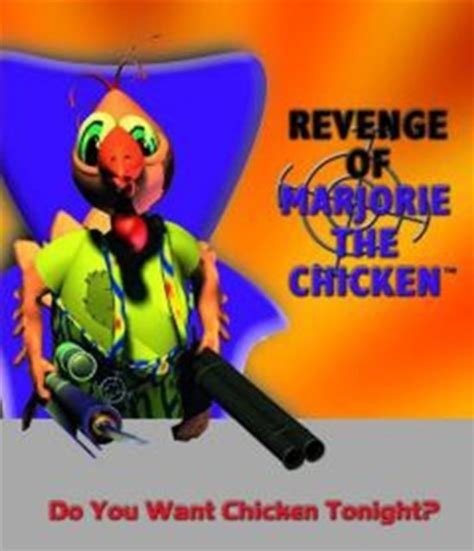
In ‘Revenge of Marjorie the Chicken’, players engage in a chaotic first-person shooter where the titular vengeful fowl, armed with a shotgun, battles humanity across 11 diverse levels. Set in land, water, and air environments, the game challenges players to hone their shooting skills against targets before confronting Marjorie herself. Success unlocks bonus levels and the chance to play as Marjorie, turning the tables on mankind in a whimsical blend of fast-paced combat and humor. Developed by Meridian’93 and released in 2000, this action-packed title offers quirky entertainment for all ages.
Gameplay Videos
Revenge of Marjorie the Chicken Reviews & Reception
theargus.co.uk (30/100): A lame duck.
Revenge of Marjorie the Chicken: Review
A Bizarre Relic of Early 2000s Tie-In Culture
Introduction
In the annals of video game history, few titles are as bewilderingly niche as Revenge of Marjorie the Chicken. Released in 2000 during the peak of reality TV mania, this first-person shooter—starring a chicken from the UK’s Big Brother—embodies the era’s fascination with monetizing novelty. With its absurd premise and bargain-bin execution, the game remains a cult curiosity: a flawed but fascinating time capsule of early 2000s pop culture excess. This review examines how Marjorie’s collision of opportunistic licensing, rudimentary design, and tonal dissonance created a game that’s equal parts baffling, problematic, and unintentionally humorous.
Development History & Context
A Studio of Oddities
Developed by Meridian’93, a now-obscure Russian studio, and published by Scarlet Software, Marjorie emerged from a team primarily known for budget titles like Die Rache der Sumpfhühner (“Revenge of the Marsh Hens”) and Alexander: The Heroes Hour. Led by software manager Anatoly Smirnov, the 16-person team included programmers like Oleg Kuznetsov and artists like Artem Polyakov, whose portfolios leaned toward European-focused edutainment and low-stakes action games.
A Perfect Storm of Constraints
The game arrived amid a booming but crowded PC market, where lightweight shooters competed for shelf space. As a tie-in to Big Brother’s 2000 season—a cultural phenomenon notorious for elevating “famous for being famous” figures—Marjorie was an obvious cash grab. Its development was likely constrained by tight deadlines and minimal budgets, evident in its recycled assets (e.g., reused explosion effects) and simplistic mechanics. This was not a passion project but a product engineered for impulse purchases, priced at £9.99 ($15) to capitalize on the show’s fleeting notoriety.
Narrative & Thematic Deep Dive
The Plot: Poultry Payback
The game’s absurdist narrative begins with players hunting Marjorie, a sentient chicken with a grudge against humanity. After completing 11 missions—shooting targets across landscapes ranging from jungles to alien environments—players “become” Marjorie in a revenge fantasy where she turns the shotgun on her oppressors. The official description promises an “egg-travaganza” finale, framing the conflict as a slapstick war between species.
Problematic Tropes & Tone
Beneath its cartoonish veneer, Marjorie stumbles into uncomfortable territory. Player reviews on Reddit noted racist caricatures of Indigenous people (“natives with bones in their noses”), casting them as hostile targets in jungle levels. This reducible “othering” aligns with early 2000s gaming’s penchant for exoticized enemies but clashes violently with the game’s purported “fun for all ages” branding. Meanwhile, Marjorie’s arc—from hunted to hunter—reads as a parody of empowerment narratives, undercut by the game’s lack of emotional stakes.
Dialogue & Satire?
Lines like “Fowl play allowed!” and “Marjorie is no bird brain” lean into poultry-themed puns, but the writing lacks consistent satire. The tone wavers between childish humor and discordant violence, never committing to parody or sincerity.
Gameplay Mechanics & Systems
Core Loop: Aim, Shoot, Repeat
Marjorie functions as a light-gun-style shooter without the peripheral. Players use a mouse to control a crosshair, firing at waves of targets—UFOs, submarines, chickens—before confronting Marjorie herself. Each level is a static screen with objects appearing on rails (e.g., flying left to right), demanding quick reflexes but minimal strategy.
Flaws & Repetition
- Unforgiving Progression: Targets move erratically, and Marjorie’s sudden appearances feel cheap rather than challenging.
- Lack of Innovation: Compared to contemporaries like House of the Dead 2, Marjorie lacks variety in enemies, weapons, or environments.
- Bonus Games: Post-level minigames (e.g., egg-collecting) feel tacked-on, offering little reward for slogging through repetitive stages.
UI & Accessibility
The interface is functional but dated, with a rudimentary score tracker and health bar. No difficulty settings or save options exist, reflecting its budget origins.
World-Building, Art & Sound
Visuals: Aesthetic Whiplash
The game’s art direction is a jarring mix of low-poly models, flat textures, and incongruous themes. Jungle levels feature garish greens and cartoonish natives, while sci-fi stages deploy blocky UFOs reminiscent of 65DOS-era CGI. Marjorie herself is a feathered monstrosity—part Looney Tunes reject, part nightmare fuel—wielding a shotgun with unsettling glee.
Sound Design: Quirky but Cheap
Composer Yevgen Bakst delivers a forgettable synth soundtrack, punctuated by grating chicken squawks and tinny gunfire. The soundscape amplifies the game’s campiness but fails to immerse players in its disjointed world.
Atmosphere: Unintentional Surrealism
The game’s true “charm” lies in its absurd juxtapositions: a chicken piloting a submarine, aliens invading pastoral farms. This surrealism feels accidental, born from limited resources rather than intentional design.
Reception & Legacy
Launch: Critical Drubbing
Marjorie was panned upon release. The Argus scored it 3/10, calling it a “lame duck” with “passable graphics” but “dreadful” gameplay. Critics savaged its lack of depth, cynical tie-in premise, and offensive stereotypes. It sold poorly, vanishing swiftly from retail.
Cult Resurrection
In the decades since, Marjorie has resurfaced as an abandonware oddity. Niche communities (e.g., Retrogek) celebrate its so-bad-it’s-good appeal, with Reddit threads reminiscing about childhood playthroughs. Its inclusion in the “Moorhuhn / Crazy Chicken variants” category on MobyGames cements its status as a footnote in poultry-themed gaming.
Industry Impact: Zero, But…
While Marjorie influenced no major trends, it epitomizes early 2000s trends: cheap TV tie-ins, budget-bin shooters, and Euro-jank aesthetics. It serves as a cautionary tale about licensing excess—a precursor to modern “asset flip” shovelware.
Conclusion
Revenge of Marjorie the Chicken is not a good game—nor is it so bad that it transcends its flaws. It is, instead, a relic: a disjointed collision of opportunistic marketing, rudimentary design, and tonal missteps. For historians, it offers insight into gaming’s awkward adolescence during the reality TV boom. For players, its value lies solely in its unintentional camp—a bizarre artifact best experienced through YouTube clips or ironic retrospectives. In the pantheon of poultry-themed games, Marjorie is neither the first (see: 1979’s Chicken) nor the worst (see: Chicken Shoot), but it may well be the strangest. Two stars for effort; zero for execution.