
- Release Year: 2005
- Platforms: Windows
- Publisher: eGames, Inc., Greenstreet Software Ltd.
- Developer: Kraisoft Entertainment, Newton Game Dynamics Ltd.
- Genre: Puzzle
- Perspective: Side view
- Game Mode: Single-player
- Gameplay: Gravity reversal, Hazards, Mouse control, Tile matching
- Setting: Ancient, Classical, Japan, Medieval
- Average Score: 76/100
Description
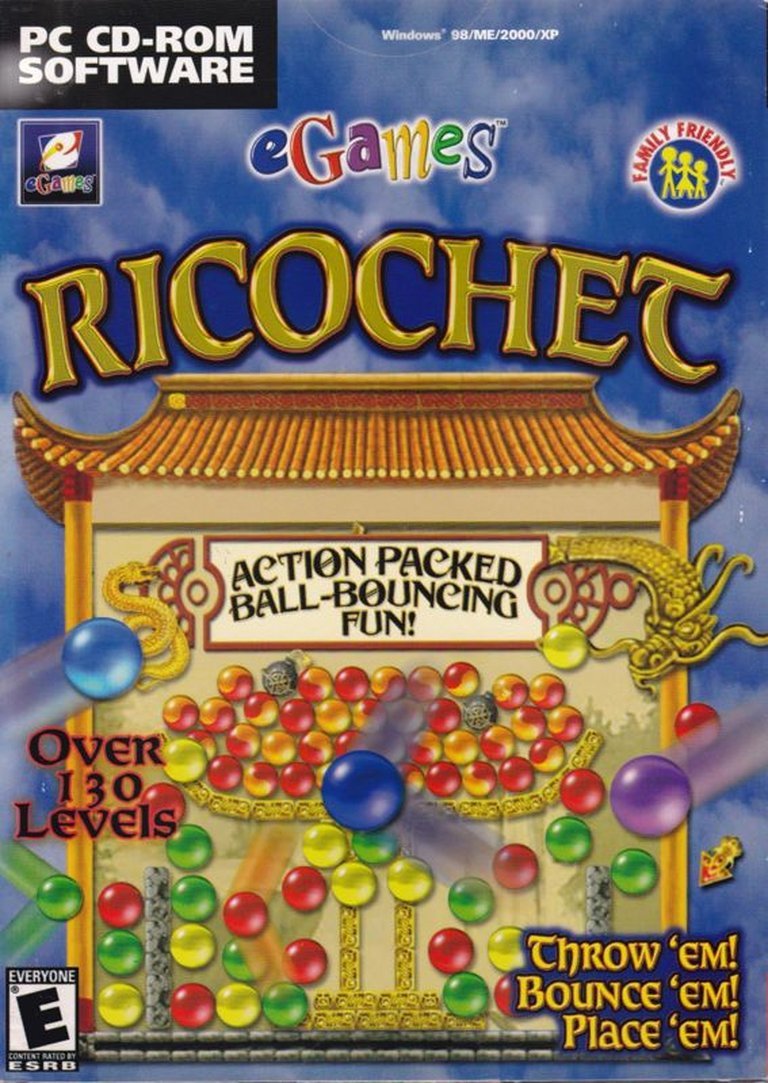
Ricochet (2005) is a tile-matching puzzle game set in ancient Japan, where players control rubber balls by clicking and moving them with the mouse. The game features three modes: Strategy (clearing tiles to reach a score), Arcade (clearing levels before a timer expires), and Puzzle (replicating patterns), introducing mechanics like bi-colored balls, stone obstacles, wind deflection, and reversed gravity as complexity increases.
Gameplay Videos
Where to Buy Ricochet
PC
Ricochet Free Download
PC
Ricochet Serial Keys
Ricochet Patches & Updates
Ricochet Mods
Ricochet Guides & Walkthroughs
Ricochet Reviews & Reception
uk.pcmag.com (80/100): Based on block-breaking games such as Breakout and Arkanoid, Ricochet jazzes up the genre with three levels of difficulty, four environments, smooth animation, and lots of power-ups that can be either helpful or harmful to game play.
Ricochet Cheats & Codes
Ricochet Xtreme (PC)
Enter codes during gameplay.
| Code | Effect |
|---|---|
| cheatnext | Skip level |
| cheatrail | Rail ball |
| cheatsmall | Small ball |
| cheatfire | Fire ball |
| cheatsplit | Multiple balls |
| cheatzach | Crazy score display |
| cheatmiss | Missiles |
| cheatgun | Guns |
| cheatreverse | Reverse mouse movement |
| cheatshrink | Shrink bat |
| cheatgrow | Grow bat |
| cheatcatch | Magnetic bat |
| flipad | Cycle through ads |
| showbackground | Toggle background setting |
| showmph | Toggle ball speed display |
Ricochet: Lost Worlds Recharged (PC)
Enter codes during gameplay.
| Code | Effect |
|---|---|
| CheatReverse | Reversed controls |
| Cheatzach | Crazy points |
| showFPS | Display frame rate |
| showMPH | Display ball speed |
| dirtyrect | Direct rect display enable |
| DebugSkip | Level skip |
| DebugUnlockAll | All levels unlocked |
| DebugUnlockLast | Last checkpoints unlocked |
| DebugGetRings | Most rings |
| flipad | Change ad picture in top right corner |
| debugright | Ball moves right in air or no speed when on paddle |
| debugleft | Ball moves left in air or no speed when on paddle |
| KillMeNow | Lose one life |
Ricochet Lost Worlds (PC)
Enter codes during gameplay.
| Code | Effect |
|---|---|
| Cheatzach | Crazy Score Display |
| DebugGetRings | Earn Most Rings |
| flipad | Flips the advertisement in upper-right |
| KillMeNow | Instant Kill |
| debugleft | Moves Ball Left |
| debugright | Moves Ball Right |
| CheatReverse | Reversed Controls |
| showMPH | Shows Ball Speed in Miles Per Hour |
| showFPS | Shows Frames Per Second |
| DebugSkip | Skip Current Level |
| DebugUnlockAll | Unlocks All Levels |
| DebugUnlockLast | Unlocks Last Area |
Ricochet Infinity (PC)
Enter codes during gameplay.
| Code | Effect |
|---|---|
| debugfinishlevel | Finish current level |
| debugunlockset | Complete current set |
| debugunlocklast | Unlock all levels of current set except the last one |
| lxylxy | Unlock all levels of current set |
| debugunlockplanets | Unlock All Levels |
| debugunlockall | Unlock all balls, ships and levels |
| debugmaxrank | Toggle Rank max |
| debugminrank | Toggle Rank min |
| debugresetachievements | Reset All Achievements |
| debugacid | Acidball |
| debugballgen | Ballgenerator |
| debuglaser | Laserball |
| debugbiggun | Meg-O-Blaster Gun |
| debugbloss | Blossom |
| debugemp | EMP Bomb |
| debugcatch | Ball Catcher |
| debugexpand | Shield Expander |
| debugextra | Extra Ion Sphere |
| debugfast | Faster Ball |
| debugfire | Fire Ball |
| debugfreeze | Ship Freeze |
| debuggun | Laser Blaster Gun |
| debuglight | Lightning Ball |
| debuginline | Inline 3 Way Ball Split |
| debug3way | 3 Way Ball Split |
| debug8way | 8 Way Ball Split |
| debugnormball | Normal Ball |
| debugnormship | Normal Ship |
| debugnuke | Nuclear Beam |
| debugprobe | Probe |
| debugrail | Rail Ball |
| debugsafe | Safety Bumper |
| debughelper | Ship Helper |
| debugspecialty | Ship Specialty |
| debugshrink | Shield Shrinker |
| debugsight | Sight |
| debugballslow | Slower Ball |
| debugsmall | Small Ball |
| debugsting | Stinger Missiles |
| cheatzach | Score points faster |
| slowmotion | Slow Motion |
| killmenow | Suicide |
| cheatreverse | Reversed controls |
| debugspawnspaceship | Spawn an invader |
| debugeveryring | Get every ring on current set |
| debuggetrings | Get all but 2 levels’ rings on set |
| showfps | Toggle FPS |
| pmon | Display Statistics |
| cachedscal | Enable Realtime scaling |
| blitx | Disable Realtime scaling |
| xxyyxx | Toggle Safezone display |
| debugon | Toggle debugging |
| debugoff | Toggle debugging |
| xybaxyba[UP ARROW] | Load All assets |
Ricochet (2004) (PC)
Type GARGLUVSBIGBOTS at the main menu to enable cheat mode. Press [Clr/Home] followed by one of the following keys.
| Code | Effect |
|---|---|
| [Inst/Del] | Add screen |
| [Plus] or [Minus] | Cycle through screens |
| [F7] | Delete screen from memory |
| N | Name Screen |
| Fire | Place block |
| [F1] | Position angry yak |
| [Clr/Home] | Return to game |
| (Various keys) | Select building blocks |
| [Commodore] | View memory coordinates |
Ricochet: A Puzzle of Time and Space
Introduction
In the vast landscape of video game history, few titles manage to carve out a niche as unique and enduring as Ricochet. Released in 2005 by Greenstreet Software Ltd. and eGames, Inc., this tile-matching puzzle game stands out for its innovative mechanics and Japanese-inspired aesthetic. At its core, Ricochet is a game about strategy, precision, and the satisfying clatter of rubber balls colliding. Yet, beneath its deceptively simple surface lies a depth of gameplay that has captivated players and critics alike. This review aims to dissect Ricochet in its entirety, exploring its development history, narrative themes, gameplay mechanics, and lasting legacy.
Development History & Context
The Studio and Creators’ Vision
Ricochet was developed by Kraisoft Entertainment and Newton Game Dynamics Ltd., with a small but dedicated team of nine individuals. The project was overseen by Victor Ryabinin and Vadim Khrulyev, who served as project managers, while Elena Kalashnikova crafted the game’s scenario. The artistic direction was handled by Mikhail Kulikov, and the game’s soundtrack was composed by Vakhtang Adamiya. The team’s collective effort resulted in a game that blended traditional puzzle mechanics with a unique Japanese theme, setting it apart from contemporaries like Bejeweled and Zuma.
Technological Constraints and the Gaming Landscape
Released in 2005, Ricochet emerged during a period of rapid evolution in the puzzle genre. The early 2000s saw a surge in tile-matching games, driven by the success of titles like Bejeweled and Tetris. However, Ricochet distinguished itself with its physics-based mechanics, where tiles behaved like rubber balls that could be moved and matched. This innovation was a response to the growing demand for more dynamic and interactive puzzle experiences. The game’s use of a mouse-controlled interface was also ahead of its time, offering a level of precision and control that was not commonly found in puzzle games of the era.
Narrative & Thematic Deep Dive
Plot and Characters
Ricochet does not boast a complex narrative, but its setting and themes are deeply rooted in Japanese culture and aesthetics. The game’s levels are inspired by ancient, classical, and medieval Japan, featuring cherry blossoms, traditional architecture, and serene landscapes. The absence of a traditional storyline allows the game to focus on its core mechanics, but the thematic elements create a cohesive and immersive atmosphere.
Dialogue and Themes
While Ricochet lacks dialogue, its themes are conveyed through its visual and auditory design. The game’s soundtrack, composed by Vakhtang Adamiya, features traditional Japanese instruments and melodies that enhance the game’s cultural setting. The sound effects, from the satisfying clink of matching tiles to the gentle rustle of wind, contribute to a sense of tranquility and focus. The game’s themes of harmony and balance are reflected in its mechanics, where players must carefully plan their moves to create the longest possible chains of matching tiles.
Gameplay Mechanics & Systems
Core Gameplay Loops
Ricochet offers three distinct game modes: Strategy, Arcade, and Puzzle. Each mode presents a unique challenge, catering to different playstyles and skill levels.
- Strategy Mode: This mode features 54 levels where the objective is to make enough combinations to clear the level. It emphasizes careful planning and strategic thinking, as players must navigate increasingly complex layouts and hazards.
- Arcade Mode: Similar to Strategy Mode, but with a time limit. Players must clear the level before the countdown timer expires, adding an element of urgency and excitement.
- Puzzle Mode: This mode presents players with a selection of balls and tasks them with replicating a specific pattern. It tests the player’s ability to visualize and execute precise moves.
Combat and Character Progression
Unlike traditional puzzle games, Ricochet does not feature combat in the conventional sense. Instead, the game’s challenge lies in overcoming obstacles and hazards, such as stone balls that cannot be matched, wind that deflects the balls, and reversed gravity on certain levels. The game’s progression is based on the player’s ability to adapt to these challenges and develop effective strategies.
UI and Innovative Systems
The user interface of Ricochet is clean and intuitive, with a minimalist design that keeps the focus on the gameplay. The game’s controls are straightforward, with players using the mouse to select and move tiles. The inclusion of a high score table for each game mode adds a competitive element, encouraging players to strive for perfection.
World-Building, Art & Sound
Setting and Atmosphere
Ricochet transports players to a serene and visually stunning world inspired by Japanese landscapes. The game’s levels are filled with cherry blossoms, traditional buildings, and tranquil water features, creating a sense of peace and harmony. The attention to detail in the art direction is evident in every aspect of the game, from the intricate tile designs to the dynamic lighting effects.
Visual Direction
The game’s visual style is a blend of traditional Japanese art and modern puzzle game aesthetics. The use of vibrant colors and detailed textures enhances the game’s appeal, making it a feast for the eyes. The fixed/flip-screen perspective allows for a clear view of the gameplay area, ensuring that players can easily plan their moves.
Sound Design
The soundtrack of Ricochet is a standout feature, with traditional Japanese instruments and melodies that complement the game’s visual style. The sound effects are equally impressive, with each tile match accompanied by a satisfying clink that reinforces the game’s tactile feedback. The ambient sounds, such as the rustling of wind and the gentle flow of water, contribute to the game’s immersive atmosphere.
Reception & Legacy
Critical and Commercial Reception
Upon its release, Ricochet received positive reviews for its innovative mechanics and beautiful art direction. Critics praised the game’s unique take on the tile-matching genre, with many highlighting its strategic depth and satisfying gameplay. The game’s commercial performance was modest, but it developed a dedicated following among puzzle enthusiasts.
Influence on Subsequent Games
Ricochet has had a lasting influence on the puzzle genre, inspiring a wave of games that incorporate physics-based mechanics and dynamic tile-matching elements. Its success paved the way for titles like The Relax Balls and Bricks vs Balls, which built upon the foundation laid by Ricochet. The game’s legacy is also evident in the enduring popularity of tile-matching games, which continue to be a staple of the puzzle genre.
Conclusion
Ricochet is a testament to the power of innovative gameplay and beautiful design. Its unique mechanics, stunning visuals, and immersive soundtrack set it apart from its contemporaries and cement its place in video game history. While it may not have achieved mainstream success, its influence on the puzzle genre is undeniable. For those seeking a challenging and rewarding puzzle experience, Ricochet remains a timeless classic.