
- Release Year: 2005
- Platforms: Linux, Macintosh, Windows
- Genre: Driving, Racing, Simulation
- Perspective: Behind view
- Game Mode: Online Co-op, Single-player
- Gameplay: Open World, Sandbox
Description
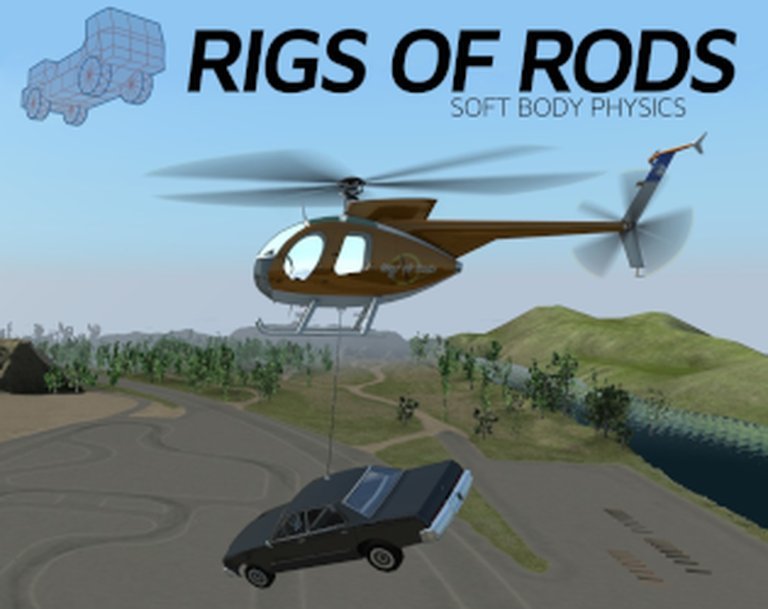
Rigs of Rods is a free, open-source sandbox vehicle simulator that utilizes soft-body physics to realistically simulate the deformation, destruction, and flexible movement of vehicles during driving and collisions. Set in expansive open-world environments, the game allows players to operate a variety of vehicles, such as cars and buses, with a focus on experimental gameplay and extensive mod support for custom vehicles and scenarios.
Gameplay Videos
Rigs of Rods Free Download
Rigs of Rods Mods
Rigs of Rods Guides & Walkthroughs
Rigs of Rods: The Unfinished Symphony of Soft-Body Physics
Introduction: The Sandbox That Crumbled the Genre
In the annals of gaming, few titles occupy as curious a position as Rigs of Rods. It is not a game defined by its commercial success, its narrative grandeur, or its graphical prowess. Instead, its legacy is forged in silicon and stress calculations—a freely available, perpetually evolving sandbox where the very concept of a “vehicle” is deconstructed into a lattice of nodes and beams, only to be spectacularly reassembled or shattered by the immutable laws of its own physics. This review argues that Rigs of Rods (RoR) is not merely a vehicle simulator but a foundational physics art piece and an open-source phenomenon. Its genius lies in its ruthless, beautiful commitment to a single, radical idea: that the joy of driving comes not from mastering a pre-bent track, but from contending with and creatively overcoming a universe where every bolt, beam, and chassis flexes with a life of its own. To play RoR is to engage with a living physics laboratory, a testament to the power of community-driven development that, for two decades, has stubbornly refused to become a finished product.
Development History & Context: From French Basement to Global Sandbox
The saga of Rigs of Rods begins not in a corporate studio, but with the solitary vision of Pierre-Michel Ricordel (“pricorde”), a French developer. Inspired by the flexible car physics of 1nsane (2001) and the structural engineering sim Pontifex (2000), Ricordel sought to answer a simple question: why couldn’t a truck simulator’s chassis actually bend and break under stress? The technological landscape of 2005 was dominated by rigid-body physics engines (like those in Grand Theft Auto III or Need for Speed), where vehicle deformation was a pre-scripted, low-polygon affair. Ricordel’s solution was the Beam engine, a custom, mass-spring-damper system built from scratch in C++.
The first public iteration, version 0.11 (August 11, 2005), was a stark, demanding proposition. As the official blog warned, it required a 3GHz Pentium 4—extreme hardware for the time—and offered no goals, no “game” in the traditional sense. It was a raw, closed-source tech demo: an off-road truck navigating procedurally generated terrain from heightmaps, its frame visibly flexing over bumps, its collisions resulting in genuinely organic, permanent deformation. Early updates were frantic and personal. Version 0.12 (August 15, 2005) added crudely textured “phantom buildings” for collision and the first taste of shadows. The development blog reads like a hacker’s manifesto, filled with notes on shadow techniques (“Texture shadows is the best compromise. Stencil shadows are slower, and are still buggy”) and performance tweaks. The focus was purely on the fidelity of the physical model, with aesthetics and structure as afterthoughts.
The pivotal moment arrived on February 8, 2009, when Ricordel open-sourced the project under the GPLv2 (later GPLv3). This was not an admission of failure but an acknowledgement of the project’s natural evolution. The physics core was robust and fascinating, but the surrounding ecosystem—terrain editors, vehicle creators, mission designers—required a crowd. The shift to SourceForge (later GitHub) catalyzed a Cambrian explosion of contribution. Key figures emerged: Thomas Fischer (“tdev”), who from 2007-2013 provided critical engine optimizations and stability; Petr Ohlidal (“onlyaptr”), who became the long-term maintainer post-2015; and a legion of specialists like “Estama” (collision/friction), “Aperion” (networking, axles), and “Lifter” (animation systems).
The project’s technological backbone solidified around the OGRE rendering engine and a transition from the initially used Lua to the more robust AngelScript for in-game scripting (version 0.38). A landmark innovation was the Flexbody system (circa 2009, version 0.36), which allowed static 3D meshes to be deformed by the underlying node-beam skeleton, moving beyond simple wireframe vehicles to beautifully contorting, skin-wrapped machines. The development timeline, stretching from 2005 through 2025 release candidates like 2025.08 RC2, is not a linear march to a “gold master” but a continuous, community-led accretion of features—AI waypoints, enhanced multiplayer, modern UI with Dear ImGui—all built upon that immutable, stress-bearing core physics.
Narrative & Thematic Deep Dive: The Story You Write Yourself
To speak of “narrative” in Rigs of Rods is to speak of the emergent, player-authored story. There is no plot, no characters, no dialogue. The “themes” are not embedded in a script but are inherent in the simulation’s DNA: the fragility of design, the triumph of adaptation, and the sublime comedy of failure.
The game provides the stage: vast, often brutal terrains generated from grayscale heightmaps—real-world topographies like the Alps or user-created nightmares of sheer cliffs and deep, soft soil. The actors are the vehicles, born from plaintext .truck files where every node’s mass and every beam’s stiffness and breaking strength are defined. The script is the player’s intent: “I want to drive this meticulously modeled Kirovets K-700 tractor-trailer up this 80-degree incline.” The physics engine becomes the unflinching, impartial narrator.
The narrative emerges in the catastrophic pivot. The perfectly tuned suspension beam, stressed beyond its plastic limit, snaps with an audible crack. The left side of the chassis collapses. The vehicle, now a lopsided, groaning monument to poor engineering, limps and rolls instead of drives. The player’s original narrative—conquering the hill—ends in a crumpled heap. A new, richer narrative begins: a desperate, inventive struggle to salvage the situation. Do you abandon ship and walk? Do you attempt a bizarre, reverse-gear descent? Do you spawn a crane to try and right the beast? The game’s utter lack of punitive “game over” states allows these micro-dramas to unfold. The theme is process over outcome. The “win condition” is not a checkered flag but the successful, physics-plausible execution of an idea, however mundane or absurd.
The modding community amplifies this infinitely. Download a Vistara Airlines 777-300ER (a flexbody marvel), not to simulate a transatlantic flight, but to see if its massive, deformable wings can generate enough lift on a steep downhill run to become a glider. Or attach a dozen porta-potties as an unstable trailer and see how they bounce on a rocky descent. The narrative is no longer about driver vs. terrain, but player vs. simulation rules. The deepest thematic resonance lies in the game’s status as a digital ant-farm. You are both a participant and a god, observing the chaotic, beautiful consequences of your constructions within a world that obeys no rules but its own.
Gameplay Mechanics & Systems: The Cathedral of Nodes and Beams
At its heart, RoR is a physics-first design, with all other systems orbiting its gravitational pull.
Core Loop & Systems: There is no traditional “core gameplay loop” of run-shoot-loot. The loop is Concept → Build/Select → Deploy → Observe → Adapt. The player selects or builds a vehicle from the repository, chooses a terrain (or builds one from a heightmap), and drives. The terminal point of any run is not a finish line but a state of terminal mechanical failure or successful arrival. Progress is measured in accumulated knowledge of physics interactions.
-
Vehicle Construction (.truck files): This is the game’s deepest mechanic. Vehicles are defined by:
- Nodes: Mass points in 3D space. Each has position, mass, and collision properties.
- Beams: Massless, spring-damper constraints connecting two nodes. Their core parameters are
stiffness(spring constant k),damping(c),strength(breaking stress), andplastic(whether permanent deformation occurs). The engine calculates beam force as F = -kΔL – c·v, as noted in the source material. Suspension, chassis, axles—all are networks of beams. - Submeshes & Flexbodies: Visual representation is decoupled. Simple skins wrap the node network. The Flexbody system (since ~0.36) maps a static 3D mesh to a “skeleton” of nodes, allowing visual deformation to match physical deformation—a Dodge Viper’s fender denting under a beam’s stress.
- Engine/Suspension Syntax: A complex, text-based language defines gear ratios, differential locks, hydraulic kinematics, and aerodynamic surfaces.
-
Terrain Generation: Maps are built from grayscale heightmaps (RAW/PNG). White is high, black is low. This means any image can be a terrain—a scanned photograph, a work of art, a fractal pattern. Objects (buildings, trees, ramps) are added via
.odeffiles placed in terrain archives. -
Control & Input: Direct, analog control via keyboard/mouse or wheel. The handling model is entirely derivative of the vehicle’s physical construction. A poorly balanced truck will understeer or oversteer based on node mass distribution and beam elasticity. There is no artificial “grip” slider.
-
Scripting & Goals (AngelScript): The sole concession to traditional design. Scripts can create timed missions, checkpoints, drag strips, and basic AI behavior (via waypoints, added in 2022.12). However, these are community add-ons. The stock game has no campaign or career mode.
Innovations & Flaws:
* Innovation: The unified soft-body model is unparalleled. Everything—tires, chassis, wings, hulls—is a deformable network. This creates seamless, believable interactions a rigid-body engine cannot replicate: a tire compressing into a soft rock trench, a boat’s hull flexing with each wave, a plane’s wing warping under G-force.
* Innovation: Total moddability as a philosophical stance. No black boxes. Every parameter is exposed and editable.
* Flaw: Extreme Performance Cost. The explicit Euler integration running at 2kHz (fixed 0.5ms timestep) is computationally immense. This necessitates high-end CPUs (historically) and limits scene complexity and multiplayer player counts (default 10, max ~16 stably).
* Flaw: The Editor Void. There is no integrated, user-friendly vehicle or terrain editor. Creation requires external tools (Blender, L3DT, text editors) and technical literacy. This creates a high barrier to entry, gating content creation behind a skills wall.
* Flaw: Aesthetic Inconsistency. Graphics are dependent entirely on modder artistry. The base terrain is often stark and low-poly. The UI, until the 2021.02 Dear ImGui overhaul, was rudimentary.
* Flaw: Physics “Jank.” The node-beam model, while brilliant, can produce non-realistic oscillations (“wobble”) if beams are poorly tuned or if the integrator struggles with extreme scenarios. It’s a simulator of structural dynamics, not always of driving dynamics.
World-Building, Art & Sound: A User-Generated Tapestry
The “world” of Rigs of Rods is a paradox: a technically sophisticated physics engine housed within an artistically anarchic, user-generated multiverse.
- Setting & Atmosphere: The base terrains are functional, often desolate landscapes—barren deserts, rocky outcrops, generic “off-road” zones. The atmosphere is one of solitude and industrial exploration. There is no ambient life, no bustling cities. The only sounds are the engine’s roar (often simple, looping samples), the crunch of suspension, and the terrifying metallic shriek of breaking beams.
- Visual Direction: There is no singular visual direction. The aesthetic is eclectic modding. One moment you’re piloting a photorealistic, flexing DAF TurboTwin semi-truck through a foggy, realistic mountain pass. The next, you’re launching a cartoonish, blocky school bus off a ramp in a bright, low-poly fantasy map. The Flexbody system is the hero here, allowing meticulously crafted 3D models to participate in the physics drama. The lighting is basic (ambient + directional), with shadows as a persistent performance trade-off.
- Sound Design: Sparse and utilitarian. Engine sounds are often generic and repetitive. The true “sound design” is auditory feedback from physics: the clang of a beam reaching its limit, the abrupt snap of a failure, the grinding scrape of a dragged axle. These sounds are critical cues for the player, more important than any soundtrack.
The contribution of these elements is to frame the physics as the sole, unifying spectacle. The art and sound serve the simulation, not the other way around. A visually stunning mod is valueless if its underlying .truck file has poorly tuned beams that feel “floaty” or unbreakable. The experience is of a consistent, unforgiving physical reality wearing countless different masks.
Reception & Legacy: The Scholar’s Darling and the Com mercial Heir
Critical Reception: Rigs of Rods exists almost entirely outside traditional review aggregates like Metacritic. Its acclaim comes from technical and academic spheres. The most cited endorsement is from Dr. Brian Beckman, a physicist at Microsoft Research, who in a famous 2007 Channel 9 interview called it “one of the best driving simulations I have ever seen,” praising its accurate depiction of vehicle dynamics. This sentiment was echoed in publications like PC Gamer UK (Christmas 2007) and French magazine MicroSim (June 2008). The game’s creator was invited to present at the Libre Software Meeting in 2009, cementing its status as a landmark open-source project. Criticisms were consistent: a steep learning curve, dated graphics (even for its time), and daunting technical requirements for creation.
Community & Modding Legacy: This is where RoR transcends its limitations. The official forum (thousands of threads) and Discord server (4,000+ members) are bustling hubs of collaboration. The in-game repository (with over 6.4 million downloads as of 2022) hosts thousands of vehicles and terrains. The modding culture is a profound achievement: users reverse-engineer the .truck format, create intricate 3D models in Blender, painstakingly tune beam parameters for specific handling, and build entire themed worlds. This ecosystem is the game’s true “content,” sustaining it for 20 years. It fostered a generation of vehicle simulation modders.
Industry Influence & The Proprietary Heir: RoR’s most significant legacy is the direct lineage to BeamNG.drive. In 2011, key RoR developers, most notably Thomas Fischer, co-founded BeamNG GmbH to create a commercial, polished successor. BeamNG’s proprietary “Torque3D”-based soft-body physics engine is a spiritual and philosophical descendant of the Beam engine. It directly inherited the node-and-beam concept but implemented it with far greater performance (via sophisticated solver algorithms and GPU acceleration), a polished UI, and first-party, high-fidelity content. As noted in the sources, BeamNG has sold over 5 million copies, bringing the concept of real-time soft-body vehicle destruction to a mainstream audience. While RoR remains GPL and BeamNG is proprietary, the connection is explicit and acknowledged. Games like Wreckfest also owe a conceptual debt to this lineage, incorporating deformable metal, though with a different, more arcade-oriented implementation.
Current Status: RoR persists as a shining example of sustainable open-source development. It is not “abandoned” but maintained at a pace dictated by volunteer passion. The 2022.12 release and subsequent 2025 RCs show active development: AI improvements, modding tools, UI refinement. Its GitHub repository is a living document of incremental progress. It remains free, cross-platform (Windows/Linux), and a haven for tinkerers who want to play with the raw guts of a physics simulation without commercial constraints.
Conclusion: The Imperfect, Essential Prototype
Rigs of Rods is not a “great game” by conventional metrics. It is ugly, obtuse, performance-hungry, and has no beginning, middle, or end. Its interface has historically been cryptic, and the barrier to meaningful participation is high. To dismiss it on these grounds, however, is to miss its monumental achievement.
It is the essential prototype. It proved that a convincing, unified soft-body vehicle simulation was possible on consumer hardware and within an open-source framework. It established the node-beam paradigm that would later power a commercial hit. More importantly, it demonstrated that a game could be a physics-first sandbox, where player creativity, not designer hand-holding, is the primary content. Its legacy is bifurcated: on one branch, the accessible, commercial spectacle of BeamNG.drive; on the other, the endlessly malleable, community-driven laboratory of RoR itself.
For the historian, RoR is a crucial artifact of the late-2000s open-source gaming surge, alongside titles like 0 A.D. and SuperTuxKart. It stands as a monument to a specific kind of developer—the hacker-artist for whom the simulation is the game. Its place in history is secure: it is the messy, brilliant, unfinished sketch that taught the industry how to make vehicles that break, and in doing so, gave a community the tools to build their own worlds, one stress-laden beam at a time. Its final, definitive verdict is that it is not a completed game to be judged, but a living engine to be used, and in that utility, it has already triumphed.