
- Release Year: 2009
- Platforms: Nintendo Switch, PlayStation 4, Windows, Xbox 360, Xbox One, Xbox Series
- Publisher: ak tronic Software & Services GmbH, Koch Media GmbH, THQ Nordic GmbH
- Developer: Piranha Bytes
- Genre: Role-playing (RPG)
- Perspective: Behind view
- Game Mode: Single-player
- Gameplay: Action RPG, Alchemy, Arena fighting, Blacksmithing, Character development – Training, Goldsmithing, Hunting, Mining, Survival cooking
- Setting: Deserted Island, Fantasy, Tropical Island
- Average Score: 76/100
Description
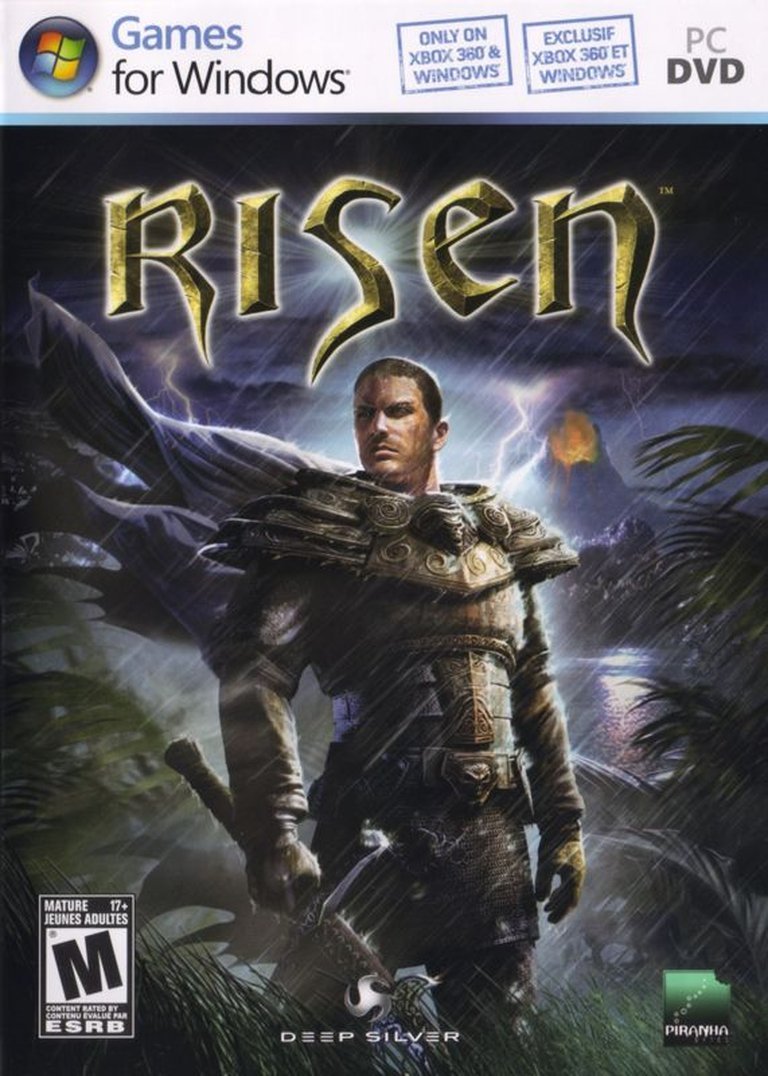
Risen is a fantasy action RPG set on a volcanic island that has been partially shielded from a catastrophic global upheaval. The protagonist, a shipwrecked survivor, must explore the island, uncover its mysteries, and align with one of three factions—bandits, mages, or inquisitors—to determine their fate. With a focus on open-ended exploration, skill-based combat, and faction-driven choices, the game blends the classic Gothic series’ gameplay with a smaller but densely packed world, emphasizing survival, crafting, and tactical battles against creatures like gnomes and ash-beasts.
Gameplay Videos
Where to Buy Risen
Risen Patches & Updates
Risen Mods
Risen Guides & Walkthroughs
Risen Reviews & Reception
metacritic.com (85/100): Piranha Bytes has created a new series. Risen is not only a good heir to Gothic, but also establishes solid bases which could mark the way for this studio in the future.
reddit.com : Risen is an action RPG developed by Piranha Bytes. Released in 2009, Risen tells us that just because a developer loses the rights to their game doesn’t mean they can’t make a sequel to it anyways.
opencritic.com (67/100): Risen is packed with content and if you can get past its blemishes there is a solid RPG here to last you at least 60 hours, but I feel a lot of today’s gamers won’t even get off the beach tutorial at the beginning of the game.
ign.com : Piranha Bytes delivers a game with powerful, authentic atmosphere.
Risen Cheats & Codes
PC
Type ‘minsky’ during gameplay and press Enter to enable cheat mode. Then press ~ (North American version), § (European version), or F1 to display the console window and enter the following codes.
| Code | Effect |
|---|---|
| God | God mode |
| Invisible | Ignored by enemies until you hit someone or steal something |
| Teach [skill] [number] | Teach specific skill |
| Teach All [number] | Teach all skills |
| Give [item name] | Get item |
| give It_Gold | Get gold |
| give It_Gold [number] | Get indicated amount of gold |
| give It_Armor | All armor |
| give It_Ru_Teleport | All 14 Teleport Runes |
| Give All [number] | Get all items; may glitch game |
| Spawn [entity name] | Spawn specific entity |
| Time [hh.mm] | Set game time |
| Time scale [number] | Set slow or fast motion; 1 is default |
| IsoView | Isometric view |
| FirstPersonCamera | First person view; may glitch game |
| Set [variable] [value] | Set variable or state |
| help | Console help |
| list | Use after ‘help’ to list cheat codes |
| goto [name] | Go to indicated NPC (case-sensitive) |
| edit PC_Hero | Player editor |
| setqueststatus [quest tag] [open, run, cancel, close, succeed, fail] | Set state of any open quest |
Risen: A Gothic Legacy Reforged in Fire and Flaw
Introduction: The Unlikely Phoenix of a Fallen Franchise
In the annals of RPG history, few studios have evoked as much devotion—or as much frustration—as Piranha Bytes. The German developers, architects of the Gothic series, had carved a niche for themselves with their uncompromising, immersive, and often punishing brand of fantasy role-playing. Yet by 2009, their reputation was in tatters. Gothic 3, released in 2006, had been a technical disaster—bug-ridden, unfinished, and a shadow of the studio’s former glory. The fallout was swift: Piranha Bytes split from publisher JoWooD, losing the rights to the Gothic name in the process. For many fans, it seemed the end of an era.
But from the ashes of that collapse rose Risen—a game that was, in many ways, Gothic by another name. Released on October 2, 2009, Risen was Piranha Bytes’ defiant attempt to reclaim their legacy, to prove that the spirit of their earlier works could survive without the brand. Set on the volcanic island of Faranga, Risen promised a return to the studio’s roots: a harsh, open world, deep character progression, and a narrative driven by player choice and factional allegiance.
Yet Risen was more than just a spiritual successor. It was a statement—a game that wore its influences proudly but also sought to refine and redefine them. It was a game that, for all its flaws, dared to be different in an era increasingly dominated by the polished, streamlined RPGs of Bethesda and BioWare. And it was a game that, a decade and a half later, remains one of the most fascinating, frustrating, and underappreciated entries in the Western RPG canon.
This review is not just an evaluation of Risen as a game, but an exploration of its place in history—of what it meant in 2009, what it means now, and why, despite its many imperfections, it remains a vital artifact of RPG design.
Development History & Context: The Birth of a Phoenix
The Fall of Gothic and the Rise of Risen
To understand Risen, one must first understand the turbulent history of Piranha Bytes and the Gothic series. The studio’s first two games, Gothic (2001) and Gothic II (2002), were critical darlings, praised for their immersive worlds, challenging combat, and deep role-playing mechanics. They were games that demanded patience, skill, and a willingness to engage with their systems on their own terms. They were, in many ways, the antithesis of the increasingly accessible RPGs emerging from North America.
But Gothic 3 (2006) was a disaster. Plagued by development issues, including an overly ambitious scope and a rushed release, the game shipped in a nearly unplayable state. Bugs, performance issues, and a lack of polish marred what should have been a triumphant conclusion to the trilogy. The fallout was swift: Piranha Bytes’ relationship with publisher JoWooD deteriorated, culminating in a bitter split that left the studio without the rights to the Gothic name.
For Piranha Bytes, Risen was not just a new game—it was a chance at redemption. The studio, now under the banner of Deep Silver, set out to create a game that would recapture the magic of the first two Gothic titles while avoiding the pitfalls of the third. The result was Risen, a game that was, in many ways, Gothic in all but name.
The Vision: A Return to Roots
From the outset, Risen was conceived as a return to the studio’s roots. The game’s creative leads—including Michael Rüve (Managing Director), Michael Hoge, Björn Pankratz, Mattias Filler, and Stefan Kalveram—sought to create a world that was smaller in scope than Gothic 3 but richer in detail and atmosphere. The island of Faranga, inspired by the landscapes of Sicily, was designed to be a self-contained, living world, a far cry from the sprawling, bug-ridden continent of Gothic 3.
The game’s narrative was similarly focused. Unlike Gothic 3, which attempted to tell an epic, continent-spanning story, Risen’s plot was confined to a single island, with a narrative that revolved around the discovery of ancient ruins, the conflict between factions, and the looming threat of the Titans—ancient beings unleashed by humanity’s hubris. It was a story that, while not without its flaws, was more cohesive and focused than anything Piranha Bytes had attempted since Gothic II.
Technological Constraints and Innovations
Risen was built using the GENOME engine, a proprietary technology developed by Piranha Bytes. While not as advanced as the engines powering contemporaries like The Elder Scrolls IV: Oblivion or Fallout 3, the GENOME engine was optimized for the type of dense, detailed environments that Piranha Bytes sought to create. The engine supported advanced physics (via NVIDIA’s PhysX), dynamic lighting, and a seamless open world—features that were still relatively rare in RPGs at the time.
Yet the engine was not without its limitations. The game’s draw distance was limited, and textures often appeared muddy or low-resolution, particularly in the Xbox 360 version. The animation system, while functional, lacked the fluidity of more modern engines, leading to stiff, sometimes awkward character movements. These technical limitations would later become a point of contention, particularly among critics who compared Risen to more polished contemporaries.
The Gaming Landscape of 2009
Risen arrived at a pivotal moment in RPG history. The late 2000s saw the rise of the “open-world RPG” as a dominant genre, with games like Oblivion (2006) and Fallout 3 (2008) setting new standards for scope, freedom, and accessibility. These games, with their streamlined mechanics and player-friendly designs, stood in stark contrast to the punishing, systems-driven RPGs of Piranha Bytes’ past.
Yet Risen was not alone in its old-school sensibilities. Games like The Witcher (2007) and Dragon Age: Origins (2009) proved that there was still an audience for more traditional, mechanics-heavy RPGs. Risen, with its emphasis on skill-based combat, deep character progression, and factional allegiance, fit squarely within this niche. It was a game that, for better or worse, refused to compromise its vision to fit the trends of the time.
Narrative & Thematic Deep Dive: A World on the Brink
The Premise: A World Without Gods
Risen’s narrative is set in a world where humanity, in its arrogance, has banished the gods—only to unleash the Titans, ancient beings of immense power who now ravage the land. The game’s opening cinematic sets the stage: storms rage across the seas, earthquakes split the earth, and ancient temples rise from the ground, heralding the return of forgotten horrors. Amidst this chaos, the island of Faranga stands as a rare sanctuary, protected by an unknown force from the Titans’ wrath.
The player takes on the role of a nameless stowaway, washed ashore after their ship is destroyed by a Titan. From the moment they wake on the beach, the game’s tone is set: this is a world where survival is not guaranteed, where every shadow could hide a deadly foe, and where the player’s choices will shape not just their character, but the fate of the island itself.
The Factions: Three Paths to Power
Central to Risen’s narrative is the player’s choice of faction. Early in the game, the player must align themselves with one of three groups:
-
The Bandits: Led by the deposed Don Esteban, the bandits are a ragtag group of outlaws and rebels, fighting against the oppressive rule of the Inquisition. Joining the bandits grants access to unique weapons, armor, and skills, as well as a more roguish, independent playstyle.
-
The Warriors of the Order: The military arm of the Inquisition, led by the ruthless High Inquisitor Mendoza. The Warriors are disciplined, heavily armored, and focused on combat prowess. Aligning with them grants access to powerful melee weapons and armor, as well as a more structured, militaristic playstyle.
-
The Mages: A secretive group of scholars and spellcasters, based in the island’s monastery. The Mages are the most intellectually oriented of the factions, with a focus on magic, alchemy, and ancient knowledge. Joining them grants access to powerful spells and magical artifacts, as well as a more cerebral, strategic playstyle.
The choice of faction is more than just a mechanical one—it shapes the player’s experience in profound ways. Each faction has its own quests, allies, and enemies, and the player’s alignment affects how NPCs react to them, what skills they can learn, and even how the game’s story unfolds. It’s a system that encourages replayability, as each faction offers a fundamentally different experience.
Themes: Hubris, Survival, and the Cost of Power
At its core, Risen is a story about hubris—the consequences of humanity’s arrogance in banishing the gods and unleashing the Titans. The game’s narrative is steeped in this theme, from the ruins of ancient temples to the desperate struggles of the island’s inhabitants to survive in a world torn apart by forces beyond their control.
Yet Risen is also a story about survival. The island of Faranga is a harsh, unforgiving place, where every resource is precious and every decision could mean the difference between life and death. The game’s early hours, in particular, emphasize this theme, as the player struggles to find food, weapons, and shelter in a world that seems determined to kill them.
Finally, Risen is a story about the cost of power. The game’s central conflict—between the Inquisition’s desire to control the Fire Titan and the player’s eventual realization that such control is both dangerous and morally dubious—is a meditation on the dangers of unchecked ambition. Mendoza, the game’s primary antagonist, is not a mustache-twirling villain, but a man driven by a genuine desire to save the world, even if it means sacrificing everything—and everyone—else.
The Characters: A Mixed Bag of Memorable and Forgettable
Risen’s cast of characters is, like much of the game, a mix of the brilliant and the flawed. The game’s NPCs are, for the most part, well-written and voice-acted, with distinct personalities and motivations. Don Esteban, the leader of the bandits, is a charismatic and morally ambiguous figure, while Mendoza, the High Inquisitor, is a complex antagonist whose actions, while often brutal, are driven by a genuine belief in his cause.
Yet the game’s characters are not without their issues. The player’s own character is a blank slate, with no backstory or personality beyond what the player projects onto them. While this is not uncommon in RPGs, it does make it difficult to become emotionally invested in the protagonist’s journey. Similarly, many of the game’s side characters, while well-voiced, lack the depth and development of those in more narrative-driven RPGs.
The Dialogue: A Double-Edged Sword
Risen’s dialogue is, like its characters, a mixed bag. On the one hand, the game’s writing is often sharp, witty, and full of personality. The banter between NPCs is frequently entertaining, and the game’s more serious moments are handled with a surprising degree of nuance.
On the other hand, the game’s dialogue is also plagued by inconsistencies and occasional awkwardness. Some lines are delivered with all the subtlety of a sledgehammer, while others feel out of place or tonally inconsistent. The game’s localization, while generally strong, occasionally stumbles, leading to moments where the dialogue feels stilted or unnatural.
The Plot: A Journey of Discovery and Betrayal
Risen’s plot is divided into four chapters, each of which advances the game’s central narrative while also introducing new challenges, enemies, and locations. The game’s structure is reminiscent of Gothic II, with a clear progression from one act to the next, each building on the last.
The first chapter serves as an introduction to the island and its factions, as the player struggles to survive and find their place in Faranga’s brutal hierarchy. The second chapter sees the player aligning with one of the factions and beginning their journey toward uncovering the island’s secrets. The third chapter is the game’s most combat-heavy, as the player battles their way through ancient ruins and dungeons in search of the artifacts needed to enter the volcano’s heart. The fourth and final chapter culminates in a confrontation with Mendoza and the Fire Titan, as the player must decide whether to attempt to control the Titan or find another way to save the island.
Yet for all its strengths, Risen’s plot is not without its flaws. The game’s pacing is uneven, with some chapters feeling rushed or underdeveloped. The final act, in particular, has been criticized for its abrupt conclusion, which leaves many of the game’s narrative threads unresolved. Similarly, the game’s central conflict—between the player and Mendoza—lacks the emotional weight it could have had, with Mendoza’s motivations and actions often feeling under-explored.
Gameplay Mechanics & Systems: The Soul of a Gothic Game
Combat: A Dance of Steel and Strategy
Combat in Risen is, like much of the game, a throwback to the studio’s earlier works. It is a system that demands precision, timing, and strategy, with a focus on blocking, dodging, and countering rather than brute force. The game’s combat is divided into three main categories: melee, ranged, and magic, each with its own strengths, weaknesses, and playstyles.
Melee Combat: The bread and butter of Risen’s combat system, melee combat is a dance of timing and positioning. Players must learn to block and parry enemy attacks, dodge out of the way of powerful strikes, and counter with their own combos. The game’s melee weapons are divided into three categories—swords, axes, and staves—each with its own unique moveset and playstyle. Swords are fast and precise, axes are slow but powerful, and staves are versatile, offering a mix of melee and magical attacks.
Ranged Combat: Ranged combat in Risen is less emphasized than melee, but still viable. The game offers two main ranged weapons: bows and crossbows. Bows are faster and more maneuverable, while crossbows are slower but deal more damage. Ranged combat is particularly useful in the game’s early hours, where the player’s melee skills may not yet be sufficient to take on stronger enemies.
Magic: Magic in Risen is divided into two categories: Crystal Magic and Rune Magic. Crystal Magic allows players to launch magical projectiles, dealing damage from a distance. Rune Magic, on the other hand, is more utility-focused, offering spells that can heal, buff, or debuff the player and their enemies. Magic is trained similarly to weapon skills, with players needing to find trainers and spend learning points to improve their abilities.
Yet for all its depth, Risen’s combat system is not without its flaws. The game’s controls, particularly on console, can feel clunky and unresponsive, leading to moments of frustration. The game’s targeting system is also inconsistent, with attacks sometimes missing their mark despite the player’s best efforts. And the game’s difficulty curve is uneven, with some enemies feeling unfairly powerful, particularly in the game’s early hours.
Character Progression: A System of Choice and Consequence
Character progression in Risen is a deep, complex system that rewards experimentation and specialization. The game’s skill system is divided into two main categories: combat skills and non-combat skills.
Combat Skills: Combat skills in Risen are tied to the game’s weapon types. Players can train in swords, axes, staves, bows, and crossbows, each of which offers its own unique moveset and playstyle. Training in a weapon type unlocks new abilities, such as powerful combos, special attacks, and defensive maneuvers.
Non-Combat Skills: Non-combat skills in Risen are equally important, offering players a wide range of abilities to explore. These include skills like lockpicking, pickpocketing, alchemy, smithing, and goldsmithing, each of which opens up new ways to interact with the game’s world. For example, alchemy allows players to craft potions and poisons, while smithing allows them to forge and repair weapons and armor.
Character progression in Risen is tied to the game’s faction system. Each faction offers access to unique trainers, skills, and equipment, encouraging players to specialize in a particular playstyle. For example, joining the bandits grants access to unique weapons and armor, as well as skills like lockpicking and pickpocketing. Joining the Warriors of the Order, on the other hand, grants access to powerful melee weapons and armor, as well as skills like smithing and goldsmithing. Joining the Mages grants access to powerful spells and magical artifacts, as well as skills like alchemy and rune magic.
Yet for all its depth, Risen’s character progression system is not without its issues. The game’s skill system can feel overwhelming, particularly for new players, with a wide range of abilities to choose from and no clear guidance on which to prioritize. The game’s leveling system is also somewhat opaque, with experience points often feeling arbitrarily awarded or withheld. And the game’s faction system, while innovative, can feel restrictive, particularly for players who wish to experiment with multiple playstyles.
The UI: Functional but Flawed
Risen’s user interface is, like much of the game, a mix of the functional and the flawed. The game’s inventory system is robust, offering a wide range of options for managing equipment, potions, and crafting materials. The game’s quest log is similarly well-designed, offering clear objectives and markers to guide the player through the game’s many quests.
Yet the game’s UI is not without its issues. The game’s menus can feel clunky and unintuitive, particularly on console, where navigation is often slow and cumbersome. The game’s map system is also somewhat lacking, with no in-game map to speak of, forcing players to rely on external guides or their own memory to navigate the island’s many locations.
Innovation and Flaws: A Game of Contradictions
Risen is, at its core, a game of contradictions—a game that innovates in some areas while stumbling in others. On the one hand, the game’s faction system is a brilliant example of player choice and consequence, offering a level of replayability and depth that few RPGs can match. On the other hand, the game’s combat system, while deep and rewarding, is also clunky and inconsistent, particularly on console.
Similarly, the game’s character progression system is both a strength and a weakness. While it offers a wide range of skills and abilities to explore, it can also feel overwhelming and restrictive, particularly for players who wish to experiment with multiple playstyles.
Yet for all its flaws, Risen is a game that rewards patience and perseverance. It is a game that, like its predecessors, demands that the player engage with its systems on their own terms, rather than expecting the game to cater to them. And it is a game that, for all its imperfections, offers a level of depth, challenge, and immersion that few RPGs can match.
World-Building, Art & Sound: The Island of Faranga
The Setting: A World of Fire and Mystery
The island of Faranga is, in many ways, the star of Risen. A volcanic island inspired by the landscapes of Sicily, Faranga is a place of stark contrasts—lush forests and sandy beaches give way to jagged cliffs and smoldering ruins, while the ever-present threat of the volcano looms over everything.
The island is divided into several distinct regions, each with its own unique atmosphere and challenges. Harbor Town, the game’s main hub, is a bustling port city under the control of the Inquisition, filled with merchants, soldiers, and desperate civilians. The Bandit Camp, hidden deep in the island’s swamps, is a haven for outlaws and rebels, offering a stark contrast to the ordered, militaristic atmosphere of Harbor Town. The Monastery, perched high in the island’s mountains, is a place of learning and magic, where the game’s mages study the ancient secrets of the Titans.
Yet Faranga is more than just a collection of locations—it is a living, breathing world, filled with secrets, dangers, and opportunities. The island is home to a wide variety of creatures, from the cute but deadly gnomes to the terrifying ash beasts, each with its own unique behaviors and weaknesses. The island is also filled with ancient ruins, hidden caves, and forgotten temples, each offering its own challenges and rewards.
The Atmosphere: A World on the Brink
Risen’s atmosphere is one of its greatest strengths. The game’s world is steeped in a sense of mystery and danger, with the ever-present threat of the Titans hanging over everything. The island’s inhabitants are desperate, fearful, and often brutal, reflecting the harsh realities of life in a world torn apart by forces beyond their control.
The game’s sound design plays a crucial role in creating this atmosphere. The howl of the wind, the crash of the waves, the distant roar of the volcano—all of these sounds combine to create a world that feels alive and dangerous. The game’s music, composed by Kai Rosenkranz, is similarly atmospheric, with a mix of orchestral and ambient tracks that perfectly capture the game’s tone.
The Visuals: A Mixed Bag of Beauty and Limitations
Risen’s visuals are, like much of the game, a mixed bag. On the one hand, the game’s environments are often stunning, with detailed textures, dynamic lighting, and a level of environmental detail that was rare in RPGs at the time. The island’s forests, beaches, and ruins are all beautifully rendered, with a level of realism that helps to immerse the player in the game’s world.
On the other hand, the game’s visuals are also held back by the limitations of its engine. Character models, in particular, are often stiff and poorly animated, with facial expressions that lack the nuance and detail of more modern games. The game’s draw distance is also limited, leading to moments where distant objects pop into view abruptly.
Yet for all its flaws, Risen’s visuals are more than sufficient to create a compelling, immersive world. The game’s environments are richly detailed, with a level of realism that helps to sell the illusion of a living, breathing island. And the game’s lighting and weather effects are particularly impressive, with dynamic shadows, realistic water reflections, and a day-night cycle that adds to the game’s sense of immersion.
The Sound Design: A Symphony of Danger and Mystery
Risen’s sound design is one of its greatest strengths. The game’s world is filled with a wide variety of ambient sounds, from the rustle of leaves in the wind to the distant roar of the volcano. These sounds combine to create a world that feels alive and dangerous, with every noise serving as a reminder of the island’s many threats.
The game’s voice acting is similarly strong, with a cast of professional actors bringing the game’s characters to life. The game’s dialogue is well-written and well-delivered, with a mix of humor, drama, and tension that helps to keep the player engaged.
The game’s music, composed by Kai Rosenkranz, is similarly atmospheric. The soundtrack is a mix of orchestral and ambient tracks, with a focus on creating a sense of mystery and danger. The game’s main theme, in particular, is a haunting, melancholic piece that perfectly captures the game’s tone.
Reception & Legacy: A Game Divided
Critical Reception: A Tale of Two Platforms
Risen’s reception was, like the game itself, a tale of contradictions. On PC, the game was generally well-received, with critics praising its deep combat system, immersive world, and challenging gameplay. On Xbox 360, however, the game was met with a more mixed response, with critics citing technical issues, clunky controls, and a lack of polish.
PC Reception: On PC, Risen was praised for its return to the studio’s roots. Critics lauded the game’s deep combat system, which rewarded skill and strategy over brute force, as well as its immersive world and challenging gameplay. The game’s faction system was also singled out for praise, with critics noting that it added a level of replayability and depth that few RPGs could match.
Yet the game was not without its detractors. Some critics found the game’s combat system clunky and inconsistent, particularly in the game’s early hours. Others criticized the game’s uneven pacing, with some chapters feeling rushed or underdeveloped. And the game’s abrupt ending was a common point of criticism, with many feeling that it left too many narrative threads unresolved.
Xbox 360 Reception: On Xbox 360, Risen was met with a more mixed response. While some critics praised the game’s deep combat system and immersive world, others cited technical issues, clunky controls, and a lack of polish. The game’s draw distance, in particular, was a common point of criticism, with many noting that it was significantly worse than the PC version.
Commercial Reception: A Niche Success
Risen’s commercial reception was similarly mixed. While the game sold well enough to justify a sequel, it was not the breakout hit that Piranha Bytes or Deep Silver had hoped for. The game’s niche appeal, combined with its technical issues and uneven pacing, likely limited its mainstream success.
Yet Risen found a dedicated fanbase, particularly among fans of the Gothic series. For these players, Risen was a return to form—a game that captured the spirit of Piranha Bytes’ earlier works while also offering something new and innovative. The game’s deep combat system, immersive world, and challenging gameplay resonated with a audience that was hungry for a more old-school, mechanics-driven RPG experience.
Legacy: The Birth of a New Franchise
Risen’s legacy is, in many ways, a story of redemption. For Piranha Bytes, the game was a chance to prove that they could still create compelling, immersive RPGs without the Gothic name. And while Risen was not without its flaws, it was a success—both critically and commercially—enough to justify two sequels, Risen 2: Dark Waters (2012) and Risen 3: Titan Lords (2014).
Yet Risen’s legacy is also a story of what could have been. The game’s technical issues, uneven pacing, and abrupt ending left many feeling that it was a missed opportunity—a game that could have been great, but ultimately fell short of its potential. And while the Risen series would continue, it would never quite capture the magic of the first game, with each sequel moving further and further away from the studio’s roots.
Influence: A Game That Dared to Be Different
Risen’s influence on the RPG genre is difficult to quantify. The game was, in many ways, a throwback to an earlier era of RPG design—an era that was already fading by the time of its release. Yet Risen’s emphasis on skill-based combat, deep character progression, and factional allegiance would go on to influence a number of later RPGs, from The Witcher 2: Assassins of Kings (2011) to Kingdom Come: Deliverance (2018).
Yet Risen’s greatest influence may be its willingness to be different. In an era where RPGs were increasingly focused on accessibility and streamlined mechanics, Risen dared to be challenging, demanding, and uncompromising. It was a game that refused to cater to the player, instead demanding that the player engage with its systems on their own terms. And while this approach may not have been for everyone, it resonated with a dedicated fanbase that was hungry for a more old-school, mechanics-driven RPG experience.
Conclusion: A Flawed Masterpiece
Risen is, in many ways, a flawed masterpiece—a game that is brilliant in some areas and deeply flawed in others. It is a game that captures the spirit of Piranha Bytes’ earlier works while also offering something new and innovative. It is a game that rewards patience, skill, and a willingness to engage with its systems on their own terms.
Yet Risen is also a game that stumbles in its execution. Its combat system, while deep and rewarding, is also clunky and inconsistent. Its character progression system, while offering a wide range of skills and abilities, can also feel overwhelming and restrictive. And its narrative, while compelling in its premise, is ultimately let down by uneven pacing and an abrupt, unsatisfying conclusion.
But for all its flaws, Risen is a game that deserves to be remembered. It is a game that, like its predecessors, demands that the player engage with it on its own terms, rather than expecting the game to cater to them. It is a game that, for all its imperfections, offers a level of depth, challenge, and immersion that few RPGs can match.
In the end, Risen is more than just a game—it is a testament to the power of perseverance, of redemption, and of the willingness to take risks in the pursuit of something greater. It is a game that, despite its many flaws, remains a vital artifact of RPG design—a game that, a decade and a half later, still has the power to captivate, challenge, and inspire.
Final Verdict: 8.5/10 – A Flawed but Essential RPG Experience
Risen is not a perfect game, but it is an essential one—a game that captures the spirit of Piranha Bytes’ earlier works while also offering something new and innovative. It is a game that rewards patience, skill, and a willingness to engage with its systems on their own terms. And it is a game that, despite its many flaws, remains one of the most fascinating, frustrating, and underappreciated entries in the Western RPG canon. For fans of the Gothic series, or for anyone looking for a challenging, immersive RPG experience, Risen is a game that should not be missed.