
- Release Year: 2002
- Platforms: Windows
- Publisher: Infogrames Interactive, Inc.
- Genre: Compilation
- Perspective: Top-down
- Game Mode: LAN, Online PVP
- Average Score: 100/100
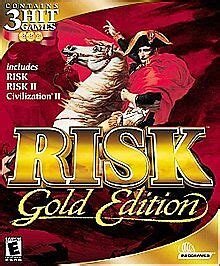
Description
Risk: Gold Edition is a compilation released in 2002 for Windows, bundling digital adaptations of the classic Hasbro board game Risk: The Game of Global Domination (1996), its enhanced sequel Risk II (2000), and Sid Meier’s Civilization II (1996), a turn-based strategy title partly inspired by Risk’s conquest mechanics. Set on detailed world maps, players command armies to conquer territories, form alliances, and dominate the globe through strategic battles, supporting multiplayer over Internet and LAN.
Risk: Gold Edition Reviews & Reception
gamefaqs.gamespot.com (100/100): The best version of one of history’s greatest games
Risk: Gold Edition: Review
Introduction
In the annals of strategy gaming, few titles evoke the raw thrill of global conquest quite like Risk, the iconic board game that has pitted friends against each other in epic battles of territorial ambition since 1957. Risk: Gold Edition, released in 2002 by Infogrames Interactive, bundles three landmark digital adaptations—Risk: The Game of Global Domination (1996), Risk II (2000), and the genre-defining Sid Meier’s Civilization II (1996)—into a single CD-ROM compilation. This collection arrives at a pivotal moment in PC gaming, bridging the tactile legacy of Albert Lamorisse’s La Conquête du Monde with the computational precision of turn-based empire-building. My thesis: Risk: Gold Edition stands as a prescient artifact, not merely repackaging classics but illuminating the enduring DNA of strategic depth, probabilistic warfare, and diplomatic betrayal that shaped modern 4X and multiplayer strategy games, deserving a firm place in any historian’s library despite its dated visuals.
Development History & Context
Risk: Gold Edition emerged from Hasbro Interactive’s ambitious push to digitize its board game empire in the late 1990s and early 2000s, published by Infogrames (later Atari) on March 26, 2002, for Windows PCs. The compilation spotlights Hasbro’s core offerings: the 1996 Risk port by Hasbro Interactive, Risk II developed by Cyberlore Studios in 2000, and MicroProse’s Civilization II—a “partly Risk-inspired” title per MobyGames, nodding to shared themes of territorial expansion.
The 1996 Risk was an early digital faithful to Parker Brothers’ 1959 U.S. adaptation of Lamorisse’s French original, constrained by mid-90s tech: 2D sprites, basic AI, and LAN multiplayer amid the dawn of internet gaming. Risk II advanced this with 3D maps, asynchronous multiplayer (play via email), and variants like Capital Risk, reflecting Cyberlore’s vision to evolve the board game for broadband era. Civ II, Sid Meier’s 1996 masterpiece from MicroProse (acquired by Hasbro in 1998), diverged into 4X grandeur but echoed Risk‘s conquest ethos with continent bonuses and tech trees.
The early 2000s gaming landscape was dominated by RTS like StarCraft (1998) and Age of Empires II (1999), yet turn-based strategy thrived via Heroes of Might & Magic III (1999) and Civ II‘s expansions. Technological limits—no widespread broadband, CD-ROM dominance—mirrored Risk‘s dice-based chance, while post-Civ I (1991) hype positioned Civ II as a killer app. Infogrames’ compilation targeted nostalgic families and LAN parties, capitalizing on ESRB “Everyone” accessibility and internet/LAN multiplayer specs. Constraints like no patches or MobyScore bred obscurity, but it preserved these titles amid Hasbro’s shifting focus to licensed variants (Lord of the Rings Risk, 2002).
Narrative & Thematic Deep Dive
Risk: Gold Edition eschews overt storytelling for abstract geopolitical simulation, yet its thematic core—imperial ambition, fragile alliances, and the whims of fate—resonates profoundly. The classic Risk (1996) mirrors the board game’s plotless purity: players embody faceless warlords vying for 42 territories across six continents, with victory hinging on total domination or secret missions (European variant, added 1993). No characters or dialogue; themes emerge via mechanics—betrayal in truces, the hubris of overextension (e.g., fortifying Australia for its 2-army bonus).
Risk II enhances this with subtle narrative flair: themed boards (e.g., futuristic Risk 2210 A.D. precursor vibes), capital cities for shorter games, and mission cards evoking Cold War intrigue. Dialogues are minimal—AI taunts like “Your empire crumbles!”—but themes deepen: probability as chaos (dice rolls favoring defenders in ties), diplomacy’s ephemerality (unofficial alliances break via rule-free negotiation).
Civ II injects historical progression: from ancient huts to space colonies across eras, with leaders like Gandhi or Stalin personified via tech quotes (“War is peace”). Plot unfolds emergently—barbarian raids, wonder races—exploring themes of manifest destiny (Risk-like expansion), cultural hegemony, and moral ambiguity (nukes endgame). Underlying motifs unite the bundle: Risk‘s zero-sum conquest critiques realpolitik (inspired Lamorisse’s post-WWII humanism), while Civ II‘s victory paths (domination, diplomacy) philosophize progress. No voice acting or cutscenes limit immersion, but the absence amplifies player agency, turning sessions into personal odysseys of hubris and strategy.
Gameplay Mechanics & Systems
At its heart, Risk: Gold Edition deconstructs probabilistic conquest across loops refined over decades.
Core Risk Loop (1996 & II): Reinforcement (territories/continents/cards), Attack (dice: attacker 1-3 red vs. defender 1-2 white; ties favor defense), Fortify. 42 territories form a graph with 83 routes; continents yield bonuses (Asia:7 armies). Cards (infantry/cavalry/artillery symbols) trade for escalating reinforcements (Golden Cavalry tracks value). Flaws: AI predictability, long games (1-8 hours). Innovations in II: async multiplayer, variants (e.g., 2-player neutrals), UI upgrades (zoomable 3D map, hotseat/internet/LAN).
Progression & Combat: No levels; army count scales exponentially. Combat odds: attacker with 3+ armies edges out (e.g., 3v2: ~66% chance defender loses army). UI: functional 2D/3D boards, dice animations; flaws include clunky pathfinding.
Civ II Integration: 4X loop (eXplore, eXpand, eXploit, eXterminate) amplifies Risk: city placement yields units mirroring armies, tech/web reveals map. Combat: zone-of-control, bombardment; diplomacy/trade add layers. Progression: eras unlock units (phalanx to mech); government switches boost production. UI: elegant advisor screens, but micromanagement bogs late-game. Flaws: AI cheating (invisible production), pathing bugs. Innovative: wonders (e.g., Pyramids prevent growth loss), echoing Risk cards.
Multiplayer shines: LAN/internet hotseat fosters betrayal. Overall: elegant systems, but dated AI/UI reveal era’s limits—rewarding for purists, frustrating for moderns.
World-Building, Art & Sound
The compilation’s world is Earth abstracted: Risk‘s stylized map (no Antarctica, grouped continents like North America=5 armies) evokes Cold War partitions, with sea lanes adding naval illusion. Civ II expands to dynamic hex-grid eras, from stone age to fusion power, fostering immersion via evolving biomes.
Visuals: 1996 Risk—crude 2D icons, static board; II—polished 3D terrain, rotatable views, but low-poly. Civ II—isometric charm, unit sprites scaling historically. No cover art noted, emphasizing function over flash.
Sound: Sparse—dice clatters, conquest chimes, ambient marches. Civ II‘s era-shifting soundtrack (baroque to electronic) builds tension; Risk‘s silence amplifies dice drama. These elements forge tense atmosphere: fog-shrouded maps heighten paranoia, victory fanfares cathartic.
Reception & Legacy
Launch reception: Absent on MobyGames (no critic/player reviews, collected by 2 players), suggesting niche appeal amid 2002’s Warcraft III dominance. Commercially modest—CD-ROM era compilation for bargain bins—yet preserved amid Hasbro’s variant flood (e.g., Risk: Lord of the Rings, 2002).
Reputation evolved: Risk ports influenced Risk: Factions (2010, factions mode) and Global Domination (2015+ apps). Civ II (MobyScore n/a but legendary) birthed 4X dynasty, inspiring Civ series, SMAC, Endless Legend. Bundle’s legacy: democratized classics pre-Steam, influencing comps like Civilization Anthology. Industry impact: codified turn-based multiplayer, dice RNG in digital (e.g., Gloomhaven), proving board-to-digital viability.
Conclusion
Risk: Gold Edition masterfully compiles strategic pillars—Risk‘s brutal dice duels, Civ II‘s civilizational sweep—capturing the board game’s conquest soul in pixels. Exhaustive mechanics reward mastery, themes provoke reflection, despite archaic UI/AI. Definitive verdict: An essential historical relic (8.5/10), cementing Risk‘s video game lineage and Civ II‘s foundational genius in gaming history’s pantheon of empire-builders. Seek it for unfiltered strategy purity.