
- Release Year: 1996
- Platforms: PlayStation, Windows
- Publisher: Hasbro Interactive, Inc.
- Developer: BlueSky Software, Inc., NMS Software Ltd.
- Genre: Board game, Strategy, Tactics
- Perspective: Top-down
- Game Mode: LAN, Online PVP, Single-player
- Gameplay: Alliances, Base building, Board game, Generals, Random events, Tactics, Terrain, Turn-based
- Setting: Historical, Napoleonic Wars
- Average Score: 64/100
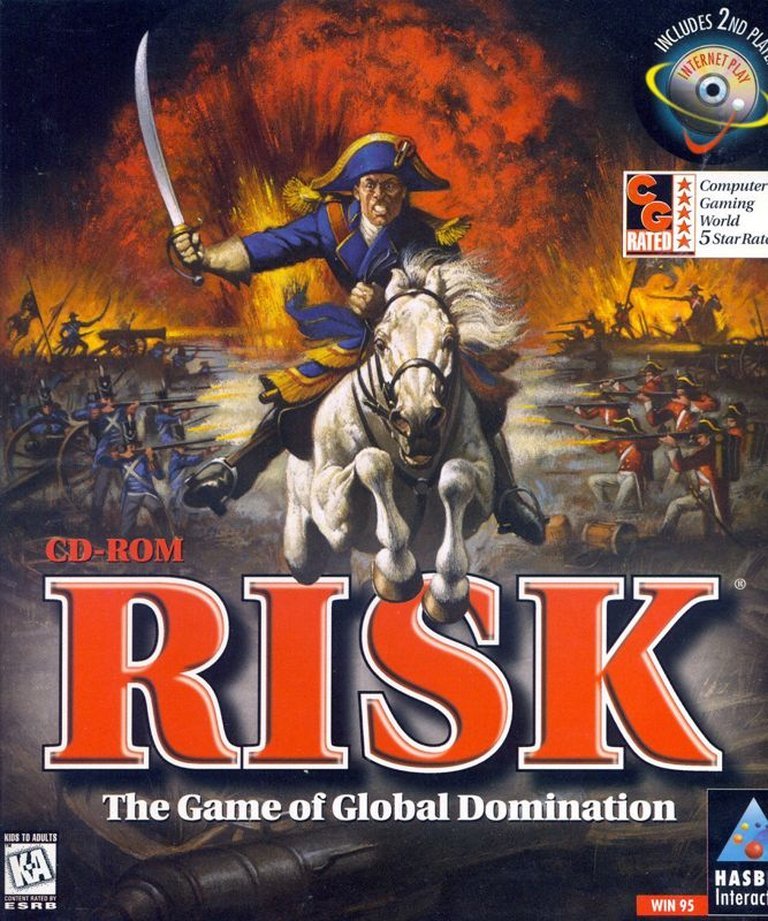
Description
Risk: The Game of Global Domination is a digital adaptation of the classic strategy board game where players vie for world conquest by strategically deploying armies and attacking rival territories. The game faithfully recreates the original board game experience against AI or human opponents, while introducing ‘Ultimate Risk’—a complex variant with generals, forts, terrain types, and tactical combat—alongside new maps, Blind Risk mode, and fully animated battles. Designed for both solo and multiplayer gameplay, it supports LAN, internet, and network play, complete with a secondary CD for streamlined multiplayer sessions.
Risk: The Game of Global Domination Free Download
Risk: The Game of Global Domination Reviews & Reception
mobygames.com (70/100): A great conversion of a classic board game.
metacritic.com (58/100): There is absolutely no risk at all after downloading the free-to-play demo with the 20 token per day regeneration rate.
Risk: The Game of Global Domination: Review
Introduction
Few board games evoke the thrill of geopolitical conquest as viscerally as Risk. When BlueSky Software and Hasbro Interactive digitized this classic in 1996 with Risk: The Game of Global Domination, they didn’t merely port cardboard to CD-ROM—they redefined it. This adaptation preserved the tactical tension of global domination while introducing innovations that leveraged the computational power of PCs and consoles. Yet, like any empire, it had its fissures. This review unpacks how Risk: The Game of Global Domination balanced reverence for its origins with ambitious reinvention, cementing its legacy as a pioneer in digital strategy gaming—one that still commands loyalty nearly three decades later.
Development History & Context
The late 1990s marked a golden age for board game digital adaptations, driven by CD-ROM technology’s capacity for richer media and networked play. Hasbro Interactive, then a fledgling division of the toy giant, sought to translate its flagship titles for the burgeoning PC market. Risk, conceived in 1957 by French filmmaker Albert Lamorisse as La Conquête du Monde, was a natural candidate: Its blend of dice-driven combat and territorial strategy begged for digital automation.
BlueSky Software (later known for Frogger and Beast Wars) and NMS Software helmed development, targeting Windows 95’s 32-bit architecture. The team faced constraints typical of the era: limited polygonal rendering (resulting in rudimentary 2D maps), reliance on dial-up multiplayer, and the challenge of simulating human unpredictability in AI opponents. The PlayStation port, developed by Runecraft in 1997, further optimized UI for consoles, though critics noted its “sparsely detailed graphics” (Official U.S. PlayStation Magazine).
At release, Risk entered a landscape dominated by real-time strategy titans like Command & Conquer and Warcraft II. Yet, it carved a niche by doubling down on turn-based deliberation—proving that slow-burn cerebral warfare could thrive even as the industry shifted toward frenetic action.
Narrative & Thematic Deep Dive
Unlike narrative-driven games, Risk’s “story” emerges from player-driven conquest. Framed by the Napoleonic Wars’ imperialist fervor (via generals like Napoleon and Wellington in Ultimate Risk mode), the game abstracts historical conflict into a battle for hex-based territories. Its dialogue-free design eschews character arcs in favor of systemic drama: alliances formed and shattered, underdog revolts, and the crushing weight of statistical probability.
Thematically, Risk interrogates power dynamics through mechanics. The Classic mode is a Hobbesian struggle—players vie for unchecked dominance via dice rolls. Ultimate Risk, however, layers nuance:
– Generals gain experience, rewarding long-term strategy over luck.
– Forts and terrain impose defensive penalties, evoking Sun Tzu’s Art of War.
– Rebel uprisings and prisoner exchanges simulate guerrilla resistance and diplomacy, echoing Cold War-era proxy conflicts.
This dichotomy—chaos vs. calculated control—mirrors real-world geopolitics, albeit sanitized through abstracted armies and cartoonish decapitations (a guillotine animation plays upon player elimination).
Gameplay Mechanics & Systems
Risk’s core loop—deploy, attack, fortify—faithfully adapts the board game’s rhythm but amplifies it with digital enhancements:
Core Loop & Combat
- Territory Draft: Players claim territories in turn-based setup, seeding armies.
- Dice Combat: Attackers roll up to three red dice vs. defenders’ two white. Defender wins ties—a small but critical advantage.
- Card Trading: Territorially themed cards (Infantry, Cavalry, Artillery) grant reinforcements when sets are traded, escalating late-game stakes.
Ultimate Risk: A Strategic Evolution
This mode reimagines combat as tactical rock-paper-scissors:
– Players select maneuvers (e.g., “Flank Attack”) against opponents’ hidden choices.
– Outcomes hinge on terrain, general rank, and army size, reducing reliance on luck.
– Forts add +21 defense, while random events (storms, disease) punish overextension—a nod to Clausewitzian “friction.”
UI & Accessibility
- The top-down map uses color-coded territories for clarity, though PlayStation’s joypad controls drew criticism for being “mühselig” (cumbersome—Video Games Germany).
- Multiplayer: LAN and modem support (with a second free CD for networked play) was revolutionary, circumventing the board game’s player-gathering hurdle.
Flaws & Quirks
- Save System: Players could only save at turn start—a design choice PC Zone lambasted as “baffling.”
- AI Limitations: Opponents rarely redeployed troops between fronts, making them predictable (David Ledgard, MobyGames). Early bugs, like phantom “300 units” materializing, required patches.
World-Building, Art & Sound
Risk’s aesthetic prioritized function over flair, yet its minimalism resonated:
Visual Design
- Maps: The classic geopolitical board was reproduced in vibrant 2D, with four expansions adding variants like Europe and Asia. Animated battle sequences showed tiny soldiers clashing—a charming, if crude, touch.
- Atmosphere: The grim guillotine cutscene upon elimination juxtaposed playful box art (Games Magazine praised its “timeless” tabletop feel).
Soundscapes
- No Music: Intentional silence avoided distraction during long turns, though ambient battle cries and dice rolls punctuated tension (krammer, MobyGames).
- PC Gamer noted the sound’s “basic but effective” role, while PlayStation’s compressed effects drew mixed reactions.
Reception & Legacy
At launch, Risk garnered a 71% critics’ average (MobyGames), with outlets split:
– Praise: Computer Gaming World awarded 100%, hailing Ultimate Risk’s “superb enhancements.” Absolute PlayStation (88%) lauded its addictive depth.
– Critique: Génération 4 (17%) dismissed it as “impoverished” next to Command & Conquer, while others found AI “no slouch” but inconsistent (GameSpot).
Commercially, it sold “exceptionally well” (Next Generation), spurring sequels like Risk II (2000) and inspiring later hybrids (Axis & Allies, Civilization). Its legacy crystallizes in three pillars:
1. Digital Board Game Template: Proved adaptations could transcend mere replication.
2. Modding Culture: “House rules” and custom maps foreshadowed community-driven content.
3. Genre Bridge: Paved the way for legacy games like Risk: Legacy (2011), which adopted its meta-progression.
Conclusion
Risk: The Game of Global Domination is a masterclass in balancing tradition with innovation. Its Ultimate Risk mode remains unmatched in complexity—a testament to BlueSky’s willingness to reinterpret a classic. While hobbled by era-specific flaws (punishing saves, erratic AI), its core design—networked multiplayer, tactical depth, emergent storytelling—endures. Today, as digital board games flourish, Risk stands not as a relic, but as a foundational keystone. For historians, it captures ’90s ambition; for players, it remains a benchmark for strategic crucibles. Dominion, after all, demands patience—and this game rewards it in spades.
Final Verdict: A flawed yet essential pillar of strategy gaming history—7/10.