
- Release Year: 2012
- Platforms: Android, Windows
- Publisher: Realore Studios, rondomedia Marketing & Vertriebs GmbH
- Developer: Realore Studios
- Genre: Strategy, Tactics
- Perspective: Diagonal-down
- Game Mode: Single-player
- Gameplay: Puzzle, Resource Management
- Setting: Classical antiquity
- Average Score: 72/100
Description
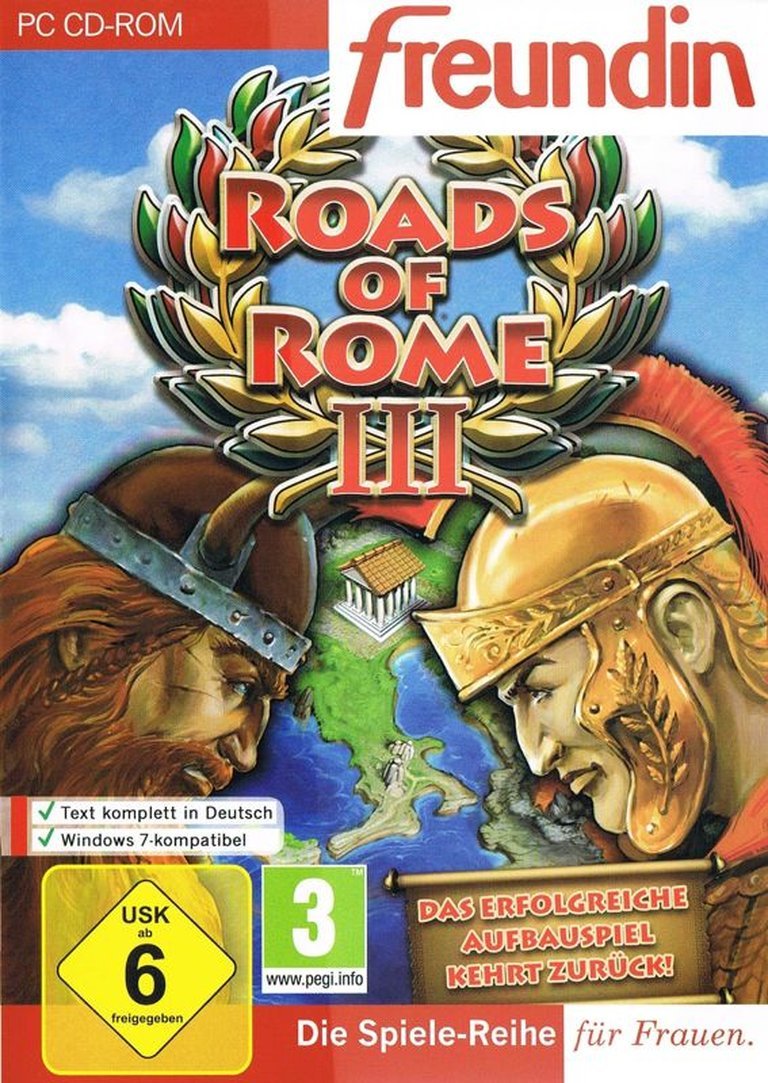
Roads of Rome III is a time management and building simulation set in classical antiquity, where players take orders from Caesar to repair the Roman Empire’s infrastructure after barbarian invasions. By directing workers to gather resources, construct buildings like farms and sawmills, and overcome obstacles such as fires, players must balance resource management with strategic planning to clear roads and complete objectives within time constraints.
Gameplay Videos
Where to Buy Roads of Rome III
PC
Roads of Rome III Guides & Walkthroughs
Roads of Rome III Reviews & Reception
metacritic.com (70/100): It’s a shame that such control and appearance difficulties arise and I had a lot of fun with Roads of Rome 3. It’s an enjoyable challenging time management game but no one appreciates some of the challenge to come from the control system.
jayisgames.com (86/100): The formula in Roads of Rome III is basically the same as the other time management/building games, keeping the balance of resource needs and resource gains carefully tuned to make sure you’re never twiddling your thumbs.
gamezebo.com (60/100): Roads of Rome 3 feels a bit too familiar. Just how often can Rome be in danger? With Roads of Rome 3, the new release by developer Realore, players might start to feel like Sisyphus doing the same work over and over again.
Roads of Rome III: Review
Introduction
The adage that “all roads lead to Rome” takes on a literal—and urgent—meaning in Roads of Rome III, a time management strategy game that tasks players with rebuilding the Roman Empire after a devastating barbarian invasion. As the third installment in Realore Studios’ beloved series, this title continues the saga of Victorius and Julia, now expecting their first child, thrust into a crisis that threatens the very foundations of their peaceful world. While the game faithfully adheres to the resource-management and building mechanics that defined its predecessors, Roads of Rome III excels in delivering a polished, addictive experience but struggles with innovation. This review examines its place within the series, its gameplay depth, and its legacy as a quintessential casual strategy title.
Development History & Context
Developed by Realore Studios and initially published by rondomedia for Windows in January 2012, Roads of Rome III was later re-released on Steam in October 2015 by Qumaron. The game emerged during a golden era for casual and mobile gaming, where time management titles like Farm Frenzy and My Kingdom for the Princess dominated the market. Realore Studios, having established the series’ formula in the first two installments, aimed to refine rather than reinvent the genre. Technologically, the game was designed for accessibility, running on modest systems—requiring just a Pentium III 800MHz processor and 256MB RAM—with a 2D top-down perspective optimized for mouse-driven gameplay. This approach reflected a broader industry shift toward accessible, low-barrier-to-entry titles, catering to players seeking bite-sized, strategic challenges.
Narrative & Thematic Deep Dive
The narrative is a classic tale of duty and resilience, set against the backdrop of a thriving Roman Empire suddenly threatened by barbarian hordes. Victorius, the series’ stoic hero, must abandon his pregnant wife Julia to lead the fight, embodying the Roman ideal of pietas (duty to state and family). The plot unfolds through brief text snippets and static cutscenes, emphasizing gameplay over cinematic storytelling. Thematic elements center on restoration—both literal (rebuilding roads and settlements) and symbolic (restoring peace and order). The barbarian invasion serves as a foil to Roman prosperity, highlighting themes of civilization versus chaos. While the narrative is functional rather than profound, it provides enough emotional weight to ground the resource-gathering loops in a compelling context. Character development remains minimal, with Victorius and Julia serving as archetypal rather than deeply realized figures.
Gameplay Mechanics & Systems
Roads of Rome III revolves around a finely tuned resource-management loop, where players direct workers to gather materials, construct buildings, and clear obstacles to restore Roman provinces.
- Core Mechanics: Each level tasks players with opening a path by repairing roads, a process requiring resources like wood, stone, gold, and food. Workers harvest from natural sources (trees, berry bushes) or upgraded structures (sawmills, quarries, farms), which offer greater efficiency at a resource cost. A key innovation is the introduction of pumping stations, which collect water to extinguish fires—a recurring obstacle that halts progress.
- Strategy Layers: Players must balance immediate needs (e.g., dousing fires, fending off barbarians) with long-term investments (upgrading buildings for faster production). The inclusion of “bonus” buildings—like those that boost worker speed or resource generation—adds strategic depth, demanding foresight.
- Progression: The game offers 43 levels across four difficulty modes (relaxed, easy, normal, hard), with three expert-level challenges for completionists. Levels typically last 5–10 minutes, encouraging quick, iterative play.
- Flaws: The absence of a queueing system for workers leads to frustrating moments where tasks pile up unattended. Additionally, early levels frequently begin with fires requiring immediate attention, creating a repetitive start that undermines variety.
World-Building, Art & Sound
The game’s visual style is functional yet charming, employing a 2D top-down perspective with bright, cartoonish graphics. The four distinct worlds—snowy tundras, jungles, and deserts—offer varied terrain features like quicksand and frozen rivers, but lack the nuanced details of Roads of Rome II. Animations are smooth, with workers trudging between tasks and buildings pulsating with life. The art effectively conveys scale, juxtaposing grand ruins with intimate resource nodes.
Sound design leans into ambient simplicity: a looping, period-appropriate score provides a steady backdrop, while sound effects—axe chops, water splashes, and barbarian grunts—offer tactile feedback. Despite this, the audio landscape is unremarkable, never elevating the experience beyond utility. The atmosphere is one of determined optimism, transforming war-torn landscapes into symbols of rebirth through visual and environmental storytelling.
Reception & Legacy
Roads of Rome III received a mostly positive reception, particularly among casual gamers. JayIsGames awarded it 4.3/5, praising its “smart, addictive, challenging experience” and noting that its “carefully tuned” resource balance prevents idle moments. Metacritic’s sole critic review (148Apps, 70/100) lauded its enjoyment but criticized fiddly controls. On Steam, it holds a “Mostly Positive” rating (78% of 42 reviews), with users commending its polish but citing repetition. Commercially, it exceeded expectations, with over 500,000 players across platforms and inclusion in a bundle with its predecessors.
Legacy-wise, the game solidified the series as a reliable, if formulaic, entry in the time management genre. It failed to innovate beyond established norms but excelled at accessibility, appealing to newcomers and veterans alike. Its emphasis on resource layers and obstacle diversity influenced subsequent titles like Northern Tale, though its legacy is ultimately overshadowed by the more ambitious Roads of Rome: New Generation (2017).
Conclusion
Roads of Rome III is a masterclass in refined, accessible strategy gameplay. It delivers a satisfying loop of resource management, construction, and problem-solving, wrapped in a charming Romanesque package. While its lack of innovation and occasional repetition may frustrate genre veterans, its polished mechanics and engaging challenges make it a standout casual title. For historians of casual gaming, it represents a pivotal moment where time management games prioritized accessibility over ambition, carving out a niche for themselves in the mobile and PC markets. As a testament to the series’ enduring appeal, it cements Roads of Rome as a cornerstone of the genre—proving that sometimes, the best path forward is to perfect the road already built.