
- Release Year: 2008
- Platforms: Windows
- Publisher: Avanquest Software Publishing Ltd.
- Genre: Educational, Puzzle
- Perspective: 1st-person
- Game Mode: Hotseat, Single-player
- Gameplay: Board game, Mini-games
- Average Score: 100/100
Description
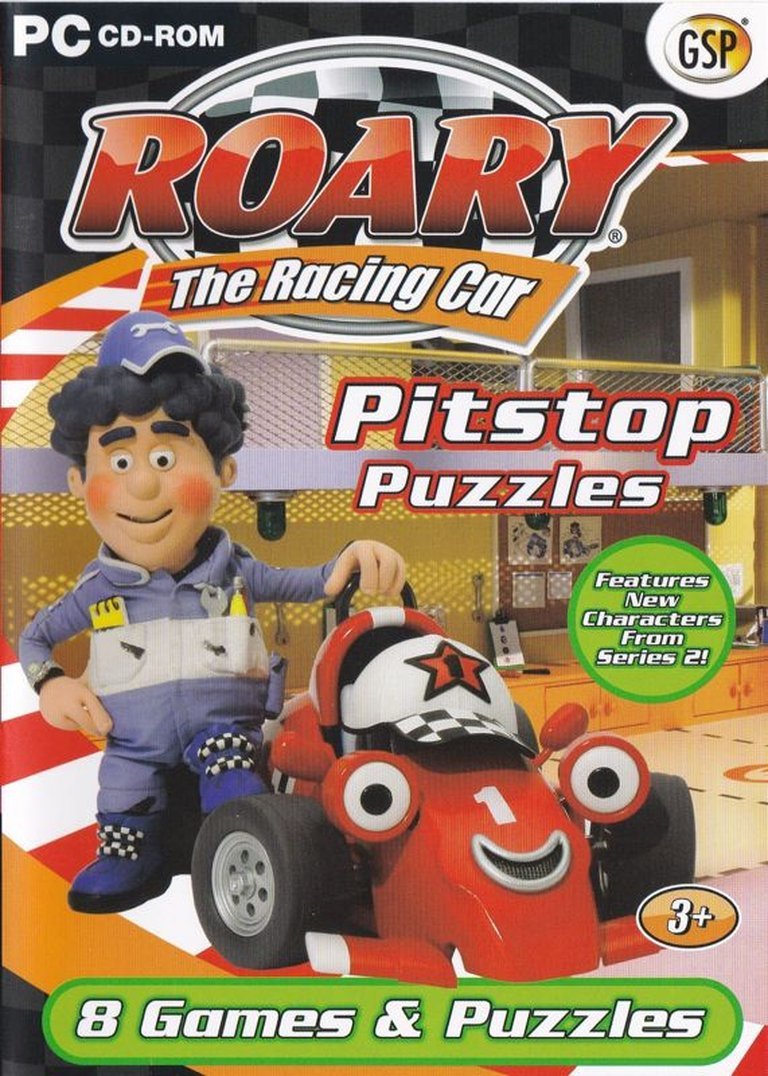
Roary The Racing Car: Pitstop Puzzles is a charming collection of simple, mouse-controlled mini-games for children aged three and up, inspired by the British TV series Roary the Racing Car. Set in a vibrant racing world, it features seven activities including a character meet-and-greet, a Snakes and Ladders variant called Skids & Bridges, Peg Solitaire with doughnuts, apple-collecting drives, tic-tac-toe, word searches, sliding tile puzzles, and jigsaws, all with bright graphics, sound effects, and no score tracking to encourage free play.
Roary The Racing Car: Pitstop Puzzles Free Download
Roary The Racing Car: Pitstop Puzzles: Review
Introduction
Imagine a pint-sized race car enthusiast, barely tall enough to reach the mouse, gleefully clicking through doughnut-jumping puzzles and hay-bale mazes, all while the familiar vroom-vroom of engines echoes from beloved TV characters. Roary The Racing Car: Pitstop Puzzles (2008), a humble CD-ROM gem from the golden age of edutainment software, captures this unadulterated joy for pre-schoolers aged 3 and up. Tied to the short-lived but fondly remembered British children’s TV series Roary the Racing Car (2007-2010), this collection of eight mouse-driven mini-games isn’t just kid fodder—it’s a time capsule of early 2000s licensed media crossovers, blending puzzle classics with vehicular whimsy. As a game historian, I argue that while its simplicity borders on primitiveness by modern standards, Pitstop Puzzles excels as an accessible gateway to cognitive play, faithfully extending the Silver Hatch racetrack’s charm into interactive form, cementing its niche legacy in toddler gaming.
Development History & Context
Developed in the shadow of the UK’s burgeoning children’s media empire, Roary The Racing Car: Pitstop Puzzles emerged from Chapman Entertainment Limited’s licensing machine, with publishing handled by Avanquest Software Publishing Ltd. Though specific credits are sparse—typical for budget edutainment titles of the era—the project likely originated from GSP Software, a studio known for low-fi PC kids’ games, as evidenced by archived ISO dumps. Chapman, the IP holders behind the stop-motion TV series, envisioned a digital extension to capitalize on the show’s mid-2007 debut on Five’s Milkshake! block, aiming to teach basic motor skills, pattern recognition, and social play through racing-themed puzzles.
The 2008 release landed amid technological twilight: Windows XP dominated home PCs, CD-ROMs were the standard for family software (269-275 MB ISOs confirm this), and broadband was patchy in UK households. Constraints like fixed/flip-screen visuals and point-and-click interfaces reflected Flash-era simplicity—no 3D engines or saves needed for 3-year-olds. The gaming landscape buzzed with edutainment rivals like Reader Rabbit or JumpStart, but TV tie-ins proliferated post-Bob the Builder and Teletubbies. Pitstop Puzzles rode this wave, predating app stores and touchscreens, positioning itself as a “plug-and-play” pitstop for parents seeking screen time sans violence. Vision-wise, creators prioritized accessibility over innovation: no progression systems, optional audio, and multiplayer hot-seat modes mirrored board games, adapting Snakes & Ladders et al. to digital while dodging the complexity of contemporaries like Nintendo DS ports (a related 2009 DS title by Uacari/GSP hints at cross-platform ambitions).
Narrative & Thematic Deep Dive
Lacking a linear plot, Pitstop Puzzles weaves its “story” through the Roary universe, immersing players in Silver Hatch racetrack—a vibrant pitstop hub teeming with anthropomorphic vehicles. The sole narrative hub, Meet The Cast, serves as a interactive character bible: static screens showcase Roary (the plucky red racer), Big Chris (the boisterous mechanic), Cici (the cheeky yellow car), and ensemble like Flash, Big Christine, and Molecom. Hovering the mouse triggers biographies and voice clips—”I’m Roary, ready to race!”—instilling familiarity without exposition dumps. This non-game activity sets thematic tones: teamwork (multiplayer boards), perseverance (puzzle retries), and racing spirit (engine revs on moves).
Themes orbit preschool pedagogy: problem-solving via solitaire jumps or tile slides symbolizes pitstop strategy; collection and navigation in Apple Catchers evokes resource gathering; communication through wordsearches reinforces literacy. Dialogue is minimal but punchy—voiceovers during Skids & Bridges (“Skid ahead!”) or jigsaws add encouragement, echoing the TV show’s gentle moralism (e.g., “Racing is about fun and friends!”). No deep arcs exist; instead, emergent narratives arise in play sessions: a child “racing” siblings on the board, tumbling down skids like Roary’s on-track mishaps. Critically, this ties to Roary‘s ethos—overcoming obstacles with cheer—transforming rote puzzles into thematic vehicles for emotional growth, though adults may find the repetition narratively barren.
Gameplay Mechanics & Systems
At its core, Pitstop Puzzles is a turn-based anthology of eight mouse-only mini-games, eschewing progression for endless replayability tailored to tiny hands. No combat, RPG elements, or metasystems; UI is pristine—bold icons from a central menu, with intuitive point-and-select controls.
-
Skids & Bridges: Up to four-player Snakes & Ladders clone. Click to roll dice; a green marker highlights the target square—manual click advances your vehicle amid revving SFX. Skids slide backward, bridges leap forward, teaching probability and turns sans frustration.
-
Doughnut Solitaire: Peg Solitaire reskinned with sugary tokens. Jump doughnuts over each other to isolate one in the center; Easy/Hard boards scale complexity, honing spatial logic.
-
Apple Catchers: Vehicular maze—drive Roary-esque car through hay-bale grids, collecting apples. Fixed-screen navigation builds pathfinding.
-
Noughts & Crosses: Tic-Tac-Toe with Easy/Hard AI or hot-seat multiplayer; flawless for social deduction.
-
Wordsearch: 15 grids (4×4 easy, 5×5 tricky, 6×6 hard) with racing-themed words. Drag-highlight and click to find—progressive difficulty boosts vocabulary.
-
Sliding Tiles: 18 puzzles (2×2 to 4×4 grids) shuffling character images. Click adjacent tiles to empty space; standard but themed visuals engage.
-
Jigsaws: 20 pictures (Roary, cast scenes) in 4/9/16 pieces. Drag-to-fit, no rotation—pure shape matching.
Innovations? Multiplayer integration and audio cues aid non-readers. Flaws: No scores, unlocks, or memory means zero progression; repetition risks boredom post-30 minutes. Loops are tight—5-10 minutes per game—prioritizing bite-sized wins over depth, a boon for ADHD toddlers but shallow for analysis.
World-Building, Art & Sound
Silver Hatch pulses as a cohesive microcosm: racetrack pits, hay fields, and workshops backdrop every mode, fostering immersion without open worlds. Art direction shines in “big bright graphics”—cartoonish 2D cel-shaded vehicles pop against primary colors, fixed/flip-screen views evoking board books. Jigsaw/sliding images (e.g., Roary mid-lap) reinforce canon; hay bales and doughnuts add tactile whimsy.
Sound design elevates: Optional effects (toggleable) include revving engines, skids, bridge whooshes, and character voice clips (“Great job!”). No OST, but clips tie to TV, creating auditory nostalgia. Together, they craft a safe, stimulating atmosphere—vibrant visuals stimulate senses, sounds reward actions, immersing tots in Roary’s high-octane yet hazard-free realm. Contribution? Seamless preschool synergy: art teaches shapes/colors, sound boosts phonics/motor response.
Reception & Legacy
Launch reception? Nonexistent—MobyGames lists zero critic/player reviews, Metacritic ignores it, underscoring its direct-to-parent obscurity. Commercial fate: UK-exclusive CD-ROM (EAN undisclosed), likely modest sales via retail bundles, buoyed by TV synergy but eclipsed by flashier DS kin (2009’s Roary: The Racing Car with 15 mini-games scored “tbd”). No patches, forums silent.
Legacy endures in preservation: Archive.org ISOs ensure playability, while MobyGames catalogs it amid Roary licensees. Influence? Marginal—epitomizes edutainment’s puzzle-board hybrid, prefiguring apps like Toca Boca or Sago Mini. It subtly shaped toddler tie-ins, prioritizing accessibility over gamification, and nods to genre forebears (Peg Solitaire boards, 1980s Pitstop racers). Today, amid touch-first kids’ games, it reminds us of mouse-era purity—niche artifact for Roary fans and retro archivists.
Conclusion
Roary The Racing Car: Pitstop Puzzles distills preschool gaming to essentials: simple joys, thematic fidelity, and unpretentious fun. Its exhaustive mini-game suite— from skid-tumbling boards to doughnut solos—deftly educates via play, wrapped in Silver Hatch’s cheery shell, though absent progression curbs replay for all ages. In video game history, it claims a quiet corner as exemplary 2000s edutainment: not revolutionary, but reliably revving young minds. Verdict: 8/10 for its audience—essential for parents seeking wholesome pitstops; a nostalgic footnote for historians. Fire up that CD-ROM; Roary awaits.