
- Release Year: 2023
- Platforms: PlayStation 5, Windows, Xbox Series
- Publisher: Nacon S.A.
- Developer: Teyon S.A.
- Genre: Action
- Perspective: 1st-person
- Game Mode: Single-player
- Gameplay: Moral choices, RPG elements, Shooter
- Setting: Cyberpunk, dark sci-fi, North America
- Average Score: 90/100
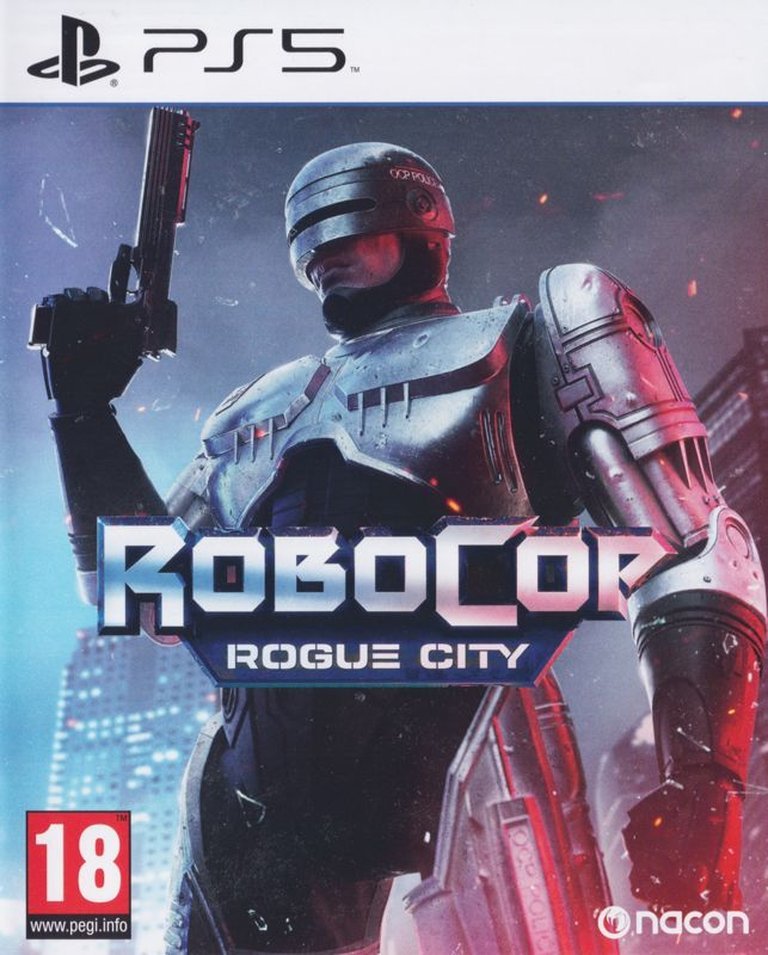
Description
RoboCop: Rogue City is a first-person shooter set in a dark cyberpunk rendition of Detroit, where players assume the role of RoboCop, a cyborg law enforcer, to combat crime and corruption in a dystopian North American city.
Gameplay Videos
Where to Buy RoboCop: Rogue City
RoboCop: Rogue City Free Download
RoboCop: Rogue City Mods
RoboCop: Rogue City Guides & Walkthroughs
RoboCop: Rogue City Reviews & Reception
metacritic.com (90/100): Robocop: Rogue City exceeded my wildest expectations
ign.com : absolutely nails the look and feel of its film inspiration
techradar.com : the gore-soaked shootouts offer a retro first-person shooter experience not to be missed.
primagames.com : I’m pleased to say my apprehension was misplaced with RoboCop.
RoboCop: Rogue City Cheats & Codes
PC
| Code | Effect |
|---|---|
| BLASTOVERRIDE | Provides unlimited ammo, preventing reloading. |
| STEELSHIELD | Grants invincibility, making RoboCop virtually indestructible. |
| TURBOCHARGE | Increases movement speed to lightning-fast levels. |
| ARMORYMAX | Instantly maximizes weapon proficiency. |
| CASHINHAND | Provides an immediate large amount of in-game currency. |
| GHOSTOPS | Enables stealth mode for silent takedowns. |
| TECHNOGOD | Unlocks all upgrades instantly. |
| INSTANTDOOM | Allows one-hit kills on enemies. |
PlayStation 5
| Code | Effect |
|---|---|
| BLASTOVERRIDE | Provides unlimited ammo, preventing reloading. |
| STEELSHIELD | Grants invincibility, making RoboCop virtually indestructible. |
| TURBOCHARGE | Increases movement speed to lightning-fast levels. |
| ARMORYMAX | Instantly maximizes weapon proficiency. |
| CASHINHAND | Provides an immediate large amount of in-game currency. |
| GHOSTOPS | Enables stealth mode for silent takedowns. |
| TECHNOGOD | Unlocks all upgrades instantly. |
| INSTANTDOOM | Allows one-hit kills on enemies. |
Xbox Series X
| Code | Effect |
|---|---|
| BLASTOVERRIDE | Provides unlimited ammo, preventing reloading. |
| STEELSHIELD | Grants invincibility, making RoboCop virtually indestructible. |
| TURBOCHARGE | Increases movement speed to lightning-fast levels. |
| ARMORYMAX | Instantly maximizes weapon proficiency. |
| CASHINHAND | Provides an immediate large amount of in-game currency. |
| GHOSTOPS | Enables stealth mode for silent takedowns. |
| TECHNOGOD | Unlocks all upgrades instantly. |
| INSTANTDOOM | Allows one-hit kills on enemies. |
RoboCop: Rogue City: A Critical Review & Historical Analysis
Introduction: The Duty of a Franchise
For decades, the RoboCop franchise—a cornerstone of 1980s satirical sci-fi—languished in the interactive medium, shackled by mediocre adaptations that failed to grasp the singular tone of Paul Verhoeven’s seminal 1987 film. The challenge was immense: translating a property built on brutal, hyper-stylized violence, razor-sharp corporate satire, and the tragic duality of Alex Murphy into a compelling interactive experience. Against all odds, Polish studio Teyon, previously known for the divisive Rambo: The Video Game and the well-received Terminator: Resistance, has delivered RoboCop: Rogue City. This is not merely another licensed game; it is a deliberate, often fervent, attempt to construct the elusive “true” third RoboCop film, a goal it achieves with such conscientiousness that its very flaws become part of its character. This review argues that RoboCop: Rogue City stands as the definitive interactive RoboCop experience—a flawed, janky, yet wildly successful love letter that perfectly captures the essence of its source while revealing the constraints of its AA budget, ultimately securing its place as a cult classic of modern game design.
Development History & Context: From Rambo’s Ashes to Detroit’s Streets
The path to Rogue City is a narrative of studio redemption. Teyon’s 2014 Rambo: The Video Game was critically panned, a title derided for its lack of direct control and failure to embody its hero. However, the studio learned. 2019’s Terminator: Resistance was a surprise hit, praised for its faithful atmosphere, solid shooting, and understanding of its source’s 80s aesthetic. This established a template: a mid-budget (AA) first-person shooter, built in Unreal Engine, that prioritizes fan service and tonal authenticity over cutting-edge polish.
RoboCop: Rogue City represents the maturation of that template. Released on November 2, 2023, for PlayStation 5, Xbox Series X/S, and PC (Windows), it was developed by Teyon S.A. and published by Nacon. The development team, led by Director Piotr Łatocha and Producers Tomasz Dziobek and Mariusz Sajak, numbered 233 developers. Their stated vision, gleaned from interviews and the final product, was clear: create a game that felt like a lost sequel to RoboCop 2, respecting the canon and aesthetic of Verhoeven’s vision while creating an original narrative. The technological context is Unreal Engine 5, a engine capable of spectacular lighting and detail, but one that here seems applied selectively, highlighting a core tension: a high-fidelity engine powering a game with character models and animations that frequently recall a previous console generation. This “B-movie” aesthetic, whether intentional or born of budgetary constraint, paradoxically aligns with the gritty, practical-effects feel of the original films.
The gaming landscape of late 2023 was dominated by polished, open-world AAA behemoths and live-service titles. Rogue City’s commitment to a linear-narrative, single-player campaign with light RPG elements felt deliberately retro, a throwback to an era of focused, story-driven shooters like SWAT 4 or F.E.A.R., albeit filtered through a distinctly 80s action movie lens.
Narrative & Thematic Deep Dive: The Ghost in the Machine
Set between the events of RoboCop 2 (1990) and the ill-received RoboCop 3 (1993), Rogue City’s narrative is its most celebrated and most contested aspect. The plot is straightforward: a new synthetic drug, “Nuke,” has flooded the streets of Old Detroit under the command of a charismatic cult leader, “The New Guy.” RoboCop, Alex Murphy, must navigate the intersecting threats of street gangs, rogue OCP executives, and his own lingering humanity.
Faithfulness as a Narrative Engine: The game’s greatest strength is its unwavering commitment to the RoboCop universe. It resurrects key figures—Officer Anne Lewis (voiced by an uncredited actress mimicking Nancy Allen), the cynical Sergeant Reed, the sleazy TV host Bixby Snyder (“I’d buy that for a dollar!”), and OCP’s “The Old Man” (voiced by Dan O’Herlihy, who played the role in RoboCop 2). Most crucially, Peter Weller reprises his iconic role, providing voice and likeness. His performance is a anchor of gravitas, selling both the mechanical cadence of RoboCop and the pained, searching humanity of Alex Murphy within. As noted in the IGN review, “RoboCop looks and sounds like his original self, complete with Peter Weller’s piercing gaze under his helmet.”
The Therapy Sessions & Core Duality: The narrative’s most ambitious thread is Murphy’s mandatory therapy with Dr. McNamara. Here, the game explores the central theme of the original film: the man versus the machine. Dialogue choices allow players to guide Murphy’s responses, ranging from coldly logical to struggling with emotion. This system, reminiscent of Alpha Protocol, promises consequences. However, as the IGN critique astutely observes, “it exists exclusively in dialogue options and cutscenes, with no ramifications in gameplay. That’s too bad, as it relegates us to being an observer in his introspective crises, rather than sharing in it.” The theme is present but under-utilized, a missed opportunity to make the “cop” and “man” in RoboCop mechanically distinct.
Satire and Subtext: The original film’s vicious satire of 1980s corporatism, media, and police militarization is present but softened. The game is set in a dystopian Detroit where OCP’s privatization of the police is a done deal, and the Springwood “Delta City” project looms as a perpetual, empty promise. The satire is more nostalgic pastiche than biting contemporaneous critique. The VG247 review notes this, stating, “The only thing malfunctioning around here is the economics of game production… a brilliant piece of work emerges, that somehow nails every part of the brief and finally proves that Robocop can inspire worthy sequels.” The critique from Slant is harsher, arguing the game strips away the original’s critique of police violence, turning RoboCop into an unproblematic force for good: a “family.” This represents the central thematic compromise: to be a power fantasy, the game must largely sideline the original’s most uncomfortable questions.
Player Agency and Branching Paths: Side missions and certain main-story choices create a branching narrative. Deciding the fate of a reformed Nuke addict, issuing warnings vs. fines for minor infractions, and dialogue options during investigations provide a sense of impact. The TechRadar review compares this favorably to Alpha Protocol. While not on the same scale of reactivity, these choices color the world and its characters’ reactions, making Old Detroit feel slightly more alive and responsive.
Gameplay Mechanics & Systems: The Weight of the Law
Gameplay is where Rogue City both soars and stumbles, defined by its central, ironclad design philosophy: RoboCop is a walking tank.
Core Combat Loop: The Brap Brap Experience: The combat is methodical, chunky, and immensely satisfying. RoboCop moves with a slow, deliberate, heavy thud—a design choice that immediately separates it from the sprint-and-slide of modern military shooters. You are not a agile super-soldier; you are an unstoppable, armored law enforcement unit. The Auto-9 machine pistol, with its unlimited ammunition built into RoboCop’s leg, is the star. Its three-round burst dismembers enemies with spectacular, gratuitous violence—arms, heads, and torsos exploding in a shower of pixels and blood. This is the “brutal and disgusting” violence lauded by Gaming Outsider, perfectly capturing the R-rated spirit of the films. The sound design is exceptional; the crunch of bullet impacts, the splat of a headshot, and the clunk of RoboCop’s footsteps are all tactile and weighty.
Enemy variety is decent: low-level street punks (splatter-punks, bikers), more tactically sound mercenaries, and returning robotic foes like the iconic, terrifying ED-209. The combat AI is often criticized as rudimentary—enemies frequently charge directly at RoboCop or take cover poorly. Yet, in the context of playing a nearly indestructible cyborg, this feels appropriate. The challenge comes from overwhelming numbers, positioning, and heavier enemies (snipers, ED-209, grenadiers), not from cunning tactics.
Destructibility and Environmental Interaction: The environments are highly destructible. Wooden barriers, drywall, glass panes, and even concrete pillars shatter under fire. This isn’t just cosmetic; it’s tactical. You can blast through pre-scripted “breach” points for slow-motion takedowns, or simply dismantle enemy cover. The TechRadar review highlights an arms-fair shootout where “the flimsy walls come apart under the heavy gunfire,” showcasing a clever use of the engine’s physics.
RPG-Lite Systems & Progression: The game layers light RPG mechanics onto the shooter foundation. Skill points are earned through combat, exploration, and completing objectives, spent in a simple, branching skill tree. Categories include:
* Combat: Damage resistance, firearm proficiency, slow-motion duration.
* Investigation: Scanner range, evidence analysis, safe-cracking.
* Social: Dialogue options, intimidation.
Maxing out certain trees unlocks powerful perks, like ricocheting small-arms fire off RoboCop’s armor or rapidly regenerating health. The IGN review notes these upgrades make RoboCop feel truly powerful, though some, like a 30% XP boost, are “very boring to write about.” The system is functional and provides a nice sense of growth, but lacks the depth or meaningful choice of a true ARPG like Deus Ex.
The “Cop” in RoboCop: Investigation and Exploration: Alternating with linear combat stages are semi-open “hub” areas, primarily a recreated section of Old Detroit. Here, the game shifts to a slower pace. You can respond to dispatch calls: investigating crime scenes (using a scanner to find clues), issuing parking tickets, mediating disputes, and helping citizens. These segments are a love-it-or-hate-it proposition. For the Gaming Age reviewer, they are a welcome change of pace that “really lets you embody the ‘cop’ part of Robocop.” For others, like the PC Gamer critic, they contribute to a “dull narrative and bloated pacing.” This duality is the game’s most defining mechanical schism: the exhilarating, power-fantasy shooting versus the plodding, methodical “police work.”
Technical and QoL Issues: This is where the AA budget is most evident. The game is plagued by bugs: frame-rate drops (especially in cutscenes on PS5’s default “Quality” mode), audio-desync, frozen facial animations, occasional collision issues, and assets left untranslated (Polish text). The Destructoid review states it well: “it almost looks like something that belongs in the scrap heap, but if you’re able to look past its rough exterior and exposed seams, you might see the heart that beats underneath.” The checkpoint system can also be frustrating, with some long stretches without saves, leading to repeated sections upon death.
World-Building, Art & Sound: A Love Letter in 4K (Mostly)
The world of Rogue City is its most triumphant aspect, a meticulously crafted pastiche of Verhoeven’s Detroit.
Visual Fidelity and Atmosphere: Using Unreal Engine 5, Teyon has created a visually stunning, rain-slicked, neon-and-concrete dystopia. The downtown hub is dense with detail: flickering neon signs for “6000 SUX” cars, CRT monitors in police precinct cubes, grimy alleyways, and the monolithic, brutalist architecture of OCP towers. The lighting, particularly at night with raytraced reflections in puddles, is frequently gorgeous. The Prima Games review calls it “gorgeous… oozes with detail.” However, this fidelity is uneven. Character models, especially facial animations and lip-syncing, are frequently wooden and Uncanny-valley-inducing, a stark contrast to the beautiful environments. This dissonance is the game’s primary visual failing, making cutscenes a jarring experience. The overall effect, however, is a world that feels authentic to the films—less a realistic simulation and more a loving, high-definition recreation of the practical-set aesthetic.
Sound Design and Music: The audio is a resounding success. The soundtrack heavily utilizes Basil Poledouris’ iconic, percussion-driven themes from the first film, re-orchestrated and used sparingly but effectively to elevate key moments. The sound effects for the Auto-9, ED-209’s stomps, and the chaotic cacophony of gunfire are perfectly judged. Peter Weller’s voice is the irreplaceable crown jewel. His delivery of lines like “Dead or alive, you’re coming with me” carries the weight of the original performance. The ambient soundscape—the constant drizzle, the distant sirens, the murmur of police radios—sells the oppressive, rain-soaked atmosphere of Old Detroit.
The 80s Aesthetic Reborn: Everywhere you look, there are touches of the 80s: the fashion (mohawks, leather jackets), the technology (payphones, VHS tapes, bulky computers), the corporate logos, and the satirical commercial breaks (implied through context). This isn’t just nostalgia; it’s a rigorous adherence to a specific, diegetic world. As the IGN review notes, “The entire ‘80s-ness of the presentation is brilliant.”
Reception & Legacy: The People’s Verdict
RoboCop: Rogue City received a “Mixed or Average” rating on Metacritic (72 on PS5/XSX, 76 on PC), but the critic breakdown is telling: 50% positive, 45% mixed, only 5% negative. The vast majority of professional reviews fell in the 70-90% range, with a notable cluster at 80% and 90%. The user score on Metacritic is notably higher at 7.8/10 (Generally Favorable), based on over 800 ratings.
Critical Consensus: The praise is nearly universal for its faithfulness to the source material, the strength of its core shooting, the return of Peter Weller, and its successful recreation of the film’s world. Words like “love letter,” “authentic,” “respectful,” and “the best RoboCop game ever” are common. The criticisms consistently target technical polish (bugs, animations), the slow movement, and the repetitive or bloated pacing, particularly in the later-game side content. The narrative is seen as solid but not groundbreaking, and the RPG systems as lightweight.
The Polarization: A stark divide exists between those who view the jank as part of the charm and those who see it as a deal-breaker. Reviews like Gaming Shogun’s perfect score (“mixes the feel of an 80’s game with a modern FPS”) sit opposite GamesRadar+’s scathing 2.5/5 (“flat, heavy, lifeless. Like a metal boot. Clump”). The Slant review’s critique of its political neutering represents a more academic disappointment. For the mainstream audience, it’s a “good but rough” 7/10; for the fan, it’s a 9/10 experience where flaws are forgiveable because the soul is so present.
Legacy and Influence: Rogue City has already cemented its legacy as the gold standard for movie-licensed games in the 2020s. Following Terminator: Resistance, Teyon has proven that a smaller studio with genuine affection for a property can outclass many AAA efforts. It demonstrates that “authenticity” can be more valuable than “polish.” Its success has likely greenlit more projects from Teyon for dormant 80s/90s IPs, as hinted by the Power Unlimited and Mirror.co.uk reviews. Most importantly, it has proven that the RoboCop mythos can thrive outside of film, offering a narrative experience that many fans consider a superior conclusion to the original trilogy over RoboCop 3. The announcement of the DLC/sequel Unfinished Business (2025) is direct testament to this success.
Conclusion: An Imperfect, Essential Masterpiece
RoboCop: Rogue City is a game of glorious contradictions. It is a Unreal Engine 5 showcase hampered by PS2-era character models. It is a methodical, slow-paced shooter that is nevertheless thrilling. It is a game with a profound thematic core (the nature of humanity in a machine) that rarely lets the player mechanically engage with that core. It is packed with bugs yet radiates a confident, crafted love.
To play Rogue City is to understand Teyon’s mission: to make you feel like RoboCop. This they achieve with almost obsessive success. The weight, the violence, the world, the voice—every moment spent in Old Detroit is soaked in the aesthetic and spirit of Verhoeven’s creation. The gameplay systems, while not revolutionary, are sufficiently layered to reward engagement, and the narrative, for all its familiar beats, is a satisfying capstone to Alex Murphy’s story.
Its flaws are not negligible; they are frequently frustrating. The movement speed can feel like a chore, the cutscenes are technically embarrassing, and the late-game structure sags. But these flaws become part of the texture, like the scratches on RoboCop’s armor. They remind you that this was made with heart, not just a balance sheet.
In the pantheon of video game adaptations, RoboCop: Rogue City stands tall. It is not the most polished, nor the most innovative. It is, however, the most faithful. It understands that a RoboCop game must be brutal, satirical, and steeped in a very specific 80s aesthetic. It delivers a 20+ hour campaign that is, at its best, an interactive RoboCop film. For fans, it is nothing short of essential—the “third movie” we always wanted. For everyone else, it is a robust, enjoyable, if imperfect, AA shooter that occasionally achieves a strange, gritty greatness. Like its protagonist, Rogue City is a machine built from spare parts and human passion, and it gets the job done. I’d buy that for a dollar, and you should too.