
- Release Year: 1992
- Platforms: DOS, Windows
- Publisher: TOM Productions
- Developer: TOM Productions
- Genre: Action
- Perspective: Top-down
- Game Mode: Single-player
- Gameplay: Puzzle elements
- Setting: Fictional Island
- Average Score: 0/100
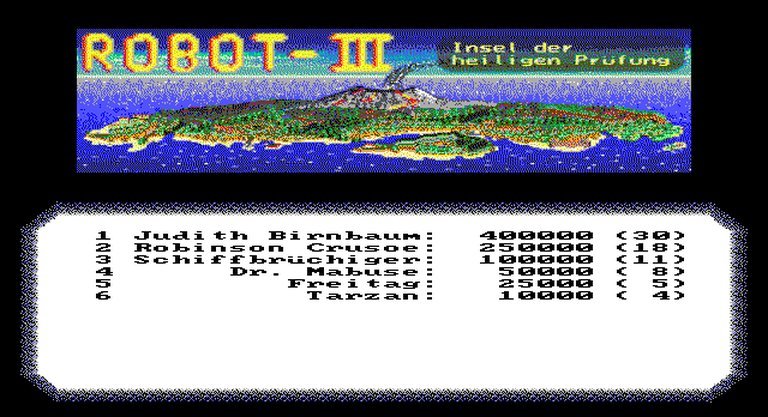
Description
Robot III: Insel der heiligen Prüfung is the third installment in the Robot series, set on the fictitious island of Fana. After receiving a call for help via telegram in the previous episode, the player must journey to the island to find the missing friend who sent it. The game emphasizes a richer storyline, requiring players to gradually learn and understand the unique language of the Tamala inhabitants to overcome environmental puzzles and progress.
Robot III: Insel der heiligen Prüfung Reviews & Reception
myabandonware.com (0/100): they are quite complex despite their age and the way they look, but you can softlock and be unable to progress.
Robot III: Insel der heiligen Prüfung: A Linguistic Landmark Hidden in the DOS fog
Introduction: The Unassuming Pioneer
In the vast, often-overlooked archives of early 1990s German shareware, certain titles whisper rather than shout their significance. Robot III: Insel der heiligen Prüfung (“Island of the Holy Test”) is one such game. Released in December 1992 by the enigmatic, single-studio outfit TOM Productions, it represents the third—and arguably most conceptually ambitious—entry in a niche series that began with Robot Junior in 1991. While its predecessors follow a more traditional action-adventure template, this installment makes a daring, almost prescient pivot: it centers its entire gameplay and narrative around the mechanic of learning a fictional language. This review argues that Robot III is not merely a forgotten piece of software trivia but a fascinating, if flawed, precursor to modern narrative-driven games and serious language-learning mechanics. It stands as a testament to the era’s experimental spirit, where a small team in Germany could conceive of a game whose primary puzzle was not a key or a lever, but a vocabulary.
Development History & Context: The “TOM Productions” Experiment
The Studio and Vision: TOM Productions remains a shadowy figure in gaming history. With no public-facing biographies, interviews, or a discernible web of credits, the studio existed, it seems, to produce the Robot series and little else. This lack of a corporate coat-of-arms suggests a tight-knit, possibly amateur, team driven by a singular creative vision rather than market trends. The leap from the action of Robot Junior to the linguistic focus of Robot III indicates a developer unafraid to reinvent its own series’ core identity. The subtitle, “Insel der heiligen Prüfung” (Island of the Holy Test), frames the entire experience as a ritual of learning and cultural immersion, not just physical exploration.
Technological and Genre Context: 1992 was a pivotal year for DOS gaming. The visual and conceptual bar was being raised by titles like Indiana Jones and the Fate of Atlantis (puzzle-adventure) and Dune II (RTS). However, the German shareware scene, while prolific, often lagged in high-budget production values. Robot III was built on the technological constraints of the era: EGA/VGA graphics, PC speaker or AdLib sound, and memory limitations that demanded simple, elegant asset design. Its top-down perspective and action-adventure base placed it in the lineage of games like The Great Giana Sisters or early Zelda titles, but its designers consciously subverted the expected “action” component. The “Puzzle elements” tag on MobyGames is a profound understatement; here, puzzles are the game. The decision to make language acquisition the central mechanic was a brilliant workaround for limited resources—a complex, emergent gameplay system requiring no new graphical assets, only clever text and dialog design.
The Gaming Landscape: In 1992, narrative in games was often delivered via static text boxes or simple dialog trees. The idea of a language barrier as a persistent, core mechanic was virtually unheard of outside of extremely niche text adventures (Infidel‘s hieroglyphics come to mind, but not as a learnable system). Robot III anticipated later masterpieces like Chrono Trigger‘s diverse dialects or The Witcher 3‘s elder speech by making linguistic understanding a tangible, progressive skill that gates access to the world itself.
Narrative & Thematic Deep Dive: The Test of Understanding
Plot as Framework: The narrative is deliberately sparse, serving as a skeleton for the gameplay. It directly follows the cliffhanger of Robot Junior: the player’s friend has vanished after a telegram directed them to the fictional island of Fana. The quest is simple: find your friend. This simplicity is a strength; it removes extraneous motivation, making the journey itself the reward. The island of Fana is not just a location; it is a character—a place of ancient ritual and isolation.
The Tamala and Their Language: The Heart of the System: The indigenous inhabitants, the Tamala, are the game’s defining feature. They speak a fully constructed, albeit basic, conlang (constructed language). From the moment of arrival, the player is immersed in untranslated Tamala script. The genius of the design lies in the gradual and contextual learning process. As the MobyGames description states, the player learns “understanding and speaking bit by bit.” This implies a dynamic system, likely tracking a vocabulary list. Early interactions might yield a single useful word (“water,” “danger,” “friend”). Finding a glossary item (a carved stone, a talking elder’s缓慢 speech) adds another term. The player must then apply this growing lexicon to:
1. Understand Critical Dialog: Deciphering pleas for help, warnings about traps, or clues to the friend’s whereabouts.
2. Solve Environmental Puzzles: A sealed door may require speaking a password learned from a village elder. A ritual site might need a specific sequence of Tamala words.
3. Navigate Social Dynamics: Correctly using culturally specific terms (greetings, titles) might open paths or yield items, while misuse could cause hostility or dead ends.
Themes: The game’s themes are inextricably linked to its mechanics. It explores:
* Cultural Empathy vs. Exploitation: The player cannot brute-force or hack their way through Fana. Success requires patience, observation, and respect for the Tamala way of life. The “Holy Test” is arguably a test of the player’s humility and willingness to learn.
* Language as Power and Barrier: Language is not just communication; it is the key to the island’s secrets, the lock to its treasures, and the bridge to its people. This elevates linguistics from a academic pursuit to a vital survival tool.
* Personal Connection in a Foreign Land: The search for a friend provides emotional stakes that ground the potentially abstract language puzzles in human warmth.
The dialogue, as noted by retrospective analyses, balances exposition with charm—village children teaching playful phrases adds levity, while elder lore provides depth. The environmental storytelling (murals, journals) reinforces the “layered narrative” approach, where every artifact whispers a piece of Tamala history and, by extension, a clue for the player.
Gameplay Mechanics & Systems: A Delicate Ecosystem
Core Loop: The loop is: Explore Top-Down Environment -> Encounter Tamala/Environmental Puzzle -> Apply Current Vocabulary -> Decode Clue or Activate Mechanism -> Learn New Vocabulary -> Progress. This is a slow, contemplative pace, a stark contrast to the action implied by the “Action” genre tag. It is more accurately an “Interaction Adventure.”
Combat & Character Progression: Based on available descriptions, traditional combat appears minimal or absent. The “action” likely refers to navigation, item use, and perhaps avoiding environmental hazards (quicksand, falling rocks, temple traps). Character progression is measured exclusively in Vocabulary Acquisition. There is no health bar, no experience points, no new weapons. Your “level” is your Tamala dictionary. This is a radical design choice that makes the player’s intellectual growth the sole metric of advancement.
UI and Innovation: The user interface must have been a critical design challenge. It likely featured:
* A dedicated “Language” or “Dictionary” screen, listing discovered Tamala words with tentative translations.
* Context-sensitive interaction prompts that change based on known vocabulary.
* Dialog boxes displaying Tamala script, with the player’s understanding level determining if subtitles (in German) appear or if it remains gibberish.
The innovative, and potentially flawed, system is the softlock risk. As one user comment on MyAbandonware notes from a personal anecdote (“you can softlock and be unable to progress”), this design is perilous. If a crucial word is missed—perhaps from failing to visit a specific hut or examine a particular stone—the player can reach an absolute dead end with no recourse. This highlights the fine line between immersive challenge and unfair obscurity, a common pitfall in early adventure design.
Flaws and Strengths: The strength is unparalleled thematic integration. The weakness is likely the “trial-and-error” aspect mentioned in the Retro Replay analysis. Without a robust hint system woven into the language learning (e.g., a word learned early having a second, late-game meaning), players can hit walls. The game’s “complexity” (as noted by the commenter Berthold) stems not from mechanical difficulty but from the mental load of maintaining and applying an evolving linguistic database.
World-Building, Art & Sound: Evocative Constraints
Visual Design: The available screenshots (640×348 resolution) reveal a clean, functional top-down view. The island of Fana is rendered with a distinct aesthetic: lush greens for jungle, sandy beiges for beaches, and warm, textured browns for temple stone. The art style is more suggestive than detailed, relying on color and simple sprite shapes to differentiate flora, ruins, and Tamala villagers. The Tamala themselves appear with unique, culturally specific costumes (body paint, simple garments) that help visually identify different tribes or roles (elders, warriors, children), compensating for the lack of facial detail. The visual storytelling in murals and inscriptions would have been crucial for conveying narrative and linguistic clues.
Atmosphere and Sound: Given the DOS constraints (likely PC speaker or basic AdLib), the sound design would have been functional: simple beeps for interactions, perhaps a few repetitive, melodic loops for the island ambiance. The atmosphere is therefore built primarily through the concept of isolation and the visual quiet of the top-down perspective. The “living, breathing world” mentioned in modern retrospectives is a function of player imagination spurred by the language mechanic, not by dense audio-visual detail. The “dynamic weather” and “drifting fog” cited in the Retro Replay review seem like modern interpretive praise, possibly applying contemporary sensibilities to what were likely static palette shifts or simple animation cycles. The true atmospheric power lies in the silence of untranslated speech and the moment of comprehension.
Contribution to Experience: The art and sound serve the language mechanic perfectly. They provide a consistent, uncluttered canvas upon which the player projects meaning. The world feels mysterious because its primary mode of communication is opaque. The moment a visual cue (a specific mural) connects to a newly learned word is a profound “aha!” moment that the simple graphics could never diminish.
Reception & Legacy: The Ghost in the Machine
Critical and Commercial Reception: Robot III existed almost entirely in the German-speaking shareware ecosystem. There is no record of mainstream magazine reviews from 1992-93 in the provided data. The sole “critic review” slot on MobyGames is empty. Its commercial success is unquantifiable but presumed modest, given its shareware status and the obscurity of the series. The single user rating on MobyGames (4.0/5, from 1 user) and the 4/5 vote on MyAbandonware come from modern retro enthusiasts, not contemporary critics. The anecdotal evidence—”My dad used to spend his weeknights on this game”—suggests it found a dedicated, if small, audience in Germany, likely passed via floppy disk or local BBSs.
Evolving Reputation: Its reputation has not so much evolved as been rediscovered by a niche of retro gamers and game studies scholars interested in:
1. Non-Western/Non-English Game Development: As a significant German-language title from the pre-internet era.
2. Ludolinguistics: As an early, serious attempt to integrate language learning as core gameplay.
3. Obscure Innovation: A case study in how constraints breed creativity—using text as the primary puzzle asset.
Influence: Direct influence is impossible to trace. There is no citation from later developers naming Robot III as an inspiration. However, it exists in the cultural DNA of narrative adventure games that use language as a barrier (e.g., Catherine‘s puzzles, Heaven’s Vault‘s entire deciphering mechanic, Chanted‘s sign language). It represents a conceptual branch that was largely unexplored in the 1990s but has seen a renaissance in the indie and narrative-focused scenes of the 2010s. Its legacy is that of a proof-of-concept: demonstrating that a language barrier could be a compelling, central mechanic rather than a simple dialog-choice gimmick.
Conclusion: The Holy Test, Revisited
Robot III: Insel der heiligen Prüfung is not a lost masterpiece. It is a rough, deeply idiosyncratic gem carved from the limitations of its time. Its graphics are dated, its scope is small, and its systems are unforgiving. Yet, it achieves something remarkable: it makes the player feel the profound satisfaction of cross-cultural understanding. The “Holy Test” is twofold: it is the test the island gives the player, and it is the test the game gives the player’s patience and intellect.
In the grand canon, it occupies a tiny, fascinating footnote. It is a bridge between the text-based parsing of 80s adventures and the cinematic storytelling of the mid-90s, but its bridge is made of vocabulary words. For a professional historian, its value is immense as an artifact of design audacity—a game that bet its entire experience on a single, elegant, and risky idea. For the modern player willing to engage with its obscurity and potential for softlocks, it offers a unique, contemplative journey where the most powerful tool is your growing ability to say “hello” in Tamala. It is, ultimately, a game about the quiet, diligent work of connection—a message as holy and relevant now as it was on that forgotten DOS floppy disk in 1992.
Final Verdict: 7.5/10 – A historically significant, mechanically unique, and profoundly flawed adventure that deserves to be studied and preserved, even if its execution shows its age and constraints. Its heart is in the right place: in the mind of the learner.