
- Release Year: 1996
- Platforms: Windows
- Publisher: Call Your Vegetables, Jordan Freeman Group, LLC, Mondadori New Media, SegaSoft, Inc.
- Developer: Rocket Science Games, Inc.
- Genre: Action, Driving, Racing
- Perspective: Third-person
- Game Mode: LAN, Online PVP, Single-player
- Gameplay: Fighting, Physics-based, Racing
- Setting: Futuristic, Sci-fi
- Average Score: 81/100
Description
Rocket Jockey is a futuristic sports game released in 1996 for Windows, where players control rocket-powered jockeys in high-speed events like Rocket Ball, Rocket War, and Rocket Race. Set in a sci-fi world, players use cable launchers to hook onto structures or opponents to maneuver, attack rivals, and perform tricks in fast-paced multiplayer competitions.
Gameplay Videos
Where to Buy Rocket Jockey
PC
Rocket Jockey Free Download
Rocket Jockey Patches & Updates
Rocket Jockey Guides & Walkthroughs
Rocket Jockey Reviews & Reception
imdb.com (90/100): Great fun.
mobygames.com (72/100): Cool concept turned into a pretty good game.
zombs-lair.com : Fun concept, but shows its age.
Rocket Jockey Cheats & Codes
PC
Enter codes at the main menu or during gameplay.
| Code | Effect |
|---|---|
| FEZME | Race as Fez Boy |
| LEVELME | Access all levels |
| ROCKETME | Access new rockets |
| ANCHORME | Anchor |
| CLAWME | Claw |
| COOLME | Coolant |
| PROBEME | Probe |
Rocket Jockey: Review
1. Introduction
In the chaotic mid-1990s gaming landscape dominated by first-person shooters and real-time strategy epics, Rocket Jockey emerged as a defiantly original, cult-classic anomaly. Developed by Rocket Science Games and published by SegaSoft in November 1996, this Windows-exclusive title blended high-speed rocket sleds, grappling-hook physics, and brutal gladiatorial sports into a concoction that felt simultaneously ahead of its time and tragically misaligned with its era. Its premise—piloting rocket bikes through arenas while using cables to turn, attack, and humiliate opponents—was audacious, but its journey from critical darling to commercial failure exemplifies the volatile intersection of innovation, timing, and technology. This review argues that Rocket Jockey remains a fascinating artifact of gaming history, a testament to visionary design undone by systemic flaws and poor marketing. Its legacy, however, endures through a dedicated cult following and decades of failed remakes, cementing its status as a “what if” masterpiece.
2. Development History & Context
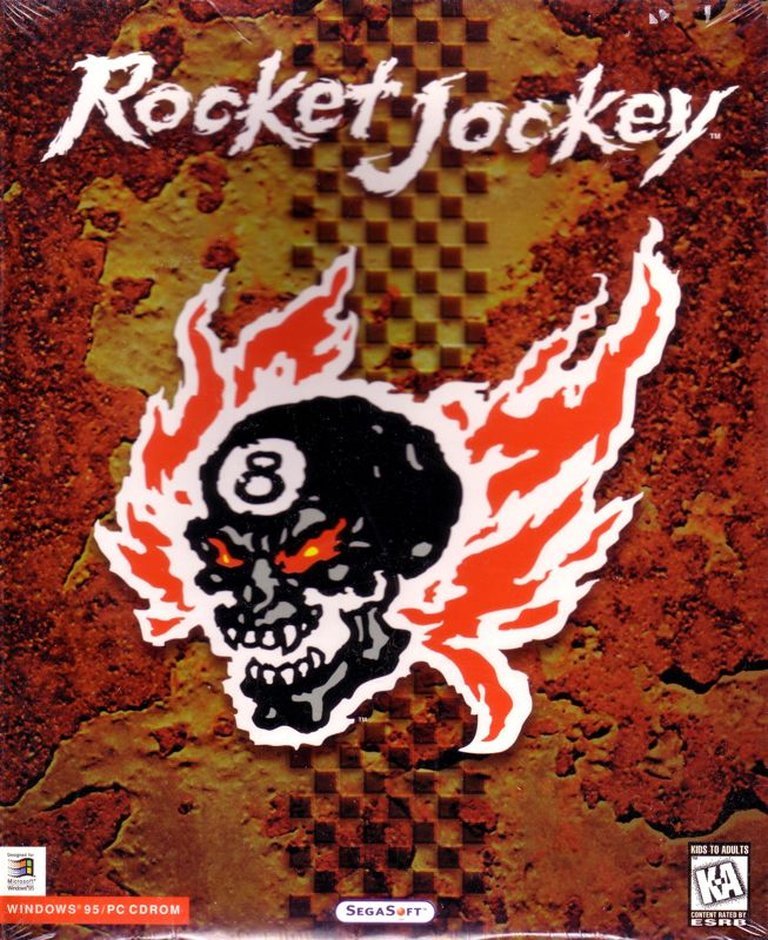
Rocket Science Games, founded in 1993, was a studio synonymous with high-concept but troubled projects. Rocket Jockey emerged from the minds of lead designer/programmer Sean Callahan and creative director Bill Davis, who envisioned a unique alternate reality: a 1930s-inspired America where rocket sleds evolved into a televised bloodsport. The concept was born from Callahan’s desire to create a physics-based vehicle combat game, with Davis adding the retro-futuristic aesthetic to ground the absurdity. Technologically, the game pushed the limits of 1996 PCs. Originally slated for the Sony PlayStation, the project shifted to Windows due to “hardware limitations and longer lead times,” as Callahan later explained. The final product demanded a 90 MHz Pentium CPU (120 MHz recommended), 16MB RAM, and a 3D accelerator—premium specs for the era. Yet despite these ambitions, SegaSoft’s marketing was disastrous. As recounted by former team members, the studio failed to provide press materials for previews, resulting in zero pre-release coverage. The box art—a garish tattoo design with tire textures—alienated potential buyers, and the promised LAN multiplayer patch arrived months late. When the game launched in November 1996, it was already doomed by a confluence of technical hurdles, commercial indifference, and the industry’s shift toward more established genres.
3. Narrative & Thematic Deep Dive
Rocket Jockey eschews traditional storytelling for a pure spectacle of sport and violence. Its narrative is embedded in its setting: a dystopian 1930s America where rocket sleds are the new chariots, and arenas resemble grotesque circuses. Eight jockeys—each with a punny name and logo like “Buster Buetox-Eightball” or “Demolition Donna Dombrowski-Heart”—compete in three brutal events. The game’s thematic core is a satirical take on commodified aggression, blending the gladiatorial ethos of ancient Rome with the chaotic energy of roller derby. Rocket War mode embodies this best, reducing opponents to points for creative takedowns: “matchmaker” (hooking two riders together) or “ball and chain” (tying a jockey to a mine). Rocket Ball, a demented soccer variant, underscores the futility of teamwork in a sport where referees are fair game and balls explode. Rocket Race transforms the spectacle into a high-stakes obstacle course, emphasizing the fragility of human ambition. There’s no deeper lore—only the cathartic, cartoonish cruelty of a world where winning means dragging rival jockeys through pylons or detonating them mid-air. The absence of narrative is intentional, focusing instead on the visceral thrill of survival and domination.
4. Gameplay Mechanics & Systems
Rocket Jockey’s genius lies in its physics-based grappling system. Each rocket sled is perpetually in motion, with minimal steering and non-existent brakes. Players rely on dual grappling-hook launchers (fired 45° left/right) to latch onto pylons, mines, or opponents, turning momentum into sharp turns or offensive maneuvers. Mastering this “cable ballet” is exhilarating: whipping around a pylon to evade a missile, then firing a hook to snag an enemy rider and drag them into a wall. The three modes showcase this versatility:
– Rocket War: Points-based deathmatch where creativity is rewarded. Eliminating opponents via “triplines” (cables strung between pylons) or “matchmakers” yields higher scores than simple ramming. Stealing sleds adds a layer of strategy, as unlocked sleds boast superior stats.
– Rocket Ball: A timed soccer variant with explosive balls and tethered referees. Shortened cable durations force aggressive play, turning goals into desperate, high-risk maneuvers.
– Rocket Race: A precision obstacle course demanding flawless cable usage to light up pylons. AI opponents’ stupidity reduces it to a solo time trial.
Sleds evolve through theft or tier completion, but progression feels uneven. AI is rudimentary—opponents rarely use advanced tactics—and late levels require pixel-perfect execution. Yet the core loop remains addictive: every successful grapple or creative takedown elicits genuine glee.
5. World-Building, Art & Sound
The game’s 1930s retro-futurism is its most charming trait. Arenas combine Art Deco structures with crude, industrial grit—think grassy fields dotted with pylons, mines, and billboards for fictional brands like “Crazy Jamal’s Used Rocket Cycles.” The art direction, led by Elliot Fan, prioritizes readability over spectacle; environments are functional, with muted textures and simple character models. This pragmatism suits the gameplay’s chaos, though it left critics wanting more. Sound, however, is Rocket Jockey’s crowning achievement. The 20-track soundtrack by surf-rock legend Dick Dale (of “Misirlou” fame) pulses with manic energy, blending twangy guitars with tribal drums. As GameSpot’s Trent Ward raved, it was “the best soundtrack to ever bless a video game.” Effects—screams, explosions, cable zips—enhance the mayhem without overwhelming. The result is a world that feels both timeless and absurd, where rocket sleds roar to the tune of a bygone era’s rebellion.
6. Reception & Legacy
Rocket Jockey launched to critical acclaim but commercial oblivion. Reviewers lauded its originality and physics, with PC Gamer awarding it 85% and Computer Gaming World declaring it “the most enjoyable way to sustain a concussion.” Yet the lukewarm 68% Metascore reflected persistent flaws: graphics were “passable,” and the missing LAN multiplayer (a box promise) was a near-fatal omission. As one reviewer noted, “It’s like praising tennis after playing only against a ball machine.” Sales were abysmal—under 3,000 copies by early 1997—dooming Rocket Science Games to bankruptcy. Its legacy, however, flourished in the dark. A devoted Facebook community preserves its history, while developers like Yossi Cohen (“AwesometonGames”) attempt remakes using Unity. A 2023 Steam re-release by Call Your Vegetables introduced it to new audiences, proving its enduring appeal. Though it never spawned a franchise, its influence echoes in physics-based multiplayer titles like Rocket League—a spiritual successor that refined Rocket Jockey’s chaos into a global phenomenon. For all its flaws, Rocket Jockey remains a cult touchstone, a reminder that brilliance can emerge even from industry collapse.
7. Conclusion
Rocket Jockey is a flawed masterpiece—brilliant in concept, maddening in execution, and haunting in its legacy. Its grappling-hook mechanics and brutal sports modes redefined vehicular combat, while Dick Dale’s soundtrack remains a benchmark for game audio. Yet steep hardware demands, buggy multiplayer, and SegaSoft’s inept marketing consigned it to the bargain bins of history. In retrospect, it’s a parable of ambition: a game that dared to be different but was crushed by the industry’s machinery. Yet its cult following and the decades-long quest for a remake underscore its resonance. Rocket Jockey may never have been a classic, but it’s a vital piece of gaming DNA—a testament to the joy of innovation, even in failure. For historians and genre enthusiasts, it’s not just a game to be played, but a story to be remembered: of rockets, cables, and the fleeting glory of a sport too wild for its time.