
- Release Year: 2000
- Platforms: Windows
- Publisher: Gamesoft Publishing, Positech Computing Ltd.
- Developer: Positech Computing Ltd.
- Genre: Action, Driving, Racing
- Perspective: Top-down
- Game Mode: LAN, Online PVP, Single-player
- Gameplay: Shooting, Space racing, Tractor beam
- Setting: Futuristic, Sci-fi
- Average Score: 35/100
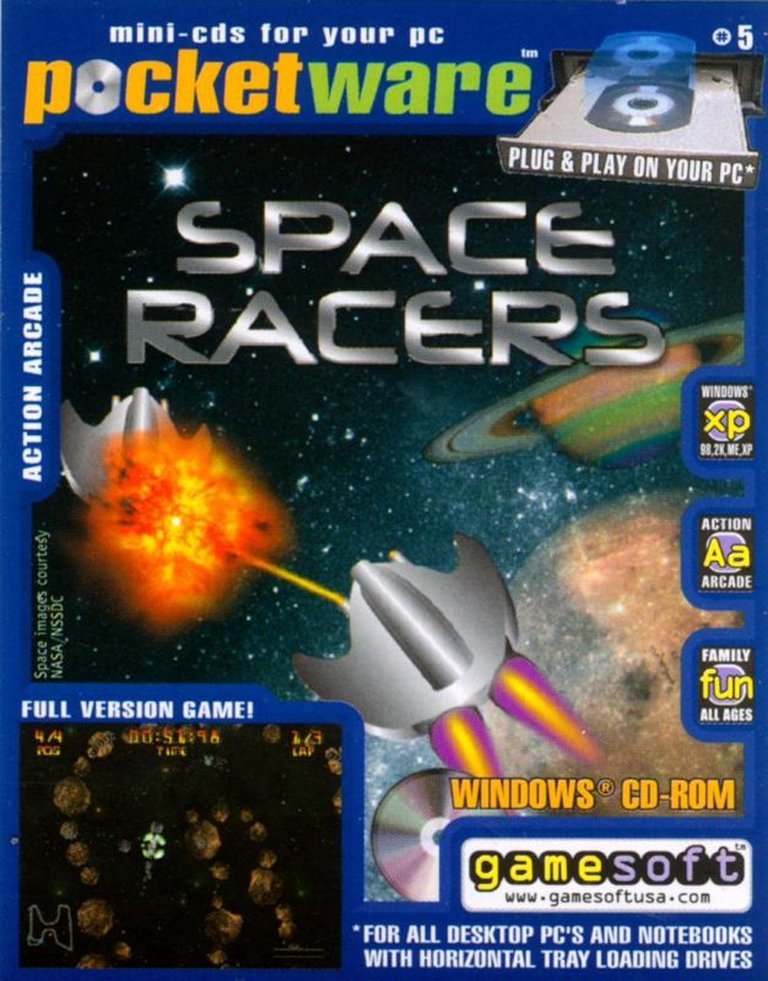
Description
Rocky Racers is a top-down 2D space racing game set in a futuristic sci-fi universe, where players compete in high-speed races through asteroid-filled courses. Beyond mere speed, racers can fire weapons and use tractor beams to hinder opponents, adding a strategic combat element to the races. The game features nine unique tracks, such as the Jupiter 500 and The Black Hole, and supports multiplayer battles via LAN or internet for up to four players.
Rocky Racers Free Download
Rocky Racers Reviews & Reception
mobygames.com (30/100): Average score: 30% (based on 1 ratings)
myabandonware.com (40/100): 2/5 – 2 votes
retro-replay.com : Rocky Racers delivers a fresh spin on top-down 2D racing by blending high-speed competition with tactical combat.
Rocky Racers Cheats & Codes
PlayStation 2
Enter codes at the main menu.
| Code | Effect |
|---|---|
| Hold R1 and press Right, Down, Up, Left, Up, L1 | Unlocks all default boxers and arenas |
| Hold R1 and press Right(3), Left, Right, L1 | Unlocks all default boxers, arenas, and Rocky Statue |
| Hold R1 and press Up, Down(2), Left(2), L1 | Unlocks all default boxers, arenas, Rocky Statue, and Mickey |
| Hold R1 and press Right, Down, Left, Up, Left, L1 | Doubles punch damage |
| Hold R1 and press Down, Left, Down, Up, Right, L1 | Doubles speed boxing |
| Hold R1 and press Right, Down(2), Up, Left, L1 | Full stats in movie mode |
| Hold R1 and press Left, Up(2), Down, Right, L1 | Full stats in tournament and exhibition modes |
| Hold R1 and press Right(2), Left(2), Up, L1 | Win fight in movie mode (press L2 + R2 during fight) |
Rocky Racers: A Forgotten Gem of Early 2000s Space Racing
Introduction
In the vast cosmos of racing games, Rocky Racers (2000) remains a curious artifact—a top-down, 2D space racing title that blended high-speed competition with tactical combat. Developed by Positech Computing Ltd. and published by Gamesoft Publishing, this game emerged during a transitional era for PC gaming, where 3D acceleration was becoming standard, yet 2D titles still held their ground. Rocky Racers carved its niche by offering a unique fusion of arcade-style racing and strategic warfare, set against the backdrop of asteroid fields and cosmic hazards.
This review aims to dissect Rocky Racers in exhaustive detail, exploring its development history, gameplay mechanics, narrative context, and lasting legacy. While it may not have achieved mainstream acclaim, the game’s innovative approach to multiplayer racing and its retro-futuristic aesthetic warrant a closer examination.
Development History & Context
The Studio and Vision
Positech Computing Ltd., founded by Cliff Harris, was a small but ambitious studio known for its focus on strategy and simulation games. Rocky Racers marked a departure from their usual fare, venturing into the action-racing genre. Harris, who served as both lead programmer and artist, envisioned a game that combined the accessibility of arcade racers with the depth of tactical combat. The result was a title that emphasized player skill, quick reflexes, and strategic use of weapons.
The game’s development coincided with the rise of online multiplayer gaming. While titles like Quake III Arena (1999) and Unreal Tournament (1999) dominated the first-person shooter scene, Rocky Racers offered a lighter, more casual alternative for racing enthusiasts. Its support for TCP/IP and IPX networking reflected the era’s reliance on LAN parties and early internet connectivity.
Technological Constraints
Rocky Racers was designed to run on modest hardware, with system requirements listing a Pentium 200 MHz processor, 16 MB of RAM, and an 8 MB DirectX-compliant video card. This accessibility ensured that the game could reach a broad audience, even those without high-end gaming rigs. The use of 2D sprites and top-down perspective allowed for smooth performance, even in multiplayer matches with up to eight players.
The game’s reliance on keyboard controls—without support for gamepads or joysticks—was a notable limitation. While this simplified development, it also restricted the game’s appeal to players who preferred analog controls for racing titles.
The Gaming Landscape of 2000
The year 2000 was a pivotal moment for racing games. Titles like Need for Speed: Porsche Unleashed and Midtown Madness 2 pushed the boundaries of 3D graphics and open-world racing. In contrast, Rocky Racers embraced a retro aesthetic, harkening back to classic top-down racers like Super Sprint (1986) and Micro Machines (1991). Its sci-fi setting and combat mechanics set it apart from contemporary titles, offering a fresh take on the genre.
However, the game’s release coincided with the decline of shareware and the rise of digital distribution. While Rocky Racers was available as a shareware demo, its full version struggled to gain traction in a market increasingly dominated by blockbuster titles.
Narrative & Thematic Deep Dive
Plot and Setting
Rocky Racers is set in the Galactic Racing League, a high-stakes tournament where pilots from across the universe compete for fame and fortune. The game’s narrative is minimal, with no cinematic cutscenes or voice acting. Instead, it relies on brief text updates and quirky character profiles to flesh out the rival pilots. These snippets of flavor text add personality to the competition, making each race feel like a showdown against distinct personalities rather than faceless AI.
The game’s nine courses—Jupiter 500, Phobos Derby, Andromeda Cup, Mars Madness, Jovian 500, Mercury 2000, The Black Hole, Asteroid Alley, and The Vortex—each offer unique hazards and layouts. The course names and environmental art hint at a larger universe, with Jupiter’s stormy atmosphere and the eerie void of The Black Hole providing a sense of scale and danger.
Themes
At its core, Rocky Racers is about competition and strategy. The game’s emphasis on tactical combat—using weapons and tractor beams to sabotage opponents—reflects a broader theme of cunning over brute force. The Galactic Racing League serves as a metaphor for the cutthroat nature of competition, where victory is as much about outsmarting rivals as it is about raw speed.
The game’s sci-fi setting also explores themes of exploration and danger. The asteroid fields and cosmic hazards represent the unpredictability of space, where even the most skilled pilots can be undone by a single misstep.
Gameplay Mechanics & Systems
Core Gameplay Loop
Rocky Racers is a top-down racing game where players control spacecraft navigating asteroid-lined tracks. The core gameplay loop involves accelerating, steering, and using weapons to gain an advantage. The controls are simple—thrust to move forward, turn to navigate, and fire weapons to disrupt opponents. However, mastering the nuances of weapon cooldowns, tractor beam timing, and track shortcuts adds depth to the experience.
The game’s physics are straightforward, with no complex simulations of inertia or momentum. This simplicity makes the game accessible to newcomers but may disappoint players seeking a more realistic racing experience.
Combat and Progression
Each spacecraft is equipped with a primary weapon and a tractor beam. The primary weapon fires projectiles that can knock opponents off course, while the tractor beam slows down rivals, allowing for strategic overtakes. The game’s combat mechanics are balanced, with weapons having limited ammunition and cooldown periods, encouraging players to use them judiciously.
The single-player campaign offers nine distinct courses, each with increasing difficulty. Players unlock new tracks as they progress, providing a sense of achievement and replayability. However, the lack of a deeper progression system—such as unlockable ships or upgrades—limits the game’s long-term appeal.
Multiplayer
Rocky Racers shines in its multiplayer mode, supporting up to eight players via TCP/IP or IPX. The ability to race against human opponents adds a layer of unpredictability and excitement, as players must adapt to real-time strategies and sabotage attempts. The game’s network stability is solid, though the lack of modern matchmaking tools may deter contemporary players.
The multiplayer experience is chaotic and adrenaline-fueled, with players jostling for position while deploying weapons and tractor beams. The absence of split-screen or hotseat modes is a missed opportunity, as these features could have enhanced the game’s local multiplayer appeal.
UI and Accessibility
The game’s user interface is clean and functional, with speed indicators, weapon meters, and lap counters displayed prominently. The UI avoids excessive clutter, ensuring that players can focus on the action. However, the lack of customizable controls and gamepad support limits the game’s accessibility.
World-Building, Art & Sound
Visual Design
Rocky Racers embraces a vibrant, retro-futuristic aesthetic. The spacecraft are well-defined, with distinctive shapes and color schemes that make them easy to identify during races. The courses are set against richly detailed cosmic backdrops, featuring swirling nebulae, asteroid belts, and planetary surfaces. These environmental details not only enhance the game’s visual appeal but also provide cues for upcoming hazards.
The game’s 2D sprites and top-down perspective are reminiscent of classic arcade racers, giving Rocky Racers a timeless quality. The animations are smooth, with engine flares, projectile blasts, and tractor beams adding visual flair without overwhelming the screen.
Sound Design
The game’s sound design is minimal but effective. Engine noises, weapon fire, and explosions provide auditory feedback, enhancing the sense of speed and combat. The lack of a dynamic soundtrack is a notable omission, as music could have heightened the game’s adrenaline-fueled races.
Reception & Legacy
Critical and Commercial Reception
Rocky Racers received mixed reviews upon release. Absolute Games (AG.ru) gave the game a scathing 30% score, criticizing its lack of depth and short campaign. The reviewer likened the experience to a tedious chore, stating that the game failed to captivate players beyond its initial novelty.
Player reception was similarly lukewarm, with an average score of 2.6 out of 5 on MobyGames. Many players found the game’s simplicity and lack of progression systems underwhelming, especially when compared to contemporary racing titles.
Influence and Legacy
Despite its modest reception, Rocky Racers remains a cult favorite among retro gaming enthusiasts. Its blend of racing and combat mechanics influenced later titles like Obliteracers (2016), which expanded on the concept of weaponized racing. The game’s emphasis on multiplayer also foreshadowed the rise of online competitive racing games.
Rocky Racers is a testament to the creativity of small studios like Positech Computing. While it may not have achieved mainstream success, its innovative gameplay and retro aesthetic continue to resonate with niche audiences.
Conclusion
Rocky Racers is a flawed but fascinating experiment in blending racing and combat mechanics. Its top-down perspective, tactical depth, and multiplayer focus set it apart from contemporary titles, offering a unique experience for players willing to overlook its limitations. While its lack of progression systems and minimal narrative may deter some, the game’s adrenaline-fueled races and chaotic multiplayer matches provide a thrilling challenge.
In the grand tapestry of racing games, Rocky Racers occupies a modest but noteworthy place. It is a relic of an era when 2D games still held their own against the rising tide of 3D graphics, and its legacy endures as a reminder of the creativity and innovation that defined early 2000s gaming.
Final Verdict: 6.5/10 – A cult classic with niche appeal, best enjoyed in multiplayer.