
- Release Year: 2004
- Platforms: iPad, iPhone, Macintosh, Windows
- Publisher: ak tronic Software & Services GmbH, Akella, Aspyr Media, Inc., Atari Interactive, Inc., Frontier Developments Ltd., Mastertronic Games Ltd.
- Developer: Frontier Developments Ltd.
- Genre: Simulation
- Perspective: 1st-person
- Game Mode: Single-player
- Gameplay: Business simulation, City building, construction simulation, Managerial
- Setting: Amusement park
- Average Score: 54/100
Description
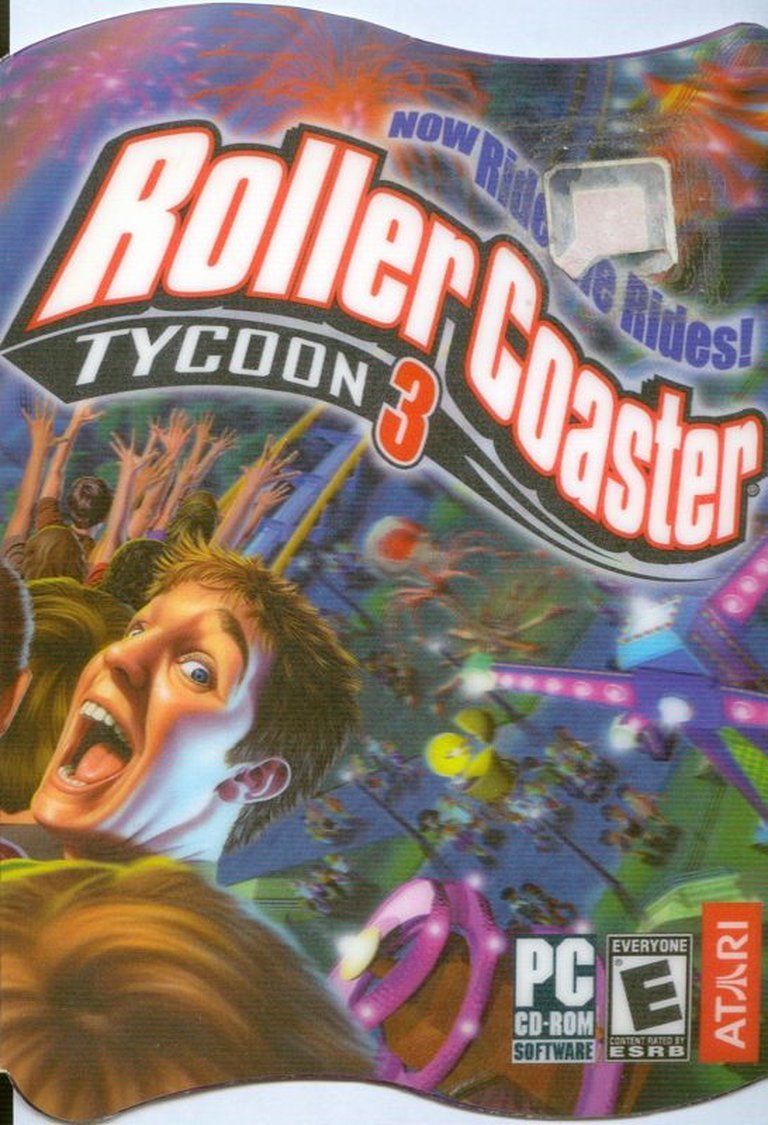
RollerCoaster Tycoon 3 is a theme park simulation game that introduces a 3D engine to the series, allowing players to design and manage their own amusement parks with enhanced visuals and gameplay mechanics. The game features day/night cycles, customizable guests, improved terraforming tools, and first-person ride perspectives. Players must complete scenario objectives across three difficulty levels—Apprentice, Entrepreneur, and Tycoon—while managing staff, attractions, and finances. A sandbox mode also lets players build freely with unlimited resources.
Gameplay Videos
Where to Buy RollerCoaster Tycoon 3
PC
RollerCoaster Tycoon 3 Free Download
RollerCoaster Tycoon 3 Cracks & Fixes
RollerCoaster Tycoon 3 Patches & Updates
RollerCoaster Tycoon 3 Mods
RollerCoaster Tycoon 3 Guides & Walkthroughs
RollerCoaster Tycoon 3 Reviews & Reception
metacritic.com (81/100): A triumphant return to form for the series.
ign.com : A great series completes its transition to a new dimension and a new developer.
opencritic.com (73/100): Rollercoaster Tycoon 3: Complete Edition brings the classic theme park building sim and all of its DLC to Switch in a generously priced package that’s hard to knock.
gamespot.com : If not for some of the glaring bugs in the retail version, RollerCoaster Tycoon 3 would have been a truly excellent sequel to a beloved franchise.
imdb.com (10/100): This is most probably the best roller-coaster simulation ever made.
RollerCoaster Tycoon 3 Cheats & Codes
RCT3: Wild!
Rename a peep to the name in bold before each description.
| Code | Effect |
|---|---|
| Rabbit | Animals Constantly Breed |
| Alvin Swazonegger | Allow Large Billboard Movies |
RCT3: Soaked!
Rename a peep to the name in bold before each description.
| Code | Effect |
|---|---|
| Mornington Crescent | Allows building shops etc. underground |
| David Walsh | Allows removal of the user interface using CTRL+U |
| M Brookes | Enables placing wall pieces and other scenery items on the edge of path tiles |
| Alistair Lindsay | Alters the speed at which some sound effects are played at pause, fast and fastest |
| Rick Griffiths | Changes the inside of a tunnel from rubble to sharks on both sides, the ceiling and the floor |
v1a Beta Patch (for Original RCT3)
Rename a peep to the name in bold before each description.
| Code | Effect |
|---|---|
| Andrew Thomas | Decreases track friction, which can make coasters go faster along their tracks |
| David Braben | Disable the Lift Chain Speed & Launch Speed limits |
| Andrew Gillett | Unknown effect (On the first Career mission, this code will double the value rating of your park) |
Original RCT3
Rename a peep to the name in bold before each description.
| Code | Effect |
|---|---|
| John D Rockefeller | Increase your money by 1,000 |
| Chris Sawyer | Cheer (Lp) – All guests applaud you & jump into the air |
| Mouse | All guests stand around looking down at the ground |
| Guido Fawkes | Enables the ‘Advanced firework editor’ |
| Atari | Cheer (Fade) – All guests applaud you |
| James Hunt | You are given a buggy vehicle to ride in |
| D Lean | Open the ‘Flying Camera’ routes editor |
| A Hitchcock | Hitchcock – not sure what this does (could be related to the birds like Alfred’s movie) |
| PhotoStory | Unknown |
| ATITech | Every Person (both guests & staff) move super fast, though the game time passes at normal speed (rides & coasters do not speed up) (Expires after 20 seconds) |
| Make Me Sick | All guests become Sick and vomit immediately |
| Jonny Watts | PeepCam (see the world through the eyes of the guest who you just renamed) |
| John Wardley | Coaster Heights (ride & coaster tracks can be built without height limitations) |
| Frontier | Unbreakable (Buildings/Rides/Coasters do not break down any longer) |
| Jon Roach | Ride All Rides (make all guests ride every park ride before leaving the park) |
| Sam Denney | Ride All Coasters (make all guests ride every park coaster before leaving the park) |
| Atomic | Big Explosion – never saw a noticable effect on this one (assume it makes certain buildings, rides, or coasters explode) |
PC
Rename a guest to one of the following names.
| Code | Effect |
|---|---|
| Jonny Watts | Peep cam, see through eyes of guest |
| Andrew Gillett | Increase park value |
| Mouse | Guests stand around looking down at the ground |
| D Lean | Flying Camera path editor |
| ATITech | Peeps move fast for 20 seconds |
| Make Me Sick | All guests get sick |
| Sam Denney | All guests ride every coaster before leaving |
| Atomic | Big explosion |
| PhotoStory | Peeps take photos |
| A Hitchcock | Ducks appear |
| John D Rockefeller | Extra Money |
| Frontier | All rides and coasters never break down |
| Guido Fawkes | Gives access to the advanced Fireworks editor |
| Atari | All guests Laugh |
| Chris Sawyer | Guests Jump for joy |
| Jon Roach | Peeps ride all non-coaster rides |
| John Wardley | Removes height restrictions when building coasters |
| Andrew Thomas | Decreases track friction, which can help when importing some RCT1 or 2 coasters into RCT3. Only works after Update #1 |
| David Braben | Unlimited launch and chain lift speeds |
| James Hunt | You are given a buggy vehicle to ride in |
Base Game
Rename a peep to the name in bold before each description.
| Code | Effect |
|---|---|
| A Hitchcock | Creates many flying ducks |
| Andrew Gillett | Sets track friction to 0, which completely prevents vehicles on most tracked rides from gradually losing speed over time |
| Andrew Thomas | Decreases track friction, which reduces the amount of speed that vehicles on most tracked rides lose over time |
| Atari | Peeps applaud you |
| ATITech | All peeps, staff and animals move very fast for twenty seconds; in-game clock stays at a normal speed |
| Chris Sawyer | Peeps applaud and jump into the air |
| D Lean | Opens the Flying Camera routes editor |
| David Braben | Allows the player to set chain lift and launch speeds on roller coasters, free-fall towers and water slides |
| Frontier | All rides and coasters never break down |
| Guido Fawkes | Enables the advanced firework editor |
| James Hunt | You are given a buggy vehicle to ride in |
| John D Rockefeller | Increase your money by 1,000 |
| John Wardley | Removes height restrictions when building coasters |
| Jon Roach | Peeps ride all non-coaster rides |
| Jonny Watts | PeepCam (see the world through the eyes of the guest who you just renamed) |
| Make Me Sick | All guests become Sick and vomit immediately |
| Mouse | All guests stand around looking down at the ground |
| Sam Denney | Peeps ride all coasters |
Soaked!
Rename a peep to the name in bold before each description.
| Code | Effect |
|---|---|
| Mornington Crescent | Allows building shops etc. underground |
| David Walsh | Allows removal of the user interface using CTRL+U |
| M Brookes | Enables placing wall pieces and other scenery items on the edge of path tiles |
| Alistair Lindsay | Alters the speed at which some sound effects are played at pause, fast and fastest |
| Rick Griffiths | Changes the inside of a tunnel from rubble to sharks on both sides, the ceiling and the floor |
Wild!
Rename a peep to the name in bold before each description.
| Code | Effect |
|---|---|
| Rabbit | Animals Constantly Breed |
| Alvin Swazonegger | Allow Large Billboard Movies |
RollerCoaster Tycoon 3: A Masterclass in Theme Park Simulation
Introduction
RollerCoaster Tycoon 3 (RCT3) is not just a game—it’s a digital sandbox where creativity, strategy, and management collide in a symphony of screams, laughter, and the occasional vomit cleanup. Released in 2004 by Frontier Developments, RCT3 marked a seismic shift in the RollerCoaster Tycoon series, transitioning from the isometric charm of its predecessors to a fully realized 3D world. This leap wasn’t merely cosmetic; it redefined what a theme park simulator could be, blending depth with accessibility in a way that few games have matched since.
At its core, RCT3 is a celebration of player agency. Whether you’re meticulously crafting a heart-stopping coaster, balancing the books to keep your park afloat, or simply watching your “peeps” (guests) wander through your meticulously designed landscapes, the game offers an intoxicating mix of creativity and challenge. It’s a title that respects its lineage while boldly forging its own path, and its influence can still be felt in modern management sims like Planet Coaster and Parkitect.
But what makes RCT3 truly special is its ability to appeal to both the casual player and the hardcore simulator enthusiast. The game’s dual-mode structure—career scenarios with escalating objectives and a freeform sandbox—ensures that there’s always something new to explore, whether you’re chasing high scores or letting your imagination run wild. And with the additions of the Soaked! and Wild! expansions, RCT3 evolved into a near-complete theme park experience, offering water parks, zoos, and even more ways to torment (or delight) your virtual guests.
In this review, we’ll dissect RCT3’s development, gameplay, and legacy, exploring why it remains a beloved classic nearly two decades after its release. From its innovative 3D engine to its quirky peep behaviors, we’ll leave no stone unturned in our analysis of this landmark title.
Development History & Context
The Changing of the Guard
The RollerCoaster Tycoon series had, up to this point, been the brainchild of Chris Sawyer, a programming virtuoso whose previous work on Transport Tycoon had already cemented his reputation as a master of simulation games. Sawyer’s first two RCT titles, released in 1999 and 2002 respectively, were critical and commercial darlings, praised for their depth, charm, and addictive gameplay. However, by the early 2000s, Sawyer was deeply engrossed in Chris Sawyer’s Locomotion, a spiritual successor to Transport Tycoon, leaving the future of RollerCoaster Tycoon in limbo.
Enter Frontier Developments, a Cambridge-based studio founded by David Braben, co-creator of the Elite series. Frontier had already proven its mettle with the Xbox port of the original RollerCoaster Tycoon, and when Atari (then Infogrames) approached them to develop the third installment, they saw an opportunity to push the series into the third dimension. Sawyer remained involved as a consultant, but the reins were firmly in Frontier’s hands.
Technological Leap: The Cobra Engine
The most immediate and transformative change in RCT3 was its shift to a fully 3D environment, powered by Frontier’s proprietary Cobra engine. This wasn’t just a graphical upgrade—it was a fundamental reimagining of how players interacted with the game world. Gone were the fixed isometric angles of RCT1 and RCT2; in their place was a dynamic, free-roaming camera that allowed players to zoom, rotate, and tilt their view with unprecedented freedom.
This shift had profound implications for gameplay. Building coasters and parks was no longer a battle against the limitations of a 2D grid. Players could now construct rides at any angle, tweak terrain with surgical precision, and even ride their creations in first-person via the CoasterCam—a feature that became one of the game’s most celebrated innovations. The ability to experience your park from the perspective of a guest added a layer of immersion that was revolutionary for the genre.
However, this technological leap came with challenges. The Cobra engine, while powerful, was demanding for the hardware of the time. Players with lower-end PCs found that large parks could bring the game to a crawl, and some of the more ambitious user-created parks were nearly unplayable without significant optimizations. Frontier addressed many of these issues with post-launch patches, but the game’s performance quirks remained a point of contention for some players.
The Gaming Landscape of 2004
RCT3 arrived at a fascinating juncture in gaming history. The early 2000s were a period of rapid evolution for PC gaming, with 3D graphics becoming the norm and genres like real-time strategy and first-person shooters dominating the market. Management simulators, while niche, had a dedicated following, and titles like The Sims and Zoo Tycoon had proven that there was a hunger for games that blended creativity with strategy.
Yet, RCT3 stood out for its sheer ambition. While The Sims focused on the micro-scale of individual lives and Zoo Tycoon emphasized animal care, RCT3 offered a macro-scale sandbox where players could build entire worlds from the ground up. Its blend of engineering, economics, and aesthetics made it a unique proposition, and its release was met with considerable anticipation from fans of the series and simulation enthusiasts alike.
Atari’s marketing campaign leaned heavily into the game’s new features, particularly the CoasterCam and the ability to design parks in 3D. The publisher also capitalized on the series’ existing fanbase, offering pre-order bonuses and demo versions that showcased the game’s improved graphics and gameplay. The result was a launch that exceeded expectations, with RCT3 quickly climbing the sales charts and cementing its place as one of the year’s standout titles.
Post-Launch Support and Expansions
Frontier’s commitment to RCT3 didn’t end at launch. The studio released several patches that addressed performance issues, bugs, and player feedback, demonstrating a level of post-launch support that was relatively rare for the time. This dedication to refining the experience paid off, as the game’s reputation improved significantly in the months following its release.
The true test of RCT3’s longevity, however, came with its two expansion packs: Soaked! (2005) and Wild! (2005). Soaked! introduced water parks, complete with swimming pools, water slides, and new ride types like the Roller Soaker. Wild! added zoos and safari rides, allowing players to incorporate animals into their parks and create immersive wildlife exhibits. Both expansions were well-received, with Soaked! in particular praised for its innovative take on water-based attractions.
These expansions didn’t just add new content—they expanded the game’s creative possibilities, giving players even more tools to craft their dream parks. The ability to build underground, introduced in Wild!, was a particularly welcome addition, as it allowed for more complex and visually interesting park layouts.
Legal Battles and the Complete Edition
The story of RCT3’s development didn’t end with its expansions. In the years following its release, the game became embroiled in legal disputes between Atari and Frontier over royalty payments and licensing agreements. These conflicts culminated in RCT3 being temporarily pulled from digital storefronts like Steam and GOG in 2018, much to the dismay of fans.
However, this setback ultimately led to a silver lining. In 2020, Frontier reacquired the rights to RCT3 and released RollerCoaster Tycoon 3: Complete Edition, a remastered version of the game that included both expansions, widescreen support, and modernized controls. This release not only revived interest in the classic title but also introduced it to a new generation of players, ensuring that RCT3’s legacy would endure.
Narrative & Thematic Deep Dive
The Unspoken Story of RCT3
At first glance, RollerCoaster Tycoon 3 might seem like a game devoid of narrative. There are no cutscenes, no dialogue trees, and no overarching plot to speak of. Instead, the game’s storytelling is emergent, unfolding through the player’s actions and the reactions of their peeps. Yet, beneath its surface, RCT3 is rich with thematic depth, exploring ideas of creativity, capitalism, and even the ethics of entertainment.
The career mode scenarios, while ostensibly about meeting financial and operational goals, often carry subtle narratives of their own. For example, the “Fright Night” scenario tasks players with revitalizing a struggling horror-themed park, complete with eerie scenery and spooky rides. The “Paradise Island” scenario, unlocked only after mastering the game’s most challenging objectives, feels like a reward—a tropical paradise where players can let their imaginations run wild.
Even the peeps themselves tell stories. Watching a family navigate your park, from the wide-eyed excitement of children on their first coaster to the exhausted parents searching for a place to rest, creates a sense of narrative that’s entirely player-driven. The game’s VIP system, which introduces special guests with unique demands, adds another layer of storytelling, as players must cater to the whims of celebrities, inspectors, and other high-profile visitors.
Themes of Creativity and Control
At its heart, RCT3 is a game about creation. Whether you’re designing a coaster that defies the laws of physics or meticulously landscaping a garden to evoke a specific mood, the game empowers players to bring their visions to life. This creative freedom is tempered by the realities of park management—budget constraints, guest satisfaction, and the ever-present threat of bankruptcy.
This tension between creativity and control is one of RCT3’s most compelling themes. The game rewards players who can balance artistic ambition with practical considerations, whether that means placing enough trash cans to keep the park clean or ensuring that ride queues don’t become unbearably long. It’s a delicate dance, and one that mirrors the real-world challenges faced by theme park designers.
The game also explores the ethics of entertainment in subtle ways. For example, the ability to design coasters that induce nausea or even harm peeps (albeit in a cartoonish, non-lethal way) raises questions about the responsibilities of park owners. Should you prioritize thrills at the expense of guest comfort? Is it ethical to charge exorbitant prices for food and drinks? RCT3 doesn’t provide easy answers to these questions, but it does encourage players to think critically about the consequences of their decisions.
The Role of Aesthetics and Atmosphere
RCT3’s themes are reinforced by its visual and auditory design. The game’s art style is bright, colorful, and inviting, evoking the whimsy of classic amusement parks. The day/night cycle, a new feature in RCT3, adds a dynamic element to the atmosphere, with parks taking on a magical quality under the glow of lampposts and ride lights.
The sound design plays a crucial role in immersing players in the world. The screams of riders on a coaster, the laughter of children on a merry-go-round, and the ambient chatter of crowds all contribute to the game’s lively atmosphere. The MixMaster feature, which allows players to create custom fireworks shows set to music, further enhances this sensory experience, turning parks into spectacles of light and sound.
Even the game’s UI design reflects its themes of creativity and control. The interface is clean and intuitive, with tools and menus organized in a way that makes complex tasks feel manageable. The ability to pause the game while building, another new feature in RCT3, gives players the time and space to plan their parks without the pressure of real-time constraints.
The Peep Experience: A Study in Emergent Narrative
The peeps of RCT3 are more than just faceless NPCs—they’re the lifeblood of the game’s emergent narrative. Each peep has their own personality, preferences, and behaviors, which are influenced by factors like age, nausea tolerance, and preferred ride intensity. Watching them interact with your park is like observing a miniature society, complete with its own rhythms and quirks.
For example, teenagers might flock to high-thrill rides at night, while families with young children prefer gentler attractions during the day. Some peeps might get lost, others might complain about long lines, and a few might even get sick after riding a particularly intense coaster. These behaviors aren’t just random—they’re the result of complex underlying systems that simulate human decision-making.
The game’s Peep Designer, which allows players to create custom guests, adds another layer of narrative depth. By designing families with specific traits and preferences, players can craft their own stories within the game. Will your park cater to adrenaline junkies, or will it be a haven for families with young children? The choice is yours, and the peeps will react accordingly.
Gameplay Mechanics & Systems
Core Gameplay Loop: Build, Manage, Optimize
At its core, RollerCoaster Tycoon 3 is a game about three interconnected activities: building, managing, and optimizing. The building phase is where players unleash their creativity, designing coasters, placing rides, and shaping the park’s landscape. The management phase involves hiring staff, setting prices, and ensuring that the park runs smoothly. The optimization phase is where players fine-tune their designs, balancing guest satisfaction with financial viability.
This loop is reinforced by the game’s two primary modes: career and sandbox. In career mode, players tackle pre-designed scenarios with specific objectives, such as achieving a certain park rating or impressing a VIP guest. These scenarios are divided into three difficulty levels—Apprentice, Entrepreneur, and Tycoon—each with increasingly challenging goals. Completing objectives unlocks new scenarios, providing a sense of progression and accomplishment.
Sandbox mode, on the other hand, is a blank canvas. Players are given a large plot of land and unlimited funds, allowing them to build without constraints. This mode is perfect for experimentation, whether you’re testing out a new coaster design or creating a themed park from scratch. The lack of objectives means that the only limits are your imagination and the game’s technical capabilities.
Ride Construction: The Heart of RCT3
The ride construction system is where RCT3 truly shines. The game offers a staggering variety of ride types, from classic roller coasters to gentle carousels, thrill rides, and water attractions. Each ride type has its own unique mechanics and customization options, allowing for near-infinite creativity.
Coaster construction is the most complex and rewarding aspect of the game. Players can design tracks piece by piece, adjusting curves, slopes, and inversions to create the perfect ride. The game’s physics engine simulates factors like speed, G-forces, and excitement, providing real-time feedback on how your design will perform. This system is both intuitive and deep, allowing beginners to create simple coasters while giving experts the tools to craft intricate, high-thrill masterpieces.
One of the most innovative features of RCT3’s ride system is the CoasterCam, which allows players to experience their creations from a first-person perspective. This feature isn’t just a gimmick—it’s a crucial tool for testing and refining coaster designs. By riding your coaster, you can identify problematic sections, adjust speeds, and ensure that the experience is as thrilling (or gentle) as you intend.
Park Management: Balancing Act
While ride construction is the flashiest part of RCT3, park management is where the game’s depth truly becomes apparent. Players must juggle a wide range of responsibilities, from hiring and training staff to setting prices and maintaining facilities. Each decision has ripple effects, and the best players are those who can anticipate and adapt to changing conditions.
Staff management is a key component of this system. Players can hire mechanics, janitors, entertainers, and security guards, each with their own roles and responsibilities. Mechanics keep rides running smoothly, janitors clean up litter and vomit, entertainers boost guest happiness, and security guards maintain order. Staff can be trained to improve their efficiency, and their wages can be adjusted to balance performance with cost.
Financial management is another critical aspect of the game. Players must set admission prices, ride prices, and stall prices, all while ensuring that guests don’t feel overcharged. The game’s economy is dynamic, with factors like park rating, guest satisfaction, and ride popularity influencing revenue. Players must also manage loans and interest rates, adding another layer of complexity to the financial system.
Guest Behavior: The Peep Factor
The peeps of RCT3 are more than just passive observers—they’re active participants in the park’s ecosystem. Each peep has their own personality, preferences, and behaviors, which are influenced by factors like age, nausea tolerance, and preferred ride intensity. Understanding and catering to these behaviors is key to running a successful park.
For example, peeps with high nausea tolerance might seek out intense coasters, while those with low tolerance might avoid them. Families with young children might prefer gentle rides and attractions, while teenagers might gravitate toward thrill rides and arcades. The game’s guest AI is sophisticated enough to simulate these behaviors in a believable way, creating a dynamic and unpredictable park environment.
The game also features VIP peeps, special guests with unique demands and objectives. These VIPs might require specific ride experiences, park ratings, or even custom-designed attractions. Pleasing them often unlocks new scenarios or rewards, adding another layer of challenge to the career mode.
Terraforming and Scenery: Crafting the Perfect Park
RCT3’s terraforming and scenery tools are among the most powerful in the series, allowing players to shape the land and create immersive environments. The game’s terrain editor supports a wide range of modifications, from gentle hills to towering mountains, and even underwater landscapes (with the Soaked! expansion).
Scenery placement is equally robust, with a vast library of objects, buildings, and decorations to choose from. Players can create themed areas, such as spooky forests, western towns, or futuristic cities, using the game’s extensive scenery sets. The ability to import custom scenery and ride designs further enhances this creative freedom, allowing players to share and download user-generated content.
The game’s day/night cycle adds another layer of depth to park design. Rides and scenery take on a different character at night, with lights and shadows creating a magical atmosphere. Players must consider how their park will look and function in both daylight and darkness, adding another dimension to the design process.
Multiplayer and Modding: Extending the Experience
While RCT3 is primarily a single-player experience, its modding community has played a crucial role in extending the game’s lifespan. Players can create and share custom rides, scenery, and even entire parks, adding endless replayability to the base game. Websites like NE Designs and RCTGo have become hubs for this creative community, offering thousands of user-generated designs.
The game’s scenario editor is another powerful tool for modders. Players can create their own scenarios, complete with custom objectives, terrain, and starting conditions. This feature has led to a wealth of user-created content, from faithful recreations of real-world parks to entirely original designs.
World-Building, Art & Sound
A Living, Breathing World
RollerCoaster Tycoon 3 excels in creating a world that feels alive and dynamic. From the moment you boot up the game, you’re greeted with a vibrant, colorful environment that’s brimming with activity. The parks you build aren’t static—they’re bustling ecosystems where every element, from the rides to the peeps, interacts in meaningful ways.
The game’s art style is a perfect blend of realism and whimsy. The rides are detailed enough to feel authentic, but they’re also stylized in a way that enhances their appeal. The coasters, in particular, are a marvel of design, with intricate track pieces, supports, and theming options that allow for near-infinite customization. Whether you’re building a classic wooden coaster or a futuristic launch coaster, the visual feedback is immediate and satisfying.
The peeps, too, are a testament to the game’s attention to detail. While their models are simple by modern standards, their animations and behaviors bring them to life. Watching a group of peeps react to a coaster—some cheering, others screaming, and a few looking distinctly green—is a joy in itself. The game’s day/night cycle further enhances this immersion, with parks taking on a different character under the glow of lampposts and ride lights.
The Sound of Fun
Sound design is often an overlooked aspect of simulation games, but RCT3 uses audio to great effect. The game’s soundtrack, composed by Alistair Lindsay, is a mix of upbeat, whimsical tunes that perfectly complement the park atmosphere. The music shifts dynamically depending on the time of day and the park’s overall mood, adding another layer of immersion.
The ambient sounds are equally impressive. The screams of riders on a coaster, the laughter of children on a merry-go-round, and the chatter of crowds all contribute to the game’s lively atmosphere. Even the more mundane sounds, like the hum of a ride motor or the clink of a drink stall, help to sell the illusion of a real, functioning park.
The MixMaster feature, which allows players to create custom fireworks shows set to music, is a standout example of the game’s audio design. Players can choreograph elaborate displays, syncing explosions and effects to in-game music or even custom tracks. The result is a spectacle that’s as much about sound as it is about visuals, turning your park into a symphony of light and noise.
Thematic Depth and Atmosphere
RCT3’s world-building is reinforced by its thematic depth. The game offers a wide range of scenery themes, from spooky and western to sci-fi and adventure. Each theme comes with its own set of buildings, decorations, and even ride designs, allowing players to create parks that feel cohesive and immersive.
For example, a spooky-themed park might feature haunted houses, graveyards, and eerie lighting, while a western-themed park could include saloons, mine shafts, and cowboy statues. The game’s attention to thematic detail extends to the rides themselves, with many attractions featuring custom theming options that match the park’s overall aesthetic.
The game’s weather system adds another layer of atmosphere. Rain, snow, and fog all affect the park’s appearance and guest behavior, creating dynamic conditions that players must adapt to. A rainy day might drive peeps indoors, while a sunny day could see them flocking to outdoor attractions. These environmental factors add unpredictability to the gameplay, ensuring that no two playthroughs are exactly alike.
Reception & Legacy
Critical and Commercial Success
RollerCoaster Tycoon 3 was met with widespread acclaim upon its release, earning an average score of 81/100 on Metacritic and 84% on GameRankings. Critics praised the game’s transition to 3D, its deep gameplay mechanics, and its wealth of creative tools. Many reviews highlighted the CoasterCam and MixMaster features as standout innovations, while others commended the game’s attention to detail and immersive atmosphere.
However, the game wasn’t without its detractors. Some critics noted performance issues, particularly on lower-end hardware, and a few felt that the game’s learning curve could be steep for newcomers. Despite these criticisms, RCT3’s strengths far outweighed its weaknesses, and it quickly became one of the most beloved entries in the RollerCoaster Tycoon series.
Commercially, RCT3 was a massive success. It debuted as the second best-selling PC game on Amazon.com in November 2004 and climbed to the top spot the following week. By the end of the year, it had become the ninth best-selling computer game in the United States, according to The NPD Group. The game’s popularity endured, with Frontier CEO David Braben reporting in 2015 that RCT3 had sold over 10 million copies worldwide.
Influence on the Genre
RCT3’s impact on the theme park simulation genre cannot be overstated. Its transition to 3D set a new standard for the genre, influencing later titles like Planet Coaster and Parkitect. The game’s emphasis on creativity, combined with its deep management mechanics, created a template that many subsequent simulators would follow.
Planet Coaster, developed by Frontier and released in 2016, is perhaps the most direct successor to RCT3. The game builds on many of RCT3’s core concepts, including 3D park design, ride customization, and guest AI, while adding modern graphics and new features like a robust multiplayer mode. Parkitect, released in 2018, takes a different approach, focusing more on the operational side of park management while still offering deep creative tools.
RCT3’s influence extends beyond its direct successors. The game’s modding community, which continues to thrive to this day, has inspired similar communities around other simulation games. The ability to share and download custom content has become a staple of the genre, and RCT3 was one of the first games to fully embrace this concept.
The Complete Edition and Beyond
The release of RollerCoaster Tycoon 3: Complete Edition in 2020 marked a new chapter in the game’s legacy. This remastered version, which included both expansions and modernized features, introduced RCT3 to a new generation of players. The Complete Edition’s success demonstrated that there was still a hunger for classic simulation games, even in an era dominated by open-world RPGs and battle royales.
The Complete Edition also served as a bridge between RCT3 and Frontier’s newer titles. Players who cut their teeth on RCT3’s creative tools found a natural progression in Planet Coaster, while those who preferred the game’s management aspects could explore Parkitect or other modern simulators.
Cultural Impact and Memes
RCT3’s cultural impact extends beyond the gaming world. The game’s quirky peep behaviors and emergent storytelling have made it a favorite among content creators, who often share their most outrageous park designs and peep mishaps online. The game’s reputation for allowing players to create “sadistic” coasters—rides designed to maximize nausea or even harm peeps—has become a meme in its own right, with players competing to create the most brutal (or absurd) attractions.
One of the most famous examples of this is the “Mr. Bones’ Wild Ride” meme, which originated from a 4chan thread describing a slow, ghostly train ride that lasts for four in-game years. The meme, which features peeps expressing their desire to “get off Mr. Bones’ Wild Ride,” has become a staple of internet humor, demonstrating RCT3’s enduring appeal as a source of both creativity and comedy.
Conclusion: A Timeless Classic
RollerCoaster Tycoon 3 is more than just a game—it’s a testament to the power of creativity, simulation, and emergent storytelling. Nearly two decades after its release, it remains a benchmark for the theme park simulation genre, thanks to its deep gameplay mechanics, innovative features, and enduring appeal.
The game’s transition to 3D was a bold move that paid off in spades, offering players unprecedented freedom to design and manage their dream parks. Features like the CoasterCam, MixMaster, and Peep Designer added layers of immersion and customization that set RCT3 apart from its predecessors and competitors alike.
Yet, what truly makes RCT3 special is its ability to adapt to the player’s preferences. Whether you’re a meticulous planner who loves optimizing every aspect of your park or a creative free spirit who just wants to build the wildest coaster imaginable, RCT3 has something for you. Its dual-mode structure, combined with its robust modding community, ensures that the game remains fresh and engaging even after hundreds of hours of play.
The legacy of RCT3 is evident in the games that followed, from Planet Coaster to Parkitect, but none have quite captured the magic of the original. The Complete Edition’s release in 2020 proved that there’s still a place for classic simulators in the modern gaming landscape, and RCT3’s continued popularity is a testament to its timeless appeal.
In the end, RollerCoaster Tycoon 3 is a game about possibilities. It’s a digital playground where the only limits are your imagination and the laws of physics (which, let’s be honest, are more like suggestions in this game). Whether you’re crafting a meticulously themed park or unleashing chaos with a coaster designed to induce maximum nausea, RCT3 invites you to create, experiment, and, above all, have fun.
For these reasons and more, RollerCoaster Tycoon 3 isn’t just a classic—it’s a masterpiece. And like any great masterpiece, it continues to inspire, entertain, and delight players old and new. So, if you haven’t already, grab your hard hat, fire up the game, and get ready to build the park of your dreams. Just don’t be surprised if you lose a few hours (or days) in the process. After all, in the world of RCT3, the ride never ends.