
- Release Year: 2000
- Platforms: Android, iPad, iPhone, Macintosh, PlayStation 2, PlayStation, PS Vita, PSP, Windows
- Publisher: Acer Third Wave Software (Beijing) Co., Ltd, Acer TWP Corp, KOEI Co., Ltd., KOEI Corporation, KOEI Korea Corporation, Tecmo Koei Games Co., Ltd.
- Developer: KOEI Co., Ltd., Koei Tecmo Games Co., Ltd.
- Genre: Strategy, Tactics
- Perspective: Diagonal-down
- Game Mode: Single-player
- Gameplay: Diplomacy, Grand strategy, Military planning, Nation management, Turn-based combat
- Setting: Ancient, China, Historical events, Imperial
- Average Score: 80/100
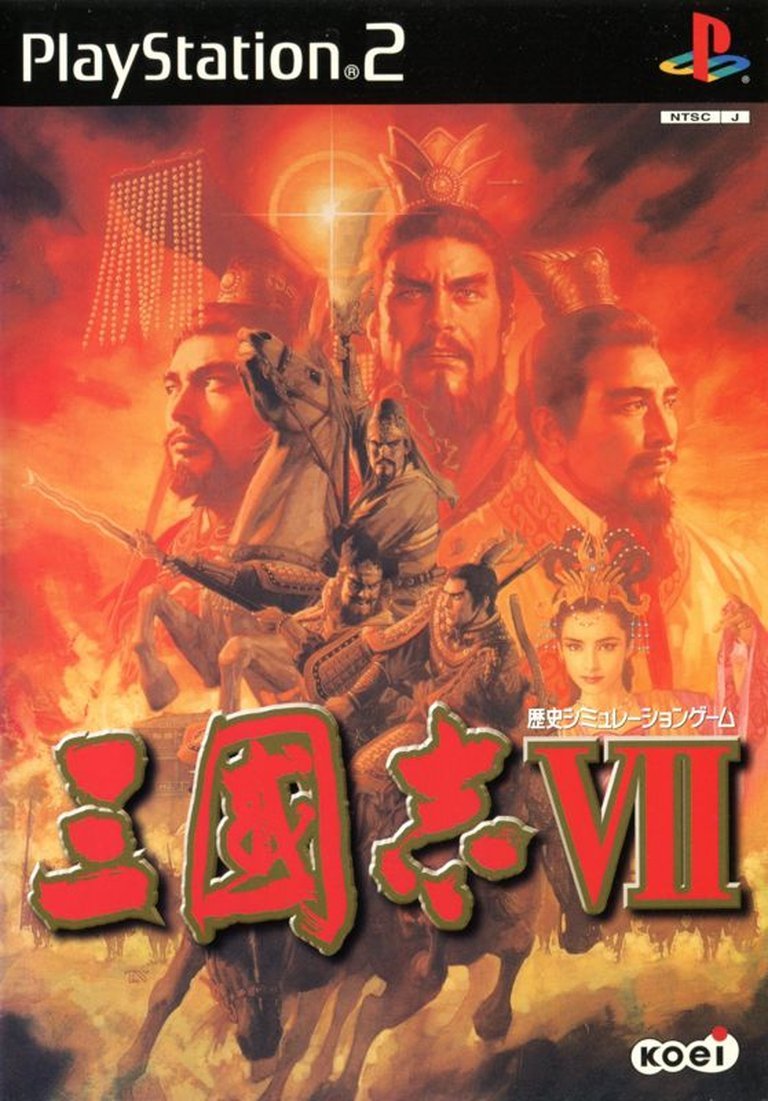
Description
Romance of the Three Kingdoms VII is a grand strategy game set during China’s Three Kingdoms period (late 2nd to 3rd century AD), following the collapse of the Han Dynasty. Players vie to unite fragmented warlord states through diplomacy, economic management, and military conquest, with turn-based tactical battles determining territorial conflicts. This seventh installment introduces 3D graphics and the unprecedented ability to play as any historical figure, blending empire-building with character-driven decision-making.
Gameplay Videos
Romance of the Three Kingdoms VII Free Download
Romance of the Three Kingdoms VII Patches & Updates
Romance of the Three Kingdoms VII Mods
Romance of the Three Kingdoms VII Guides & Walkthroughs
Romance of the Three Kingdoms VII Reviews & Reception
metacritic.com (72/100): With many hundreds of officers to meet, totally open-ended gameplay and ten scenarios to experience, this may be the best and longest lasting game you’ve ever bought.
gamefaqs.gamespot.com (90/100): Koei’s latest addition to one of the oldest franchises in gaming history is clearly the best as well.
Romance of the Three Kingdoms VII Cheats & Codes
PlayStation 2
During gameplay, press **L1 + L2 + R1 + R2 + SELECT** to access the multiplayer officer‑selection menu. Enable CodeBreaker or Action‑Replay codes via a code disc or external device (see listed codes).
| Code | Effect |
|---|---|
| L1 + L2 + R1 + R2 + SELECT | Opens the Add/Remove Player Officer menu for multiplayer |
| R1 + R2 + L1 + L2 + SELECT | Adds up to seven additional officers to user control during a single‑player game |
| FA7A006E 328061D9 | Enables CodeBreaker cheats (requires CodeBreaker/GameShark disc) |
| 0E3C7DF2 1853E59E | Infinite AP for all created officers |
| EE4F4CC6 BCF87352 | Infinite AP for all created officers |
| BE6486C2 BC0D9BD4 | Max funds for all created officers |
| BE64854A BC0D9BD4 | Max deeds for all created officers |
| BE6486D2 BC0D9BD4 | Max fame for all created officers |
| BE6486DE BC0D9BD4 | Max troops for all created officers |
| BE6486DA BC0D9BD4 | Max drill for all created officers |
| BE6486E6 BC0D9BD4 | Max WAR for all created officers |
| BE648616 BC0D9BD4 | Max INT for all created officers |
| BE64861E BC0D9BD4 | Max POL for all created officers |
| BE64861A BC0D9BD4 | Max CHA for all created officers |
| BE648636 BC0D9BD4 | Max WAR experience for all created officers |
| BE648632 BC0D9BD4 | Max INT experience for all created officers |
| BE64863E BC0D9BD4 | Max POL experience for all created officers |
| BE64863A BC0D9BD4 | Max CHA experience for all created officers |
| BE6486EE BC0D9BD4 | All skills unlocked for all created officers |
| BE6485AE BC0D9BD4 | All arms (equipment) unlocked for all created officers |
| BE64867E BC0D9BD4 | Liege status unlocked for all created officers |
PC
Launch the game and start a single‑player session. To use the multiplayer/officer‑selection cheat, hold **Right Shift**, click the **Left Mouse Button**, and then **right‑click twice** to bring up the multiple‑character selection menu.
| Code | Effect |
|---|---|
| Hold Right Shift + Left Mouse Button and click the Right Mouse Button two times | Brings up a menu to select multiple characters within the game |
Romance of the Three Kingdoms VII: A Dynasty Forged in Strategy and Ambition
Introduction
In the pantheon of grand strategy games, few franchises carry the weight of history like Koei’s Romance of the Three Kingdoms series. Released in 2000 for Windows, PlayStation 2, and later ported to PSP and mobile platforms, Romance of the Three Kingdoms VII (RTK VII) marked a bold evolution for the storied franchise. Building upon 15 years of legacy, RTK VII dared to reimagine the player’s role in its dramatization of China’s fractured Three Kingdoms era (184–280 CE). Forged in the fires of historical simulation and tactical nuance, this entry remains a polarizing yet pivotal chapter—a game that rewarded patience with unprecedented depth while exposing the technological and creative constraints of its era. This review argues that RTK VII stands as a flawed masterpiece, marrying rich narrative ambition and mechanical complexity at the cost of accessibility and modernity—a testament to Koei’s uncompromising vision of historical strategy gaming.
Development History & Context
Studio Vision & Historical Gaming Landscape
Developed by Koei (now Koei Tecmo) under the guidance of general producer Kou Shibusawa and director Kazuhiro Fujishige, RTK VII emerged during a transformative period for strategy games. The late ’90s and early 2000s saw the rise of titles like Civilization III and Total War, which blended macro-scale empire-building with tactical warfare. Against this backdrop, Koei sought to refine its niche: historically dense simulations rooted in Luo Guanzhong’s 14th-century novel Romance of the Three Kingdoms and Chen Shou’s Records of the Three Kingdoms.
Technological Constraints & Innovations
RTK VII debuted in a transitional era between 2D and 3D graphics. While Koei touted the addition of 3D battlefields—a departure from predecessor RTK VI’s sprite-based visuals—technical limitations forced compromises. The PlayStation 2 hardware, though capable, prioritized gameplay fidelity over graphical flair, resulting in crude isometric cities and choppy animations. As IGN noted, the visuals felt “outdated, reminiscent of the SNES era,” a critique echoed across reviews (IGN, 2002). Yet these constraints birthed creativity: RTK VII’s focus shifted to systemic depth, introducing a revolutionary “any character” playstyle and robust RPG mechanics—a gamble that redefined the series’ identity.
Narrative & Thematic Deep Dive
Historical Foundations & Fictional Flourishes
RTK VII draws deeply from both historical chronicles and Luo Guanzhong’s embellished epic. Ten historical scenarios span pivotal moments, from the Yellow Turban Rebellion (184 CE) to the Jin Dynasty’s unification (280 CE). Players experience the collapse of the Han Dynasty, the machinations of warlords like Cao Cao and Liu Bei, and the shifting alliances of the Three Kingdoms (Wei, Shu, Wu). Unlike earlier entries, RTK VII empowered players to embody any of 535 historical figures—from rulers and generals to bureaucrats and wanderers—allowing emergent storytelling that deviated from historical fatalism.
Themes of Loyalty, Ambition, and Cosmology
The game mirrors the novel’s exploration of Confucian virtue versus Legalist pragmatism. Characters like Guan Yu (symbolizing unwavering loyalty) and Cao Cao (ambition incarnate) serve as narrative anchors, their relationships and betrayals driving events. A cyclical motif—repeated in the iconic opening line, “The empire, long divided, must unite; long united, must divide” (added by the Mao Lun recension)—permeates every campaign, transforming the player into both historian and renegade.
Role-Playing as Historical Figures
RTK VII’s most radical innovation was its shift from ruler-centric gameplay to individual officer dynamics. Players could pursue diverse paths:
– Warlords: Conquer cities, forge alliances, and crush rivals.
– Vassals: Serve a lord while climbing the ranks or scheming to usurp power.
– Ronin: Roam China as a free agent, seeking fame or forming mercenary bands.
This flexibility—paired with 28 character skills (e.g., “Divine Fire” for siege tactics or “Eloquence” for diplomacy)—created narratives as varied as the era itself (Mobygames, 2005).
Gameplay Mechanics & Systems
Core Loop: Strategy, Diplomacy, and Dynasty-Building
RTK VII centers on a monthly turn cycle that tasks players with governing cities, managing economies, and directing officers. Key systems include:
– City Management: Assign officers to farm, trade, train troops, or quell unrest. Neglecting agriculture starves armies; ignoring loyalty risks rebellions.
– Character Progression: Earn XP from actions (e.g., duels, speeches) to unlock skills and boost stats (Leadership, War, Intelligence, Politics).
– Diplomacy: Bribe rivals, arrange marriages, or form coalitions—each action influenced by relationships and hidden traits.
Combat Systems: Tactical Warfare’s Double-Edged Sword
War unfolds in turn-based tactical battles on gridded maps. Players command units (cavalry, archers, infantry) with terrain advantages (e.g., forests reduce archer accuracy) and deploy officer skills (e.g., Zhou Yu’s fire attacks). While rich in strategic options, battles suffer from pace-breaking tedium. IGN’s Jeremy Dunham lamented their “meticulous” length, exacerbated by loading screens and repetitive animations (IGN, 2002).
UI & Accessibility Woes
RTK VII’s complexity demands mastery of its labyrinthine menus—a hurdle for newcomers. The PlayStation 2 port simplified controls but retained the PC version’s dense data spreadsheets. As GameSpot observed, players needed an “interest in Chinese history and culture” just to parse the onslaught of names and statistics (GameSpot, 2002).
World-Building, Art & Sound
Visual Design: Austere Ambition
Though graphically primitive by 2000 standards, RTK VII’s art direction excels in historical authenticity. Hand-painted character portraits—each capturing the essence of figures like Diaochan or Lu Bu—imbue the otherwise rudimentary sprites with personality. City screens blend functional isometry with stylized Han Dynasty architecture, conveying scale through economic indicators (grain stores, population) rather than visual splendor.
Musical Score: A Timeless Ode to Ancient China
The game’s greatest artistic triumph is its orchestral soundtrack, blending traditional Chinese instruments like the guzheng and pipa with Wagnerian grandeur. Tracks like “The Silent Strategist” evoke both battlefield tension and courtly intrigue. Critics universally praised the music; IGN called it “the best Chinese-style tunes since Crouching Tiger, Hidden Dragon” (IGN, 2002), though sound effects remain sparse and utilitarian.
Reception & Legacy
Critical & Commercial Response
RTK VII earned mixed-to-positive reviews (72% average on Metacritic), lauded for depth but criticized for inaccessibility:
– Praises: “A vast store of early tradition integrated into a single story” (Yao Yao, 1990); “endless effort to restore the Han Dynasty” (Mobygames).
– Criticisms: “Blandness and an interface that makes tasks annoying” (GameSpy, 2002); “lack of concern for flashy graphics is a must” (GameSpot, 2002).
Commercially, it underperformed in the West but solidified Koei’s cult following in Asia.
Influence & Enduring Cult Status
RTK VII’s legacy lies in its paradigm shift:
– RPG Integration: Later entries (e.g., RTK VIII, X) refined its role-playing DNA.
– Nostalgic Reverence: Fan sites like Kongming’s Archives preserve its strategies and secrets, celebrating its complexity.
– Industry Impact: Its modular officer system influenced franchises like Mount & Blade and Crusader Kings.
Conclusion: The Cost of Ambition
Romance of the Three Kingdoms VII is a contradiction—a game both of its time and timeless. Its unapologetic depth, historical fidelity, and narrative freedom remain unmatched in strategy gaming, offering a sandbox where players can rewrite one of history’s greatest epics. Yet for all its genius, RTK VII is hamstrung by archaic presentation, glacial pacing, and a steep learning curve that alienates all but the most dedicated. Over two decades later, it stands not as a relic but as a monument to Koei’s vision: a game where the burdens of empire-building are as real as the glory, and where patience is rewarded with a dynasty forged by one’s own hand. For historians, strategists, and masochists, it remains essential—a flawed jewel in the crown of the Three Kingdoms.