
- Release Year: 2006
- Platforms: Android, iPad, iPhone, Macintosh, Windows
- Publisher: Feral Interactive Ltd., SEGA Corporation
- Developer: Creative Assembly International Limited, The, Creative Assembly Ltd., The
- Genre: Strategy, Tactics
- Perspective: Diagonal-down
- Game Mode: LAN, Online PVP, Single-player
- Gameplay: Real-time tactics, Turn-based strategy
- Setting: Africa, Classical antiquity, Europe, Historical events, Middle East
- Average Score: 78/100
Description
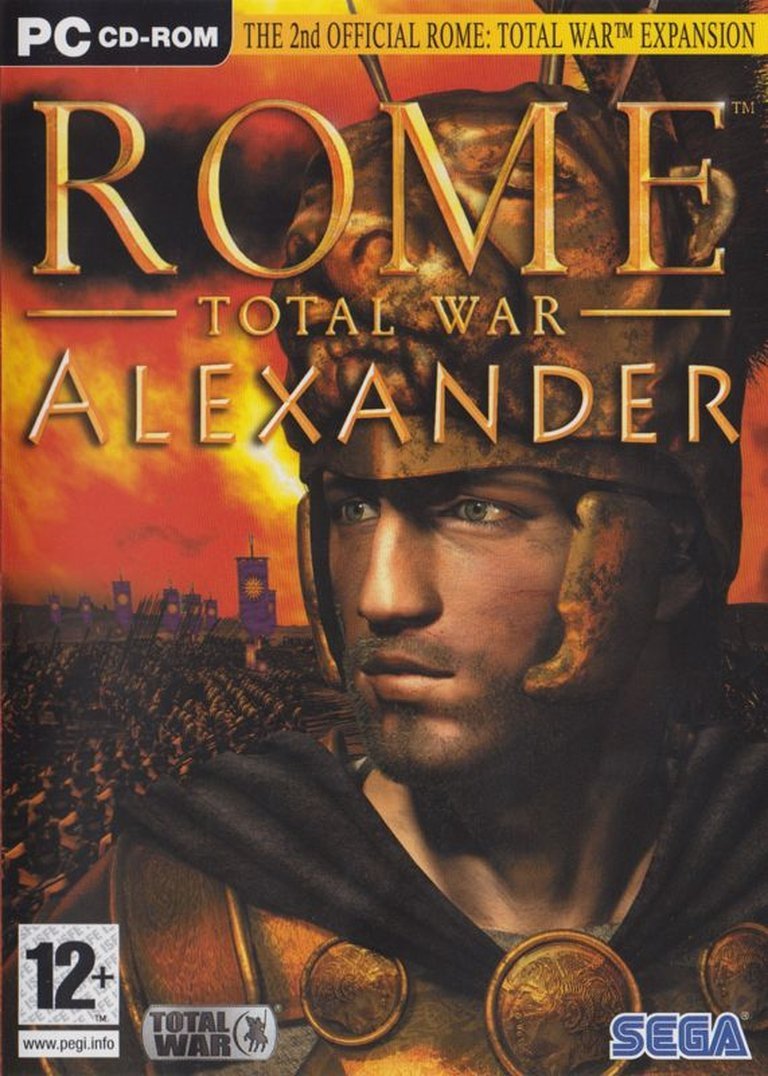
Rome: Total War – Alexander is the second expansion pack for Rome: Total War, casting players as the legendary Macedonian conqueror Alexander the Great during the years 336 BC to 323 BC. The game challenges players to unite Greek city-states and conquer the vast Persian Empire under King Dareios within a condensed 100-turn campaign, introducing four new factions (Macedonia, Persia, India, and barbarians), 60 additional units, six historical battles for single and multiplayer, and a tournament mode. While mobile versions are standalone, computer installations require the base game.
Gameplay Videos
Where to Buy Rome: Total War – Alexander
PC
Rome: Total War – Alexander Free Download
Rome: Total War – Alexander Mods
Rome: Total War – Alexander Guides & Walkthroughs
Rome: Total War – Alexander Reviews & Reception
gamewatcher.com : One of the most brilliant general in the Western civilization is being relived in this second expansion of the Total War Series.
Rome: Total War – Alexander Cheats & Codes
PC
Press ‘~’ during gameplay to open the console window, then enter the codes.
| Code | Effect |
|---|---|
| add_money <1-40000> | Adds denari (money) to your treasury. |
| bestbuy | Reduces the cost of all units by 10%. |
| process_cq |
Completes all buildings in the construction queue for a specified settlement. |
| add_population |
Adds population to a specified settlement. |
| auto_win |
Automatically wins the next auto-resolved battle for the specified side. |
| toggle_fow | Toggles the Fog of War on or off. |
| create_unit “ |
Creates a unit in a specified settlement or under a general. |
| give_trait “InspiringSpeaker” “ |
Gives a character the ‘Best Speaking’ trait. |
| give_trait “Arse” “ |
Eliminates the ‘Arse’ trait line for a character. |
| give_trait “Feck” “ |
Eliminates the ‘Feck’ trait line for a character. |
| give_trait “GoodAdministrator” “ |
Gives a character the ‘Best Administration’ trait. |
| give_trait “GoodAmbusher” “ |
Gives a character the ‘Best Ambushing’ trait. |
| give_trait “Berserk” “ |
Gives a character the ‘Best Berserk’ trait. |
| give_trait “Brave” “ |
Gives a character the ‘Best Bravery’ trait. |
| give_trait “GoodCommander” “ |
Gives a character the ‘Best Command’ trait. |
| give_trait “GoodDefender” “ |
Gives a character the ‘Best Defender’ trait. |
| give_trait “Disciplinarian” “ |
Gives a character the ‘Best Discipline’ trait. |
| give_trait “Drink” “ |
Gives a character the ‘Best Drinking/Sobriety’ trait. |
| give_trait “Energetic” “ |
Gives a character the ‘Best Energy level’ trait. |
| give_trait “PublicFaith” “ |
Gives a character the ‘Best Faith’ trait. |
| give_trait “PoeticSkill” “ |
Gives a character the ‘Best Poetry’ trait. |
| give_trait “RhetoricSkill” “ |
Gives a character the ‘Best Rhetoric’ trait. |
| give_trait “GoodSeigeAttacker” “ |
Gives a character the ‘Best Siege Attack’ trait. |
| give_trait “GoodSeigeDefender” “ |
Gives a character the ‘Best Siege Defense’ trait. |
| give_trait “StrategicSkill” “ |
Gives a character the ‘Best Strategy’ trait. |
| give_trait “Warlord” “ |
Gives a character the ‘Best Warlord’ trait. |
| give_trait “Xenophobia” “ |
Gives a character the ‘Best Xenophobic’ trait. |
| give_trait “GoodAttacker” “ |
Gives a character the ‘Best Attacker’ trait. |
| burn_piggies_burn | Set all Piggy Wings on fire. |
| list_units | Lists all units in your current army. |
| diplomacy_mission | Creates a Diplomacy Mission. |
| diplomatic_stance | Set the stance of the two factions. |
| force_diplomacy accept/decline/off | Forces the AI to accept or decline a diplomatic proposal. |
| invulnerable_general charactername | Makes a specified general invulnerable in combat. |
| disable_ai | Disables the AI, allowing you to roam the map without being attacked. |
| run_ai | Re-enables the AI. |
| ai_turn_speed [number] | Sets the AI’s turn processing speed. |
| list_traits | Lists all available traits. |
| character_reset | Resets a character to their default state. |
| capture_settlement | Captures the currently selected city. |
| create_building [city] [building] | Creates a specified building in a city. |
| jericho | Causes city walls to crumble. |
| oliphaunt | Makes elephants 40% larger. May cause crashes. |
| date [year] | Changes the current year in the game. |
| season summer/winter | Changes the current season. |
| move_character [character name] X,Y | Moves a character to specified map coordinates. |
Rome: Total War – Alexander: A Conquest of Ambition and Limitation
Introduction
In the pantheon of real-time strategy, the Total War series stands as a colossus, blending grand strategy with visceral tactical combat. Rome: Total War – Alexander, released in 2006 as the series’ second expansion pack, occupies a peculiar niche. It thrusts players into the legendary campaigns of Alexander the Great, promising an intimate, high-stakes reimagining of one of history’s most ambitious conquests. Yet, this expansion—developed by Creative Assembly and published by Sega—emerges less as a definitive sequel and more as a focused, experimental chapter. While it captures the thunderous spectacle of ancient warfare and the relentless momentum of Alexander’s march, its constrained design and limited scope reveal the delicate balance between historical fidelity and expansive gameplay. This review dissects Alexander’s legacy, arguing that despite its flaws, it remains a compelling, albeit niche, tribute to a military titan that pushes the boundaries of the Total War formula.
Development History & Context
Studio and Vision
Alexander emerged from the crucible of Creative Assembly’s early 2000s dominance. Riding the wave of Rome: Total War‘s (2004) critical acclaim (Metacritic: 92), the team, led by director Ian Roxburgh and designers Melvyn Quek, James Whitston, and Stephen Virgo, sought to distill the series’ essence into a hyper-focused narrative. Their vision was not to replicate the sprawling empire-building of the base game but to channel the mythos of Alexander the Great—a figure whose life was a whirlwind of conquest cut tragically short. This ambition was technological and conceptual: the Rome engine, already praised for its tactical depth, was repurposed to simulate Alexander’s lightning-fast campaigns within a compressed timeframe.
Constraints and Context
Development occurred amid a pivotal moment for the series. Barbarian Invasion (2005) had expanded Rome‘s scope into the Late Antiquity, while Medieval II: Total War loomed on the horizon. Alexander was explicitly positioned as a bridge—an appetizer for the medieval era. Technologically, it operated within the constraints of mid-2000s hardware. The game required the base Rome: Total War installation, limiting its accessibility. Its smaller map and reduced faction count (eight, versus dozens in the base game) reflected a deliberate choice to prioritize historical authenticity over breadth. Notably, retail versions were absent in the U.S., sold only via download—a prescient move foreshadowing digital-first expansions. Ports by Feral Interactive (2014 for Mac, 2017–2019 for mobile) underscored the game’s enduring niche appeal, proving that even a compact Total War experience could find audiences across platforms.
Narrative & Thematic Deep Dive
The Conquest as Narrative
Alexander’s campaign is a masterclass in thematic economy. Spanning 100 turns (336–323 BCE), it forces players to relive Alexander’s relentless march from Macedonia to India, with a singular, unforgiving objective: conquer 30 provinces while keeping Alexander himself alive. This structure eschews the base game’s sandbox freedom for a rail-like narrative of inevitability. Brian Blessed’s booming narration—rich with dramatic flair—frames each battle as a step in a preordained destiny, turning history into a Greek tragedy. The plot is minimalist but potent: unite fractious Greek city-states, shatter the Persian Empire, and carve a path to the Indus. Yet, this brevity sacrifices nuance. Alexander’s complex legacy—cultural syncretism, administrative ambition, and psychological unraveling—is reduced to a military checklist.
Characters and Themes
Characters serve as conduits for thematic conflict. Alexander, rendered as an unkillable demigod, embodies the tension between genius and hubris. His survival is non-negotiable, mirroring the historical weight of his legend. Antagonists are archetypal: the decadent Persians (Darius III), the warlike Indians (Porus), and the “barbarian” tribes (Scythians, Illyrians) as faceless obstacles. This binary structure—East vs. West, civilization vs. chaos—echoes Alexander’s own worldview but lacks the moral ambiguity that defined his reign. The expansion’s central theme is the fleeting nature of conquest: empires built on the edge of a sword crumble without foundation. Yet, without mechanics to simulate cultural integration or statecraft, the narrative feels hollow—a series of battles rather than a cohesive epic. It’s a tribute to Alexander’s military genius, not his statesmanship.
Gameplay Mechanics & Systems
Campaign Mechanics
Alexander’s campaign is a tightrope walk. As Macedon, players begin with limited resources, a precarious economy, and a map crammed into Greece and the Near East. The 100-turn limit creates relentless pressure, turning strategy into a desperate sprint. Provinces must be seized or risk rebellion, and logistics—reinforcing armies distant from Macedonia—become a core challenge. This design emphasizes tactical precision over grand strategy. However, the map’s artificial compression (e.g., two “Greek” settlements vs. the base game’s dozen) and sparse factions (only Macedon is playable) create a claustrophobic experience. The AI, while improved (flanking maneuvers, coordinated attacks), often falters against Persia’s numerical superiority, leading to frustrating stalemates or inexplicable blunders. The campaign is a puzzle box—solve it once, and replayability plummets.
Battles and Units
Combat remains the expansion’s zenith. Six historical battles—Chaeronea, Granicus, Halicarnassus, Issus, Gaugamela, Hydaspes—are meticulously scripted challenges. Here, Alexander’s tactical brilliance shines: at Gaugamela, the player must feign retreat to expose the Persian flank, mirroring history. Sixty new units enhance this, including Macedonian Hypaspists, Persian Immortals, and Indian war elephants. Factions have distinct identities: Macedon relies on phalanx synergy, Persia on archer swarms and scythed chariots, and India on elephants and chariots. Yet, unit variety is thin—many are reskinned Rome units—and battles feel smaller than the base game’s epic clashes. The 20-unit cap trivializes engagements like Gaugamela, which should be a crescendo but plays out as a skirmish. A new tournament mode offers multiplayer thrills, but the core campaign’s rigidity limits innovation.
Innovations and Flaws
Alexander experiments with asymmetry: starting weak and staying weak, with Alexander as an unkillable linchpin. This heightens tension but also frustration—his death ends the campaign arbitrarily. The expansion excels in battlefield design but falters in depth. Religion, trade, and diplomacy from Barbarian Invasion are excised, reducing empire-building to a war machine. Multiplayer is a saving grace, especially historical battles against humans, but the AI’s inconsistencies mar the experience. Ultimately, Alexander is a “mission pack”—polished, but lacking the systemic richness that defines Total War.
World-Building, Art & Sound
Setting and Atmosphere
The game’s world is a triumph of historical specificity. From the sun-baked coasts of Phoenicia to the snow-capped Hindu Kush, the map captures Alexander’s theater of war. Cities like Tyre and Babylon are rendered with period-appropriate architecture, and the Mediterranean’s azure waters contrast the arid Persian interior. However, this authenticity is undermined by the map’s small scale. Provinces feel crammed, and cultural diversity—Greeks, Persians, Indians—is flattened into stereotypes. The atmosphere is one of relentless motion: armies march from battle to battle, with no time for peace or cultural exchange. It’s a world of dust and blood, mirroring Alexander’s blitzkrieg.
Art and Sound
Visually, Alexander builds on Rome’s strengths. Unit designs are sharp—Macedonian phalanxes gleam under the sun, Persian Immortals shimmer in ornate armor. Environmental details, like charred ruins after sieges, add texture. Animations, particularly Alexander’s charge on Bucephalus, are heroic. The soundtrack, by Jeff van Dyck, is a blend of martial anthems and Greek lyre melodies, heightening the epic tone. Brian Blessed’s narration is the star—his booming voice lends gravitas to even minor skirmishes. Sound effects—the clatter of hooves, the thud of spears—immerse players. Yet, the lack of dynamic events (e.g., cultural shifts, rebellions) leaves the world static. It’s a beautifully crafted diorama, but not a living society.
Reception & Legacy
Launch and Evolution
Upon release, Alexander received “generally favorable” reviews (Metacritic: 79). Critics praised its ambition and challenge. GameSpot (85%) lauded its “must-play” intensity for fans, while IGN (80%) called it a “welcome addition” but criticized its “mission pack” feel. European outlets like PC Powerplay (81%) highlighted its difficulty, while GameSpy (60%) deemed it “ridiculously hard.” Player reviews on Steam (76%) echo this dichotomy: some celebrate its historical focus, others lament its brevity. Over time, its reputation has softened. It’s seen as a flawed experiment—a bold step that prioritized Alexander’s myth over gameplay innovation.
Influence and Place in History
Alexander’s legacy is one of “what could have been.” Its restrictive campaign model was abandoned after Medieval II, which favored open-ended conquests. Yet, it influenced later Total War expansions like Thrones of Britannia (2018), which also experimented with limited scopes. Historically, it popularized Alexander’s campaigns among gamers, inspiring mods like Alexander Grand Campaign to expand its vision. Commercially, it was a modest success, bolstered by digital sales and ports. Today, it’s a footnote in the series’ history—overshadowed by Rome Remastered (2021) but remembered for its unforgettable historical battles. It stands as proof that Total War’s strength lies not just in scale, but in the stories it tells within its constraints.
Conclusion
Rome: Total War – Alexander is a paradox: a triumph of thematic focus hampered by design limitations. It captures the lightning-fast, high-stakes rhythm of Alexander’s conquests with breathtaking historical battles and Brian Blessed’s narration, yet its cramped map, sparse factions, and stripped-down mechanics make it feel less like an expansion and more a polished mod. As a tribute to a legend, it succeeds—it’s a visceral, challenging experience that immerses players in the myth of Alexander. As a Total War game, it falls short, sacrificing the series’ signature depth for a narrower narrative. Ultimately, Alexander is a worthy, if flawed, entry. It’s a testament to Creative Assembly’s ambition and a reminder that even history’s greatest conquerors can be constrained by the limits of their own design. For fans seeking a concise, tactical masterclass, it remains essential. For those yearning for the grand tapestry of empire-building, it’s a bittersweet footnote in the annals of strategy gaming.