
- Release Year: 2003
- Platforms: PlayStation 2, PlayStation 3, Windows, Xbox
- Publisher: Cherry Pop Games, Jaleco Entertainment, Inc.
- Developer: Blade Interactive Studios Ltd.
- Genre: Action, Driving, Racing
- Perspective: Behind view
- Game Mode: Co-op, Online PVP, Single-player
- Gameplay: Arcade, Car soccer, Domination, Power-ups, Racing
- Setting: Contemporary
- Average Score: 84/100
Description
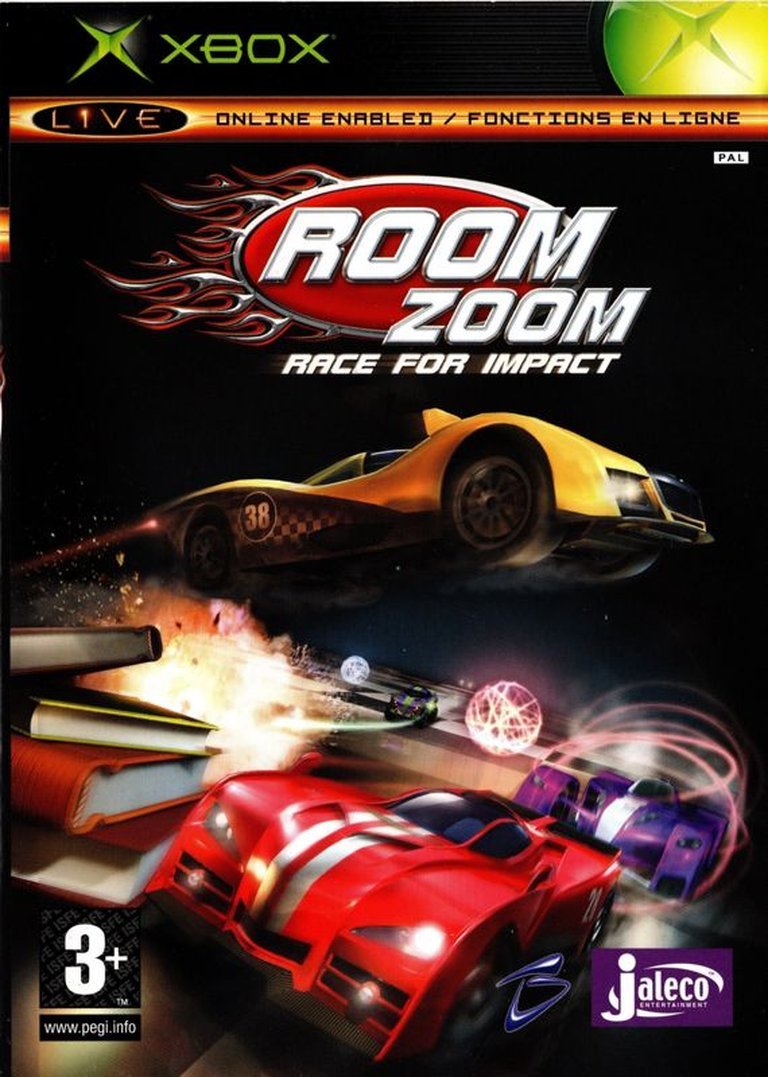
Room Zoom: Race for Impact is an arcade racing game set in the contemporary Room Zoom manor, where players race toy-like cars through household environments. It features sixteen unlockable vehicles, eight tracks, power-ups such as shields and nitros, and modes including championship, car soccer, and domination for single-player and multiplayer experiences.
Gameplay Videos
Room Zoom: Race for Impact Free Download
Room Zoom: Race for Impact Cracks & Fixes
Room Zoom: Race for Impact Patches & Updates
Room Zoom: Race for Impact Reviews & Reception
gamepressure.com (72/100): Re-volt for poor people. Still, it’s pretty
myabandonware.com (97.8/100): Re-volt for poor people. Still, it’s pretty
Room Zoom: Race for Impact: Review
Introduction
In the vast, often-overlooked museum of video game history, Room Zoom: Race for Impact stands as a peculiar exhibit—a title that flickers briefly in the periphery of early-2000s gaming consciousness before sinking into obscurity. Released in 2003 for Xbox and Windows, with later ports to PlayStation 2 and PlayStation 3, this arcade racer from Blade Interactive Studios and Jaleco Entertainment aimed to reinvigorate the micro-racing genre pioneered by Micro Machines by transporting its scale-swapped thrills into a fully explorable 3D household. Yet, despite an ambitiously interactive design, the game stumbled under the weight of its own simplifications and a failure to capture the addictive chaos of its inspirations. This review posits that Room Zoom is not merely a failed experiment but a case study in how promising concepts can be undermined by execution flaws, technical constraints, and a misreading of genre expectations—ultimately relegating it to a curious footnote rather than a landmark.
Development History & Context
Studio Background and Vision
Blade Interactive Studios Ltd., a UK-based developer, was known for its work on eclectic titles like World Championship Pool 2004 and Goblin Commander: Unleash the Horde, suggesting a studio comfortable with genre-hopping but not necessarily a specialist in racing games. For Room Zoom, the core team—including programmers Gary Leach and Huw Lloyd, AI lead Jake Gartland, and artists Pete Daniels and Raymond Livings—embarked on a project initially codenamed Micro Mayhem, as revealed by a March 2003 prototype uncovered by Hidden Palace. This prototype, featuring placeholder assets like the Sega Rally Championship announcer, hints at an early desire to directly evoke Micro Machines’ legacy, though licensing or branding concerns likely prompted the rename. The shift from Micro Mayhem to Room Zoom symbolized a broader ambition: to create a standalone identity centered on the “twisted Room Zoom manor” setting.
Technological and Market Context
The early 2000s saw the rise of 3D gaming on Xbox and PlayStation 2, with racing franchises like Mario Kart and Crash Team Racing dominating the accessible, item-based subgenre. However, the micro-racing niche—where vehicles are tiny and tracks are domestic or everyday environments—was still synonymous with Codemasters’ Micro Machines series, which used top-down or isometric views. Room Zoom’s move to a behind-the-car 3D perspective was a bold, if risky, attempt to modernize the formula. Technologically, the game leveraged the era’s hardware for dynamic environments but likely faced limitations in physics simulation and texture detail, as evidenced by the prototype’s rudimentary HUD and menu systems. The decision to support online play for up to six players—via network code by Leach and John C. Ogden—was forward-thinking for a niche title, but the infrastructure of the time may have hampered its execution.
Production Challenges and Unfulfilled Ambitions
Development was marked by cut features: the prototype included an “Edit mode” that was ultimately scrapped, and a planned GameCube version—complete with mockup covers—never materialized, with no evidence of a retail release. This suggests scope creep or commercial doubts. The final build polished the core concept but retained a rough edge, perhaps due to budget or time constraints. The credited team’s diversity (with members later working on pool and strategy games) implies a project that may have been a secondary priority for the studio.
Narrative & Thematic Deep Dive
Absence of Traditional Narrative
Room Zoom eschews any semblance of plot, characters, or dialogue. There is no story mode, lore, or narrative framing—just pure arcade racing. This aligns with its design philosophy: a pickup-and-play experience focused on immediate, chaotic fun. The absence of narrative is both a strength and a weakness. On one hand, it reinforces the game’s accessibility; on the other, it deprives players of motivation beyond victory, making the world feel transient and disposable.
Implied Themes: Domestic Chaos and Toy-Scale Satire
Despite no explicit story, the setting itself tells a story. The “Room Zoom manor” is a contemporary house transformed into a racetrack, with environments ranging from mundane (kitchens, bathrooms) to exotic (spooky labs, hidden tombs). This juxtaposition evokes themes of playful rebellion—children’s toy cars invading adult spaces—and chaotic domestication, where household objects become obstacles and tools. The interactive elements (tipping over ketchup bottles, blowing up cereal boxes) suggest a toy-box logic, where the laws of physics are bent for amusement. The “twisted” descriptor hints at a subtle satire of suburban life, yet the game never commits to this tone, leaving thematic depth implied but unexplored. Unlike Micro Machines, which embraced miniature absurdity, Room Zoom’s 3D world feels more like a generic backdrop than a characterful arena.
Gameplay Mechanics & Systems
Core Racing Loops and Interactive Dynamics
At its heart, Room Zoom is an arcade racer where players control miniature vehicles on tracks laid out across house rooms. The core loop involves racing multiple laps while navigating dynamic obstacles and picking up power-ups. The innovation lies in environmental persistence: objects pushed or destroyed during a lap (like a tipped ketchup bottle) remain as hazards for subsequent laps, creating a strategic layer where players must clear paths or sabotage rivals. This system encourages tactical aggression but also predictability—as the critic from Joypad noted, the chaos becomes routine quickly.
Car Customization and Statistical Depth
The game offers 16 unlockable cars, each with six statistical attributes: weight, power, acceleration, speed, grip, and braking. This depth allows for playstyle differentiation—for example, heavier cars are harder to knock off track but slower, rewarding defensive driving. However, the impact of these stats is muted by the game’s overall simplicity; tracks are too short and AI too rudimentary for nuanced optimization to shine. Unlocking is tied to finding hidden keys in tracks or achieving championship goals, but the progression feels arbitrary rather than satisfying.
Power-Ups and Combat Elements
Five power-ups—shield, nitro, fire, ice, and lightning—provide offensive and defensive options. While standard for the genre, their implementation is barebones: nitro boosts speed, fire and ice attack rivals, lightning perhaps disrupts electronics. The Joypad review lamented that combat lacks the strategic depth of Micro Machines, where item placement and rival positioning mattered more. Here, power-ups are randomly scattered, reducing tactical decision-making to reflex-based grabs.
Game Modes and Unlockables
Beyond standard Championship and Time Trial modes, Room Zoom includes two bonus modes: Car Soccer (a ball-driven goal-scoring affair) and Domination (a territory-control variant). These extend multiplayer appeal but feel like afterthoughts, lacking balance or depth. The eight environments each host three track variants, but these are often cosmetic reskins rather than distinct layouts, diminishing replay value. Unlockables—additional cars and tracks—are gatekept by keys hidden in tracks, encouraging exploration but frustrating players with opaque design.
Multiplayer and Online Features
The game supports offline split-screen for 1-4 players and online races for up to six. This was commendable for 2003, but network stability and matchmaking were likely issues, given the era’s peer-to-peer limitations. The Xbox Communicator Headset support hints at intended voice chat, but without robust servers, online play probably devolved into laggy sessions.
Flaws and Shortcomings
Critically, Room Zoom suffers from repetitive design, shallow AI, and predictable environments. The Joypad review succinctly captured this: it’s “too easy, too quickly dispatched, and predictable,” with fun evaporating after ten minutes. The interactive elements, while innovative on paper, lack systemic interplay—blowing up a cereal box might block your path, but debris physics are simplistic. Car handling feels arcade-y without nuance, and the 3D perspective sometimes obscures hazards, unlike the clearer isometric views of its inspirations.
World-Building, Art & Sound
The Room Zoom Manor: Setting and Atmosphere
The manor is divided into eight “fully interactive environments,” including kitchens, living rooms, labs, and tombs. This diversity promises visual variety, but descriptions suggest a homogenized aesthetic—all rendered with a cartoonish, slightly psychedelic flair, as the French critic noted. The “twisted” angle implies surrealism (e.g., a hidden tomb in a house), but the execution feels more like a generic funhouse than a cohesive world. Secret passages and shortcuts add exploration but are inconsistently signposted.
Visual Style and Technical Execution
Artwork by Pete Daniels and Raymond Livings likely aimed for a bright, toy-like presentation, but early 2000s hardware limitations would have constrained texture quality and draw distance. Screenshots from sources show blocky models and flat lighting, lacking the charm of Micro Machines’ sprite-based purity. The 3D perspective, while novel, introduces camera issues—walls and furniture can obstruct views, making precise driving frustrating. Compared to contemporaries like Re-volt, which embraced gritty realism, Room Zoom’s visual identity is forgettable.
Sound Design and Music
Audio by Matt Hindle and music by Anthony Davey (of Airtight Productions) comprise engine roars, crash sounds, and a presumably upbeat score. The prototype’s use of a Sega Rally announcer placeholder suggests sound was an afterthought. Without access to the soundtrack, one can infer it aimed for energetic, arcade-y tunes but likely lacked memorability. Sound effects for power-ups and interactions are functional but unremarkable, failing to enhance the chaotic atmosphere.
Cohesion and Immersion
The marriage of art and sound does little to immerse players in the “manor” concept. The house feels like a disjointed collection of rooms rather than a unified space. Interactive objects (fans, ketchup bottles) are visually distinct but lack tactile feedback in sound or animation, reducing the sense of playing with toys. The overall package feels technically competent but artistically bland, missing the whimsical spark that defines great micro-racers.
Reception & Legacy
Critical Reception at Launch
Room Zoom was critically savaged. MobyGames aggregates a 41% score from five critics, but the lone detailed review from Joypad (30%) is damning: it dismisses the game as a pale imitation of Micro Machines, criticizing its 3D shift, predictability, and lack of addictive hook. The review’s metaphor—”coche (à savon)” or soapbox car—aptly describes the flimsy feel. No other professional reviews are documented, suggesting minimal press coverage, likely due to Jaleco’s low profile and the game’s niche appeal.
Commercial Performance
Commercially, the game vanished quickly. MobyGames lists only seven collectors, and it never appeared on major sales charts. Multi-platform releases (Xbox, Windows, PS2) indicate publisher confidence, but poor marketing and competition from established racers doomed it. The cancelled GameCube version further hints at uncertain demand.
Cult Status and Abandonware Community
Paradoxically, Room Zoom has found a small but passionate audience in the abandonware scene. My Abandonware ratings average 4.89/5 from nine votes, with users praising its quirky charm and recommending it as “Re-volt for poor people.” This dissonance highlights how niche preservation groups value obscure titles for their conceptual ambitions, even if flawed. The availability of disc images and patches (e.g., NoCD fixes) on sites like Old Games Download sustains a minuscule modding and playing community.
Influence and Industry Impact
The game left zero discernible influence on the industry. Blade Interactive pivoted to other genres, and Jaleco faded from prominence. No sequels or spiritual successors emerged. Room Zoom is rarely cited in discussions of racing game evolution, overshadowed by Micro Machines’ longevity and Re-volt’s cult status. Its interactive environment concept was arguably ahead of its time—later games like Battlefield with destructible environments or Mario Kart’s item-based chaos owe nothing to it.
Comparison to Contemporaries
Against Micro Machines (e.g., Micro Machines V4 in 2002), Room Zoom’s 3D transition feels like a step backward, losing the clarity and tight design of top-down play. Compared to Re-volt (1999), which also used toy cars in 3D but with a focus on realistic physics and track editors, Room Zoom lacks depth and community tools. It stands as a missed opportunity: a game that understood the appeal of interactive destruction but failed to weave it into compelling systems.
Conclusion
Summary of Strengths and Weaknesses
Room Zoom: Race for Impact’s strengths lie in its ambitious design vision— interactive, persistent environments and a variety of modes—and its accessible multiplayer framework. However, these are negated by shallow gameplay, uninspired art and sound, predictable AI, and a failure to leverage its 3D perspective effectively. The game’s core loop devolves into repetitive mayhem rather than strategic chaos, and its world lacks the character to sustain interest.
Final Verdict on Historical Significance
Historically, Room Zoom is a fascinating failure. It represents a moment when a traditional genre attempted a 3D leap without the polish or innovation to justify it. Its prototype reveals a development history marked by cuts and placeholder assets, underscoring its rushed nature. While not without charm for retro enthusiasts, its critical panning, commercial obscurity, and lack of legacy cement it as a minor footnote—a “what-if” that highlights the perils of translating beloved 2D concepts into 3D without rethinking gameplay fundamentals. In the pantheon of racing games, it is not a forgotten gem but a cautionary tale: ambition without execution is merely noise.
This review is synthesized from archival data, critical aggregates, and community resources, including MobyGames, Hidden Palace, and My Abandonware. All factual claims are derived from the provided source material.