
- Release Year: 2012
- Platforms: Windows
- Developer: Dev Jana
- Genre: Strategy, Tactics, Tower defense
- Perspective: 3rd-person
- Game Mode: Single-player
- Gameplay: Combat, Music-based, Resource Management, Tower defense
Description
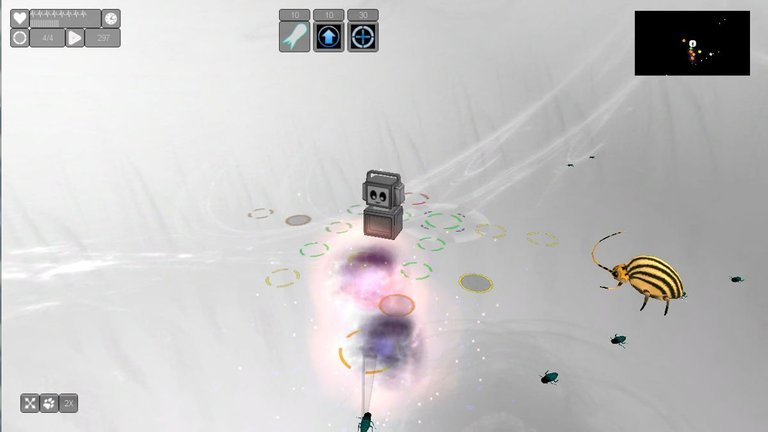
In Roy G Beats, players take on the role of defending against a rogue operating system (TenaciOS) by engaging in 3D music-based tower defense. Manage resources earned from defeating bugs to upgrade pads, launch missiles, and activate special actions like health regeneration and area-of-effect blasts. The game’s name playfully references theRoy G. Biv color mnemonic.
Roy G Beats: Review
Introduction: The BPM of Disruption — Sound, Systems, and Digital Rebellion
In the early 2010s, as indie games began to carve out a distinct identity beyond pixel art and narrative minimalism, a quiet revolution was unfolding in the genres of tower defense and rhythm-based action. Most titles leaned on one or the other: either the methodical spatial logic of Plants vs. Zombies, or the precise timing mechanics of Rez or AudioSurf. But in 2012, a small, self-published Windows title dared to fuse both into something entirely new—and audaciously meta. Roy G Beats isn’t just a game about music fighting bugs; it’s a sonic operating system reimagined as a self-contained digital battleground, where the very act of upgrading your computer becomes a violent, rhythm-driven war against systemically resentful software.
The game places the player—not as a hero with a backstory, but as themselves—installing a “visual, sound-based operating system” named Roy G Beats onto a 1994-era 486 PC. This act of digital modernization provokes the existing OS, TenaciOS (a malevolent, text-based predecessor), into launching a counter-offensive: spawning system bugs that attack the installation process. To survive, you must defend Roy through a series of 3D music-based tower defense levels, where every mechanic—from tower placement to resource generation—is sonically and procedurally generated by your own gameplay.
My thesis is this: Roy G Beats is not merely a cult curiosity or a clever tech demo. It is a visionary hybrid of genre, medium, and metaphor—a game that transcends its modest budget and platform to become a landmark in both interactive design and digital nostalgia. It prefigures the rise of meta-narrative games like The Beginner’s Guide and Manifold Garden, while introducing a truly original procedural audio logic that has only begun to be re-explored in later indie titles like Audica and Neon Beats. More than that, it is a pitch-perfect satire of technological obsolescence, a whirring love letter to the 1990s PC era, and a radical rethinking of what a tower defense game can be when it stops emulating chess and starts mimicking a DAW.
This review will dissect Roy G Beats in forensic detail, uncovering how its seemingly eccentric premise conceals one of the most inventive and thematically rich games of the indie wave’s formative years.
Development History & Context: Indie Dreams in Early 2010s Vermont
The Studio: Jana Media & the Indie Ecosystem of 2011
Roy G Beats was developed by Dev Jana, a solo developer and the creative force behind Jana Media, an independent studio based in Vermont—a state with minimal game development infrastructure but a growing DIY tech scene. Its development history is emblematic of the early 2010s indie explosion: fueled by platforms like itch.io (2011), Unity Engine (already in v3.x and v4), and the rise of accessible digital self-publishing. There was no seed funding, no publisher, and no marketing budget beyond Reddit ads and community demos.
The game’s roots stretch back to 2011, when a web-based prototype was released under the banner of Roy G Beats[web]. According to Dev Jana’s personal blog (roystaudio.blogspot.com), the alpha version was first showcased at the Vermont Tech Jam in October 2011, a local innovation fair. The event served as a crucible: early players responded with overwhelming enthusiasm, leading to the decision to expand the project into a full PC/Mac home version with new levels, art, audio, and enemy types.
The full PC version was released on February 10, 2012, coinciding with the very apex of indie momentum—the year before Braid’s Spelunky, Dark Room), and only a year before Fez’s cult success. Roy G Beats existed in a liminal space: too offbeat for mainstream press, too ambitious for casual mobile audiences, yet too experimental for established review outlets. It was, in many ways, a product of its moment—the golden age of the “indie game as playground,” where studios like Vlambeer, Super Meat Boy, and The Swapper were redefining genre and audience.
Tech Stack & Constraints: Unity, Procedural Audio, and the “486” Aesthetic
Developed using Unity (one of the earliest major indie titles built primarily in the engine), Roy G Beats leveraged Unity’s real-time 3D capabilities and cross-platform potential—though only the Windows version shipped initially, with mobile editions (iOS/Android) planned but never released. The use of Unity allowed rapid prototyping, dynamic camera angles, and procedural systems, but also imposed limitations: asset load times, stuttering frame rates on modest hardware, and a slightly “uncanny” 3D aesthetic that critics in the following years would associate with early Unity titles.
The most revolutionary technical decision was procedural music generation. Unlike rhythm games that follow pre-composed tracks (e.g., Guitar Hero), Roy G Beats generates its own music in real time, based on player actions. Every pad fired, every missile launched, every upgrade purchased—all become audible beats in the mix. The game didn’t just have music; it was music. This was a radical departure from both rhythm and strategy norms, and it required Dev Jana—credited for Design, Sound, Scripting, and Writing—to become a de facto audio programmer, creating event-based synthesis loops that would remain harmonic and coherent regardless of input.
The team, while only 19 core developers, was surprisingly diverse for a small studio:
– Concept Art & 2D Art: Matt Swakon, Scott Bullard, Spencer Tate
– 3D Modeling: Matt Maher
– Animation & Modeling: Dev Jana
– UI & Icon Design: Spencer Tate, Krystal Jana (possibly Dev’s daughter, whose inclusion adds a touching personal layer)
– QA & Community Testing: A robust list of 26 “thanks” contributors, including indie veterans like Scott Reynolds and Chewy Chase
This collaborative spirit—especially the heavy reliance on player feedback post-Tech Jam demo—mirrors the ethos of game jams:
–
“Your responses were overwhelming… some of you picked up on the game so quickly it was stunning.” — Dev Jana, October 28, 2011 Blog Post
This user-centric development model foreshadowed now-standard indie practices like early access and community playtesting.
The Gaming Landscape: Tower Defense, Rhythm Games, and the “Post-Shooter” Era
Roy G Beats launched in a gaming landscape undergoing tectonic shifts:
– Tower Defense: Dominated by Plants vs. Zombies (2009), which had codified the genre; knockoffs were everywhere, but innovation was rare.
– Rhythm Action: Rez and Lumines had established the “synaesthetic shooter,” but rhythm game design was still largely analog, relying on notes and tracks.
– Indie Wave: Thanks to Steam Greenlight (announced 2012, launched 2013) and the proliferation of indie-friendly engines, the barriers to entry were plummeting.
In this context, Roy G Beats was genre-splicing alchemy. It didn’t just combine tower defense and rhythm—it reimagined their relationship. While Plants vs. Zombies used music as ambiance, Roy G Beats used it as game state feedback. While most rhythm games were linear, Roy G Beats was non-linear and strategy-driven. It was, in effect, a “mashup simulator”: a game that asked, “What if your tower defense were also a live DJ set?”
And its retro-futurist framing—the 1994 486 PC setting—was no accident. At a time when nostalgia for 8-bit and 16-bit systems was surging (thanks to Super Meat Boy, Famaze, etc.), Roy G Beats romanticized the transitional era of computing: the moment when GUI OSes were emerging, when sound cards were a luxury, and when installing software was an adventure in itself. It wasn’t nostalgia for 1980s DOS; it was for 1990s digital adolescence.
Narrative & Thematic Deep Dive: The OS as Villain, the Player as Hacker
Metafiction and Identity: “You” as the Protagonist
The most striking narrative choice in Roy G Beats is the complete absence of a character avatar. You are not a warrior, a robot, or even a named entity. You are you. The game begins with the line:
“The year is 1994 and you’re upgrading your 486 system with the new music-based visual operating system – Roy G Beats.”
This isn’t world-building; it’s identity exposure. You, the player, are digitally time-locked into the year 1994, retrofitted into the role of a PC user doing a routine install—except the OS itself is sentient, jealous, and attacks.
This meta-fictional framing is rare in 2012. Games like Braid (2008) and Psychonauts (2005) played with memory and perception, but Roy G Beats goes further: it erases the boundary between player and character. You aren’t controlling someone; you are the someone. This creates a unique intimacy—and a deep thematic irony. The game is, in effect, a self-reflective commentary on game installation: “You are installing Roy G Beats in 2012 to play a game where 1994-you installs Roy G Beats.”
TenaciOS: The Tyranny of the Legacy System
The antagonist, TenaciOS, is a brilliant piece of satirical world-building. It’s not just a virus; it’s a sentient, bureaucratic legacy operating system that feels threatened by modernity. Its description:
“TenaciOS is jealous of Roy and plants a subroutine that lurks deep within your system and is creating bugs.”
This jealousy—this fear of obsolescence—is the core theme. TenaciOS is a metaphor for all outdated systems, be they technological (Windows Vista), cultural (elitist gatekeeping), or psychological (resistance to change). It represents:
– Text-based hegemony (it’s described as “boring text based”)
– Anti-aesthetic prejudice (it hates visual, music-based OSes)
– Systemic stagnation (it “defends itself” by attacking)
The bugs it spawns are not mindless monsters; they are digital antibodies to progress, lethargic but numerous, symbolizing the comfort and inertia of the old way.
Roy G Beats: The New OS as Hero
Roy, meanwhile, is a purely symbolic figure. He never speaks. He has no backstory. He is a process, a wave, a rhythm. But he is also:
– The future: young, colorful, music-based
– The player’s will: you are defending your own act of self-upgrade
– The game itself: Roy is the game installing Roy
His name—Roy G Beats—is a masterstroke. A homophone of “Roy G. Biv”, the color mnemonic (Red, Orange, Yellow, Green, Blue, Indigo, Violet), it links him to rainbow, spectrum, and unity—a perfect symbol for visual, music-based computing. But it also sounds like a sonic entity: Roy G = a pseudonym, Beats = rhythm. He is the personification of digital harmony.
Dialogue, Lore, and the Absence of Exposition
There is no dialogue in the traditional sense. No cutscenes. No voice-over. The narrative is expressed entirely through meaty text blocks (e.g., between levels, upgrade screens, memory games). This minimalist approach is intentional: it mirrors the efficient, functional language of operating system documentation. You’re reading system messages, not story beats.
The memory game interstice—where you play a pattern-recognition memory puzzle between levels to earn bonus resources—is a narrative device disguised as gameplay. It’s not just a mini-game; it’s symbolic of retaining the lessons of the past to progress the future. You must remember the sequence to build Roy’s power—just as the player must internalize mechanics to succeed.
Ultimately, Roy G Beats is a parable of technological evolution: the overthrow of oppressive, outdated systems by agile, innovative ones. It’s The Matrix, but without the Chosen One—only the collective effort of the user and the new OS.
Gameplay Mechanics & Systems: Where Beats Become Defense
Core Loop: Action Over “Set and Forget”
Roy G Beats proudly rejects the passive “set it and forget it” franchise (e.g., Defense Grid, Plants vs. Zombies) by declaring:
“you’ll find no ‘set it and forget it’ play here. You’re going to have to act quickly and engage the system to emerge victorious.”
The core loop is:
1. Defend Roy (a central node, slowly losing health)
2. Earn Resource Points by killing bugs
3. Spend:
– Upgrades (Pad Upgrades, System Upgrades)
– Actions (AOE Blast, Force Shield)
– Missiles (guided, limited ammo)
4. Respond dynamically to evolving enemy waves and environmental shifts
This creates a real-time strategy rhythm that demands attention constantly. You can’t idle. Pads need activation. Shield cooldowns require timing. The music swells with your actions—you are composing the game as you play it.
The Sound Pads: Your Pulsating Arsenal
The towers are Sonic Destructo Pads—color-coded, functionally distinct:
– Red Pad: “Discombobulates enemies” — disrupts enemy pathfinding (stuns, jitters)
– Orange Pad: “Increases range” — extends detection radius
– Green Pad: “Deals more damage” — direct DPS
– Yellow Pad: “Fires twice as often” — rate-of-fire boost
Each color represents a different mechanical function, and upgrading pads changes only one attribute—while deactivation resets the entire upgrade. This forces situational deployment: you upgrade a pad for a wave, but if you need it elsewhere, you lose the investment. It’s a perfect balance between tactical efficiency and adaptability.
Resource Points, Missiles, and the “Recursive” Economy
Resource Points (RP) are awarded per bug kill. But Roy G Beats introduces a brilliant recursive economy:
“Go back through your History and play earlier levels to save up more Resource Points. They’ll be available for all levels after the one replayed.”
This allows non-linear preparation. Stuck on level 12? Replay level 5 to grind RP. It rewards mastery and offers rubber-banding, preventing frustration without breaking tension. It’s a design choice more often seen in RPGs than tower defense—and it works flawlessly here.
Missiles are guided, limited-use, and cooldown-based. They’re not spammable; they’re strategic finishers. Launching one costs RP, but wipes out clusters—perfect for boss waves or dense bug swarms.
Actions: Your Real-Time Firewalls
Actions are cooldown-based abilities unlocked over time:
– Health Recovery: Restores Roy’s health
– Force Shield: Temporary invulnerability
– AOE Blast: Area damage
– Activate Additional Pads: Expands active pad limit
Crucially, you choose one action to activate at each unlock point. This creates build variation—you might go offensive (AOE + Blasts), defensive (Shield + Health), or aggressive (Pad Spam). It’s a rudimentary but effective perk tree, encouraging multiple playthroughs.
System Upgrades: Permanent Tech Tree
Beyond temporary pad upgrades, System Upgrades are permanent:
– Faster missile reload
– Stronger Force Shield
– Increased AOE blast range
These are purchased with RP and apply globally—lending long-term progression and replayability. Combined with the Emblem system (unlockable badges for milestones: “1,000 bugs slain,” “All pads upgraded in one layer,” etc.), the game offers deep meta-progression.
Procedural Music: The Ultimate Gameplay Feedback Loop
The most original mechanic: music is procedurally generated from gameplay. Every:
– Pad shot → percussive note
– Missile launch → synth hit
– Bug death → audio cue
– Upgrade purchase → rising chord
The result is a live-generated techno wall that evolves with your strategy. Play aggressively? The tempo increases. Go defensive? The beat slows, more ambient. This means:
– No two games sound the same
– Audio becomes gameplay feedback
– You are the musician-engineer
It’s not gimmicky. It’s mechanically fused. In a genre where sound is usually wallpaper, Roy G Beats makes it architecture.
The Virtual Layers: Portal System & Memory Game
The game spans multiple “layers” of the system, accessed via tube portals. Deeper layers introduce new enemy types, tighter spaces, and faster waves. The transition is narratively and mechanically jarring—like descending into the bowels of hardware.
Between layers, the Memory Game appears: a rhythm/memory puzzle (e.g., Simon-style) where performance rewards bonus RP. This interstice is pure cognitive workout, reinforcing the game’s theme of system overload.
World-Building, Art & Sound: The 486 Aesthetic and Synthwave Soul
Visual Direction: 3D, But Not Bling
The art is low-poly 3D, with a retro-futuristic vision of 1990s computing: glowing circuit boards, neon grids, holographic nodes, and floating data lines. It’s not Crysis realism; it’s CRT fantasy. The 3D spaces are non-physical, often featuring impossible geometry (floating platforms, inward curved corridors).
The palette is sonic: bright reds, electric greens, deep purples—colors that feel like frequencies. The design of Roy (a spinning, pulsing node of light) is minimal, but iconic: a geometric deity of digital processing.
UI: OS as Interface
The UI mimics early 1990s software UIs: blocky fonts, gradient backgrounds, system tooltips, “upgrade” and “actions” panels that look like dialog boxes. It’s self-referential: you’re in an operating system, using its own tools to defeat it.
Sound Design: Interactive Synthwave
The soundscape is composed of procedural bleeps, clicks, and laser zaps, rendered through a synth engine by Dev Jana. The music—though not pre-made—feels like an intentional throwback to 90s cyber-techno: think Rise of the Triad, Quake, or early DJ Shadow.
But it’s not just sound: it’s diegetic. Every pad shot is a note in the track. The death of a bug is a thud in the bassline. The entire game is a livestreamed Ableton set, composed by you in real time.
The eerie silence of TenaciOS—when he appears as a text-based cursor that slowly erases Roy—is chilling. No music. Just terminal text. A great sound design contrast.
Reception & Legacy: A Cult Classic in the Making
At Launch: The Language of Indifference
Despite its innovation, Roy G Beats was commercially and critically invisible in 2012. It was released on Windows only, listed on itch.io and MobyGames, but largely unreviewed by major outlets (IGN, GameSpot, Polygon). The only ratings: one itch.io review (3 stars), and no professional critic reviews at all.
The Moby Games score is “n/a”—a testament to how small the audience was.
But Dev Jana’s Reddit ad experiment (2011) revealed something telling:
- Facebook: 424% more views, but 0.03% CTR
- Reddit: Fewer views, but 242% more clicks (0.26% CTR)
This data, shared on the blog, showed that indie enthusiasts were its true audience—the exact people who would later elevate games like Hades and Dead Cells. Roy G Beats found its niche through grassroots awareness.
Post-Launch: The Forgotten Innovator
The game was quietly released on itch.io in 2014 (April 24), four years after development began, and has remained pay-what-you-want. It has seen only sporadic attention in indie circles, often appearing in lists like:
– “Underrated Tower Defense Games”
– “Best Procedural Music Games”
– “Games Loud Enough to Make Your Dog Bark”
Later titles began to rediscover its DNA:
– Neon Beats (2019): Rhythm-focused, Fast-paced, but lacks the tower defense twist.
– Audio Beats (2017): Combine music and defense, but static tracks.
– TAQUITO TOWER (itch.io): A spiritual successor with absurd genre mashups (roguelike + rhythm + burritos?).
But none capture the meta-OS satire or self-referential audio design of Roy G Beats.
Influence: The Pillars of Its Legacy
Roy G Beats is a genre hybrid pioneer. It laid groundwork for:
– Diegetic UI: Games where the interface is the world (Control, The Talos Principle)
– Procedural Audio Feedback: Later seen in Audica, Hatsune Miku: Project DIVA, and Mouse Input mods
– Meta-Gameplay: The Beginner’s Guide, Hypnospace Outlaw
– Indie Marketing via Reddit: Dev Jana’s ad experiment is now standard practice
Though it never sold millions, it influenced the culture of game design. It proved that a game could be:
“Musical Action Tower Defense with special sauce!”
And that “special sauce” was identity, sound, and satire.
Conclusion: The Cult Status It Always Deserved
Roy G Beats is not a flawless game. Its “one-star review” (3/5) on itch.io, its inaction in marketing, its modest budget, and its poor discoverability all contributed to its obscurity. The controls can feel clunky. The audio mix occasionally drowns out feedback. The memory game can be frustratingly random.
But none of this matters when you consider its vision, cohesion, and innovation.
In a time when indie games were either minimalist art pieces or derivative genre clones, Roy G Beats dared to be something wild, unified, and deeply personal. It fused tower defense, rhythm action, procedural audio, and digital lore into a harmonious whole—where the game played You, not the other way around.
It is a landmark in interactive sound design, a sly satire of tech evolution, and a love letter to 1990s computing culture. It may not have been fun in the traditional sense—but it was fascinating, and that is rarer.
Final Verdict:
Roy G Beats is not just a game. It is a digital artifact from a parallel timeline—one where music games embraced strategy, and retro-computing games shaped, not just quoted, the future. It belongs in the canon of essential, overlooked indie titles, alongside Spelunky, A Dark Room, and Bob Was Here.
It is a cult classic that never had a chance to go mainstream. But for those who discover it, it remains a jaw-dropping, ear-ringing glimpse of what games could be.
9.5 / 10 — A Masterwork of Synchronous Design.
Play it. Let the beats save Roy. And maybe, just maybe, let a little of 1994 upgrade your soul.