
- Release Year: 2003
- Platforms: Macintosh, Windows
- Publisher: Terzio, Möllers & Bellinghausen Verlag GmbH
- Developer: Elephant Seven Multimedia GmbH, Renate Wünschl & Thomas Polajnar GbR
- Genre: Educational
- Perspective: 1st-person
- Game Mode: Single-player
- Gameplay: Mini-games
- Setting: Futuristic, Sci-fi
Description
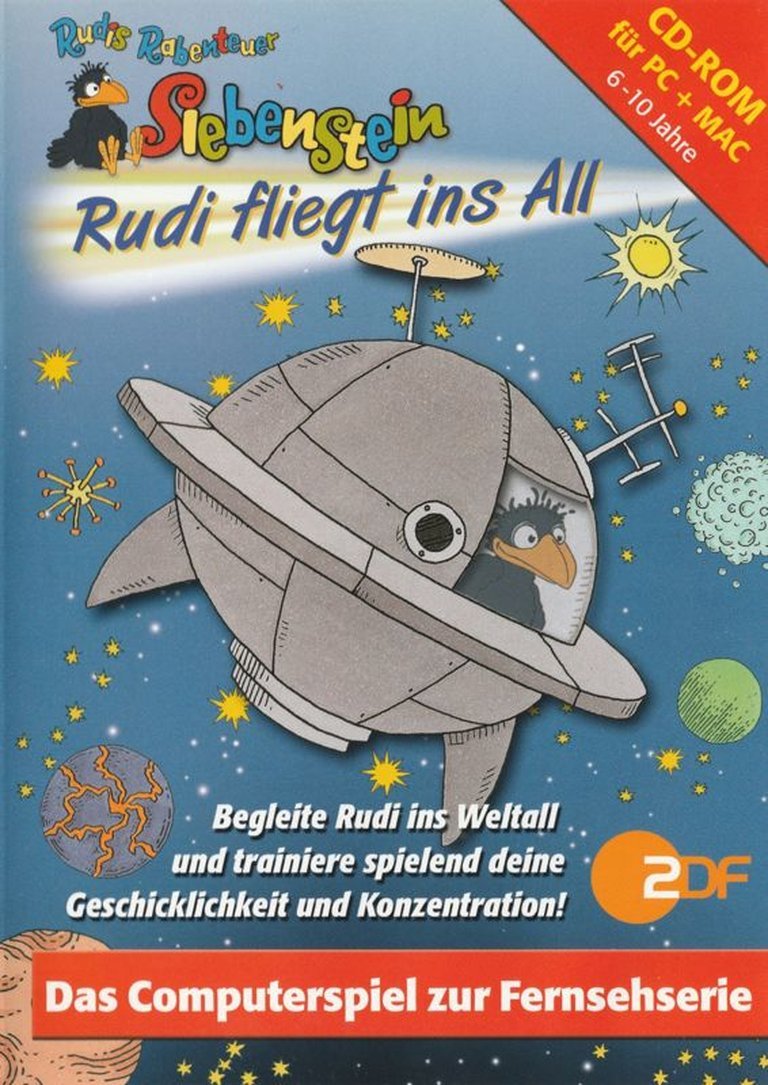
Rudis Rabenteuer: Siebenstein – Rudi fliegt ins All is the third and final installment in a German educational game series based on the ZDF television show Siebenstein. Aimed at children aged 6 to 10, the game follows Rudi the raven and his friend Koffer the suitcase as they assist robot spaceship captain Lizzy in saving the universe by completing five sci-fi-themed mini-games. With a first-person perspective and point-and-select interface, the game blends science education with playful, futuristic adventures.
Rudis Rabenteuer: Siebenstein – Rudi fliegt ins All: A Forgotten Gem of German Edutainment
Introduction: The Final Flight of a Beloved Raven
In the early 2000s, the German edutainment landscape was a vibrant ecosystem of creativity, where television and interactive media collided to create experiences that were as educational as they were entertaining. Among these, Rudis Rabenteuer: Siebenstein – Rudi fliegt ins All (2003) stands as a fascinating artifact—a culmination of a beloved children’s series, a bold leap into digital storytelling, and a testament to the era’s ambitions in blending learning with play. As the third and final installment in the Siebenstein game series, this title tasked young players with saving the universe alongside Rudi the raven, his sentient suitcase friend Koffer, and the robotic spaceship captain Lizzy. Yet, despite its charm and educational merits, the game has largely faded from public memory, overshadowed by the march of time and the evolution of gaming technology.
This review seeks to resurrect Rudi fliegt ins All from obscurity, examining its development, narrative depth, gameplay mechanics, and cultural significance. Through a meticulous analysis of its design, themes, and legacy, we will argue that while the game may not have revolutionized the industry, it represents a pivotal moment in German edutainment—a bridge between traditional media and interactive learning, and a snapshot of early 2000s gaming for children.
Development History & Context: A Collaboration of Visionaries
The Birth of a Multimedia Franchise
Rudi fliegt ins All is inextricably linked to Siebenstein, a German children’s television series that aired on ZDF (Zweites Deutsches Fernsehen) from 1999 to 2003. Created by Renate Wünschl and Thomas Polajnar, the show followed the adventures of Rudi, a mischievous yet endearing raven, and his anthropomorphic suitcase companion, Koffer. The series was celebrated for its whimsical storytelling, gentle humor, and subtle educational undertones, making it a staple in German households.
The transition from television to video games was a natural progression for Siebenstein. The first two games in the series—Rudi’s Rabenteuer: Siebenstein (2001) and Rudi’s Rabenteuer: Siebenstein 2 (2002)—laid the groundwork for interactive storytelling, blending the show’s charm with simple, child-friendly gameplay. Rudi fliegt ins All was conceived as the grand finale, pushing the boundaries of the franchise into the cosmos.
The Creative Team and Technological Constraints
The game was developed by a collaboration of studios, including Renate Wünschl & Thomas Polajnar GbR (the creators of the original series) and Elephant Seven Multimedia GmbH, a German developer specializing in educational software. The production was overseen by Terzio, Möllers & Bellinghausen Verlag GmbH, a publisher with a strong portfolio in children’s media.
Technologically, Rudi fliegt ins All was constrained by the hardware of its time. Released in 2003 for Windows and Macintosh, the game was designed to run on modest specifications, ensuring accessibility for families with older PCs. The first-person perspective and point-and-click interface were chosen for their simplicity, catering to the target audience of children aged 6 to 10. However, these choices also limited the game’s complexity, restricting it to a series of mini-games rather than a fully open-ended experience.
The Edutainment Boom of the Early 2000s
The early 2000s were a golden age for edutainment software, particularly in Europe. Games like The ClueFinders, Reader Rabbit, and JumpStart dominated the market, blending education with engaging gameplay. In Germany, titles such as Pumuckl: Mit Lichtgeschwindigkeit ins Weltall (1995) and Lern mit Timmy (2001) set the standard for interactive learning.
Rudi fliegt ins All entered this competitive landscape with a unique advantage: its connection to a beloved television series. The game’s sci-fi setting and emphasis on science education (astronomy, physics, and problem-solving) aligned with the era’s push for STEM-focused edutainment. However, its reliance on mini-games rather than a cohesive narrative or exploratory gameplay may have limited its appeal compared to more ambitious titles.
Narrative & Thematic Deep Dive: A Cosmic Quest for Young Minds
Plot Overview: Saving the Universe, One Mini-Game at a Time
The narrative of Rudi fliegt ins All is deceptively simple. Rudi and Koffer are recruited by Lizzy, a robotic spaceship captain, to help restore order to the universe. The premise is thin but effective, serving as a framing device for the game’s five mini-games, each representing a different cosmic challenge. While the story lacks the depth of contemporary narrative-driven games, it excels in its accessibility and child-friendly pacing.
Characters: The Heart of the Adventure
- Rudi the Raven: The protagonist of the Siebenstein series, Rudi is a curious and adventurous raven whose antics drive the narrative. In the game, he serves as the player’s avatar, guiding them through the challenges with his trademark humor and enthusiasm.
- Koffer the Suitcase: Rudi’s loyal companion, Koffer is a sentient suitcase with a knack for problem-solving. His role in the game is primarily supportive, offering hints and encouragement to the player.
- Lizzy the Robot: The spaceship captain who enlists Rudi and Koffer’s help. Lizzy’s design and voice acting (provided by Bauer Studios GmbH) give her a friendly, authoritative presence, making her a compelling mentor figure for young players.
Themes: Exploration, Teamwork, and Scientific Curiosity
At its core, Rudi fliegt ins All is a celebration of exploration and discovery. The game’s sci-fi setting allows it to introduce children to basic astronomical concepts, such as planetary orbits, gravity, and the vastness of space. The mini-games are designed to reinforce these ideas through interactive play, encouraging players to experiment and learn through trial and error.
Teamwork is another central theme. Rudi and Koffer’s dynamic emphasizes cooperation, with Koffer often providing the logical counterbalance to Rudi’s impulsiveness. This relationship models positive social behaviors for young players, subtly teaching the value of collaboration.
Dialogue and Localization: A German-Centric Experience
The game’s dialogue is entirely in German, reflecting its target audience of German-speaking children. The voice acting, recorded at Bauer Studios GmbH and Loft Tonstudios GmbH, is lively and engaging, with each character’s personality shining through. However, the lack of localization limited the game’s international appeal, confining it to the German market.
Gameplay Mechanics & Systems: Mini-Games and Missed Opportunities
Core Gameplay Loop: A Series of Cosmic Challenges
Rudi fliegt ins All is structured around five distinct mini-games, each representing a different planetary system or cosmic phenomenon. The gameplay is straightforward:
1. Planet Sorting: Players must categorize planets based on size, color, or other attributes, teaching basic classification skills.
2. Asteroid Dodging: A simple reflex-based game where players navigate a spaceship through a field of asteroids, introducing concepts of spatial awareness and hand-eye coordination.
3. Gravity Puzzle: Players manipulate objects in varying gravitational fields, demonstrating the effects of gravity in a playful context.
4. Constellation Matching: A memory game where players match stars to form constellations, reinforcing pattern recognition.
5. Alien Communication: A puzzle game where players decode alien messages using symbols, promoting logical thinking.
While these mini-games are well-designed for their target audience, they lack the depth and variety to sustain prolonged engagement. The absence of a progression system or unlockable content means that the gameplay experience remains static, with little incentive for replayability.
Interface and Controls: Simplicity Over Complexity
The game’s interface is a model of simplicity. The first-person perspective and point-and-click controls are intuitive, allowing young players to navigate the game with minimal frustration. The UI is colorful and uncluttered, with large, easily identifiable buttons and icons.
However, the simplicity of the controls also highlights the game’s limitations. The lack of more complex interactions (such as drag-and-drop or multi-step puzzles) restricts the depth of the gameplay, making it feel more like an interactive storybook than a fully realized video game.
Innovations and Flaws
Rudi fliegt ins All’s greatest innovation lies in its integration of educational content into a sci-fi narrative. The mini-games are carefully designed to align with the game’s themes, making learning feel like a natural part of the adventure. The use of voice acting and animated cutscenes also enhances the immersive quality of the experience.
However, the game’s flaws are equally apparent. The lack of a cohesive narrative thread between mini-games makes the experience feel disjointed. Additionally, the absence of adaptive difficulty or personalized feedback limits the game’s educational effectiveness. While it succeeds in introducing children to basic scientific concepts, it fails to provide the depth of engagement seen in more ambitious edutainment titles.
World-Building, Art & Sound: A Whimsical Journey Through the Cosmos
Visual Design: A Colorful, Child-Friendly Universe
The art direction of Rudi fliegt ins All is a highlight, blending the whimsical aesthetic of the Siebenstein television series with a vibrant, otherworldly palette. The game’s environments are rendered in a cartoonish, non-threatening style, with soft edges and bright colors that appeal to young children. The character designs are faithful to the original series, with Rudi’s expressive animations and Koffer’s quirky movements adding charm to the experience.
The spaceship interiors and planetary landscapes are imaginative, if somewhat simplistic. The game’s sci-fi setting is more fantastical than realistic, with exaggerated planets and playful alien designs that prioritize fun over scientific accuracy.
Sound Design and Music: A Symphony of Whimsy
The sound design of Rudi fliegt ins All is another standout feature. The game’s music, composed by db media Dupre & Buhr GbR, is a lively mix of upbeat melodies and atmospheric tracks that enhance the sense of adventure. The voice acting, recorded at Bauer Studios GmbH and Loft Tonstudios GmbH, is energetic and expressive, bringing the characters to life in a way that resonates with young players.
The sound effects are equally well-crafted, with each action accompanied by satisfying auditory feedback. From the hum of the spaceship to the playful chimes of successful puzzle completion, the game’s audio design contributes significantly to its immersive quality.
Atmosphere: A Safe and Engaging Space
The game’s atmosphere is carefully calibrated to be engaging without being overwhelming. The sci-fi setting is presented in a way that feels exciting rather than intimidating, with a focus on wonder and discovery. The absence of any real danger or failure states ensures that the experience remains positive and encouraging, aligning with the game’s educational goals.
Reception & Legacy: A Forgotten Chapter in Edutainment History
Critical and Commercial Reception
Rudi fliegt ins All was released to little fanfare in 2003. While it likely found an audience among fans of the Siebenstein television series, it failed to make a significant impact on the broader gaming landscape. The lack of critical reviews or commercial data suggests that the game was overshadowed by more prominent edutainment titles of the era.
Evolution of Reputation
In the years since its release, Rudi fliegt ins All has faded into obscurity. It is rarely discussed in retrospectives of German gaming or edutainment software, and its presence on digital platforms is minimal. The game’s preservation is largely thanks to archives like the Internet Archive, where it can be downloaded and played by those willing to navigate its technical limitations.
Influence and Industry Impact
While Rudi fliegt ins All did not directly influence subsequent games, it represents an important moment in the evolution of edutainment. Its blend of narrative, interactive learning, and licensed content foreshadowed later trends in children’s gaming, particularly the rise of franchise-based educational software.
The game’s emphasis on science education also aligns with modern STEM initiatives, demonstrating the enduring relevance of its themes. However, its reliance on mini-games and linear progression feels dated compared to contemporary educational games, which often incorporate open-ended exploration and adaptive learning.
Conclusion: A Modest but Meaningful Adventure
Rudis Rabenteuer: Siebenstein – Rudi fliegt ins All is not a masterpiece of game design, nor is it a groundbreaking educational tool. However, it is a charming, well-intentioned artifact of its time—a game that sought to inspire young minds with the wonders of space and the joy of learning. Its strengths lie in its faithful adaptation of the Siebenstein series, its vibrant art and sound design, and its commitment to making science accessible and fun.
Yet, the game’s limitations are equally clear. Its disjointed mini-game structure, lack of depth, and technical constraints prevent it from standing alongside the greats of edutainment. It is, in many ways, a product of its era—a time when the potential of interactive learning was still being explored, and the line between education and entertainment was blurry.
Final Verdict: 6.5/10 – A Nostalgic Journey Worth Preserving
Rudi fliegt ins All is a game best appreciated through the lens of nostalgia and historical context. For those who grew up with the Siebenstein series, it offers a delightful trip down memory lane. For modern audiences, it serves as a fascinating snapshot of early 2000s edutainment—a reminder of how far children’s gaming has come, and how much potential still lies in the intersection of learning and play.
While it may not be a must-play by today’s standards, Rudi fliegt ins All deserves recognition as a modest but meaningful contribution to German gaming history. Its preservation is essential, not just for the sake of nostalgia, but as a testament to the creativity and ambition of the developers who dared to send a raven and his suitcase friend on a cosmic adventure.