
- Release Year: 1999
- Platforms: Macintosh, Windows
- Publisher: Mattel Media
- Developer: KnowWare
- Genre: Action
- Perspective: 3rd-person (Other)
- Game Mode: Single-player
- Gameplay: Puzzle elements
- Average Score: 89/100
Description
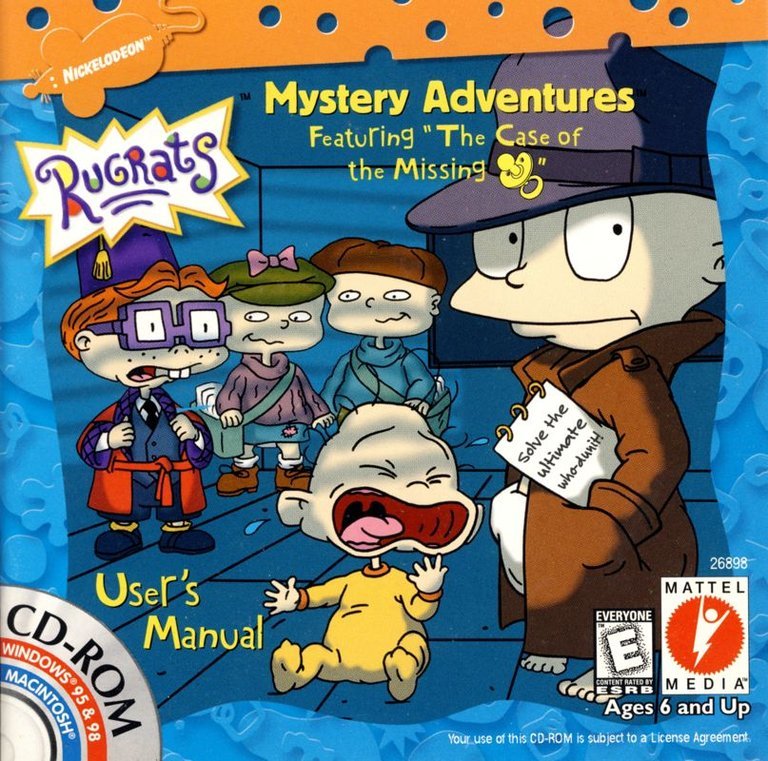
Rugrats: Mystery Adventures is a 1999 action-puzzle game based on the Nickelodeon animated series, where players take on the role of baby detective Tommy Pickles to solve ten cases defending the Rugrats from mischievous ‘mustardminds.’ In a third-person perspective, players collect clues and Reptar Bars by mastering six arcade-style mini-games like Turtle Recall and Just Ducky, using them to pay informants and accuse suspects in this charming, family-friendly adventure released for Windows and Macintosh.
Gameplay Videos
Rugrats: Mystery Adventures Free Download
Rugrats: Mystery Adventures: Review
Introduction
Imagine a world where diaper-clad toddlers wield magnifying glasses and chase clues amid playgrounds and hardware stores, parodying film noir tropes with gleeful innocence. Released in 1999, Rugrats: Mystery Adventures transforms the beloved Nickelodeon series—winner of multiple Daytime Emmys—into an interactive detective saga starring Tommy Pickles as the pint-sized gumshoe “Pickles, Tommy Pickles.” This obscure PC/Mac title, developed amid the late ’90s edutainment boom, captures the chaotic charm of babies bungling adult concepts like “framing” (literally hanging someone on a wall) and “good name” theft. While it never achieved the fame of console Rugrats games like Scavenger Hunt, its legacy endures as a nostalgic artifact of licensed software that prioritizes fun over frustration. My thesis: Rugrats: Mystery Adventures is a delightfully simple yet cleverly structured minigame collection masquerading as a detective adventure, cementing its place as an underrated entry in children’s gaming history that masterfully blends arcade challenges with the show’s whimsical worldview.
Development History & Context
KnowWare, a small studio with limited credits (notably overlapping with The Rugrats Movie: Activity Challenge), crafted this title under publisher Mattel Media, which had acquired Brøderbund’s Rugrats PC license via The Learning Company. The core team was lean: Creative Director Mike Bailey, Producer Warren Scott (11 other games), Lead Programmer David Serduke, and Programmer Tim Heilig—totaling just four credited individuals. Released on September 16, 1999, for Windows (CD-ROM, keyboard/mouse input) and Macintosh, it targeted ESRB “Everyone” audiences amid a landscape dominated by edutainment like The Oregon Trail and early JumpStart titles.
The era’s tech constraints shaped its design: 3rd-person perspective with 2D visuals (traditional animation for characters, occasional CGI for effects like Reptar Bars), no complex 3D engines, and reliance on mouse-driven point-and-click mechanics. This mirrored the post-* Myst* puzzle-adventure wave but geared for toddlers, competing with Nickelodeon licensees on N64 (Scavenger Hunt) and PlayStation (Studio Tour). Visionary elements shine through: a noir parody via babies, voiced by originals like E.G. Daily (Tommy) and Cree Summer (Susie), emphasizing replayable arcade minigames over narrative depth. Released alongside The Rugrats Movie, it capitalized on franchise hype, though Mattel’s Interactive division folded soon after amid industry consolidation.
Narrative & Thematic Deep Dive
At its heart, Rugrats: Mystery Adventures is Tommy Pickles’ imaginary detective agency defending the babies from “mustardminds” (masterminds, baby-style). Clients Susie Carmichael and Angelica Pickles present 10 episodic cases, each a self-contained “whodunit” drawn from playground pettiness:
- The Case of the Missing Jack-in-the-Box: Clear Lil’s name (culprit: Angelica; clues: party horn, cookie, Cynthia box).
- The Case of the Sand in the Sippy Cup: Angelica framed? (Phil; sand castles, worms, pails).
- The Case of the Missing Binky: (Dil; wet toys, splotches, dust bunnies).
- The Case of the Missing Chocolate Milk: (Angelica; candies, Dummi Bear glass, Cynthia).
- The Case of the Grand Thief Auto: (Chuckie; leash, tracks, handkerchief).
- The Case of the Missing Buried Treasure: (Spike; dog cookie, sandwich, kitty).
- The Case of the Malties Ducky: (Chuckie; malty balls, feathers, handkerchief).
- The Case of Cynthia’s Doll-Napping: (Dil; alphabet block, drool, binky).
- The Case of the Macarodi Art Heist: (Spike; drool, Spike’s dish, leash).
- The Case of the Missing Crayons: (Lil; red crayon, worm picture, bottle).
Dialogue sparkles with toddler literalism—Tommy mishears “framed” as wall-hanging—and Angelica’s blatant lies (“I’d never do wrong!”) nod to her scheming canon. Themes explore amateur sleuthing (Tommy’s fantasy credentials), all-loving heroism (lenient verdicts for friends/family/dog Spike), and baby-world absurdities like lost food/toy grievances. Informants Belinda (park) and Dean (store) demand Reptar Bars post-minigames or teddy bear fetches, adding light gating. No overarching plot binds cases; it’s anthology-style, solvable in any order, emphasizing episodic fun over cohesion. Underlying motifs parody noir (Bond-style intro) while reinforcing Rugrats’ bonds of friendship amid mischief.
Gameplay Mechanics & Systems
Core loop: Select a case from Susie/Angelica, choose venue (Stu’s store or Didi’s park), play six arcade minigames for Reptar Bars (currency for informant clues), then accuse via puzzle pieces/suspects. Minigames escalate difficulty, blending skill with luck:
| Minigame | Mechanics | Objective |
|---|---|---|
| Turtle Recall | Match same-color balloons to clear paths | Combine balloons strategically |
| Just Ducky | Herd ducklings (herding sim) | Reunite before scare-off; Chuckie warns “wait an hour after eating” |
| Worm-a-licious | Collect worms, dodge bugs | Survival/resource gathering |
| Shake It Up Babies | Catch balls in paint mixer | Color-matching reflex |
| Baby Shower | Water cannon vs. babies | Precision shooting |
| Drummi Bear | Knock stars from Dummi Bear train | Timing-based aerial targeting |
Reptar Bars buy two informant interactions: clues (three puzzle pieces) then culprit pick (two suspects). Guesses are forgiving—wrong pieces/culprits still “solve” cases—prioritizing playtime (10 cases = weeks for kids). UI is intuitive: mouse-driven 3rd-person navigation, contextual help, in-game tutorials. No combat/progression; flaws include repetition and easy mysteries (challenge in minigames). Innovations: Branching leads, venue choice for variety, tying arcades to narrative progression.
World-Building, Art & Sound
Dual hubs evoke Rugrats’ domestic chaos: Stu’s hardware store (tools, gadgets) and Didi’s park (sandbox, ducks)—vibrant 2D hand-drawn backdrops with 3D effects (Reptar Bars, Dummi Bears). Atmosphere blends whimsy and noir shadows, scaled to baby POV for immersion. Visuals: Cel-shaded characters (Tommy’s diaper detective hat iconic), smooth animations, charming details like Spike’s tracks or drool pools.
Sound design amplifies joy: Original voice cast (E.G. Daily’s plucky Tommy, Cheryl Chase’s bratty Angelica, Tara Strong as Dil) delivers ad-libbed baby babble with grammatical flubs. Minigame jingles, upbeat Rugrats OST, and effects (boings, splats) create arcade energy. No full score, but Nickelodeon polish enhances replayability, contributing to a cozy, nostalgic feel evoking ’90s cartoons.
Reception & Legacy
Launch reception was warmly positive yet niche: MobyGames aggregates 89% critic score (All Game Guide: 90%/4.5/5, “amusing…must-have for fans”; Review Corner: 88%/8.8/10, “charming fun”) from two reviews; 4.5/5 player average (four ratings). Praised for accessible challenges suiting “young or old,” Rugrats fidelity, and minigame variety; critiqued mildly for brevity/simplicity. Commercially modest—collected by few, eBay rarities ($10-32)—it flew under radar amid console dominance.
Reputation evolved to cult obscurity: Preserved on Archive.org, wiki’d on Fandom/StrategyWiki/TVTropes (highlighting tropes like “Literal-Minded,” “Food as Bribe”). Influenced few directly (Rugrats PC sequels like Munchin’ Land), but exemplifies ’90s licensed edutainment bridging TV-to-game. In industry context, it prefigures minigame anthologies (WarioWare) and toddler detectives (Pajanimals), underscoring Nickelodeon’s multimedia prowess amid Viacom’s empire.
Conclusion
Rugrats: Mystery Adventures distills the series’ essence into bite-sized sleuthing: forgiving puzzles, addictive arcades, and heartfelt baby antics across 10 cases in twin hubs. Its small-team polish, faithful voicing, and noir-baby parody shine despite simplicity, earning solid reviews and enduring as a charming relic. In video game history, it occupies a sweet spot—overlooked gem for Rugrats fans, testament to ’90s PC kids’ games blending education and entertainment. Verdict: 8.5/10—Highly recommended for nostalgia seekers; a toddler triumph warranting emulation revival.