
- Release Year: 2003
- Platforms: Windows
- Publisher: Coolmoose Productions
- Developer: Coolmoose Productions
- Genre: Action, Driving, Racing
- Perspective: 3rd-person (Other)
- Game Mode: Single-player
- Gameplay: Falling, Gliding, High score list, Running
- Average Score: 60/100
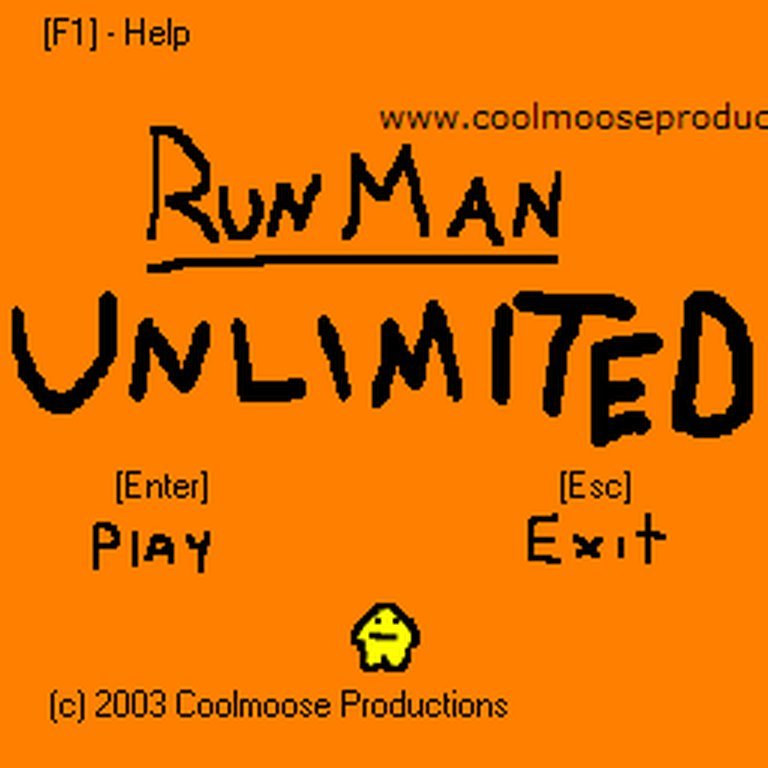
Description
RunMan Unlimited is a freeware endless runner game where players control the titular character as he automatically sprints forward at increasing speeds, requiring quick reflexes to jump over or duck under obstacles. The game features three distinct phases—running, gliding, and falling—each with unique mechanics, such as avoiding obstacles in the air or collecting orbs while descending. With dynamic visual transitions like day-to-night cycles and a high score system, the game offers a simple yet addictive challenge in a side-view, third-person perspective.
RunMan Unlimited Free Download
RunMan Unlimited Reviews & Reception
retro-replay.com : RunMan Unlimited redefines adrenaline-pumping action by taking the iconic endless-run formula to new heights—literally.
RunMan Unlimited: A Pioneering Sprint Through Indie Gaming History
Introduction
In the annals of early 2000s indie gaming, few titles evoke the raw thrill of unadulterated speed like RunMan Unlimited, a deceptively simple endless runner that burst onto the scene in 2003 as a freeware gem crafted on a shoestring budget. Imagine a yellow-haired protagonist dashing forward at escalating velocities, forcing players into split-second decisions between leaping over barriers or ducking beneath them—it’s a formula that predates modern hits like Temple Run or Subway Surfers by nearly a decade, yet it captures the essence of arcade purity in an era dominated by hulking AAA blockbusters. As the second entry in Tom Sennett’s beloved RunMan series, this unassuming Windows title not only expanded the franchise’s mechanics but also encapsulated the DIY spirit of GameMaker-fueled creativity. My thesis is straightforward: RunMan Unlimited may be a minimalist relic of bedroom coding, but its elegant mechanics and infectious momentum cement it as a pioneering artifact in indie gaming history, one whose legacy extends far beyond its modest origins to influence speedrunning, platforming, and the very notion of accessible, joyful escapism.
Development History & Context
The story of RunMan Unlimited begins in the humble confines of a Windows 95-era family computer, where teenage creator Tom Sennett first tinkered with Mark Overmars’ GameMaker engine—a revolutionary tool that democratized game development for non-programmers in the early 2000s. Released in 2003 under his Coolmoose Productions banner, RunMan Unlimited was a solo endeavor born from floppy-disk transfers between bedroom and basement machines due to spotty internet access. Sennett, then a self-taught artist drawing with a mouse in MS Paint, envisioned a quick arcade diversion that captured the relentless forward drive of classic side-scrollers like Super Mario Bros. and early Sonic the Hedgehog titles, but stripped to their barest essentials.
The technological constraints of the era profoundly shaped RunMan Unlimited. GameMaker’s limitations—no built-in physics engines like modern Box2D—meant Sennett had to hand-code every incremental speed boost and obstacle collision, resulting in a lean, performant game that ran smoothly on low-spec PCs. This was the Wild West of indie development: no Steam storefronts, no itch.io, just personal websites and forums like the GameMaker Community where creators like Sennett and future collaborators (such as Maddy Thorson) swapped prototypes. The broader gaming landscape in 2003 was a contrast—Sony’s PlayStation 2 ruled with cinematic epics like Grand Theft Auto: Vice City, while PC gaming leaned toward MMOs like EverQuest. Amid this, RunMan Unlimited stood as a beacon of freeware accessibility, a public-domain download that anyone could grab without barriers, reflecting the era’s underground ethos where passion trumped profit.
Sennett’s vision evolved iteratively; the original RunMan was a proof-of-concept endless runner, spawning sequels like RunMan Unlimited and RunMan’s Christmas Adventure (both 2003), which refined the formula with thematic twists. By 2009, Sennett’s ambitions peaked with RunMan: Race Around the World (RATW), a collaboration with Thorson that transformed the series into a full-fledged platformer. As Sennett later reflected in his “History of RunMan” blog, early games were “short and constrained,” limited by his novice level design skills, but they laid the groundwork for bolder experiments. This progression mirrors the indie scene’s maturation, from forum-shared EXEs to Steam releases, with RunMan Unlimited as the spark that ignited Sennett’s career and influenced peers like Thorson, whose later works (Super Meat Boy, Celeste) echo the series’ momentum-driven joy.
Narrative & Thematic Deep Dive
At its core, RunMan Unlimited eschews elaborate storytelling for a minimalist parable of perseverance and escalation, a narrative delivered not through cutscenes or dialogue but via kinetic action and environmental cues. The “plot,” if one can call it that, follows the titular RunMan—a slender, fair-skinned everyman with light yellow wavy hair, blue eyes, a blue jacket, white shirt, and a wristwatch—as he auto-runs forward in an abstract, obstacle-strewn world. There’s no voiced exposition or branching paths; instead, the story unfolds as a test of endurance. Starting at a leisurely pace, RunMan surges ahead with each dodged hazard, the speed meter ticking upward like a heartbeat accelerating under pressure. Backdrop shifts—day to night, clear skies to rain—serve as silent milestones, symbolizing the inexorable march of time and mounting challenge.
Thematic depth emerges from this simplicity. RunMan embodies the archetype of the reluctant hero, a “one-man army” thrust into a race against inevitability, much like Sisyphus reimagined as an anthropomorphic speed demon. The game’s three-phase structure—running, gliding, and falling—creates a metaphorical journey of ascent and descent, with each segment testing different skills: reflexes on the ground, spatial awareness in the air, and precision timing during the free-fall. The lack of explicit narrative allows players to project their own stories onto the experience, turning each high-score chase into a personal odyssey.
Underlying motifs draw from Sennett’s indie ethos. The series critiques “difficulty bloat”—unfair checkpoints, lives systems—that gatekeeps fun, promoting instead a welcoming world where failure (like bottomless pits that harmlessly eject you) is a slap on the wrist. Themes of subversion abound: water levels are breezy swims rather than drowning nightmares, lava bounces like trampolines. RunMan’s “sophisticated jerk” persona—cocky yet honorable—reflects the joy of mastery without elitism. Collectively, the narrative arc across the series is one of growth: from anonymous runner to global icon, mirroring Sennett’s own journey and the indie’s rise from obscurity to cultural touchstone. It’s a tale less about plot twists and more about the thrill of forward motion, where every obstacle dodged whispers, “Keep going—you’re faster than you think.”
Gameplay Mechanics & Systems
RunMan Unlimited’s core loop is a masterclass in elegant minimalism, boiling platforming down to auto-forward movement, timed jumps (up arrow), and ducks/rolls (down arrow), all controlled via keyboard on a single-player setup. The genius lies in escalation: each successful evasion increments speed, turning a casual jog into a blur of reflexes. Obstacles vary—low barriers demand rolls, high ones jumps—while the top-left speed counter builds tension, encouraging risk for higher scores. High-score lists add replayability, but flaws emerge in its unforgiving ramp-up; at max velocity, pixel-perfect timing feels punitive without tutorials, alienating newcomers despite the freeware model.
The game’s three-phase structure—running, gliding, and falling—introduces variety while maintaining accessibility. The running phase retains the original RunMan’s endless runner mechanics, with incremental speed boosts and dynamic backdrops (day/night cycles, rain) to prevent monotony. The gliding phase, a new addition, tasks players with managing altitude via a single key press, adding a layer of verticality and spatial awareness. The falling phase, another innovation, shifts to horizontal movement as players collect orbs and time parachute deployment for bonus points. This fixed progression creates a predictable yet captivating loop that invites repeated plays.
Progression is score-based, with no traditional levels—instead, environmental phases introduce procedural variety. Combat is absent; “enemies” are environmental hazards, “defeated” by evasion. The UI is spartan—speed display, score, and backdrops suffice, with no overwrought HUDs cluttering the side-view perspective. Innovations shine in accessibility: death restarts levels leniently (no insta-kills except manual restarts), subverting Sonic-like frustration for “idealized” speed. Flaws persist in controls—low jump height risks spike adjacency delays—and the original’s endless nature lacks goals, feeling aimless post-novelty. Yet, systems like the high-score list and dynamic backdrops elevate it. Overall, RunMan Unlimited deconstructs platformers into pure rhythm, influencing endless runners while flawed code reminds us of indie’s raw edges.
World-Building, Art & Sound
RunMan Unlimited’s world is an abstract dreamscape of perpetual motion, a side-scrolling void where grassy fields yield to stormy nights without explicit lore, yet brimming with implied vibrancy. The original’s setting is minimalist: a linear path dotted with geometric obstacles, evolving backdrops that evoke a journey from dawn to dusk, rain adding peril without narrative weight. Atmosphere builds through speed; slow starts lull, frantic peaks immerse, creating a “chill world 1” vibe akin to Super Mario 64’s Bob-omb Battlefield, where exploration feels freeing rather than foreboding.
Visually, Sennett’s hand-drawn style—low-fidelity, charming doodles in Photoshop with a Wacom tablet—defines the aesthetic. RunMan’s expressive face on every element (obstacles get eyes!) infuses personality; colors pop boldly, separated by black outlines to avoid muddiness on era monitors. No transparency fades—instead, scaling preserves punchiness. Comparisons to Yoshi’s Island flatter: both evoke crayon whimsy without direct mimicry, RunMan’s palette less textured but uniquely cohesive, like an “idea” of vibrant platformers. Enemies and environs (coconuts in Going Coconuts, monsters in Fracas) anthropomorphize hazards, blending humor with tension.
Sound design amplifies the rush: no original score details survive, but the series leans on public-domain jazz and blues for RATW—Duke Ellington’s “East St. Louis Toodle-Oo” jazzed for jungle maps, evoking 1920s swing to match the speedy groove. SFX are punchy—boings for bounces, whooshes for dashes—while escalating speed warps audio into a symphony of urgency. These elements coalesce into an experience of joyful propulsion: visuals charm with innocence, sound propels with rhythm, world-building invites endless discovery in simplicity. It’s not epic scope but intimate flow that lingers, turning a blank canvas into a canvas of velocity.
Reception & Legacy
Upon its 2003 release, RunMan Unlimited flew under the mainstream radar as freeware, garnering niche praise in GameMaker forums but scant formal coverage—mirroring the era’s fragmented indie distribution. MobyGames logs a solitary critic score of 60% from GameHippo.com (2005), calling it a “fine way to kill a little time,” while player ratings average a lukewarm 2.9/5 from two votes, critiquing its brevity. Commercial success was nil—public domain meant zero sales—but downloads proliferated via Sennett’s site, fostering a cult following. Sequels amplified this: RATW (2009) earned raves in indie circles, with Destructoid’s 2009 interview hailing it as “one of the best platformers… indie or no,” praising its Sonic-like flow minus pitfalls. Donations trickled in, funding plushie dreams (unrealized), but the real win was virality—RunMan guest-starred in Super Meat Boy (2010), cementing series status.
Reputation evolved profoundly. Initially dismissed as arcade fluff, RunMan Unlimited gained retrospective acclaim as an indie progenitor; Sennett’s 2024 Steam re-release of RATW (15th anniversary) sparked nostalgia on Reddit and Twitter, with fans crediting it for inspiring their dev journeys. Influence ripples wide: Thorson’s RATW contributions birthed masocore precision in Celeste, while the series’ accessible speedrunning (medals, secrets in RunMan the Great, 2015 mobile port) prefigured Geometry Dash and Bit.Trip Runner. Broader impact? It humanized indies—Sennett and Thorson as “generous, awesome guys” via donationware—paving for itch.io/Steam eras. Flaws like code messiness (admitted in interviews) highlight growth, but legacy endures: RunMan Turbo (upcoming 2023/2024) promises procedural zones, proving the yellow speedster’s timeless sprint through gaming history.
Conclusion
RunMan Unlimited endures not as a flawless masterpiece but as a foundational sprint in indie evolution—a 2003 spark that ignited a series blending arcade simplicity with profound joy, from endless dodges to globe-trotting bounces. Its mechanics innovate accessibility amid constraints, visuals and sound craft whimsical momentum, and themes champion perseverance without punishment, all while influencing a wave of speed-centric indies. Though reception started modest, its legacy as a GameMaker trailblazer and inspiration for creators like Thorson solidifies its place: essential for platformer historians, a delightful relic for retro enthusiasts. Verdict: 8/10—timeless fun that reminds us why we run toward the next horizon. If you’re yet to dodge an obstacle, download it free; the rush awaits.