
Description
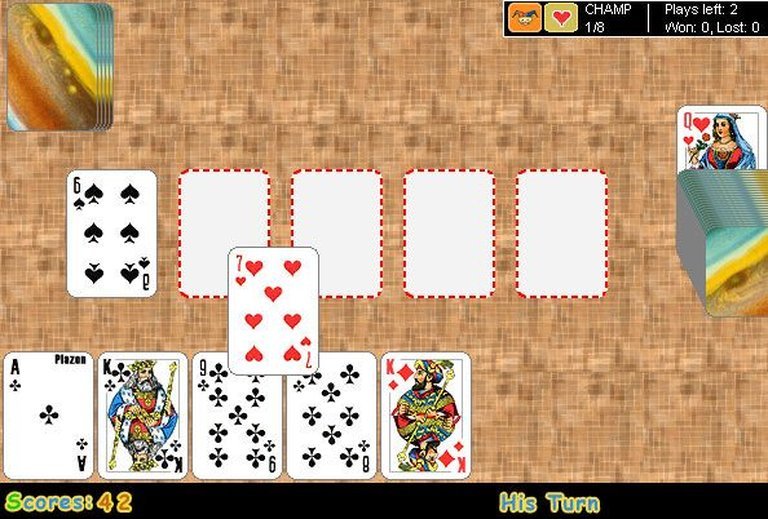
Russian Fool is a 2004 Windows shareware game that digitally recreates Russia’s most popular card game, Durak (Fool), for two players using a 36-card deck from 6 to Ace. The objective is to discard all cards by acting as the Attacker, playing cards that the Defender must cover with a higher card of the same suit or a trump, with roles switching after successful defenses and trump determined by the bottom card of the deck.
Russian Fool: Review
Introduction
In the annals of video game history, few titles evoke the unpretentious charm of early 2000s shareware like Russian Fool, a digital homage to Durak—Russia’s enduring national card game, born in the 19th century amid taverns and peasant gatherings. Released in 2004 by the obscure studio Plazon, this two-player showdown distills the ruthless cunning of trick-taking classics like Hearts and Spades into a compact Windows download. As a game journalist and historian, I’ve pored over MobyGames entries, Retro Replay retrospectives, and the broader tapestry of post-Soviet gaming; what emerges is a thesis as sharp as a trump Ace: Russian Fool is a masterful preservation of cultural gameplay heritage, flawlessly translating Durak’s psychological warfare into pixels, yet constrained by its era’s technological humility and lack of broader ambition, cementing it as a niche artifact rather than a landmark.
Development History & Context
Plazon, a diminutive Russian developer and self-publisher, unleashed Russian Fool on November 1, 2004, as shareware—freely downloadable with premium unlocks, a business model emblematic of Russia’s early digital gaming scene. Added to MobyGames by contributor Georgiy Petrov mere weeks later, the game arrived amid a post-perestroika boom in homebrew titles. The 1990s and early 2000s saw Russian studios like Gamos and Elemental Games churning out logic puzzles, strategy clones, and ZX Spectrum ports on Dendy consoles, prioritizing mental acuity over spectacle in a society valuing engineering prowess. Technological constraints were stark: Windows XP-era PCs with modest DirectX support meant no lavish 3D engines, just crisp 2D sprites and efficient card simulations.
Plazon’s vision was pure fidelity to Durak (literally “Fool”), Russia’s most ubiquitous card game, outpacing even Tetris in cultural footprint. Emerging in the 19th century, Durak spread from noble salons to Siberian barracks, its competitive bite mirroring the era’s social Darwinism. Developers faced a landscape dominated by Western juggernauts—Half-Life 2 and World of Warcraft launched that year—but Russia’s indie ecosystem thrived on shareware portals, echoing Soviet-era Elektronika handhelds that cloned Japanese games with folk twists like Nu, Pogodi!. Russian Fool embodies this: no bombast, just a deck of 36 cards (6 through Ace across four suits), enforcing rules with algorithmic precision. Constraints bred innovation—intuitive drag-and-drop UI bypassed clunky input—positioning it as a bridge between analog tradition and digital accessibility in a gaming world hurtling toward MMOs.
Narrative & Thematic Deep Dive
Russian Fool eschews linear storytelling for immersive cultural lore, transforming a ruleset into a narrative vessel for Russian identity. No protagonists or plot arcs here; instead, introductory vignettes whisk players to 19th-century Russia, where Durak ensnared peasants and tsars alike, its moniker a taunt to the last card-holder—the titular “fool.” Between rounds, lore snippets unfold: gypsy sharps in snowy villages, festival duels under samovar steam, clandestine manor games evading censors. Retro Replay highlights “Historical Challenges” mode, scenario-based reenactments like marketplace gambles or noble intrigues, tweaking rules for thematic flair (e.g., limited trumps mimicking scarcity).
Thematically, it’s a microcosm of Russian soul (dusha): deceptive simplicity masking brutal competition, where fortune favors the bold yet punishes hubris. The attacker-defender dynamic evokes folklore bogatyrs clashing—aggression met by resilient defense (“bito,” the triumphant beat-down). Psychological layers abound: bluff with low cards, hoard trumps like a Siberian winter’s rations, or force roleswaps to exploit fatigue. Absent overt politics, it subtly nods to post-Soviet resilience, much like Vangers’ chaotic cosmos or Allods Online’s folkloric factions. Characters? Mere avatars, but AI opponents scale from novice to shark, their “personalities” inferred through playstyle—aggressive bots as Cossack raiders, patient ones as chess-like grandmasters. Dialogue is sparse, rule prompts in crisp English/Russian, letting emergent narratives of victory and humiliation shine. In extreme detail, this isn’t escapism; it’s ritual, binding players to generations of outwitted fools.
Gameplay Mechanics & Systems
At its core, Russian Fool is a deconstructed perfection of Durak’s loops: shed your hand first in two-player bouts against AI or locals (online implied via shareware norms). Deal six cards each from a 36-card Russian deck; flip the 13th for trump suit, stacking the draw pile atop it. The attacker opens in one of five central “Playing Positions,” hurling any card; defender counters with higher same-suit or any trump. Fail, and cards pile up in your hand; succeed on all (“bito”), roles flip, positions expand to six post-first bito, escalating chaos.
Core Loops: Attack-build-defend cycles pulse with tension—pile attacks to overwhelm, or pinpoint weaknesses. Draws refill to six, prolonging wars until depletion. Progression? None traditional; mastery via pattern recognition: low non-trumps bait covers, Aces dominate suits, trumps trump all (pun intended). UI excels: drag-and-drop cards glide to positions, hover-to-rank previews banish errors, animations (fading defeats, trump glows) feedback every ploy.
Innovations & Flaws: Tutorials/hints onboard newcomers; AI tiers from forgiving to ruthless, simulating human tells (e.g., trump-hoarding). Position expansion post-bito innovates dynamically, preventing stagnation—early restraint yields late barrages. Flaws? Single-mode focus limits replay beyond ladders; no multiplayer depth (friend lobbies hinted, spectator/voice absent). Controls intuit on mouse/keyboard, but era’s resolution quirks grate modern eyes. Balance shines: 50/50 winrates foster grudge-matches, psychological depth rivaling poker sans betting. Exhaustive systems yield infinite variance from finite rules—endless mind games in 10-minute duels.
World-Building, Art & Sound
Durak’s “world” is intimate: a virtual tavern table amid Russia’s mythic heartland. Settings evoke 19th-century immersion—snow-dusted villages, candlelit izbas—via subtle, swappable backdrops (earthy reds/golds/blues). Art prioritizes clarity: oversized cards with pips/indices pop against muted palettes, folk-art cardbacks unlockable for personalization. No bloat; high-res scaling holds on modern displays, animations purposeful—smooth glides, shuffle rustles, bito flourishes.
Sound design whispers authenticity: soft deck shuffles, card taps, triumphant chimes on successful covers. Ambient tavern murmurs or balalaika hints (implied via Retro Replay) cocoon players, sans bombastic score—strategy reigns. Atmosphere coalesces: you’re not gaming; you’re huddled in a banya, stakes invisible yet visceral. Contributions? Visual restraint amplifies tension (no distractions), audio cues telegraph turns, forging tabletop tactility. In Russia’s gaming canon—Elektronika arcs to Atomic Heart’s atompunk—this humble aesthetic underscores cultural purity over flash.
Reception & Legacy
Launch reception? Phantom—zero critic/player reviews on MobyGames, VGTimes’ 5.5 averages anecdotal. Shareware obscurity doomed visibility amid 2004 titans (Half-Life 2’s 96 Metacritic). Commercial? Niche; collected by four Moby users, it faded into freeware limbo. Yet reputation endures via preservationists: Retro Replay lauds its “polished adaptation,” endless replay. Evolved cult status mirrors Russian indies like Space Rangers—unseen globally, revered domestically.
Influence? Subtle: paved digital Durak clones (Fool! 2019), echoing shareware’s role in Soviet-adjacent logic games. In industry arc—from arcades like Gorodki to IL-2 sims—it exemplifies “mental training” ethos, prefiguring Pathfinder’s depth or Beholder’s dystopia. No genre revolutions, but preserves Durak amid Western tropes (vodka gangsters). Legacy: artifact of 2000s Russian gaming’s grassroots, inviting rediscovery in an MMO deluge.
Conclusion
Russian Fool distills Durak’s savage elegance into 2004 pixels—a taut, cultural time capsule where strategy trumps spectacle, flaws forgiven by fidelity. Plazon’s shareware gem captures Russia’s competitive dusha, from bito reversals to trump gambits, amid artful minimalism. No epic quests or Metacritic glory, yet its exhaustive mechanics and lore cement a definitive digital Durak. Verdict: Essential for card aficionados, a 8.5/10 historical footnote—play it to honor the fool who persists, outlasting flashier peers in gaming’s grand deck. Seek shareware archives; your inner Cossack awaits.