
- Release Year: 2009
- Platforms: Windows
- Publisher: ASCARON Entertainment GmbH
- Genre: Special edition
- Game Mode: LAN, Online Co-op, Single-player
- Average Score: 77/100
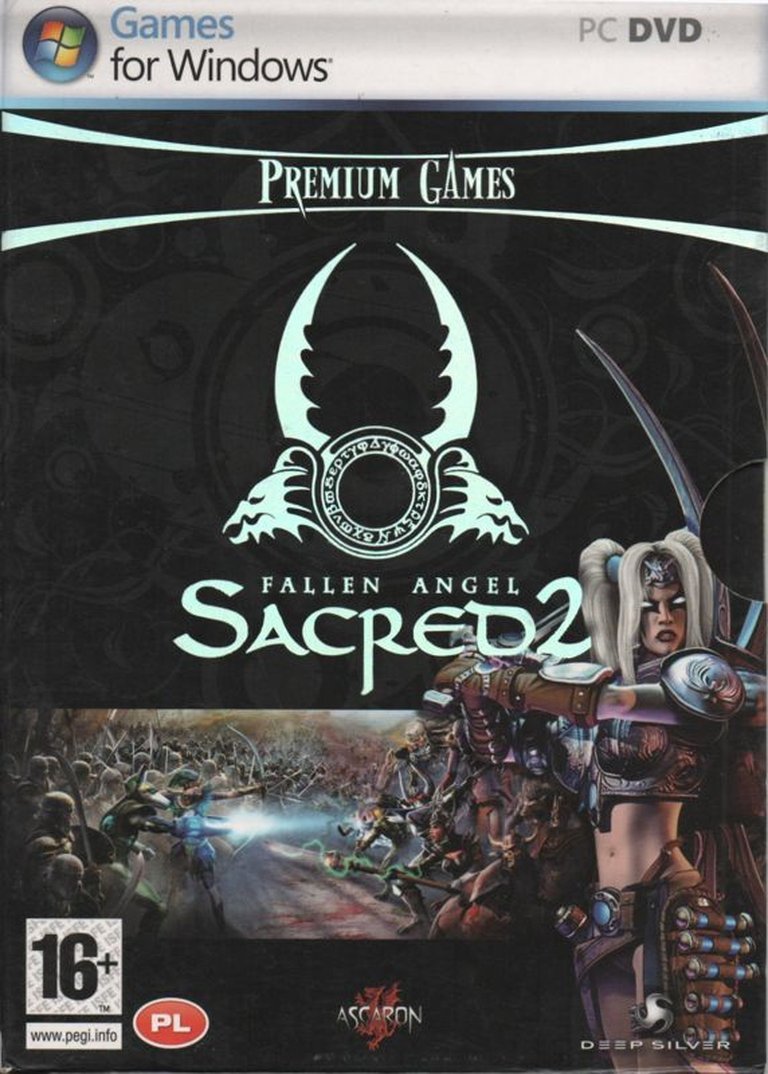
Description
Sacred 2: Fallen Angel is an action role-playing game set in the fantasy world of Ancaria, serving as a prequel to the original Sacred game. The story revolves around the volatile T-Energy, a mystical substance that fuels life and magic, which becomes the center of a power struggle among factions like the High Elves, leading to chaos and destruction. Players choose between Light and Shadow campaign paths, each offering unique objectives and intersecting storylines, while exploring a vast open world spanning 22 square miles with diverse regions and minimal loading times.
Gameplay Videos
Sacred 2: Fallen Angel (Premium Games) Patches & Updates
Sacred 2: Fallen Angel (Premium Games) Mods
Sacred 2: Fallen Angel (Premium Games) Guides & Walkthroughs
Sacred 2: Fallen Angel (Premium Games) Reviews & Reception
ign.com : Though the core mechanics are still solid, the console port emerges as an awkward, ugly, and inconvenient product.
metacritic.com (71/100): A fantastic console experience and it comes highly recommended.
analogstickgaming.com : what’s been done here is a huge disservice to what I loved about Sacred 2.
gamesradar.com : For every hundred gamers that spot the numerous inadequacies… there’ll be one that relishes creating a powerful mega character and steamrolling the map.
shockya.com (83/100): A variety of entertaining missions, tons of really cool enemies and monsters makes Sacred 2 tons of fun!
Sacred 2: Fallen Angel (Premium Games): Review
Introduction
In the pantheon of action role-playing games, few titles embody the spirit of ambitious, unbridled ambition quite like Sacred 2: Fallen Angel. Released in 2008 as a prequel to the cult classic Sacred, this colossal RPG promised a world 22 square miles in scope, seven playable classes, dual Light and Shadow campaigns, and hundreds of hours of content. Yet, this German-developed epic, birthed by Ascaron Entertainment, arrived amidst a storm of development turmoil and a genre dominated by titans like Diablo II and World of Warcraft. Its legacy is one of profound duality: a game that could simultaneously overwhelm with its sheer scale and underwhelm with its technical execution. This review dissects Sacred 2: Fallen Angel, exploring its fractured creation, sprawling world, and chaotic charm to determine its place in gaming history—a flawed masterpiece of ambition and a testament to the power of community passion.
Development History & Context
Ascaron Entertainment, a studio renowned for the Patrician trading series and Port Royale, embarked on Sacred 2 with audacious vision. Led by designer Bob Bates, their goal was to create a seamless, handcrafted open world rendered in perspective-correct 3D while retaining the beloved isometric perspective of its predecessor. This technological leap was ambitious for 2006, but development hurdles soon became evident. The project ballooned in scope and duration, straining resources and timelines. By April 2009, amidst the PC’s late-2008 release and console delays, Ascaron declared bankruptcy, citing the extended development as the primary cause. Support shifted to Deep Silver, who salvaged the US PC version but abandoned console expansion support. The Ice & Blood expansion, released exclusively for European PCs in August 2009, added new regions and the Dragon Mage class, further dividing the player base. This tumultuous birth—marked by financial collapse and fragmented support—sowed the seeds for the game’s technical and narrative inconsistencies, yet also cemented its status as a passion project for a studio fighting for survival.
Narrative & Thematic Deep Dive
The narrative of Sacred 2 revolves around T-Energy, a volatile substance that fuels all life and magic in the realm of Ancaria. Once guarded by the ancient Seraphim, T-Energy was entrusted to the High Elves, sparking a brutal civil war between their clergy and nobility. As this power struggle escalates, other races—humans, orcs, dryads—seize the opportunity to claim T-Energy for themselves, inadvertently causing it to spiral out of control. The resulting chaos mutates creatures, ravages landscapes, and threatens to engulf Ancaria in perpetual war. Players choose between the Light or Shadow campaign at the outset, determining whether they seek to restore balance or intensify the devastation. While the central premise is rich with thematic potential—power corruption, environmental desecuration, and moral ambiguity—the execution is perfunctory. The plot serves primarily as a scaffold for quests, with dialogue often repetitive and voice acting ranging from wooden to absurd. Class-specific introductions hint at deeper personal conflicts (e.g., the High Elf’s lethal ambition, the Inquisitor’s ruthless pragmatism), but these threads rarely weave into a coherent tapestry. Instead, the game’s true narrative lies in its emergent moments—chaotic skirmishes between factions, the humor of loading screen quips, and the tragicomic spectacle of players becoming T-Energy-fueled mutants. It is a world rich in conflict but starved of compelling storytelling.
Gameplay Mechanics & Systems
Sacred 2’s gameplay is a relentless loop of slaughter, looting, and progression. Its core strength lies in character customization. Seven classes (eight with Ice & Blood), each with fixed genders, offer distinct playstyles: the ethereal Seraphim (Light-only), the vengeful Shadow Warrior, the haughty High Elf, the nature-attuned Dryad, the cyborg Temple Guardian, the fanatical Inquisitor (Shadow-only), and the expansion’s Dragon Mage. Combat is real-time and visceral, with “Combat Arts” (spells/skills) mapped to buttons. Mounts provide transportation and stat bonuses but limit special moves, while unique class mounts (e.g., the Dryad’s reptilian steed) enable full combat synergy. The skill system is deep, allowing players to allocate points across four categories, level individual Combat Arts, and create combos. Runes further modify abilities, adding layers of strategy. However, the UI and inventory management are cumbersome, especially on consoles, where item selection feels imprecise. Quests number over 700, blending 100 campaign missions with class-specific and deity-ordained tasks. While side quests often devolve into fetch or kill errands, they populate Ancaria with life. The game’s notorious “Artificial Stupidity” plagues escort missions, with AI allies recklessly charging into danger. Multiplayer supports hot-swapping, letting players transition between single-player and co-op campaigns, retaining progress—a forward-thinking feature. Yet, these systems are often undermined by weighty combat, clunky controls, and a punishing lack of guidance for newcomers, making Sacred 2 as much a test of patience as skill.
World-Building, Art & Sound
Ancaria is Sacred 2’s undeniable triumph. The 22-square-mile world is a meticulously crafted tapestry of biomes—from arid deserts to lush rainforests, volcanic islands to cursed forests. Seamless transitions between regions minimize loading, while dynamic day/night cycles affect NPC behavior (merchants vanish at night). Dungeons and surface dwellings add verticality, though they rarely exceed two levels. This scale is awe-inspiring, encouraging exploration and rewarding curiosity with hidden caves and Easter eggs (e.g., lightsabers, soccer balls). Artistically, however, the game is a relic of its era. Character models are stiff, textures flicker, and pop-in persists, especially in towns. The art direction leans into vibrant fantasy tropes but lacks cohesion, with environments ranging from stunningly detailed to jarringly bland. Sound design elevates the experience. The soundtrack, featuring power metal band Blind Guardian, is a standout—their theme “Sacred Worlds” and in-game appearances lend epic gravitas. Combat effects are punchy, and environmental sounds immerse players. Yet, voice acting is inconsistent; NPCs deliver lines with flat enthusiasm, while class quips grow repetitive. Despite these flaws, Ancaria’s charm lies in its sheer density. Its towns bustle with life, quests intersect in unexpected ways, and the world reacts dynamically to player actions, creating a sense of a living, breathing realm.
Reception & Legacy
Upon release, Sacred 2 received mixed reviews. The PC version averaged 71% on Metacritic, praised for its world design, multiplayer, and customization but criticized for dated visuals, technical glitches, and gender-locked classes. Console versions fared similarly (71% Xbox 360, 70% PS3), with IGN noting the PC’s superiority due to patch support. Commercially, it found success with over 750,000 sales by August 2009, earning a Gold certification in Germany. Over time, its reputation evolved. While never a critical darling, it cultivated a dedicated fanbase drawn to its sheer scope. Community patches, most notably Ice & Blood’s continued support, addressed bugs and added content, extending its lifespan. The Ice & Blood expansion, later bundled in Sacred 2 Gold, refined the experience but remained PC-exclusive initially. Its influence is subtle; its open-world ambition and class depth prefigured later RPGs, yet its technical issues prevented it from becoming a genre benchmark. The 2025 remaster, developed by Ascaron alumni, aimed to modernize the game but was panned for omitting console co-op and failing to address core flaws. Sacred 3 (2014) abandoned the open world entirely, a move seen by fans as a betrayal. Today, Sacred 2 endures as a cult classic—a flawed, chaotic monument to a studio’s last stand, cherished for its boundless content and community-driven resilience.
Conclusion
Sacred 2: Fallen Angel is a game defined by its contradictions. It is vast yet poorly detailed, deep yet poorly explained, ambitious yet poorly executed. Its legacy is not one of polish but of passion—a sprawling, messy, and unforgettable RPG that pushed the boundaries of scale and customization. While its technical flaws, clunky UI, and narrative shortcomings hold it back from greatness, they are inseparable from its identity. Ascaron’s tragic collapse and the community’s enduring dedication to patching it speak to a unique bond between players and this imperfect world. In the end, Sacred 2: Fallen Angel is less a game and more an experience—a chaotic, exhilarating, and ultimately human journey through a realm of T-Energy and turmoil. It stands as a testament to the idea that even flawed ambition can create magic, and for those willing to brave its depths, Ancaria offers rewards as vast and unpredictable as its lands.