
- Release Year: 2008
- Platforms: Steam, Windows
- Publisher: Silverlode Interactive
- Developer: BlueOrb Studios, Inc, Silverlode Interactive, Wahoo Studios, Inc., Wasatch Games
- Genre: Strategy, Tactics
- Perspective: Diagonal-down
- Game Mode: Online Co-op, Online PVP, Single-player
- Gameplay: Card Packs, Combat, construction, Management, Micromanagement, Questing, Spells, Unit building
- Setting: Fantasy
- Average Score: 68/100
Description
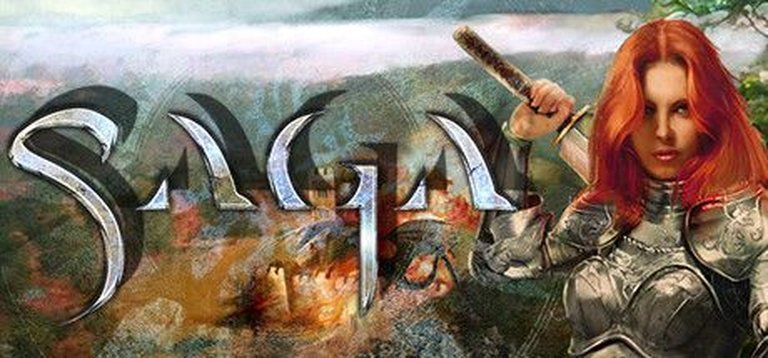
SAGA is a persistent online real-time strategy game where players build an empire aligned with one of five divine races—Dark Elves (Magic), Dwarves (Machines), Elves (Nature), Giants (Light), or Orcs (War)—to compete against others in a fantasy setting. Players manage their nation by directing peasants, constructing structures, trading resources, and collaborating with guilds, even while offline. The game also features large-scale warfare with customizable units, spells, and quests that advance the story, playable solo or with allies. Conquering territories and defending against raids adds strategic depth, while booster packs unlock new units for enhanced gameplay.
Where to Buy SAGA
PC
SAGA Reviews & Reception
metacritic.com (61/100): A mad experiment that mostly pays off.
gamefaqs.gamespot.com (61/100): A mad experiment that mostly pays off.
mobygames.com (62/100): A mad experiment that mostly pays off.
metacritic.com (88/100): its 10 potential in there not to mention game like these 1 by 1 shooting down like birds
SAGA Cheats & Codes
GameBoy Advance
Enter codes at the ‘Press Start’ screen. A chicken sound confirms correct entry.
| Code | Effect |
|---|---|
| Down, Down, Down, Down, Down, R, R | Unlocks all characters |
| Up, Right, Down, Left, R, L, L, L | All upgrades at maximum |
| Right, Right, Right, Up, Up, L, L | Unlimited lives |
| Up, Down, Up, Down, L, R, L, R | Level select |
| SDF1 (entered at name entry) | Weapon upgrades always at maximum |
Nintendo Wii
Hold Start button during character selection.
| Code | Effect |
|---|---|
| Up + B, Right + C, Left + A, Down + D (KOF ’95) | Play as Saishu Kusanagi and Omega Rugal |
| Left, Right, Left, Right, Left, Right + A + C (Iori) | Play as Orochi Iori |
| Up, Down, Up, Down, Up, Down + B + D (Leona) | Play as Orochi Leona |
| Up, Left, Down, Right, Up, Down, B + C (Leona) | Play as Orochi team |
PC (Summertime Saga)
Input via phone’s Wi-Fi menu after enabling ‘Unlock UI’, or use console commands.
| Code | Effect |
|---|---|
| sugardaddy | Adds $10,000 |
| millionaire | Sets money to $1,000,000 |
| player.inventory.money = 999999 | Max money |
| BAD MONSTER | Jenny’s Computer Password |
| L6bv12R / 12345 | TV Pink Channel login |
Playstation 4 (LEGO Star Wars)
Enter codes in Pause Menu > Settings (Extras menu).
| Code | Effect |
|---|---|
| BNM879 | Character studs |
| POJ978 | Fast Build |
| DJI523 | Invincibility |
| KOL378 | Stud Magnet |
PSP
Hold Start button during character selection.
| Code | Effect |
|---|---|
| Left, Right, Left, Right, Left, Right + AC (Iori) | Play as Orochi Iori |
| Up, Down, Up, Down, Up, Down + BD (Leona) | Play as Orochi Leona |
SAGA: A Grand Experiment in Persistent Online Strategy – A Review
Introduction
In the annals of online gaming history, few titles embody the phrase “ambitious misfire” quite like SAGA. Released in 2008 by a consortium of studios led by Silverlode Interactive, this persistent online real-time strategy (MMORTS) game fused kingdom management, fantasy warfare, and collectible card game (CCG) mechanics into a volatile cocktail. Marketed as the world’s first “collectible online RTS,” SAGA aimed to redefine multiplayer strategy gaming with its deity-driven faction warfare and persistent empires. Yet, despite its grand vision, the game stumbled under the weight of its own systems, technical limitations, and a business model that divided players. This review dissects SAGA‘s highs and lows, exploring its place as a fascinating footnote in the evolution of online strategy games.
Development History & Context
Studio Turmoil and Creative Aspirations
SAGA emerged from a turbulent production cycle. Initially funded by Saga Games LLC under producer Jason Faller, the project was contracted to Wahoo Studios (known for Dungeon Siege: Broken World). However, creative friction led Faller to sever ties with Wahoo in mid-2007, relocating development to his newly formed Silverlode Interactive and BlueOrb Studios. This fracture mirrored the era’s struggles with ambitious online titles, compounded by the technical constraints of 2008’s broadband infrastructure and the dominance of subscription-based MMOs like World of Warcraft.
Faller envisioned a “persistent-world RTS” that blended the tactical depth of Rome: Total War with the addictive card-collection loop of Magic: The Gathering. The team, including lead programmers Dallan Christensen (of Starcraft: Brood War fame) and Eric Wiggins, built the game on the proprietary “Wraith” engine, designed to handle large-scale battles and asynchronous kingdom progression. Yet, the game’s scope—requiring real-time multiplayer synchronization alongside offline resource accumulation—proved challenging, leading to a rushed open beta in February 2008 and a retail launch just one month later.
The 2008 Gaming Landscape
SAGA debuted in a crowded market dominated by MMO titans and RTS stalwarts like StarCraft II. Its free-to-play model (supported by booster-pack microtransactions) was ahead of its time but clashed with player expectations of polished online experiences. Critics noted the game’s novel approach but questioned its execution amidst technical instability and competition from sleeker titles.
Narrative & Thematic Deep Dive
A Pantheon at War
SAGA’s lore revolves around five warring gods, each commanding a distinct faction:
– Magic (Dark Elves, practitioners of forbidden arts)
– Machines (Dwarves, masters of steam and steel)
– Nature (Elves, guardians of the wild)
– War (Orcs, brutal warmongers)
– Light (Giants, champions of order)
Later updates added the Undead as a sixth faction, further complicating the celestial feud. The gods’ rivalries form cyclical oppositions: Magic vs. Machines (mysticism vs. technology), Nature vs. War (life vs. destruction), Light vs. Magic (order vs. chaos). This setup forged a “balance of tension,” where each faction had two natural enemies and two neutrals, encouraging fluid alliances and betrayals in the meta-narrative.
Opera or Afterthought?
Despite its rich potential, SAGA’s storytelling was thinly executed. The main plot—delivered through repetitive quests—amounted to a generic “endless war” backdrop. Dialogue and character development were absent, reducing factions to tactical archetypes rather than fleshed-out civilizations. The game’s true narrative emerged in player-driven conflicts, where guilds mythologized their conquests in forums. Yet, as IGN noted, the lore lacked “emotional hooks,” reducing the gods to mere stat modifiers rather than compelling forces.
Gameplay Mechanics & Systems
The Dual Pillars: Kingdom and Combat
SAGA’s gameplay splits into two interconnected modes:
1. Persistent Kingdom Management
Players governed a territory assigned by their patron god, directing peasants to harvest resources (wood, stone, gold, mana), construct buildings, and research technologies. The “Free Build” system allowed flexible city planning—a rare innovation for the era—but was hampered by UI clunkiness. Happiness mechanics dictated peasant productivity:过低supplies or failed defenses triggered riots, while victories in battle boosted morale. Offline progression let resources accrue passively, a precursor to modern mobile strategy games but criticized for encouraging absentee play.
2. Real-Time Tactical Combat
Battles used a CCG-inspired model. Players amassed troops via randomized booster packs (10 units per $2.99 purchase), drafting them into customizable armies. Over 100 unit types existed, from Elven Treants to Dwarven Automata, each upgradeable with gear looted from quests. Combat unfolded in real-time across stitched-together player maps, with spells and reinforcements adding tactical depth. However, the reliance on booster packs drew ire; as Out of Eight noted, “you need to sink time and money to make the game fun.”
Innovation vs. Frustration
- Scrimmage vs. Hardcore PvP: “Scrimmage” mode allowed risk-free skirmishes, while “hardcore” battles permanently damaged kingdoms. Veterans exploited this by arranging “gentleman’s agreements” to minimize destruction while reaping rewards.
- Quests: Solo or co-op PvE missions offered loot but recycled objectives and maps, lacking narrative payoff.
- Economy: A player-driven auction house facilitated troop trading, but inflation and rare-unit scalping created a pay-to-win perception.
Key flaws included unbalanced factions (Machines’ late-game dominance), unintuitive spellcasting, and pathfinding issues that crippled large-scale engagements.
World-Building, Art & Sound
Aesthetic Ambition Meets Dated Execution
SAGA’s art direction embraced high-fantasy tropes: Dwarven cities bristled with gears and smokestacks, Elven groves pulsed with bioluminescence, and Orc strongholds oozed decrepit menace. The diagonal-down perspective showcased detailed unit models, but environmental textures felt flat and repetitive, even for 2008. The UI, overloaded with menus, obscured critical information—a frequent complaint in reviews.
Sound design was functional but forgettable. Battle cries and spell effects lacked impact, and the absence of faction-specific music (beyond generic orchestral loops) undermined immersion. PC Gamer UK called it “a mad experiment that mostly pays off,” praising the scale but noting “rough edges everywhere.”
Reception & Legacy
Critical Divide
SAGA earned a 62% average from critics (via MobyGames) and 6.8/10 from players. Positive reviews lauded its scope: GameWatcher (80%) praised its “addictive progression” and “massive battles,” while PC Gamer UK (74%) admired its “bold fusion of genres.” Detractors, including IGN (50%), blasted its “bland combat” and “unstable servers,” with 2404.org (60%) lamenting its “growing pains” as an MMORTS-CCG hybrid.
Player reception was polarizing. Metacritic’s user score (8.8/10) reflects cult admiration for its depth, but Steam forums brim with complaints about RNG-driven progression and abandoned updates after Deep Silver’s European relaunch faltered in 2010.
Influence and Obscurity
Though commercially modest, SAGA’s DNA resurfaces in later titles:
– Persistent Worlds: EVE Online’s faction warfare and Total War: WARHAMMER’s asynchronous campaigns echo SAGA’s vision.
– CCG Integration: Gwent’s standalone success and Hearthstone’s PvE modes owe debts to its troop-collection loop.
– Free-to-Play Pioneering: Its booster-pack economy foreshadowed Fortnite and Genshin Impact’s monetization.
Yet, SAGA remains a cautionary tale—a game whose ambition outstripped execution, buried by technical woes and market saturation.
Conclusion
SAGA is a fascinating relic—a game that dared to merge RTS, CCG, and MMO elements years before the industry normalized such hybrids. Its factional depth, persistent world, and “Free Build” system hint at brilliance, but these are marred by clunky combat, predatory monetization, and half-realized storytelling. For historians, it’s a vital case study in online experimentation; for players, it’s a flawed gem best appreciated as a museum piece rather than a living title. In the pantheon of strategy games, SAGA stands not as a god but as a fallen hero—a testament to innovation’s perils in an unforgiving medium.