
- Release Year: 2012
- Platforms: Windows
- Publisher: Focus Multimedia Ltd.
- Developer: Unknown
- Genre: Compilation, Simulation
- Perspective: Third-person
- Game Mode: Single-player
- Gameplay: Resource Management, Vehicle simulation
- Setting: construction, Industrial
Description
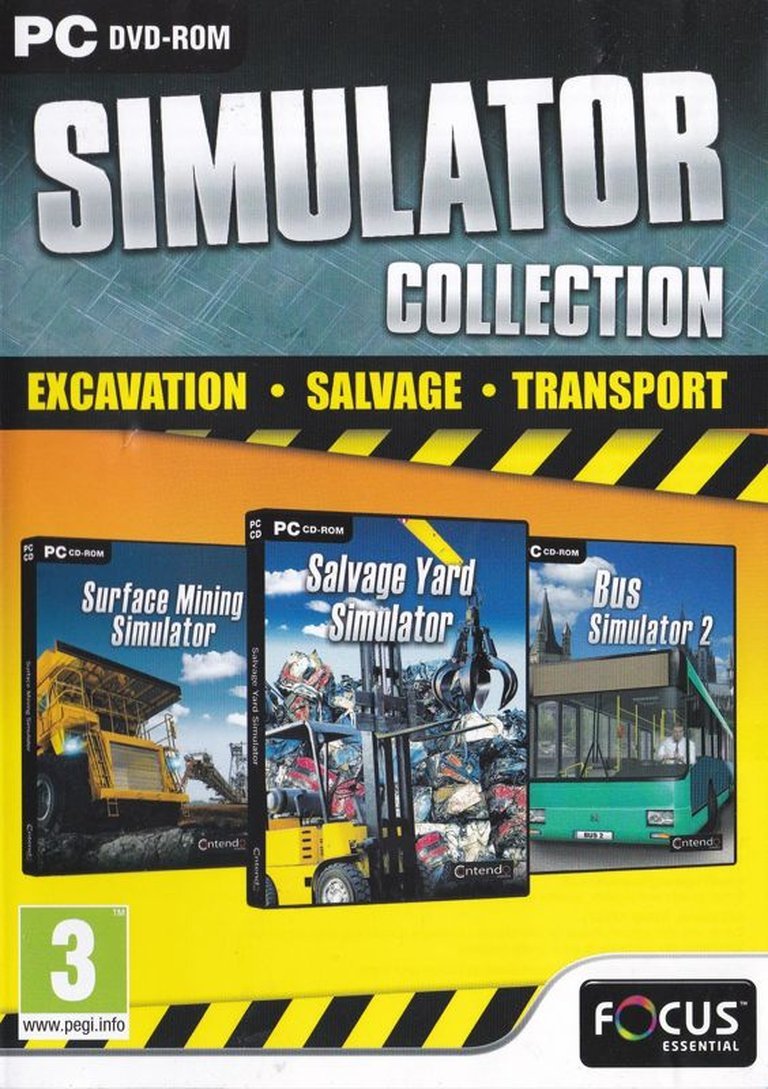
Salvage, Excavation & Transport Simulator Triple Pack is a compilation of three simulation games released in 2012 for Windows. It includes Bus Simulator 2, Surface Mining Simulator, and Salvage Yard Simulator, each offering unique gameplay experiences focused on transportation, excavation, and salvage operations. The games are installed separately from a single DVD, providing a diverse set of simulation challenges.
Salvage, Excavation & Transport Simulator Triple Pack Free Download
Guides & Walkthroughs
Reviews & Reception
spong.com : Manage your surface mining company and control all machines manually!
Salvage, Excavation & Transport Simulator Triple Pack: Review
Introduction
In the vast, often-overlooked landscape of budget PC gaming, few niches are as peculiarly compelling as the “heavy machinery simulator.” Born from the same ethos as the Farming Simulator franchise but with a grittier, industrial focus, these titles offer players a chance to inhabit worlds dominated by hydraulic pistons, roaring engines, and logistical nightmares. The Salvage, Excavation & Transport Simulator Triple Pack, released in 2012 by Focus Multimedia Ltd. and licensed from Contendo Media GmbH, bundles three distinct simulations—Bus Simulator 2, Surface Mining Simulator, and Salvage Yard Simulator—into a single DVD-ROM. It represents both the zenith and nadir of a subgenre blooming in the early 2010s: ambitious in scope yet constrained by technological limitations and repetitive design. This review posits that the Triple Pack is a fascinating artifact of simulation gaming’s populist era, offering a raw, unfiltered glimpse into the operational drudgery of public transit, mining, and salvage industries. While its technical flaws and monotonous loops prevent it from achieving greatness, it remains a surprisingly cohesive package for enthusiasts of niche realism.
Development History & Context
The Triple Pack emerged from a confluence of market forces and studio ambitions. Developed by Ingress Software—a lesser-known entity with a focus on functional, if unpolished, simulations—and published by Contendo Media GmbH (a German studio specializing in budget titles), the compilation was strategically localized for the UK market by Focus Multimedia. This three-game bundle capitalized on the burgeoning “simulator craze” of the late 2000s and early 2010s, where games like Farming Simulator and Euro Truck Simulator proved that deep, niche mechanics could find mainstream audiences. Technologically, the games were products of their era: built on basic 3D engines, they prioritized vehicle fidelity over environmental detail, ran on modest Windows XP/Vista hardware, and lacked the modding infrastructure that would later define the genre. The gaming landscape was saturated with such titles—Transport Tycoon successors and City Bus Simulator clones—but the Triple Pack distinguished itself by bundling three unrelated industrial simulations, offering breadth over depth. Its PEGI 3+ rating underscored its accessibility, while the £7.95 price point (per eBay listings) positioned it as an impulse buy for curious consumers. The vision of Ingress and Contendo was clear: democratize simulation by stripping away AAA polish and focusing on the tactile, repetitive satisfaction of operating heavy machinery.
Narrative & Thematic Deep Dive
As simulation games, the Triple Pack’s narratives are skeletal, serving primarily as frameworks for its core mechanics. There are no overarching plots, defined characters, or dialogue—instead, the “narrative” emerges from player-driven economic progression and task completion. In Bus Simulator 2, players begin with a single bus and a modest bank account, gradually expanding their company by purchasing larger vehicles and acquiring routes across European cities. The theme here is entrepreneurial capitalism: efficiency, punctuality, and fiscal discipline are the only protagonists. Similarly, Surface Mining Simulator casts players as a mining mogul, tasked with extracting coal, gravel, and sand using excavators, dump trucks, and crushers. The narrative is one of industrial conquest, where profit margins dictate expansion and machine acquisition. Salvage Yard Simulator adopts a scrappier, more cynical tone, framing the player as a salvager turning discarded vehicles and machinery into profit via shredders, compactors, and forklifts. The underlying theme across all three is the relentless cycle of extraction: whether from passengers (bus fares), the earth (minerals), or waste (scrap), the player’s role is a cog in a larger, unforgiving economic machine. There are no heroes or villains—only spreadsheets and exhaust fumes.
Gameplay Mechanics & Systems
The Triple Pack’s gameplay is defined by its breadth of machinery and depth of logistical systems, though implementation varies wildly between titles.
– Core Loops: All three games share an economic loop: earn currency through task completion, invest in new equipment, and expand operations. Bus Simulator 2 relies on route adherence and passenger management, while Surface Mining Simulator emphasizes material extraction and processing. Salvage Yard Simulator introduces a layer of inventory management, where scrapped materials must be sorted and melted for profit.
– Vehicle Control: This is the Triple Pack’s most ambitious feature. Surface Mining Simulator boasts fully controllable bucket-wheel excavators and dump trucks, with complex controls for hydraulics and gear shifting. Bus Simulator 2 simulates driving physics and passenger boarding, though its European city routes feel repetitive. Salvage Yard Simulator shines with its diverse machinery—from forklifts to shredders—each requiring distinct handling.
– Innovation & Flaws: Surface Mining Simulator includes modding tools, allowing players to create custom machines and yards—a forward-thinking feature in a budget title. However, the games share critical flaws: stiff vehicle physics, clunky UIs, and mission designs that devolve into rote labor. Economic systems feel punitive, with high operational costs and low rewards, punishing mistakes harshly. Multiplayer is nonexistent, limiting replayability.
– UI & Progression: Interfaces are utilitarian but cluttered. Menus for purchasing vehicles or checking profits resemble spreadsheets, with no narrative flair. Progression unlocks new locations in Surface Mining and Salvage Yard simulators, but these are often reskins of earlier areas. Bus Simulator 2’s schedule system offers mild variety, but route memorization quickly becomes tedious.
World-Building, Art & Sound
The Triple Pack’s worlds are functional but sterile, prioritizing industrial realism over aesthetic polish.
– Settings: Bus Simulator 2 renders generic European cities with cobblestone streets and harbor districts, populated by static pedestrians. Surface Mining Simulator features open-pit mines with terraced soil and conveyor belts, while Salvage Yard Simulator offers junkyards piled high with crushed cars and shipping containers. Environments feel static, serving as backdrops rather than living ecosystems.
– Visuals: Graphics are dated, even for 2012. Vehicle models are remarkably detailed, with visible pistons and engine grilles, but environments suffer from low-resolution textures and flat lighting. Lighting is rudimentary, with harsh shadows and no dynamic time-of-day cycles. The cover art (per Internet Archive scans) depicts diesel-soaked machinery in dramatic poses, promising excitement the games rarely deliver.
– Sound Design: Audio is the Triple Pack’s strongest element. Engine roars in Surface Mining Simulator sound guttural and authentic, while Bus Simulator 2 features ambient city noise and voice announcements at stops. Salvage Yard Simulator includes satisfying crunches of metal shredders. Sound effects are varied, but music is absent, creating an atmosphere of solitary focus. The overall effect is one of mechanical immersion—players hear the weight of their tasks, if not the beauty of their worlds.
Reception & Legacy
The Triple Pack received minimal critical attention upon release, reflecting its budget status. MobyGames shows no critic reviews, and player reviews are absent, suggesting it flew under mainstream radar. Commercially, its price point (under $10 on platforms like eBay and Infinity Collectables) positioned it as a curiosity rather than a bestseller. Over time, its reputation has solidified as a “so-bad-it’s-good” artifact among simulation enthusiasts. The games themselves were overshadowed by contemporaries like Euro Truck Simulator 2 (2012), which offered superior polish and modding support. Legacy-wise, the Triple Pack exemplifies the genre’s early-2010s boom, where low barriers to entry flooded the market with niche titles. Its influence is negligible, but it documents a specific moment in gaming history: when “simulator” meant literalism over spectacle. The inclusion of mod tools in Surface Mining Simulator hints at the community-driven ethos that would later define titles like Farming Simulator, but the package as a whole remains a footnote in industrial simulation lore.
Conclusion
The Salvage, Excavation & Transport Simulator Triple Pack is a time capsule of a bygone era in PC gaming. It offers three distinct, if flawed, windows into the drudgery of industrial life, rewarding players with the satisfaction of mastering complex machinery while punishing them with repetitive loops and dated visuals. As a compilation, it impresses in its variety—buses, excavators, and shredders coexist in a cohesive, budget-friendly package—but its technical limitations and lack of narrative depth prevent it from transcending its niche appeal. For historians, it’s a valuable artifact of the democratic rise of simulation games; for players, it’s a niche curiosity best revisited with nostalgia. In the pantheon of gaming, the Triple Pack is unlikely to be remembered as a classic, but as a testament to the genre’s populist roots, it is indispensable. It is, ultimately, the digital equivalent of a rusty but functional wrench: unglamorous, thoroughly utilitarian, and undeniably authentic to its purpose.