
- Release Year: 1995
- Platforms: Browser, Windows 16-bit, Windows
- Publisher: AHA! Software Inc.
- Developer: AHA! Software Inc.
- Genre: Adventure
- Perspective: 1st-person
- Game Mode: Single-player
- Gameplay: Graphic adventure, Point and select, Puzzle elements
- Setting: Christmas, Fantasy
Description
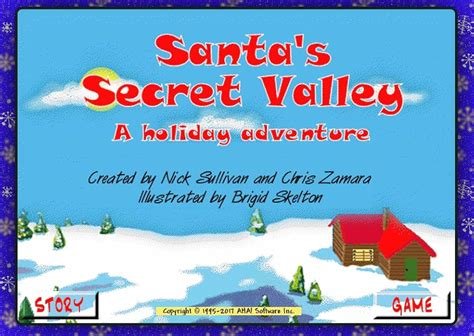
In ‘Santa’s Secret Valley’, players take on the role of Fizbin, Santa’s trusted elf, who embarks on a mission to recover his stolen magic sack, bell, and boots before Christmas Eve. The adventure unfolds in the enchanting Secret Valley, featuring locations like Main Street, the Forest of Arden, and Fairtown. Players must explore various rooms, solve puzzles, collect items and ducats, and navigate through mazes to successfully complete their quest. The game offers a hint system for challenging puzzles, ensuring an engaging and festive experience.
Gameplay Videos
Where to Buy Santa’s Secret Valley
PC
Santa’s Secret Valley Free Download
Santa’s Secret Valley: A Forgotten Holiday Gem Revisited
Introduction
In the mid-1990s, when CD-ROMs were reshaping gaming with cinematic flair, Santa’s Secret Valley (1995) emerged as a modest yet earnest holiday-themed graphical adventure. Developed by AHA! Software Inc., this whimsical quest to recover Santa’s stolen magical items encapsulates the charm and limitations of its era. While overshadowed by blockbuster contemporaries, the game’s focus on family-friendly puzzles and seasonal cheer has earned it a quiet cult following. This review argues that Santa’s Secret Valley is a time capsule of mid-90s design philosophy—a flawed but endearing relic that deserves recognition for its cozy ambition.
Development History & Context
The Studio Behind the Magic
AHA! Software Inc., a small studio best known for educational and family-oriented titles like Uncle Julius and the Anywhere Machine (1996), embraced a DIY ethos. Santa’s Secret Valley was helmed by Nick Sullivan, who served as writer, programmer, composer, and co-designer alongside Chris Zamara. The team’s multi-disciplinary approach was both a strength and a constraint: limited budgets meant relying on simplicity, while passion fueled creativity.
Technological Constraints
Released for 16-bit Windows systems on 3.5″ floppy disks, the game prioritized accessibility over technical ambition. Its static, first-person flip-screen visuals and MIDI-driven soundtrack were relics of an era transitioning to CD-ROM-driven multimedia. Yet, these limitations birthed clever workarounds, such as a lightweight hint system to guide players without overwhelming storage demands.
The 1995 Gaming Landscape
1995 saw the rise of narrative-driven epics like Chrono Trigger and Phantasmagoria, but Santa’s Secret Valley carved a niche as a holiday curio. It catered to families seeking non-violent entertainment, echoing the era’s demand for “edutainment” titles. Its re-release in 1998 (Windows) and 2017 (Browser) suggests a resilience atypical of forgotten shareware.
Narrative & Thematic Deep Dive
A Simple Yet Effective Plot
Players assume the role of Fizbin, a hapless elf tasked with guarding Santa’s magic sack, bell, and boots. After dozing off, Fizbin awakens to find the items stolen—a classic “redemption quest” framework. The narrative unfolds across three locales: Main Street, Forest of Arden, and Fairtown, each brimming with puzzles and quirky NPCs.
Characters and Dialogue
Characterization is minimal but functional. Fizbin’s dialogue oscillates between panicked urgency and lighthearted wit, while NPCs like Rob von Rudloff (a playtester-turned-in-game librarian) add metatextual humor. The lack of voice acting places burden on text, which, while charmingly earnest, occasionally feels stilted.
Underlying Themes
Beneath its festive veneer, the game explores themes of responsibility and problem-solving. Fizbin’s negligence sparks the crisis, but his perseverance—aided by the player’s logic—reinforces a message of self-improvement. The inclusion of a Christmas Quiz and library books nods to AHA!’s educational roots, blending learning with leisure.
Gameplay Mechanics & Systems
Core Gameplay Loop
The game follows a classic adventure template:
1. Explore static screens via point-and-click navigation.
2. Collect items (e.g., ducats, keys) and solve inventory-based puzzles.
3. Navigate mazes, including a train ride aboard the Secret Valley Express.
Puzzle Design
Puzzles range from straightforward (matching symbols) to obtuse (maze navigation). The hint system, while innovative for its time, often provides cryptic clues that frustrate more than assist. Standout moments include the TransDimensional InterLocator, a teleportation device requiring spatial reasoning.
UI and Progression
The interface is utilitarian, with a cursor-driven inventory and minimal feedback. Progression suffers from pacing issues—backtracking through mazes feels punitive, and the real-time clock (tying gameplay to Christmas Eve) adds unnecessary stress.
World-Building, Art & Sound
Visual Direction
Brigid Skelton’s illustrations blend folk art simplicity with vibrant fantasy. The North Pole’s candy-cane palette contrasts with Fairtown’s rustic greens, creating a cohesive yet varied aesthetic. Limited animation (e.g., flickering candles) injects subtle life into otherwise static scenes.
Atmosphere and Sound
Nick Sullivan’s soundtrack leans on jaunty melodies and chiptune bells, evoking a perpetual Christmas morning. Ambient sounds—crunching snow, distant sleigh bells—enhance immersion, though sparse voice samples (e.g., Santa’s muffled “Ho ho ho!”) feel archaic.
Reception & Legacy
Initial Reception
No formal critic reviews exist, but player anecdotes describe it as a “charming time-killer” hampered by technical quirks. Its commercial footprint was minimal, though AHA! Software’s persistence—re-releasing it for browsers in 2017—speaks to undying enthusiasm.
Evolution of Reputation
Today, the game is a footnote in adventure gaming history, mentioned alongside contemporaries like Myst only for its thematic contrast. Yet, its non-violent design and holiday focus influenced indie darlings like A Good Snowman Is Hard to Build (2015).
Cultural Impact
The game’s legacy lies in its nostalgia factor. For those who played it as children, Santa’s Secret Valley represents a bygone era of low-stakes, family-oriented gaming—a precursor to modern holiday-themed indies.
Conclusion
Santa’s Secret Valley is neither a masterpiece nor a disaster. It is a product of its time: constrained by technology yet brimming with earnest creativity. While its puzzles frustrate and its systems feel dated, the game’s cozy charm and festive spirit endure. For historians, it offers a snapshot of 1990s shareware ambition; for players, it remains a warm, if flawed, holiday diversion. In the pantheon of Christmas games, Fizbin’s adventure may not be a crown jewel, but it is a stocking stuffer worth rediscovering.
Final Verdict: A quaint, imperfect relic—best suited for nostalgic players and curious historians.