
- Release Year: 2009
- Platforms: Nintendo DS, Wii, Windows
- Publisher: Destineer, eGames, Inc.
- Developer: TechFront Studios, Ltd.
- Genre: Simulation
- Perspective: 3rd-person
- Game Mode: Single-player
- Gameplay: Fashion design, Styling
- Setting: Fashion and beauty
- Average Score: 65/100
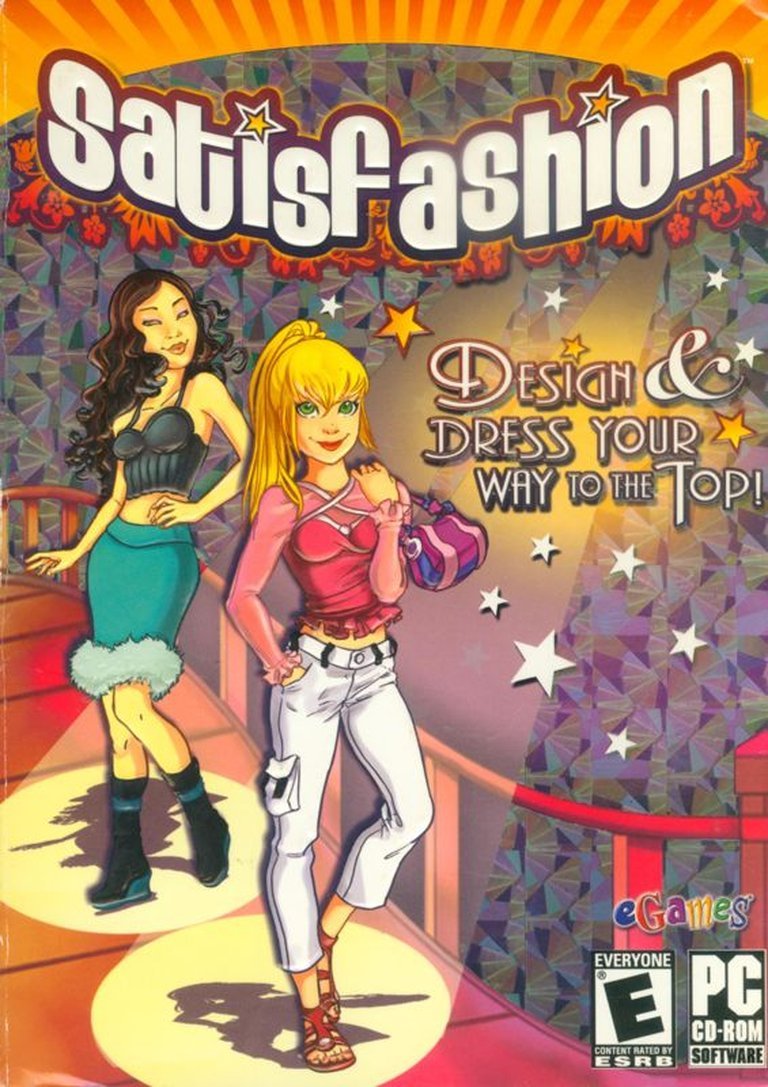
Description
Satisfashion is a fashion-themed simulation game where players step into the role of Grace Styles, a young designer leading the Satisfashion Design House to the top of the fashion industry. The game allows players to create trends, design outfits, style models, and showcase their collections on runways across the globe, spanning 60 levels set in exotic locations. With a mix of creativity and strategy, players aim to elevate their fashion brand and set the industry on fire with innovative designs.
Satisfashion Reviews & Reception
metacritic.com (65/100): Satisfashion: Rock the Runway’s lax level of difficulty can be a sticking point for a number of casual game fans.
Satisfashion: A Forgotten Gem of Fashion Simulation
Introduction: The Runway of Nostalgia
In the late 2000s, the casual gaming market was flooded with titles catering to niche interests—cooking, time management, and, of course, fashion. Among these, Satisfashion (2009) emerged as a charming, if overlooked, simulation game that allowed players to step into the stilettos of a budding fashion designer. Developed by TechFront Studios and published by Destineer and eGames, Satisfashion offered a blend of creativity, strategy, and lighthearted fun, tasking players with building a fashion empire from the ground up.
Yet, despite its ambitious premise and multi-platform release (Windows, Nintendo DS, and Wii), Satisfashion faded into obscurity, overshadowed by heavier hitters like The Sims and Animal Crossing. This review seeks to resurrect its legacy, examining its strengths, flaws, and the cultural context that shaped its existence. Was Satisfashion a revolutionary fashion sim, or merely a fleeting trend? Let’s dissect its stitches.
Development History & Context: Stitching Together a Vision
The Studio Behind the Seams
TechFront Studios, a Brazilian developer, was no stranger to casual and family-friendly games. Before Satisfashion, they worked on titles like Puzzle City and Burger Island—games that emphasized accessibility and simple mechanics. Their portfolio suggests a focus on pick-up-and-play experiences, a philosophy that heavily influenced Satisfashion’s design.
The game’s development coincided with the casual gaming boom of the late 2000s, a period where Nintendo’s DS and Wii dominated the market with titles like Nintendogs and Cooking Mama. Satisfashion was clearly positioned to capitalize on this trend, offering a fashion-forward alternative to the cooking and pet-raising sims of the era.
Technological Constraints & Design Choices
Released in 2009 for Windows and later ported to DS and Wii in 2010, Satisfashion faced the challenge of adapting its core mechanics across vastly different hardware:
- Windows (2009): The PC version benefited from higher-resolution visuals and mouse-driven controls, making it the most polished iteration.
- Nintendo DS (2010): The touchscreen was a natural fit for a fashion game, allowing players to drag-and-drop outfits with the stylus. However, the limited processing power meant simpler graphics and fewer design options.
- Wii (2010): The Wii’s motion controls were underutilized, reducing the game to a point-and-click experience with the Wii Remote.
The DS version was particularly notable for its “magazine mode”, where players could hold the system like a fashion catalog, flipping through outfits in a mock-spread layout. This was a clever use of the hardware, though it didn’t drastically alter gameplay.
The Gaming Landscape of 2009-2010
Satisfashion entered a market already saturated with life simulation games, but few focused exclusively on fashion. Competitors included:
– Style Savvy (2008, DS) – A more in-depth fashion boutique sim.
– Imagine: Fashion Designer (2007, DS) – A simpler, younger-skewing alternative.
– The Sims 2: Open for Business (2006, PC) – Allowed fashion design but as a side feature.
Unlike Style Savvy, which emphasized retail management, Satisfashion was purely about design and runway shows, carving out a unique (if narrow) niche.
Narrative & Thematic Deep Dive: Grace Styles and the Fantasy of Fashion
Plot: A Cinderella Story for the Runway
Players assume the role of Grace Styles, a young, aspiring designer who rises from obscurity to lead the Satisfashion Design House. The narrative is minimalist, serving as a loose framework for the gameplay rather than a deep story. Key beats include:
– Humble Beginnings: Grace starts with basic designs, working her way up through small-time shows.
– Global Expansion: As her reputation grows, she jets off to exotic locations (Paris, Tokyo, Milan) to showcase her collections.
– The Ultimate Goal: Dominate the fashion industry by impressing buyers and critics.
The story is wholesome and aspirational, targeting a young female audience (likely ages 8-14). There’s no conflict, no villains—just the pure, unadulterated joy of creating beauty.
Characters & Dialogue: A Cast of Cardboard Cutouts
Grace is the only character with any semblance of personality, and even she is a blank slate. Supporting characters include:
– Models: Faceless mannequins who strut down the runway.
– Buyers & Critics: Generic NPCs who offer canned reactions (“Fab!” “Not quite right…”).
– Rivals: Nonexistent—there’s no competition mechanic.
The dialogue is functional but forgettable, serving only to guide the player through the next objective. This was likely a deliberate choice—Satisfashion was gameplay-first, with narrative taking a backseat.
Themes: Creativity, Consumerism, and the Illusion of Choice
At its core, Satisfashion is a celebration of self-expression. Players are encouraged to:
– Experiment with styles (punk, elegant, bohemian).
– Mix and match outfits, accessories, and makeup.
– Design custom clothing (though limited by the engine).
However, the game also subtly reinforces consumerist ideals:
– Trends are king—players must adhere to themes to succeed.
– Buyers dictate taste—there’s no room for true avant-garde design.
– Success is measured in profit, not artistic integrity.
This tension between creativity and commercialism mirrors real-world fashion, making Satisfashion an unintentional (if shallow) commentary on the industry.
Gameplay Mechanics & Systems: Does It “Make It Work”?
Core Gameplay Loop: From Sketch to Runway
Satisfashion’s structure is repetitive but satisfying in short bursts. Each level follows this pattern:
1. Theme Selection: Players choose a fashion show theme (e.g., “Glamorous Evening Wear,” “Street Punk”).
2. Outfit Assembly: Using a drag-and-drop interface, players dress models in pre-made or custom-designed clothes.
3. Makeup & Accessories: Adjust hairstyles, jewelry, and makeup to match the theme.
4. Runway Show: Models strut, and buyers react based on how well the outfits fit the theme.
5. Scoring & Progression: Earn money and unlock new locations, clothes, and design options.
Combat? No. But There Is Pressure
While not a traditional “combat” game, Satisfashion introduces time pressure in its main mode:
– Players must quickly assemble outfits before the show starts.
– Mistakes cost money, forcing restarts if buyers dislike the looks.
This adds a light strategic layer, though the difficulty is minimal—most players will breeze through levels.
Character Progression: Unlocking the Closet
Progression is linear and reward-based:
– Money unlocks new clothing items, patterns, and venues.
– Reputation grows as players complete shows, unlocking prestige locations (e.g., New York Fashion Week).
– Custom Designs can be saved and reused, though the tool is basic (pre-set shapes, limited color palettes).
Innovative Features: Dress-Up Mode & the Lookbook
The game’s standout mechanics are:
1. Dress-Up Mode (Free Play):
– A sandbox mode where players experiment without time limits.
– Perfect for younger players or those who just want to mess around.
2. Lookbook Feature:
– Allows players to save and showcase their favorite outfits.
– A precursor to modern fashion games’ social sharing (though Satisfashion lacked online features).
Flaws in the Fabric
Despite its charm, Satisfashion suffers from:
– Repetitive Gameplay: After 20 levels, the formula grows stale.
– Limited Customization: The design tool is too simplistic for true creativity.
– Lack of Depth: No rival designers, economic challenges, or narrative twists to spice things up.
– Wii/DS Limitations: The console versions feel watered down compared to PC.
World-Building, Art & Sound: A Glossy but Shallow Runway
Setting & Atmosphere: Jet-Setting in Style
Satisfashion takes players on a global tour, with runways set in:
– Paris (elegant, haute couture)
– Tokyo (quirky, Harajuku-inspired)
– Milan (luxury, high-end)
– New York (edgy, urban)
Each location is visually distinct, though the backgrounds are static and uninteractive. The game romanticizes fashion capitals, presenting them as glittering playgrounds for the elite.
Visual Design: A Mixed Bag of Glitter and Polygons
- PC Version: The cleanest presentation, with smoother animations and higher-res textures.
- DS Version: Chibi-style models and bold colors make it cute but dated.
- Wii Version: Suffers from blurry textures and clunky controls.
The clothing designs are bright and varied, though the 3D models are stiff, with robotic runway walks.
Sound Design: A Forgettable Soundtrack
- Music: Generic lounge/jazz tracks that loop endlessly.
- Sound Effects: Clicking heels, camera flashes, and audience murmurs—functional but unremarkable.
- Voice Acting: Nonexistent—all dialogue is text-based.
The audio does nothing to elevate the experience, serving as background noise rather than an immersive element.
Reception & Legacy: A Flash in the Pan
Critical Reception: Mixed Reviews and Low Visibility
Satisfashion received little critical attention, with only a handful of reviews:
– WorthPlaying (65/100): Praised its accessibility but criticized its lack of challenge.
– Metacritic: No aggregated score due to insufficient reviews.
– User Reception: Mostly positive from casual players, but ignored by hardcore gamers.
The game’s biggest flaw was its lack of depth—it was too simple for simulation fans but too repetitive for casual players seeking variety.
Commercial Performance: A Niche Flop
Sales figures (via VGChartz) reveal a disappointing performance:
– Total Sales: ~2,234 copies (DS), ~805 copies (Wii).
– No PC sales data, but likely equally modest.
– Japan was the strongest market, suggesting it resonated more with young female audiences there.
Legacy: The Ghost of Fashion Sims Past
Satisfashion’s influence is negligible—it didn’t spawn sequels or inspire major titles. However, it paved the way for later fashion games like:
– Style Boutique series (2012–present)
– Fashion Dreamer (2023, mobile)
– Dress Up! Time Princess (2020, gacha-style)
Its biggest contribution was proving that fashion could be a viable game genre, even if it didn’t execute the idea perfectly.
Conclusion: A Charming but Flawed Fashion Fantasy
Satisfashion is a time capsule of late-2000s casual gaming—a lighthearted, colorful, but ultimately shallow experience. It succeeded in its core mission: letting players play pretend as a fashion designer without the stress of real-world industry pressures. However, its lack of depth, repetitive structure, and technical limitations prevented it from becoming a classic.
Final Verdict: 6.5/10 – “A Fun Distraction, Not a Masterpiece”
- Best For: Young fashion enthusiasts, casual gamers, fans of low-stakes creativity.
- Worst For: Those seeking deep simulation, narrative depth, or replayability.
- Legacy: A forgotten but charming experiment in fashion gaming.
Satisfashion may not have rocked the runway, but it deserves credit for daring to strut its stuff in a genre that was (and still is) underexplored. If you stumble upon a copy in a bargain bin, it’s worth a playthrough—just don’t expect Project Runway-level drama.
Final Thought: Like a fast-fashion trend, Satisfashion was fun while it lasted, but ultimately disposable. Yet, in its brief moment in the spotlight, it gave players a glimpse of glamour—and sometimes, that’s enough.