
- Release Year: 2011
- Platforms: Windows
- Publisher: S.A.D. Software Vertriebs- und Produktions GmbH
- Genre: Compilation
- Game Mode: Single-player
- Average Score: 74/100
Description
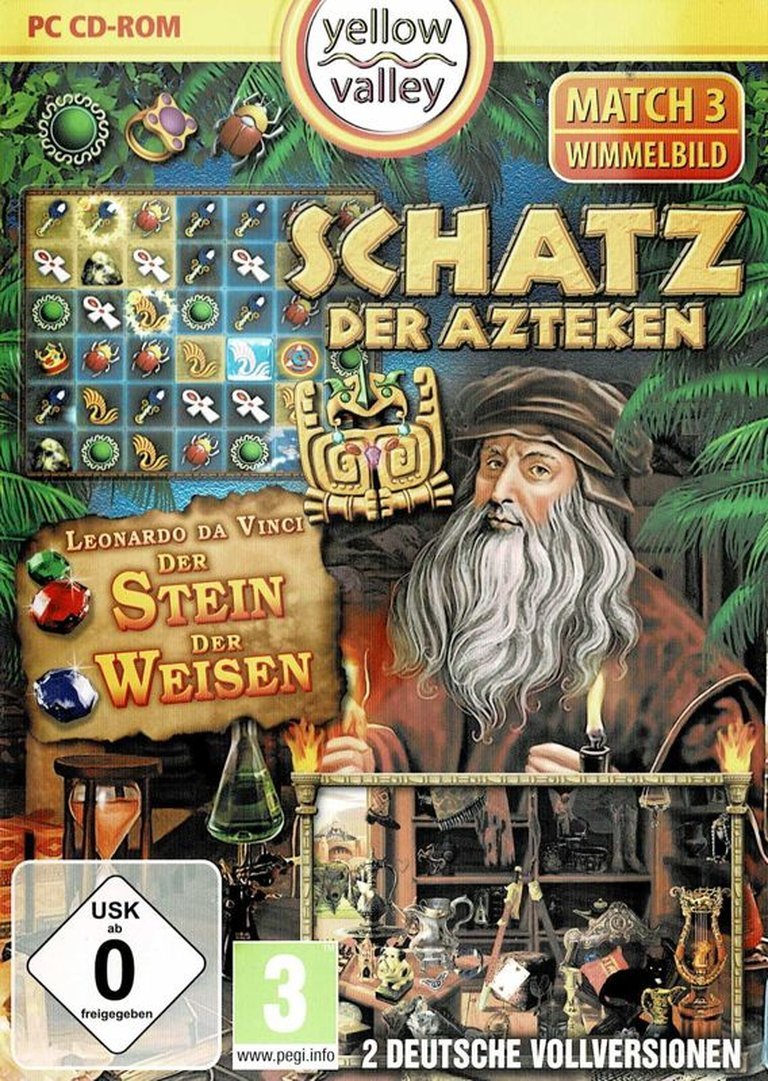
Schatz der Azteken & Der Stein der Weisen is a 2011 retail compilation for Windows that bundles two adventure games: Schatz der Azteken and Great Secrets: Da Vinci. The collection offers players a mix of treasure-hunting and historical mystery-solving, set against backdrops inspired by Aztec lore and Renaissance-era intrigue. Published by S.A.D. Software, the compilation is designed for casual gamers, featuring accessible gameplay and a PEGI 3 rating, making it suitable for all ages.
Schatz der Azteken & Der Stein der Weisen Reviews & Reception
spielemagazin.de (74/100): Der “Schatz der Azteken” bietet bewährte Spielkost mit einem Highlight: Verschiebbare Reihen verleihen dem Spiel eine neue Variante.
Schatz der Azteken & Der Stein der Weisen: A Forgotten Gem of Casual Puzzle Gaming
Introduction
Imagine stumbling upon a dusty map in a dimly lit museum, its faded lines whispering of lost Aztec treasures buried for millennia amid ancient ruins and jagged peaks. This is the tantalizing hook of Schatz der Azteken & Der Stein der Weisen, a 2011 retail compilation that bundles two distinct yet thematically linked puzzle adventures: Schatz der Azteken and Great Secrets: Da Vinci. While the latter title leans into Renaissance-era intrigue, it is the former—a vibrant, match-3 puzzle game steeped in Aztec mystique—that anchors this compilation’s appeal. Released during the golden age of casual gaming, Schatz der Azteken emerged as a budget-friendly, family-oriented gem that cleverly adapted the match-3 formula with a unique row-shifting mechanic and a treasure-hunting narrative. Yet, despite its addictive gameplay and colorful charm, it remains a largely overlooked relic of the early 2010s puzzle boom.
This review seeks to unearth the hidden depths of Schatz der Azteken & Der Stein der Weisen, analyzing its development context, narrative and thematic underpinnings, gameplay innovations, and artistic design. We will also explore its reception and legacy, assessing how it fits into the broader tapestry of casual gaming history. Ultimately, we argue that while Schatz der Azteken may not have redefined its genre, it stands as a testament to the era’s ability to blend accessibility with thematic richness, offering a relaxing yet engaging escape for puzzle enthusiasts.
Development History & Context
The Studio and Creators’ Vision
Schatz der Azteken & Der Stein der Weisen was published by S.A.D. Software Vertriebs- und Produktions GmbH, a German company known for distributing budget-friendly casual games in the European market. The compilation itself is a retail bundle, combining two distinct titles: Schatz der Azteken (developed by Purple Hills Entertainment) and Great Secrets: Da Vinci (developed by an unspecified studio). The inclusion of these games in a single package reflects the early 2010s trend of bundling casual titles to maximize shelf appeal and value for consumers.
Purple Hills Entertainment, the studio behind Schatz der Azteken, was a modest developer specializing in accessible, family-friendly games. Their vision for Schatz der Azteken was to create a puzzle experience that was easy to pick up but difficult to put down—a game that could appeal to both casual players and families looking for a shared gaming experience. The studio’s focus on simplicity and addictive gameplay loops aligns with the broader casual gaming movement of the time, which prioritized accessibility over complexity.
Technological Constraints and Era
Released in 2011, Schatz der Azteken was designed to run on modest hardware, reflecting the technological limitations of the early 2010s. The game’s minimum system requirements—Windows XP/Vista/7, a Pentium 700 MHz processor, 128 MB RAM, and a 32 MB graphics card—highlight its accessibility, ensuring it could run on even the most basic PCs of the era. This low barrier to entry was crucial for casual games, which often targeted audiences with older or less powerful machines.
The game’s 2D graphics and fixed-screen perspective were typical of the era’s casual puzzle games, which prioritized clarity and simplicity over graphical fidelity. The use of DirectX 8.0 further underscores its compatibility with older systems, making it a viable option for a wide range of players. While these constraints limited the game’s visual ambition, they also allowed Purple Hills to focus on refining the core gameplay mechanics, ensuring a polished and enjoyable experience.
The Gaming Landscape of 2011
The early 2010s were a pivotal period for casual gaming. The success of titles like Bejeweled, Zuma, and Peggle had demonstrated the market’s appetite for simple yet addictive puzzle games. Meanwhile, the rise of digital distribution platforms like Steam and Big Fish Games made it easier for smaller studios to reach audiences without relying on physical retail.
Schatz der Azteken entered this landscape as part of a wave of thematically rich puzzle games that sought to differentiate themselves through unique settings and mechanics. Its Aztec-inspired aesthetic and row-shifting gameplay mechanic set it apart from more generic match-3 titles, offering players a fresh twist on a familiar formula. However, the game’s lack of widespread critical recognition and limited marketing meant it remained a niche product, overshadowed by more prominent casual hits.
Narrative & Thematic Deep Dive
Plot and Characters
Schatz der Azteken weaves a lightweight but engaging narrative that serves as a framing device for its puzzle gameplay. The story begins in a Museum of World History, where the player stumbles upon a hidden map revealing the locations of 18 ancient Aztec artifacts scattered across 90 levels. The player’s goal is to uncover these artifacts by solving puzzles, each of which represents a “dig site” where symbols like golden scepters, ruby scarabs, and jeweled brooches must be aligned to progress.
The narrative is minimalistic, with no voiced dialogue or deep character development. Instead, the game relies on environmental storytelling and symbolic imagery to convey its themes. The player is cast as an anonymous explorer, and the lack of a defined protagonist allows for a more universal appeal, making the game accessible to players of all ages and backgrounds.
Themes and Symbolism
The game’s central theme is exploration and discovery, with each puzzle representing a step closer to uncovering the lost treasures of the Aztecs. The use of Aztec motifs—such as feathered serpents, stepped pyramids, and golden idols—reinforces this theme, immersing players in a world of ancient mystique and adventure.
Underlying this surface-level narrative is a subtle critique of greed and ambition. The game’s mechanics, which reward players for strategic planning and punish hasty moves, mirror the idea that unchecked ambition can lead to failure. The optional relaxed mode, which removes time pressure, further emphasizes the game’s focus on enjoyment over competition, aligning with its family-friendly ethos.
Dialogue and Storytelling
Given its casual nature, Schatz der Azteken features minimal dialogue, with most of the narrative conveyed through text prompts and visual cues. The game’s UI elements, such as pop-up hints and score recaps, provide just enough context to keep players engaged without overwhelming them with lore. This approach ensures that the game remains accessible to younger players and those who prefer a more straightforward gaming experience.
Gameplay Mechanics & Systems
Core Gameplay Loop
At its heart, Schatz der Azteken is a match-3 puzzle game with a unique twist: instead of swapping individual tiles, players shift entire rows or columns to align three or more identical symbols. This mechanic adds a layer of strategic depth, as players must plan their moves carefully to avoid getting stuck.
The game features 90 levels, each with increasing complexity. Early levels introduce basic mechanics, while later stages incorporate immovable “thick stones” and colored backgrounds that must be cleared to progress. The goal is to remove all tiles from the board, with points awarded for combos and special symbol matches.
Progression and Power-Ups
Progression is tied to artifact collection, with players unlocking new levels as they uncover pieces of the 18 ancient relics. Points earned from puzzles can be spent in the “Magieladen” (magic shop), where players can purchase runes and power-ups to aid their journey. These include:
- Symbol swaps: Allows players to exchange two tiles.
- Bombs: Clears a radius of tiles when matched.
- Block removals: Eliminates obstacles like rocks or ice blocks.
The inclusion of these power-ups adds a meta-layer of strategy, as players must decide when to use their limited resources for maximum effect.
Game Modes
Schatz der Azteken offers two primary modes:
- Timed Mode: Players race against the clock to complete levels, with time bonuses awarded for quick thinking.
- Relaxed Mode: Removes time pressure, allowing players to enjoy the puzzles at their own pace.
This dual-mode approach ensures that the game appeals to both competitive players and those seeking a more leisurely experience.
UI and Accessibility
The game’s user interface is clean and intuitive, with a profile system that allows multiple family members to save their progress separately. The fixed-screen perspective and point-and-click controls are typical of the era, though they may feel dated by modern standards. Despite this, the game’s simplicity ensures that it remains accessible to players of all skill levels.
World-Building, Art & Sound
Setting and Atmosphere
Schatz der Azteken transports players to a stylized Aztec-inspired world, filled with ancient ruins, hidden temples, and sacred pyramids. The game’s overarching map serves as a visual representation of the player’s journey, with each level unlocking a new location on the path to the lost treasures.
The atmosphere is one of mystery and adventure, reinforced by the game’s symbolic imagery and thematic consistency. While the game does not feature interactive exploration, its environmental storytelling creates a sense of immersion, making each puzzle feel like a step deeper into the heart of an ancient civilization.
Visual Design
The game’s art direction is a standout feature, with vibrant 2D graphics that bring the Aztec theme to life. Symbols like golden idols, feathered serpents, and gem-encrusted relics are rendered in bright, eye-catching colors, while the backgrounds feature subtle Aztec motifs that enhance the game’s aesthetic appeal.
The animations are smooth and satisfying, with tiles cascading and exploding in a shower of points. The fixed-screen perspective ensures that the gameplay remains clear and uncluttered, though it lacks the dynamic camera angles of more modern puzzle games.
Sound Design
The game’s sound design complements its visual style, with a tribal-inspired soundtrack that evokes the mystique of the Aztec civilization. The sound effects—such as the satisfying “click” of tiles aligning and the explosive burst of combos—provide auditory feedback that enhances the gameplay experience.
While the game lacks voice acting, its ambient music and sound cues create a cohesive atmosphere that draws players into its world. The looping tracks vary by level, ensuring that the soundtrack remains engaging throughout the game’s 90 levels.
Reception & Legacy
Critical and Commercial Reception
Upon its release in 2011, Schatz der Azteken received limited critical attention, reflecting its status as a budget-friendly casual title. The game was not reviewed by major gaming outlets, and its MobyGames entry remains sparse, with no critic reviews listed. However, user feedback on platforms like Amazon and eBay suggests that the game was well-received by its target audience, with players praising its addictive gameplay and family-friendly appeal.
Commercially, the game performed modestly, selling primarily through retail bundles and budget compilations. Its inclusion in the Computer Bild Spiele magazine’s 2011 edition further expanded its reach, though it remained a niche product compared to more mainstream casual hits.
Evolution of Reputation
Over time, Schatz der Azteken has gained a cult following among fans of casual puzzle games. Its unique row-shifting mechanic and Aztec-themed aesthetic have earned it a place in the hearts of players who appreciate its relaxing yet engaging gameplay. While it has not achieved the same level of recognition as titles like Bejeweled or Candy Crush, it remains a beloved relic of the early 2010s puzzle boom.
Influence on Subsequent Games
Schatz der Azteken’s influence can be seen in later match-3 puzzle games that incorporate row-shifting mechanics and thematic depth. Titles like Matchington Mansion and Aztec Puzzle clones owe a debt to its innovative approach, though they often lack the same level of narrative cohesion and artistic charm.
The game’s legacy is also evident in the continued popularity of casual puzzle compilations, which remain a staple of the budget gaming market. While Schatz der Azteken may not have redefined its genre, it stands as a testament to the era’s ability to blend accessibility with thematic richness, offering a relaxing yet engaging experience for puzzle enthusiasts.
Conclusion
Schatz der Azteken & Der Stein der Weisen is a hidden gem of the early 2010s casual gaming scene, offering a unique twist on the match-3 formula with its row-shifting mechanics and Aztec-inspired aesthetic. While it may not have achieved the same level of recognition as more mainstream puzzle games, its addictive gameplay, vibrant visuals, and family-friendly appeal make it a standout title in its genre.
The game’s legacy lies in its ability to blend simplicity with depth, creating an experience that is both accessible and engaging. Its narrative framing and thematic consistency elevate it above more generic match-3 titles, while its power-up system and dual-mode approach ensure broad appeal.
Ultimately, Schatz der Azteken is a testament to the golden age of casual gaming, offering a relaxing yet rewarding escape for players of all ages. While it may not have redefined its genre, it remains a beloved relic of an era when puzzle games were as much about exploration and discovery as they were about high scores and combos.
Final Verdict: 7/10 – A charming and addictive puzzle adventure that deserves a place in any casual gamer’s collection.