
- Release Year: 2000
- Platforms: Macintosh, Windows
- Publisher: Microsoft Corporation
- Developer: KnowWonder, Inc.
- Genre: Adventure, Educational, Science
- Game Mode: Single-player
- Gameplay: Collection, Creation, Exploration
- Setting: Educational, Insects, Science
- Average Score: 80/100
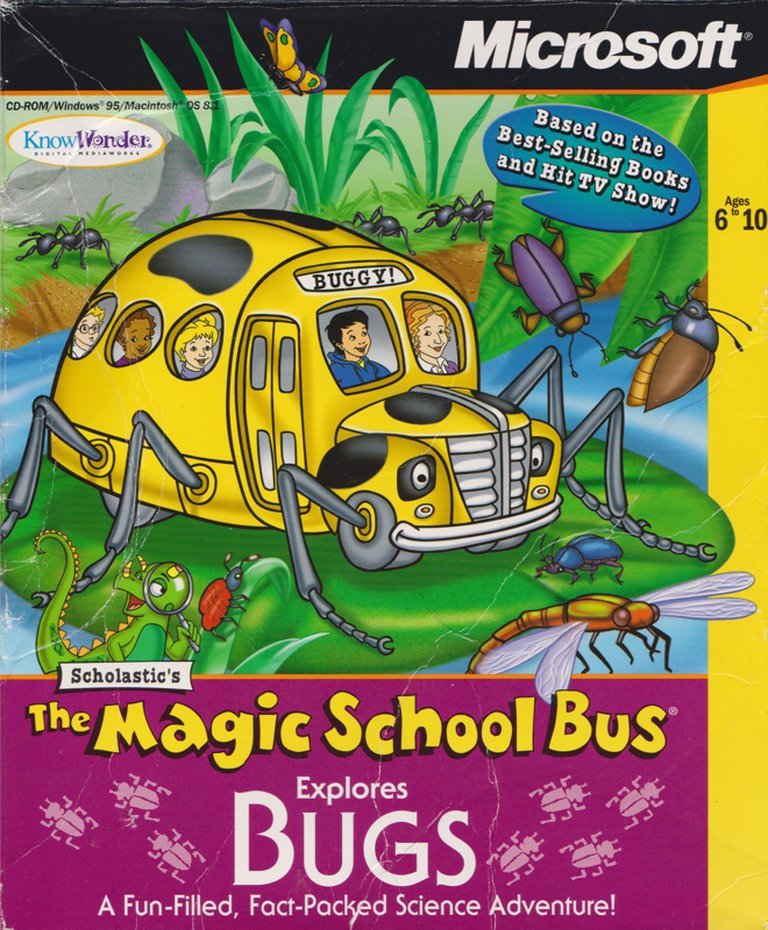
Description
In Scholastic’s The Magic School Bus Explores Bugs, players join Ms. Frizzle and her class on an insect-filled adventure to recover lost creatures from their terrariums. After boarding the iconic Magic School Bus, players shrink to bug size to explore diverse habitats, learn about insect traits through interactive activities like constructing virtual bugs and reading virtual reports, and discover survival adaptations while enjoying catchy songs and age-appropriate science content.
Gameplay Videos
Scholastic’s The Magic School Bus Explores Bugs Free Download
Scholastic’s The Magic School Bus Explores Bugs Reviews & Reception
zisman.ca : Despite this grumbling, many children in the grade 2-5 range will find MSB Bugs engaging—whether just for the games or as a way to learn about the fascinating but much maligned insects, spiders, and other bugs that surround us.
Scholastic’s The Magic School Bus Explores Bugs: A Microcosmic Marvel
Introduction
In 1999, as the third millennium dawned, Microsoft and Scholastic released Scholastic’s The Magic School Bus Explores Bugs, the eighth and final installment in the original CD-ROM series. More than a mere edutainment title, this game stands as a meticulous synthesis of educational rigor and playful exploration, shrinking players into a world where dewdrops are crystal pools and blades of grass tower like skyscrapers. As the culmination of a franchise that revolutionized children’s science education through interactive media, Explores Bugs epitomizes the series’ core ethos: curiosity is the greatest adventure. This review examines how its narrative depth, innovative gameplay, and artistic fidelity not only fulfilled its pedagogical mission but also cemented a legacy as a benchmark for educational gaming.
Development History & Context
Developed by KnowWonder, Inc. (taking the helm from Music Pen Multimedia for the final two original titles), Explores Bugs emerged during a pivotal era for educational software. By 1999, the CD-ROM market was saturated with titles vying for children’s attention, yet Microsoft’s Magic School Bus series had already carved a niche through its seamless blend of science curricula and interactive storytelling. KnowWonder, founded by industry veterans with roots in multimedia education, faced the challenge of preserving the franchise’s charm while introducing innovations. The game drew inspiration from four sources: the book Inside a Beehive and the TV episodes “Gets Ants in its Pants,” “Butterfly and the Bog Beast,” “Spins a Web,” and “In a Beehive.” Technologically, it operated within the constraints of the era—requiring a Pentium 133 processor, 16MB RAM, and 16-bit color—yet pushed boundaries with its environmental variety and transformation mechanics. This transition from Music Pen to KnowWonder marked a generational shift, symbolized by the replacement of the original TV cast’s voice actors, a move that, while controversial, allowed for fresh interpretations of the beloved characters.
Narrative & Thematic Deep Dive
The narrative unfolds with a charmingly simple premise: the students’ terrarium bugs have vanished, necessitating a rescue mission across four ecosystems. Ms. Frizzle, ever the intrepid educator, transforms her class into insect-sized explorers—Arnold becomes an ambush bug in the meadow, Keesha a luna moth in the forest, Ralphie a hercules beetle in the jungle, and Dorothy Ann a mayfly in the pond. This dual-layered narrative structure—combining real-world problem-solving with fantastical metamorphosis—mirrors the series’ signature blend of imagination and science. Dialogue crackles with the show’s trademark whimsy: Carlos cracks puns about “ant-ics,” while Dorothy Ann corrects peers with scientific precision. Thematically, the game champions adaptation (both biological and educational) and ecological interdependence. Each habitat is a living classroom, where misplaced bugs teach players about niche roles in food webs and survival strategies. The absence of a singular linear plot is intentional, emphasizing discovery over rigid goals—a pedagogical choice that mirrors constructivist learning principles.
Gameplay Mechanics & Systems
Explores Bugs excels in its open-ended design, structured around four distinct habitats, each offering a “missing bug” quest and unique mini-games. The core loop involves:
1. Exploration: Players navigate oversized environments (meadows, forests, ponds, jungles) using point-and-click mechanics. Tools like the magnifying glass (despite its noted flaws) encourage observation.
2. Mini-Games: Each zone hosts activities reinforcing entomological concepts:
– Meadow: An ant maze teaching colony cooperation.
– Forest: “Bugs Are It!” trivia show testing insect knowledge.
– Pond: A food-chain puzzle demonstrating aquatic ecosystems.
– Jungle: A camouflage game mimicking leaf-cutter ant behavior.
3. Bus Activities: The Magic School Bus doubles as a science hub, housing a “morphing machine” (allowing creative bug hybrids), an experiment station (e.g., testing firefly compatibility), and a jukebox with educational songs.
Critically, the game avoids punitive design, fostering intrinsic motivation through discovery. However, flaws persist: the magnifying glass’s inconsistent functionality and the field guide’s unclear utility occasionally disrupt immersion. Still, its adaptive difficulty—simpler tasks for younger players, deeper trivia for older ones—reflects KnowWonder’s commitment to a 6–10 age range.
World-Building, Art & Sound
The game’s world-building is masterful in its scale and detail. Habitats are rendered with ecological authenticity: meadows buzz with bumblebees and aphids, while jungle canopies drip with moisture. Environments shift dynamically—e.g., nocturnal insects emerge at night in the pond—encouraging temporal exploration. Art direction balances realism and cartoonish charm, with character designs faithful to the TV show’s exaggerated proportions. The bus’s CGI-rendered transformations (a staple of the series) remain visually striking, shrinking players into a microcosm where pollen particles drift like snowflields.
Sound design amplifies immersion: Mark Yeend’s upbeat underscore swells during discoveries, while insect chirps and rustling foliage create auditory texture. Voice acting, though recast, captures the characters’ personalities—Ms. Frizzle’s exclamations (“Take a closer look!”) retain their infectious enthusiasm. Educational facts are woven seamlessly into dialogue and sound bites, avoiding didacticism.
Reception & Legacy
Upon release, Explores Bugs garnered critical acclaim for its educational value but faced mixed technical assessments:
– PCMag (100%): Praised its “detailed” bug photography and “seamless” vocabulary integration.
– Tech with Kids (90%): Hailed the “bug treasure hunt” but noted limited replayability.
– SuperKids (80%): Commended its classroom utility but deemed it less suitable for older children.
– Macworld (50%): Critiqued design flaws, like unpauseable presentations and missing on-screen vocabulary.
Commercially, it maintained the series’ robust performance, with over 7 players collecting it on MobyGames. Its legacy is twofold:
1. Series Finale: As the last original Magic School Bus title, it epitomized the franchise’s evolution from book/TV adaptations to immersive digital experiences.
2. Educational Benchmark: Its integration of storytelling, exploration, and science influenced successors like Activity Centers (e.g., Lands on Mars, Whales and Dolphins), which adopted KnowWonder’s mini-game-heavy approach. Decades later, it remains a touchstone for edutainment design, cited for proving that complex topics like entomology could be accessible yet academically rigorous.
Conclusion
Scholastic’s The Magic School Bus Explores Bugs is not merely a relic of the CD-ROM era but a timeless testament to the power of interactive learning. Its microcosmic world transforms entomology from a textbook subject into a tactile adventure, where scientific curiosity is rewarded at every turn. While technical constraints and design quirks occasionally hinder immersion, its strengths—vibrant art, engaging mechanics, and unwavering educational integrity—ensure its relevance. As the final chapter in the original series, it honors Ms. Frizzle’s mantra: “Take chances, make mistakes, get messy.” For children of the late ’90s and modern educators alike, Explores Bugs remains a shining example: learning isn’t just about answers, but the joy of discovery. Verdict: An essential, if imperfect, masterpiece of edutainment.