
- Release Year: 1996
- Platforms: Windows
- Publisher: Microsoft Corporation
- Developer: Music Pen
- Genre: Educational
- Perspective: 3rd-person (Other)
- Game Mode: Hotseat, Single-player
- Gameplay: Arcade, Game show, Puzzle, quiz, trivia
- Setting: Alberta, Argentina, Arizona, Colorado, Cretaceous, Jurassic, Mongolia, Tanzania, Tethys Sea, Triassic
- Average Score: 98/100
Description
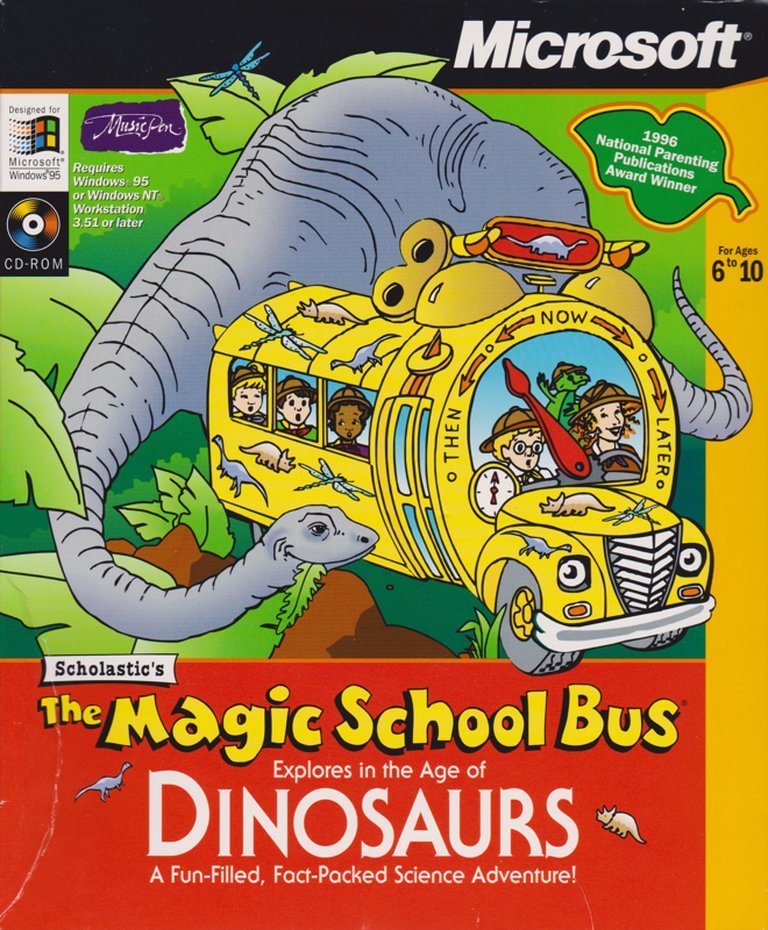
Join Mrs. Frizzle and her class aboard the Magic School Bus for an educational journey back to the Triassic, Jurassic, and Cretaceous periods, exploring seven prehistoric locations like Argentina, Arizona, Tanzania, the Tethys Sea, Alberta, and Mongolia. Players discover dinosaurs and creatures through interactive world maps, fossil sites, a dinosaur nest with jokes and facts, detailed reports with PBS clips, X-ray skull views, games, and puzzles that earn collectible paleo cards, all while helping recover Mrs. Frizzle’s lost time-travel photos to unlock dinosaur masks.
Gameplay Videos
Scholastic’s The Magic School Bus Explores in the Age of Dinosaurs Reviews & Reception
myabandonware.com (98/100): This iso is damaged and throws errors when you take dino photos.
oldgamesdownload.com : dude i used to play these all the time as a kid, this is so neat
Scholastic’s The Magic School Bus Explores in the Age of Dinosaurs: Review
Introduction
Imagine shrinking down to dinosaur size, hopping aboard a shape-shifting school bus, and hurtling through time to snap selfies with a Stegosaurus or evade a rampaging T-Rex—all while absorbing paleontological facts like a sponge. Released in 1996, Scholastic’s The Magic School Bus Explores in the Age of Dinosaurs captures this whimsical magic, transforming the beloved children’s book and PBS series into an interactive CD-ROM adventure. As the fifth entry in the Magic School Bus software series, it rode the wave of edutainment popularity, earning accolades like a National Parenting Publications Awards (NAPPA) Gold for Elementary Software and a spot on Newsweek’s Editor’s Choice Top Fifty CD-ROMs. Its legacy endures not just as nostalgic kidware but as a pioneering blend of education and gameplay that made science irresistible. This review argues that the game remains a masterful exemplar of 1990s edutainment: flawlessly marrying exploration, puzzles, and multimedia to instill dinosaur lore, even as modern eyes spot its era-specific scientific quirks.
Development History & Context
Developed by the boutique studio Music Pen—a team of 27 developers, including lead programmers Faiza Bounetta and Matthew Morse, art director Pierre Fontaine, and a cadre of 2D artists/animators like Thomas Boné and Peter Carella—the game was published by Microsoft Corporation on October 9, 1996, for Windows (with Mac support). Music Pen specialized in Scholastic tie-ins, collaborating on prior titles like Explores Inside the Earth (its direct predecessor) and leveraging Microsoft’s multimedia muscle for CD-ROM distribution. Programming supervisor Conroy Lee oversaw a lean team that integrated 3D animation by Vivian Luke, music from Mario Piazza and Miguel Echegaray, and voice talent including Little Richard’s thematic echoes from the TV series.
The era’s technological constraints shaped its design profoundly. Windows 95 had just popularized plug-and-play CD-ROMs with Super VGA graphics and sound cards as standard, enabling rich video clips from PBS’s The Dinosaurs! series and Dorling Kindersley dinosaur visuals. Yet, hardware limits (486SX/33 MHz minimum, 8MB RAM) favored 2D sprites over full 3D, resulting in sprite-animated dinosaurs and pre-rendered cutscenes. Storage was king—238MB ISOs crammed world maps, X-ray skulls, and 66 PaleoCards—while input relied on keyboard/mouse for 1-2 players.
The 1996 gaming landscape was edutainment’s golden age. Amid Quake and Duke Nukem 3D‘s violence, parents craved “wholesome” software; Microsoft’s Kids line (including this title) dominated, alongside competitors like The ClueFinders. Tied to Joanna Cole and Bruce Degen’s book In the Time of the Dinosaurs (and loosely the episode “The Busasaurus”), the creators’ vision—championed by Scholastic’s Deborah Forte—was to demystify science for ages 6-10, emphasizing discovery over rote learning. This aligned with NSF-funded pushes for engaging STEM, positioning the game as a bridge between PBS animation and hands-on curricula.
Narrative & Thematic Deep Dive
At its core, the game’s plot is a charming quest: Ms. Frizzle (“the Friz”) has lost three photos from her time-travel album, tasking players with recapturing them across randomized albums—Meat-Eating Dinosaurs (carnivores/omnivores), Plant-Eating Dinosaurs (herbivores), or Reptiles That Aren’t Dinosaurs (Mesozoic non-dinos like Plesiosaurus). Hints via silhouettes and location clues guide exploration of seven sites across Triassic (220MYA: Argentina, Arizona), Jurassic (150MYA: Tethys Sea, Tanzania, Colorado), and Cretaceous (70-65MYA: Alberta, Mongolia) periods. Completion yields printable masks (T-Rex, Apatosaurus/Brachiosaurus, or Pterodactylus), tying into the series’ crafty, tangible rewards.
Characters shine through voice-acted dialogue, with Lily Tomlin-esque Frizzle narration and class cameos (Arnold, Keesha, Phoebe, Carlos et al.) delivering quips like Carlos’s Brontosaurus/Apatosaurus debate or Phoebe’s vest-wearing arrival announcements. Liz the lizard adds silent gags, munching grass or startling awake. Themes probe paleontology’s evolution: reports debunk myths (e.g., small-brained dinos), highlight fallibility (“knowledge may evolve and change”), and cover fossils, extinctions, warm/cold-blooded debates, and bird evolution. Subtle nods to 1996 science—like Oviraptor as carnivore or Massospondylus as herbivore—underscore themes of discovery’s impermanence, while cutscenes (T-Rex chomps, meteor showers) inject peril and wonder, reinforcing “take chances, make mistakes, get messy!”
Gameplay Mechanics & Systems
The core loop is exploratory edutainment: pilot the bus (transforming via cutscenes—Coelophysis, Stegosaurus, Pteranodon), exit to photograph targets amid roaming herds, then tackle mini-games for PaleoCards (facts on era, size/weight). UI is intuitive—driver’s seat map for navigation (red lever returns to “Now”), rear bus hub for Fossil Finder (world map), Skull-X (X-rays), reports (15+ student-voiced topics with PBS clips), and Paleo gallery/printing.
Mini-games deconstruct learning:
- Dino Madness (Triassic Argentina): Quiz-show board race with Barry the Baryonyx host; trivia on “That’s Not a Dinosaur?” (birds as dino descendants) yields 5 cards.
- Marathon (Jurassic Tanzania): Endless runner as Troodon evading T-Rex obstacles.
- Meteor Meltdown (Jurassic Colorado): Stegosaurus dodges meteors (ironic pre-Cretaceous).
- Nest Watch (Cretaceous Mongolia): Defend Protoceratops eggs from predators.
- Dino Quartet (Cretaceous Alberta): Memory-match choir sequencing.
- Skeleton Puzzle/Footprint Puzzle/Dino Sizer/Name Game/Morph-a-Saurus/PastCard: Puzzles blending assembly, sizing, naming, hybridization (Arnold-dino chimeras), and postcards.
Progression unlocks via cards (66 total) and albums (9 photos), with save/Quit seamless. Flaws? Repetition in quizzes, era mismatches (e.g., Cretaceous Troodon in Jurassic), and CD checks frustrate modern abandonware runs. Yet, adaptive difficulty (visual/audio for non-readers) and 1-2 player co-op innovate for its time.
World-Building, Art & Sound
Seven vividly distinct locales immerse in Mesozoic diversity: barren Triassic rivers (Herrerasaurus hunts), lush Jurassic seas/forests (Plesiosaurus swims), fiery Cretaceous deserts (Oviraptor nests). Backgrounds teem—dragonflies flit, herds migrate—enhanced by clickable animations and student banter. Art direction (Pierre Fontaine) favors cartoonish 2D sprites with scale cues (humans vs. Brachiosaurus), Dorling Kindersley photos, and fluid bus transformations. Cutscenes dazzle with first-person runs and malfunctions (T-Rex maw, extinction meteors).
Sound design elevates: Mario Piazza’s score remixes Inside the Earth‘s classroom tune with rhythmic flair; Jurassic Marathon echoes arcade chases. Voice work—Frizzle’s enthusiasm, kids’ jokes (dino nest banter)—pairs with PBS clips and roars, creating atmospheric hubs. Subtitles (CC toggle) aid accessibility, fostering a lively, safe prehistoric soundscape.
Reception & Legacy
Critics averaged 70% (Quandary/All Game Guide: 3.5/5), praising visual/audio info delivery and dino fascination for 6-10s, noting science’s “fallibility” emphasis. Players rate 3.9/5 (MobyGames). Commercial success fueled the series (Rainforest next), influencing edutainment like JumpStart or Reader Rabbit. Its Windows compatibility (up to 11 via Setup folder) aids preservation; remakes (2010 iPad Dinosaurs, DS) nod to enduring appeal.
Legacy-wise, it epitomizes NSF-backed STEM: curricula tie-ins boosted girl/minority science interest, per Scholastic’s Forte. Goofs (Rioarribasaurus pseudonym, Iguanodon era error) reflect 1996 paleo-knowledge, now teachable meta-lessons. In a post-Ark: Survival Evolved world, its joyful accuracy endures.
Conclusion
Scholastic’s The Magic School Bus Explores in the Age of Dinosaurs is a time capsule of edutainment triumph: exhaustive exploration, clever mechanics, and thematic depth make dinosaurs unforgettable. Despite dated science and tech quirks, its innovative bus-hub, multimedia reports, and rewarding quests cement it as essential 1990s kids’ software. Verdict: 9/10—a prehistoric masterpiece deserving emulation and modern ports, proving Frizzle’s mantra: science is the ultimate adventure. Essential for retro collectors, educators, and anyone who dreamed of riding with raptors.