
- Release Year: 2001
- Platforms: Windows
- Publisher: 1C Company, Learning Company, Inc., The
- Developer: ImageBuilder Software, Inc., TerraGlyph Interactive Studios, L.P.
- Genre: Adventure
- Perspective: 3rd-person
- Game Mode: Single-player
- Gameplay: Puzzle elements
- Setting: Detective, Egypt, Mystery, Sahara desert
- Average Score: 78/100
Description
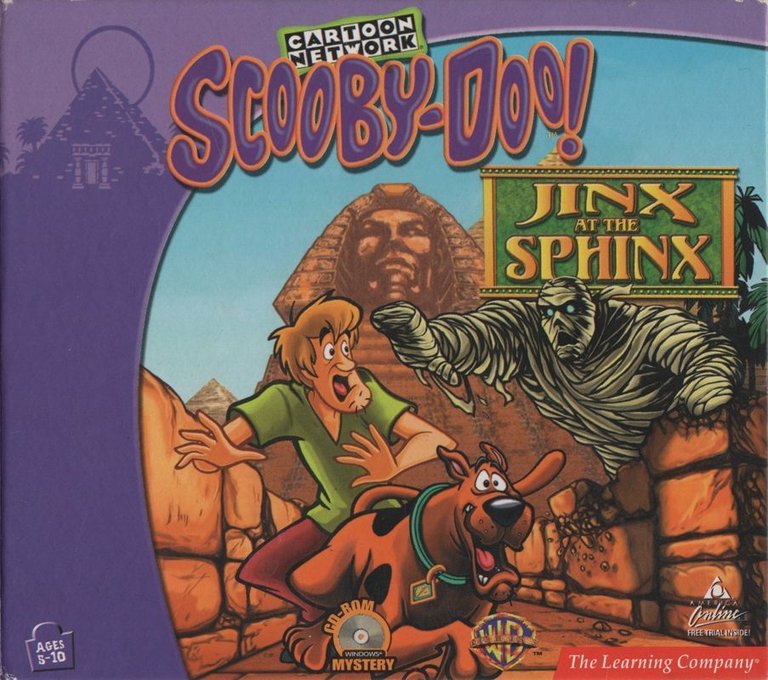
In ‘Scooby-Doo!: Jinx at the Sphinx,’ Scooby and the Mystery Inc. gang travel to Egypt as tourists to visit Velma’s missing cousin, only to encounter a mysterious mummy terrorizing the area. Set across 25 interactive desert environments, players solve puzzles, gather clues, and debunk false leads using deductive reasoning and logic skills. Designed as an edutainment adventure for ages 5-10, the game features three difficulty levels, randomized outcomes, and cartoon-style animations reminiscent of the classic TV series to engage young sleuths in a spooky yet fun mystery.
Gameplay Videos
Scooby-Doo!: Jinx at the Sphinx Free Download
Scooby-Doo!: Jinx at the Sphinx Reviews & Reception
myabandonware.com (86/100): How to play Scooby-Doo!: Jinx at the Sphinx
mobygames.com (71/100): Scooby-Doo and the gang go to Egypt as tourists and to visit Velma’s cousin who turns out to have disappeared.
Scooby-Doo!: Jinx at the Sphinx: Review
Introduction
In the early 2000s, as edutainment software sought to bridge learning and pop culture, Scooby-Doo!: Jinx at the Sphinx emerged as a curious artifact. Released in 2001 by The Learning Company and Warner Bros., this Egypt-set mystery aimed to capture the charm of Hanna-Barbera’s iconic franchise while stealthily teaching critical thinking. Two decades later, the game stands as a nostalgic time capsule—a flawed but earnest attempt to merge educational rigor with Scooby-Doo’s supernatural hijinks. This review argues that Jinx at the Sphinx succeeds as a playful gateway to deductive reasoning for children, even as its technical limitations and uneven challenge curve reveal the growing pains of early edutainment.
Development History & Context
A Convergence of Licenses and Learning
Developed by TerraGlyph Interactive Studios and ImageBuilder Software, Jinx at the Sphinx arrived during The Learning Company’s aggressive expansion into licensed titles. With Scooby-Doo enjoying a late-’90s resurgence via What’s New, Scooby-Doo?, the game leveraged the franchise’s cross-generational appeal. The project was helmed by producers like Elizabeth Perrault and Marla Cosgrove, whose prior work included Scholastic’s Magic School Bus series—a pedigree evident in the game’s emphasis on “problem-solving skills” like research and logical analysis.
Technological Limitations of the Era
Built for Windows 98/2000, the game faced constraints typical of early 2000s PC titles. Critics like 7Wolf Magazine derided its 640×480 resolution as outdated even in 2001, resulting in awkward letterboxing on modern monitors. The reliance on CD-ROM also necessitated simplistic asset design, though the team compensated with vibrant, cartoonish visuals. Notably, the game required QuickTime for cutscenes—a dependency that now complicates preservation, as abandoned copies often crash during installation.
The Edutainment Landscape
Jinx at the Sphinx entered a crowded market of mystery-adventure hybrids targeting children. Competing against peers like Pajama Sam and Nancy Drew, it differentiated itself with Scooby-Doo’s brand recognition and a “replayability” hook: procedurally generated clues and suspects ensured no two playthroughs were identical. Yet, its “edutainment” label alienated core gamers, while its age-specific difficulty tiers (“Spooky!” for ages 5–6, “Spooktacular!” for 9–10) risked segmenting its audience.
Narrative & Thematic Deep Dive
Mummy Mayhem in the Sahara
The plot follows Mystery Inc. to Egypt, where Velma’s archaeologist cousin, Thelma, has vanished amid sightings of a cursed mummy terrorizing Giza. True to franchise tropes, the narrative unfolds through environmental exploration, suspect interviews, and unmasking a human villain exploiting superstition. While structurally formulaic, the writing nails the gang’s dynamics: Shaggy and Scooby’s cowardice is played for laughs (“Zoinks!”), while Velma’s erudite dialogue reinforces the educational angle (“Let’s use deductive reasoning!”).
Educational Subtext and Replayability
Beneath the mummy antics lies a deliberate curriculum. Players must analyze 35 clues across 25 interactive zones, distinguishing red herrings from evidence—a mechanic mirroring real-world critical thinking. The game’s standout innovation is its dynamic storytelling: clue locations and culprit identities shift per playthrough, rewarding repeated investigation. Reviews praised this feature, with Quandary noting it “added replay value” despite the otherwise shallow environmental interactions.
Missed Opportunities
While thematically cohesive, the story suffers from over-reliance on Scooby-Doo tropes. Villains lack nuance, and Velma’s “missing cousin” thread resolves predictably. Worse, the educational elements sometimes clash with the farce—e.g., a fruit-catching mini-game feels disconnected from Egyptology. The result is a narrative at odds with itself: too simplistic for older players, yet too text-heavy for young children.
Gameplay Mechanics & Systems
Core Loop: Point, Click, and Learn
As a third-person point-and-click adventure, Jinx at the Sphinx tasks players with navigating Egyptian locales—markets, pyramids, desert camps—to gather clues. The UI is minimalist: a cursor highlights interactables, while a notebook auto-logs evidence. Puzzles range from sorting artifacts by size to “researching” hieroglyphics via in-game books, subtly reinforcing academic skills.
The Three-Tier Difficulty System
The game’s smartest design choice is its scalable challenge:
– Spooky! (Ages 5–6): Simplified puzzles, explicit hints.
– Spookier (Ages 7–8): Moderate complexity, limited guidance.
– Spooktacular! (Ages 9–10): Opaque clues, false leads dominate.
Yet, SuperKids noted imbalances: younger players struggled with reading-heavy sections, while older ones breezed through repetitive mini-games.
Flaws and Frustrations
Technical jank undermines the experience. Pathfinding is clumsy—characters often get stuck on scenery—and the fixed camera angles obscure key items. The clue system, while ambitious, lacks feedback; players might accuse innocent suspects due to misleading evidence, leading to cycles of trial-and-error. Quandary’s critique rings true: “More interaction and exploration would have added bulk to this shortish game.”
World-Building, Art & Sound
Aesthetic Fidelity to the Cartoon
Jinx at the Sphinx shines in its presentation. Character models mimic the show’s rubbery animation, with exaggerated expressions enhancing comedic moments. Cutscenes, though low-res, replicate Hanna-Barbera’s storyboard style—a deliberate choice praised by Tech with Kids as “greatly amusing to new millennium kids.”
Egypt as Edutainment Playground
The Sahara’s depiction blends tourist-friendly stereotypes (sarcophagi, camels) with surprisingly accurate touches. The Sphinx and Pyramid of Giza are rendered with care, while ambient sound—howling winds, bustling bazaars—immerses players. Yet, this is Egypt-lite: no deeper cultural context is offered beyond surface-level “mystery.”
Sound Design: Voices and Verve
Voice acting elevates the experience. Grey DeLisle (Daphne) and Frank Welker (Scooby) reprise their roles, delivering punchlines with veteran timing. The original soundtrack blends theremin-heavy mystery motifs with upbeat chase music, though repetitive loops grate during extended sessions.
Reception & Legacy
Launch Criticism
Reviews were mixed. Tech with Kids (90%) lauded its “fascinating Egyptian ruins” and humor, while 7Wolf Magazine (40%) lambasted its archaic tech. The MobyScore settled at 7.1/10—respectable for edutainment but forgettable alongside contemporary classics like Pajama Sam or Putt-Putt.
Long-Term Influence
Jinx at the Sphinx never achieved franchise-defining status. Its legacy lies in refining the “randomized mystery” concept later seen in Phoenix Wright spin-offs and Tangle Tower. Today, it’s a cult curio—preserved on abandonware sites and remembered for its earnest, if clumsy, fusion of learning and license.
Conclusion
Scooby-Doo!: Jinx at the Sphinx is a paradox: a game too simplistic for critics yet too ambitious for its tech. Its randomized clues and cartoon charm warrant praise, but dated design and uneven difficulty limit its appeal. For Gen Z/Millennial gamers, it remains a nostalgia trigger—a relic of when edutainment dared to teach logic through talking dogs. As history? Minor but meaningful. As a game? Best left to collectors and Scooby superfans.