
- Release Year: 2003
- Platforms: PlayStation 2, Windows
- Publisher: Ubi Soft Entertainment Software
- Developer: Runecraft Ltd.
- Genre: Strategy, Tactics
- Perspective: 1st-person Top-down
- Game Mode: LAN, Online PVP, Single-player
- Gameplay: AI opponents, Board game, Dictionary lookup, Hints system, Multiplayer variations, Turn-based, Word construction
- Setting: Board game
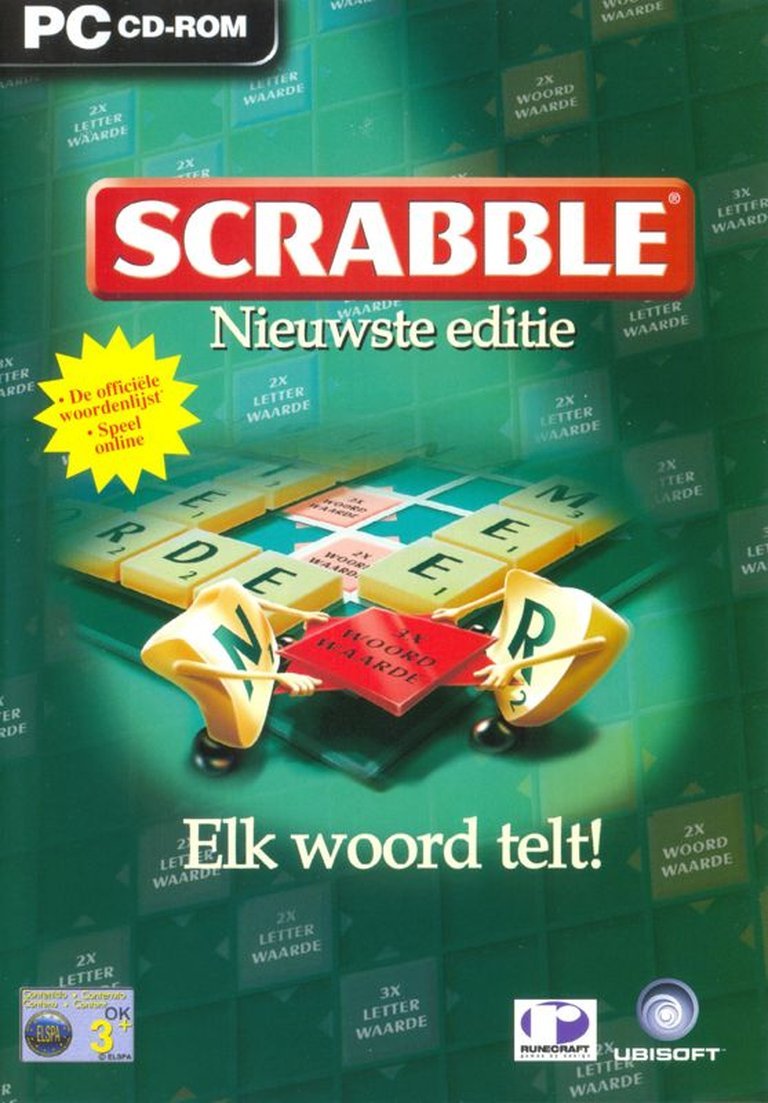
Description
Scrabble: 2003 Edition is a digital adaptation of the classic word-building board game, featuring customizable settings such as six board sizes, various themes, and adjustable timers. It offers both 2D top-down and 3D views with zoom capabilities, AI opponents across four difficulty levels, and multiple game modes including standard Scrabble and variations like championship, duplicate scrabble, conundrum, anagram, making the point, and word challenge. Multiplayer support allows up to four players to compete online or via LAN, with options for hints, dictionary lookup, and word validation challenges.
Gameplay Videos
Scrabble: 2003 Edition Patches & Updates
Scrabble: 2003 Edition Reviews & Reception
retro-replay.com : Scrabble: 2003 Edition delivers a robust gameplay experience that captures the core appeal of the classic board game while adding a host of digital enhancements.
Scrabble: 2003 Edition: The Digital Tile-Slinger’s Comprehensive Crucible
Introduction: The Weight of a Legacy, The Click of a Mouse
In the pantheon of video game adaptations, few properties carry as peculiar a burden as Scrabble. It is not a narrative epic, a fast-paced action romp, or a sprawling RPG; it is, at its immutable core, a game of letters, numbers, and spatial reasoning. Translating the physical heft of tile racks, the tactile clack of wooden pieces, and the silent, furious calculus of the human mind onto a digital platform is an exercise in philosophical game design. Scrabble: 2003 Edition, developed by Runecraft Ltd. and published by Ubisoft, arrives not as a revolutionary reimagining but as a definitive, feature-rich consolidation of what a digital Scrabble should be in the early 2000s. This review posits that its true significance lies not in groundbreaking innovation, but in its meticulous, almost obsessively complete, realization of the board game’s potential within the interactive medium. It is a masterclass in licensure execution—a game that prioritizes comprehensive rule-set fidelity and player customization over cinematic spectacle, ultimately serving as the essential, if somewhat sterile, digital home for the world’s most famous word game during its era.
Development History & Context: Polish from the Pipeline
The game emerges from a specific developmental and commercial context. Runecraft Ltd., a UK-based studio, was a known quantity within Ubisoft’s stable, having previously worked on other board game adaptations and family titles like Monopoly Party and Super Bubble Pop. Their expertise lay in translating familiar, rules-heavy properties into accessible digital formats, a skillset perfectly suited for Scrabble. The 2003 edition is a direct evolution of the 1999 PlayStation/Windows title (also by Runecraft), which had itself been a significant success, becoming one of Ubisoft’s best-selling games at Christmas 2001. This sequel, therefore, was a mandated refinement, not a reboot.
The technological constraints of the era are palpable. Target platforms were Windows PC and PlayStation 2, both powerful but with distinct limitations. The inclusion of a full 3D board with zoom and pan functionality, while a headline feature, was a technical achievement that came at the cost of UI clarity—a critical flaw noted by reviewers. The game runs from a CD-ROM, a medium that allowed for the inclusion of a substantial built-in dictionary, a crucial component for validation. The online multiplayer via ubi.com and LAN support was a standard-but-important feature for the time, tapping into the growing culture of PC and console internet gaming, though it was a service-dependent system now largely defunct.
The gaming landscape of 2003 was one of transition. Online play was becoming mainstream (Xbox Live had launched the year prior), but local multiplayer and single-player experiences remained vital. For a niche genre like digital board games, success depended on capturing the essence of the physical experience while offering undeniable digital advantages: no lost tiles, instant scoring, and tireless AI opponents. Scrabble: 2003 Edition accepted this challenge head-on, aiming to be the most complete and authentic version imaginable.
Narrative & Thematic Deep Dive: The Story Is What You Make It
A traditional narrative review finds little to dissect here. Scrabble: 2003 Edition has no plot, characters, or scripted dialogue. Its “story” is a pure emergent narrative, forged in the crucible of each match. The game’s thematic depth is its reverence for the source material’s core tension: the conflict between lexical knowledge, statistical probability, and spatial strategy.
The underlying theme is intellectual combat. Every tile drawn is a moment of potential; every placement, a calculated risk. The game’s various modes subtly reshape this thematic core:
* Championship Mode frames play as a formal tournament, evoking the serious, rule-bound world of competitive Scrabble.
* Duplicate Scrabble (where all players use the same tiles) shifts the theme to pure, unadorned board strategy and vocabulary speed, removing the luck of the draw.
* Conundrum and Anagram modes pivot to pure word-solving drills, themed around mental agility and pattern recognition.
* “Making the Point” and “Word Challenge” modes explicitly gamify the scoring system and word validation, turning the ancillary mechanics of standard play into the primary objective.
The “story” of a session is written by the players. It’s the silent drama of a well-hidden “Q” finally played on a triple-letter score, the collective groan at a missed bingo (using all seven tiles), the tactical gamble of playing a short word to block a crucial square, or the sheer, unadulterated triumph of a perfectly executed, high-scoring play that turns the game on its head. The game provides the grammar and vocabulary of this storytelling—the board, the rules, the tiles—but the narrative is entirely co-created. This is not a weakness, but a faithful adaptation of the board game’s own design philosophy. It is a stage, and the players are both author and audience.
Gameplay Mechanics & Systems: A Feature-Rich Lexicon
The core gameplay loop is, of course, the classic Scrabble experience: draw tiles, form words on the 15×15 grid, score points based on letter values and premium squares, and swap tiles as needed. The genius of the 2003 Edition lies in the sheer volume of systematic options that surround and modify this core.
Customization & Rulesets:
* Board Configuration: Six board sizes, from standard 15×15 down to smaller variants for quicker games.
* Themes: Multiple visual board themes (wood grain, modern, etc.), altering the aesthetic but not the logic.
* Timers: Options for a total game timer or individual “chess clock” style timers per player, introducing a crucial layer of pressure and pace.
* Penalties: The “lose a turn for invalid word” rule can be toggled, fundamentally changing the risk calculus of challenging an opponent.
* Dictionary Toggle: This is the master switch. With it on, the game acts as a helpful validator, preventing illegal plays. With it off, true “pub rules” Scrabble is enforced—players must manually challenge, and an incorrect challenge incurs a penalty (losing a turn). This single toggle transforms the game from a casual pastime to a serious, cutthroat duel.
AI & Progression:
* Four AI Difficulty Levels: From Beginner to Expert. The AI is described by reviewers as competent, particularly on higher levels, focusing on high-point plays. It provides a scalable, single-player experience that can genuinely improve a player’s game.
* Progression Systems: The Championship Mode provides a structured single-player “campaign,” with brackets and finals, giving a sense of advancement and purpose beyond isolated matches.
Game Variations: The suite of alternate modes is exceptional:
1. Championship: Standard tournament play.
2. Duplicate Scrabble: All players draw from the same pool; speed and board strategy are paramount.
3. Conundrum: Solve an 8-letter anagram for bonus points.
4. Anagram: Find as many words as possible from a given set of letters.
5. Making the Point: Focuses on hitting specific score targets with each word.
6. Word Challenge: A rapid-fire mode testing vocabulary speed.
User Interface & Convenience Features:
* Dual Camera Views: The classic 2D top-down view is functional and clear. The much-touted 3D perspective allows rotation, zoom, and pan but is widely criticized for obscuring tile values and making the board harder to parse quickly—a major UI flaw.
* Always-Available Tools: The tile rack sits at the bottom. Dedicated buttons allow for hints (suggesting a word) and a full in-game dictionary lookup, invaluable for learning and dispute resolution.
* Multiplayer: Supports up to 4 players via LAN or internet through ubi.com. The lobby and matchmaking systems are functional for the era, facilitating the communal experience.
World-Building, Art & Sound: Functional Immersion in a World of Words
As a literal adaptation of a real-world table, Scrabble: 2003 Edition cannot build a “world” in the conventional sense. Instead, it constructs a themed presentation layer around a timeless abstract space: the Scrabble board.
Visual Direction & Art:
The game’s aesthetic is one of clean, functional minimalism with optional decorative flair. The 2D view is pure utility: high-contrast tiles, clear premium square colors (red double-word, blue triple-letter, etc.), and a readable layout. The 3D view attempts to create a “tabletop” feel with subtle shadows under tiles and a textured board surface, but its primary value is novelty, not function. The different board themes offer visual variety, from simulated wood finishes to sleek, modern color schemes, allowing players to customize their table to a degree. The tile animations—a gentle drop when placed—add a satisfying, slightly physical feedback.
The UI is generally well-organized, with the rack, score, and timer clearly visible. The main criticism, echoed in PC Games‘s review, is that the default 3D view is “hardly usable” because it makes identifying tile point values difficult, forcing players to switch to the 2D view for serious play. This represents a failed attempt to merge digital “immersion” with the actual needs of the gameplay.
Sound Design:
The audio is unobtrusive and fitting. Sound effects are sparse but effective: a soft click for tile placement, a chime for a valid word, a buzzer for an invalid one. The music, as noted by PC Action, consists of gentle piano compositions that aim to create a relaxed, contemplative atmosphere suitable for a thinking game. It never distracts, successfully reinforcing the game’s cerebral mood without imposing a strong identity.
Together, the sights and sounds create a competent, if slightly generic, digital parlour. It feels less like a “world” and more like a very nice, customizable, and well-lit table in a quiet room.
Reception & Legacy: A Solid, Niche Success
Critical Reception at launch was mixed but generally positive, averaging 65% on MobyGames from 8 critic reviews.
* Praise centered on its comprehensiveness and faithfulness. Quandary (80%) celebrated its variety of modes and settings, calling it the “pick of the bunch.” Jeuxvideo.com (70%) and 7Wolf Magazine (70%) highlighted its completeness and attractive interface for the mass market. PC Action (75%) was enthusiastic, delighting in the dictionary’s recognition of informal words.
* Criticism consistently targeted the 3D view’s impracticality (PC Games, 58%) and a perceived lack of “joy” compared to the physical game (Official UK PS2 Magazine, 50%). Some, like Joystick (France, 60%), felt the ergonomics were imperfect and the AI too basic (focusing only on max points). Absolute Games (AG.ru, 60%) delivered a famously scathing review, implying the game was only for the desperate or masochistic, though admitted it was “not without merit.”
Commercial Context suggests it performed its job well. As noted in Wikipedia’s entry on Scrabble video games, the preceding 2000 PC version sold 260,000 copies in the US by 2006 and was a top seller. The 2003 Edition was marketed as an improved, more qualitative version. Its presence on both Windows and PS2, alongside a follow-up Scrabble Interactive: 2005 Edition (2004), indicates a successful, ongoing franchise for Ubisoft in the casual/board game space during the early 2000s.
Legacy & Influence:
Its influence is not seismic but definitive within its genre. It established a high-water mark for feature completeness in digital board game adaptations. The template it perfected—extensive rule customization, multiple digital and physical view modes, a suite of single-player variants, and robust online/LAN multiplayer—became the expected standard for future licensed board games. Subsequent entries in Ubisoft’s Scrabble Interactive series (2005, 2007, 2009) would iterate on this foundation. It demonstrated that a digital version could cater simultaneously to the casual player (with hints, dictionary, timers) and the tournament purist (with rule toggles and challenge penalties), a delicate balance few adaptations achieve. For many, this was the definitive digital Scrabble until mobile apps later revolutionized accessibility.
Conclusion: The Essential, Flawed Reference Tool
Scrabble: 2003 Edition is not a game that seeks to dazzle. It is a tool, a service, and a precision instrument for wordplay. Its monumental strength is its unwavering commitment to the completeness of the Scrabble experience. It leaves almost no stone unturned in providing options: you can change the board size, the theme, the timer, the challenge rules, the AI difficulty, and the camera angle. You can play a quick game of Anagrams or a full championship. For the dedicated word enthusiast, this is a treasure trove of configuration.
Its weaknesses are those of a workmanlike adaptation. The 3D view is a gimmick that failed to marry form and function. The presentation, while clean, lacks the warm, tactile personality of its physical counterpart. The “story” is what you and your opponents bring to it. It does not try to be more than Scrabble; it tries to be all Scrabble, simultaneously.
In the grand tapestry of video game history, it is a niche but important thread. It represents a peak of early-2000s thinking about digital board games: prioritize rule fidelity, empower the player with customization, and leverage online connectivity. It did not reinvent the genre, but it codified its best practices. For historians, it is a perfect case study in licensed game development—how to serve a core fanbase while attempting to broaden appeal. For players, it remains a highly functional, if slightly dry, digital conduit to one of humanity’s great abstract games. Its verdict is one of resounding competence: a must-play for the Scrabble devotee seeking a comprehensive digital home, and a fascinating, feature-rich artifact for anyone studying the evolution of interactive tabletop simulations.